There is no better way to understand the past than to explore what and how people ate. Trying out old recipes is an exercise in alchemy: a little bit of science and a little bit of art to transform ingredients into something better.
Martha Washington’s family recipe for Quidony of Plums is a good example. This year my small plum tree produced great quantities of small, hard purple and green plums.
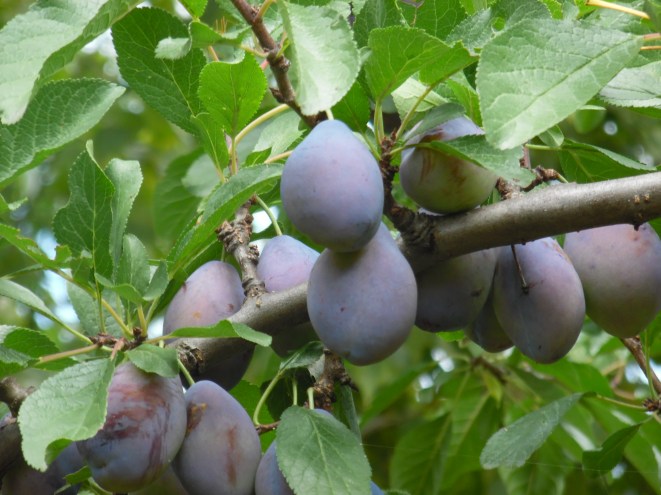
The plums were too hard and sour to eat raw. Those I left on the tree or brought in to ripen didn’t get sweeter. They rapidly turned from unripe to brown mush. But the plums were lovely, and I hate seeing food go to waste. To transform these hard, inedible plums into something delicious, I turned to Martha Washington’s Booke of Cookery (transcribed and annotated by Karen Hess.)
The first challenge was to figure out what ‘quidony’ means. Martha’s book has ten recipes for quidony made of different fruits. According to the Oxford English Dictionary, quidony (also spelled quiddony, quiddany, quidenie, and quiddeny) is a “thick fruit syrup, originally and properly, one made of quinces.” By the 18th century and even earlier, quidony was not restricted to quinces. Martha had two different recipes for quidony of quinces.
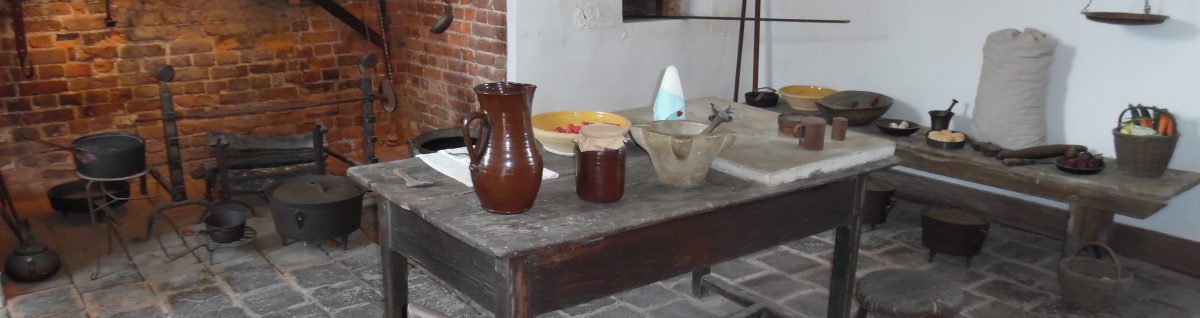
Following the recipe also takes a bit of sleuthing. The cook is instructed to boil plums in a posnet with water and sugar until they break. A posnet is a three-legged pot with a handle. Since the fruit and then the pulp must boil for a long time, I suspect specifying a three-legged pot is so the cook can keep the pot raised off the coals and maintain a more even heat during the process.

The recipe continues with directions to run the mixture through a strainer and boil it again until “it comes to its full thikness.” The cook is not told how much force to use in staining the fruit pulp, or how thick to cook it. The only clue is the final direction to print it with molds, suggesting the quidony is thick enough to hold a shape.
The quidony I made was the consistency of apple butter, which goes along with the definition of quidony, and will hold a print (though not a shape like jello does.). The final result was delicious on toast or pancakes, mixed into yogurt, or used as an ice cream topping.
Quidony of Plums for the Modern Cook
1 gallon hard sour plums
3 ½ cups brown sugar
2 cups of water
Wash the plums and put them into a heavy, enameled pot with the water. (I cut them in half just to make sure there were no worms.) Bring to a boil, them simmer until the plums are soft and the flesh of the fruit separates from the skin and pit. Stir frequently.
Pour the pulp mixture into a strainer lined with cheesecloth. Let drain for an hour. Take up the ends of the cheesecloth and squeeze out as much of the soft pulp as desired. (The more you squeeze out, the more your quidony will resemble preserves rather than jelly.)
Discard the pits and skins. Put the remaining pulp back into the pot. Add sugar to taste. Bring the mixture to a full, rolling boil. Boil hard until the mixture reaches at least 200 degrees on a candy thermometer, stirring constantly. Pour your quidony into jars or jelly dishes and enjoy. Yield: 2 ½ pints (Yield will vary depending on how long you boil it, and how much pulp you squeeze out.)
References:
__. Martha Washington’s Booke of Cookery. Transcribed and annotated by Karen Hess, New York: Columbia University Press, 1995. p. 355.
“Quiddany.” The Compact Edition of the Oxford English Dictionary. New York: Oxford University Press, 1971. p. 2393.
 BRIC-A-BRAC