As empires go, the Inca were not around for very long. They first appeared in the 12th century and expanded to rule a large part of South America in 1438. They were conquered by the Spanish in 1533. But in that century of prominence, they left an indelible mark on the Andes.
In September (the dry season) the roads are parched and dusty. Our bus rattled over gravel and dirt roads, along cliff edges and through fields. It bounced on cobblestone streets, navigated one-lane, two-way roads, and occasionally, sped along a few paved roads. Clearly, traveling in the sacred valley is an adventure, but a visit to the Sacred Valley helps in understanding Inca Civilization.
Legends and Riches
In the Inca world view, Cusco was the center of the world, and all parts of the empire were connected to Cusco. The Urubamba River forms the sacred valley. The Inca saw this river as a reflection on earth of the great river in the sky, the Milky Way. They saw in the Milky Way constellations both from bright stars, as the Greeks did, and also from the dark spaces, unlike any other civilization. The animals living in the Milky Way interacted with each other and parallel those same animals on earth. (learn more about the Inca Astronomy at the Cusco Planetarium)
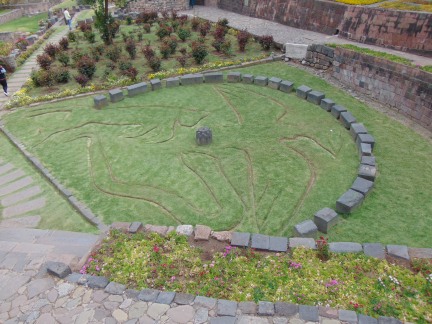
Borrowing some ideas from the many different groups inhabiting Peru before them, the Inca saw connections between all parts of the world. They worshiped Pachamama (world mother), Inti (the sun god), sacred mountains, and many others.
Qorikancha (in Cusco) (elevation 3,400 meters)
Inca stone work is nothing short of incredible. In their most important buildings, the stones fit so tightly together, without mortar, that not even a piece of paper could slip between. Qorikancha is a marvelous example of this exquisite work. Spanish chroniclers reported that Qorikancha was covered in gold and fabulous beyond belief. Just like the Inca before them, (and probably every conquering civilization in the history of the world) the Spanish adopted some Incan ways, and built upon their special places. At Qorikancha the beautiful Inca Temple of the Sun remains, and the beautiful Spanish Santo Domingo church and convent is built on and around it.


Ollantaytambo (Elevation 2792 meters)
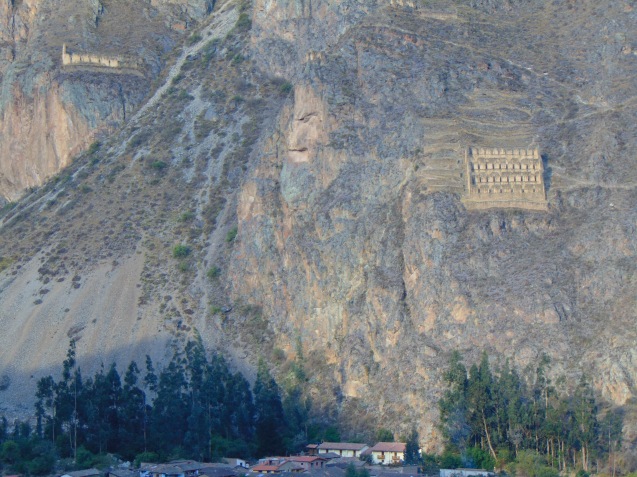
Ollantaytambo is both a town with a thriving tourist market and an archeological site. It was an important fortress for the Inca, and one of the places the Spaniards lost a major battle. It was built in the 15th century. Though many have been remodeled and repurposed, some of the oldest continuously inhabited buildings in South America can be found here.
Salineras de Maras (Elevation 3380 meters)
Long before the Inca ruled, a natural spring, bubbling up through ancient buried seas, has brought salt to the surface of this part of the Andes. For at least 500 years, local inhabitants have created and mined these pans. Many people believe the salt pans were first created even earlier by the Wari, a civilization pre-dating the Incas. The Spanish conquerors continued to mine salt here. The pans are now owned and mined by individual families in the Maras community. 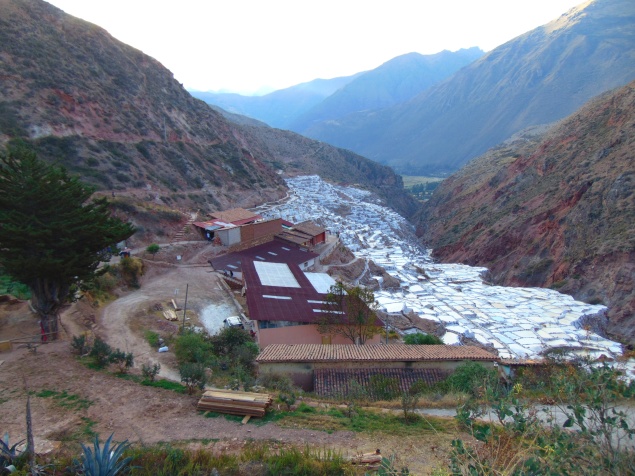
I tasted the water flowing from the spring into the pans and was surprised by how warm and salty it was.
Farming in the Andes
Fundamentally, the Incans were great farmers. Their highly developed astronomical observations helped them determine when to plant and harvest. There were only six domesticated animals in Peru: the llama, alpaca, vicuna, guanaco, hairless dog, and guinea pig. Along with these, Inca farming focused on corn, quinoa and potatoes.
Moray (elevation 3,500 meters)
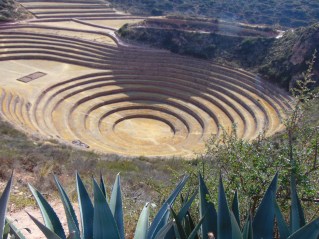 Moray is an Inca ruin with few visitors. Many scientists believe the terraced farms were an experiment in growing various crops at different altitudes or different temperatures. Their scientific development of high altitude farming was one reason for their success. There is a 27 degree (Fahrenheit) difference in temperature from top to bottom.
Pisac (Elevations 2715 meters)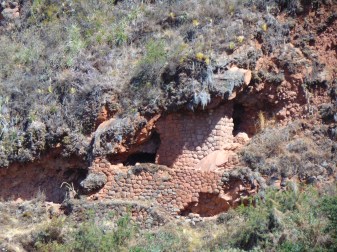
The site at Pisac includes a military area, agricultural area and residential area, as well as many tombs. (Unfortunately these were looted long ago.)
The name comes from an Aymara word, Pisaca, meaning partridge. The site is shaped like a partridge, which mirrors the partridge constellation in the Milky Way.
Wiñay Wayna (Elevation 2650 meters)
Because it is located on the Inca Trail to Machu Picchu, the only way to get to this beautiful ruin is by walking. It is near the Day 3 campsite for the 4 day Inca Trail walk, or the mid-way point for the 1 day Inca Trail Walk. However you get there the journey is daunting and the view spectacular. Rough stone buildings, probably storehouses, and steep, semi-circular terraces overlook the Urubamba River far below.


The name means “Forever Young” and is a reference to the beautiful orchids found in the Cloud Forest surrounding this area. Far fewer visitors find Winay Wayna than Machu Picchu, so a visit lets you bask in near-solitary wonder (as you sit and try to catch your breath after the hike here.)
Parque de la papa (Elevation 4000 meters)
Here, six local communities have come together to preserve native methods of potato culture. This is the highest spot in the Andes we visited, kick-started and supported by G-Adventures and the Planeterra Foundation. Besides learning about varieties of potatoes and quinoa, we had a weaving demonstration and a chance to buy hand-made goods directly from their creators.

The end of the Incas
Though weakened by civil war, and decimated by the Spanish conquerors, remnants of the Incan civilization remain. A visit to the Sacred Valley shows us the importance of the knowledge developed by the Incas. No matter how far away earth and sky may be, (even in the Andes where the mountains pierce the sky) everything is connected.
 BRIC-A-BRAC