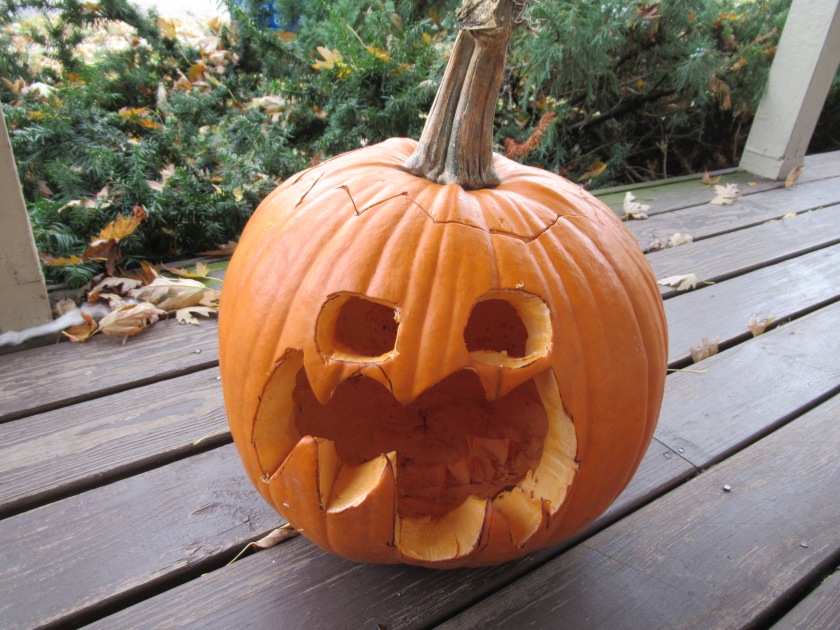
 As fall gave way to winter this week, children all over the country dressed in funny, scary or highly marketed costumes, and went out begging for candy. With colorful decorations and ubiquitous advertising on all sides, it is easy to lose track of the main theme of this week, which is death.
The idea of Halloween with Jack 0’ Lanterns, ghosts, and tricks, stems from Celtic tradition of Samhain. This celebration marks the end of the harvest and the beginning of the dark half of the year. From sunset on October 31 to sunset on November 1st, this is the time of year when the gate between this world and the next is at its most flexible. The concept of contact between this world and the next gave rise to what we currently think of as Halloween or the evening before All saints or All souls or All hallows (hallow means holy or saint, or more recently holy or mystical relic). Halloween, therefore, is a good example of the Christian church absorbing earlier traditions.
The point is that whether we are ancient Celts or modern consumers or anything in between, this is a time of year when summer dies and the dead of winter looms. We may sidestep the theme of death with fanciful costumes and trick-or-treat games, but the reality of death lurks behind the fun. The mystery of what happens next has haunted humans across time and culture, so this is a good week to discuss some of the research I did for a colonial mystery I’m writing. For the novel, I needed to find out more about specific funeral customs in Colonial Pennsylvania.
Of course, colonial customs varied by religious teachings, resources, and circumstances just as funeral customs do today, but a surprising number of traditions cross cultures. For instance, laying coins on eyes of the deceased developed in Greece to provide for paying the ferryman to cross the river styx. Preparing the corpse for burial, a process called laying out, follows specific procedures including washing the body, and closing or covering the eyes.
One of the most intriguing customs I found is the idea of dead cakes I found dead cakes listed in various places as a Dutch or German or English custom in which cakes or cookies were marked with the initials of the deceased and either sent out by rider as a funeral invitation or sent home with the mourners. Such cakes might be eaten as part of the funeral feast or kept, sometimes for years as a memento of the dead person.
In spite of the historical references to dead cakes, none of my 18th and early 19th century cookery books have a specific recipe specifically for them. Several sources suggest that dead cakes were a sort of caraway flavored shortbread. I found that 18th century recipes for caraway or seed cakes vary greatly, ranging from a drop cookie to more of a cake batter. Several require eggs and/or yeast (or emptins) for leavening. Since the point of the dead cakes is to commemorate the deceased with the carved initials, I opted for a recipe without any eggs or yeast, since detail like letters is usually lost when dough rises.
One recipe for dead cakes comes from Alice Morse Earle’s Colonial Days in Old New York. She quotes a recipe from Mrs. Ferris as: “Fourteen pounds of flour, six pounds of sugar, five pounds of butter, one quart of water, two teaspoonfuls of pearl ash, two teaspoonfuls of salt, one ounce of caraway seeds. Cut in thick dishes, four inches in diameter” (306). Earle doesn’t give a date or reference for Mrs. Ferris’s recipe, but the use of pearl ash suggests an 18th century origin. Earle also asserts that these dead cakes were advertised in 18th century newspapers (citing an ad for burial cakes in 1748 from a Philadelphia newspaper), but were also often baked at home. (306-307)
I experimented with two recipe variations–a scaled down version of Mrs. Ferris’ recipe and a recipe for apees– a caraway cookie apparently named for Ann Page, who sold the cookies in Philadelphia around the time of the Revolutionary War. She marked her cookies with ‘AP’ so customers could tell which were her’s. The original recipe for apees that I used comes from Seventy-Five Receipts for Pastry, Cakes and Sweetmeats, published in Boston in 1828.


The two recipes have some significant differences. Mrs. Ferris’ recipe calls for pearl ash, though so little that it made no difference in either taste or rise. Her recipe also has considerably fewer caraway seeds (3 Tablespoons as opposed to 1 teaspoon). The apees recipe calls for wine instead of water, and adds nutmeg, cinnamon and mace. I left out these extra spices to better compare the flavors of the finished products.
The recommended size of the finished cake also differed. Mrs. Ferris suggested cutting cakes four inches in diameter, while the Lady of Philadelphia calls for cutting circles with a tumbler. It seems to me the four inch cookie is a better memento, but the smaller cookie is more practical for serving at a funeral meal. The initials of the deceased are also more easily seen with fewer caraway seeds in the dough.
Taking all these variations into consideration, I ended up with the following recipe for modern use: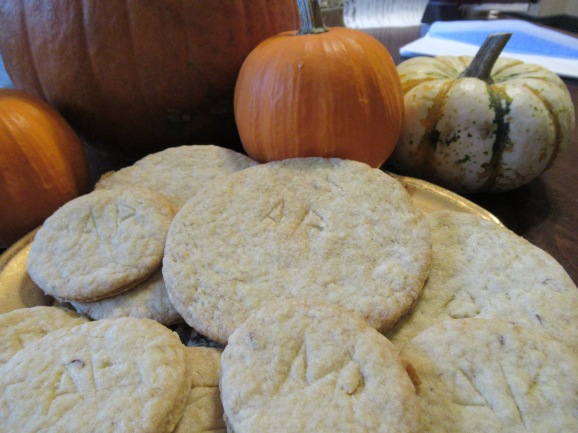
Dead Cakes
- 3 ⅓ c. flour
- 1 c. sugar
- ¼ t. Salt
- 1 T. caraway seed
- ½ lb. butter
- ½ c. water or wine
Mix the dry ingredients. Cut in the butter as for pie crust (until it resembles coarse meal). Add the water or wine and press into a ball. Roll out on a floured surface about ¼ inch. Cut the cakes to the desired size and shape. Cut the initial you want into the cookies. Bake at 350 degrees for 20 -25 minutes (depending on the thickness.) Cool and enjoy.
In spite of the somber name and original purpose, these sweet treats are surprisingly good. Perfect for a modern Halloween celebration.
Sources
Earle, Alice Morse. Colonial Days in Old New York. New York: Charles Scribner’s Sons, 1896. Digitized by Google.
Lady of Philadelphia. Seventy-five receipts for Pastry, Cakes, and Sweetmeats. Boston: Munroe and Francis, 1828. 56.
Levitt, Alice. Funerary Feasts From Around the World. Vermont’s Independent Voice: 7 Days. October 29,2014.
Rogak, Lisa. Death Warmed Over. Berkeley: 10 Speed Press, 2004
 BRIC-A-BRAC
One thought on “Dead Cakes”