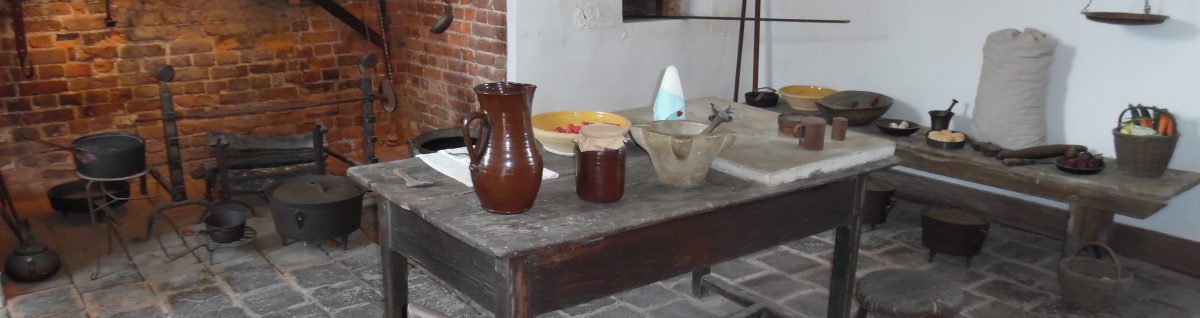
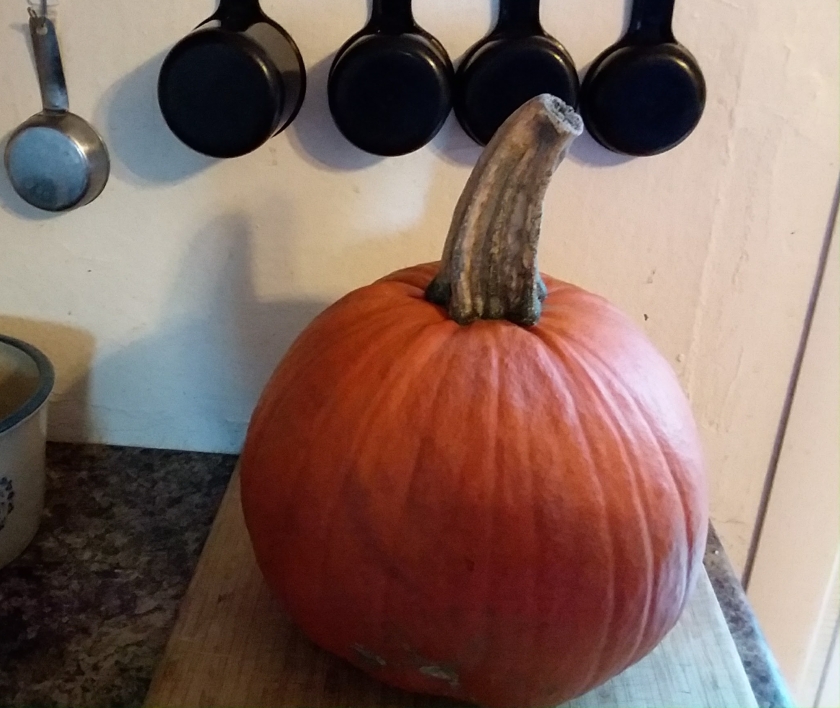
 Even more than apple pie, the pumpkin is symbolic of early America. Before Europeans landed, Native Americans used pumpkins for both food and medicine. Indeed, early colonists from England found pumpkins so important that one of the earliest folk songs from the colonies satirizes the ubiquitous pumpkin in the oft-quoted pilgrim verse from c. 1630.
“…Instead of pottage and puddings and custards and pies, Our pumpkins and parsnips are common supplies; We have pumpkin at morning and pumpkin at noon; If it was not for pumpkins we should be undone. If barley be wanting to make into malt We must be contented and think it no fault For we can make liquor, to sweeten our lips, Of pumpkins and parsnips and walnut-tree chips…” (1).
Of course, the neither the Native Americans nor the first settlers had wheat flour or sugar for making the familiar pumpkin pie. Pumpkins were baked, boiled, or roasted sometimes stuffed. These earliest pumpkins were not always the round, orange pumpkin we see today, but a variety of shapes and colors, much like other squash varieties.
By the 18th century, many of the traditional food stuffs from Europe were readily available and so were incorporated into pumpkin usage. Samuel Peters, writing in 1781, talks about marigold-colored pumpkins as large as 60 pounds. He writes,
“The pumpkin or pompion is one of the greatest blessings… Each pumpkin contains 500 seeds which, being boiled to a jelly are the Indian infallible cure for the strangury. Of its meat are made beer, bread, custards, sauce, molasses, vinegar, and on thanksgiving days, pies, as a substitute for what the Blue Laws brand as antichristian minced pies” (2).
Peters also claimed the pumpkin shell was good for making a cap by which to cut hair and also good for making lanterns. (3)
In spite of Peters’s glowing praise for the pumpkin, by the eighteenth and early nineteenth century it seems to have settled into the role of pie more than anything else. Cookbooks from the period often contain receipts for pumpkin pie, but rarely other ways of preparing pumpkin. The standard puimpkin pie, a custard made with mashed pumpkin, eggs., milk and seasoning, is much like the pie we know it today. Receipts for pumpkin pie or pudding from the late colonial and early revolutionary period differ primarily in proportion and the exact variety of spices recommended.
For instance, Hannah Glasse uses 1 pint of stewed pumpkin to 1 pint of milk, 1 glass of malaga wine, 1 glass of rose-water, 7 eggs, ½ pound of butter, one small nutmeg, and salt and sugar to taste (4).
Amelia Simmons has receipts for two versions of a pumpkin pie. The first uses 1 quart mashed pumpkin, 3 pints cream, 9 eggs, sugar, mace, nutmeg and ginger in a crust, with bits of pastry on top. Her second recipe calls for 1 quart of milk, 1 pint of pumpkin mash, 4 eggs, molasses, ginger and allspice (5).
Simmons does have a variation using both apples and pumpkin for a pudding thickened with breadcrumbs and a bit of flour and seasoned with rose-water, wine, sugar, nutmeg and salt. She says to use 1 large squash and 6 apples to ½ pint cream and 5 or 6 eggs. (5)
Mary Randolph’s pumpkin pudding adds 6 eggs to ½ pint of milk, with nutmeg, ginger wine for seasoning, sugar to taste and baked in a crust with bits of crust on top (6).
Am anonymous lady of Phildadelphia only offers one pumpkin recipe in her seventy five receipts. She directs cooks to use 1 quarter pound of stewed pumpkin with 3 eggs, a quarter pound of butter or cream, a quarter pound of sugar, a half glass of wine and brandy mixed, a half glass of rose water, and a teaspoon of mixed cinnamon, nutmeg and mace, poured in a pastry lined dish and sprinkled with sugar before baking (7).
Mrs. Child’s recipe assures cooks that 3 eggs to 1 quart of milk works very well for a common family pie, though even one egg will do. She says to remove the seeds but not scrape the pumpkin before stewing. The pie can be sweetened with molasses or sugar, and seasoned with salt, cinnamon, and ginger, and perhaps a bit of lemon peel. Ginger alone will suffice if there is enough of it. She does say the more eggs used, the better the pie (8).
Surpisingly, only Mrs. Randolph offered a recipe for fixing pumpkin in a different way.Her recipe for ‘Potato pumpkin’ makes a striking dish to bring to any fall table. (I have no idea why she calls it potato pumpkin. The recipe has no potatoes whatsoever.)
Potato Pumpkin
Get one of a good colour, and seven or eight inches in diameter; cut a piece off the top, take out all the seeds, wash and wipe the cavity, pare the rind off, and fill the hollow with good forcemeat–put the top on, and set it in a deep pan, to protect the sides; bake in a moderate oven, put it carefully in the dish without breaking, and it will look like a handsome mould… (6).
To modernize this recipe, I first had to research forcemeat. I found several receipts using veal, pork, or even fish, all bound with suet. Because veal and suet are hard to get in my town (make that impossible), I used a combination of ground pork and ground beef, seasoned with the spices suggested by Mary Randolph. Since paring a pumpkin is quite difficult, I pared only half the pumpkin before cooking to see if that step was necessary. The pared side developed a thicker outer surface that I found too dry. The unpared side was easier to scoop and held its shape better. The end result was quite tasty and made a great dinner center-piece.
Here is the modernized version of Potato Pumpkin.
- 1/2lb. ground pork
- ½ lb. ground beef
- ⅓ c. shortning
- 1/1 t. nutmeg
- 1 t. salt
- ¼ t. mace
- ½ t. pepper
- 2 t. lemon rind, grated
- 1 T. parsley
- 1 t. dried basil, crushed
- 1 egg.
- 1 small to medium pumpkin
Put all ingredients except the pumpkin in a food processor and grind to a smooth paste. (This can be done in a mortar, but that takes a long time.)
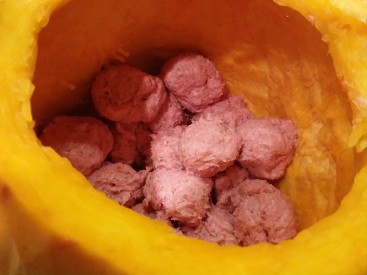
Cut off the top of the pumpkin. Remove seeds, scrape out the hollow, and rinse it. Form the forcemeat into small balls the size of walnuts, and place inthe cavity. Put the top back on the pumpkin and bake at 350 degrees. When it is done, a fork will easily puncture the pumpkin, and a meat thermometer placed in the center of a meatball will register 170 degrees. This took two hours for an eight inch pumpkin.
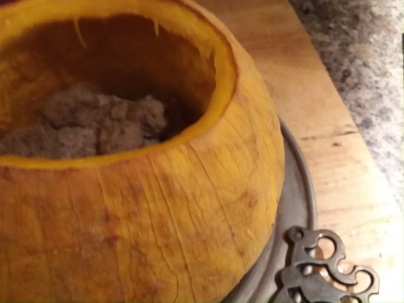
To serve, scoop out a portion of the pumpkin along with the meatballs. This makes a great conversation piece, as well as a very tasty meal for four.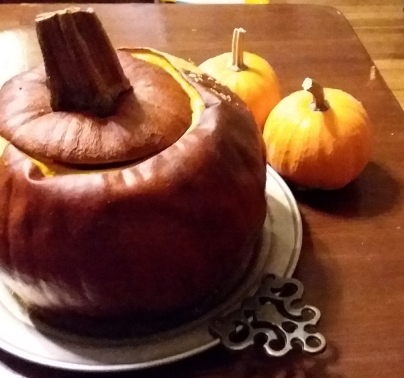
Notes:
- Forefather’s Songs: New England’s Annoyances…Source: The Annuals of America: 1493-1754, Discovering a New World. Vol. I. Mortimer Adler, Ed. London: Encyclopedia Britannica, Inc., 1976. Print Retrieved from Masterpieces of American Literature
- Peters, Samuel. A General History of Connecticutt by Samuel Peters, 1781 republished new Haven, D. Clark and Co. ,1829 Retrieved from google books
- Strangury is a painful blockage of the bladder
- Glasse, Hannah. The Art of Cookery. First published in England in 1747, 1st American edition Alexandria: Cottom and Stewart, 1805. 138.
- Simmons, Amelia. American Cookery. 1796. 27-28.
- Randolph, Mary. The Virginia Housewife Or, Methodical Cook. Washington, 1824. 127, 109, 91.
- A Lady of Philadelphia. Seventy-five receipts. Boston: Munroe and Francis: 1828. 21-22.
- Mrs. Child. The American Frugal Housewife. Boston: Carter, Hendee and Co., 1833 (12th edition, first published 1828) 66-67.
 BRIC-A-BRAC