A stark mountain retreat
 Outside the sprawling city of Dubai lies the rest of the emirate- mostly sweeping sand dunes and scrubland. A few farms (date and camel) and villages dot the landscape. Sparse grasses grow in marginal areas and the occasional acacia or ghaf tree can be found, but for the most part the area is empty desert. About 134 miles east of the city of Dubai lies the ancient village of Hatta in the Hajar mountains. Hatta is unusual in that it is an enclave. That means that although it is part of the emirate of Dubai, it is surrounded by other political entities. The country of Oman curls around to the east and south, while the emirate of Ras al-Khaimah lies to the north, and the emirate of Ajman forms Hatta’s western border.
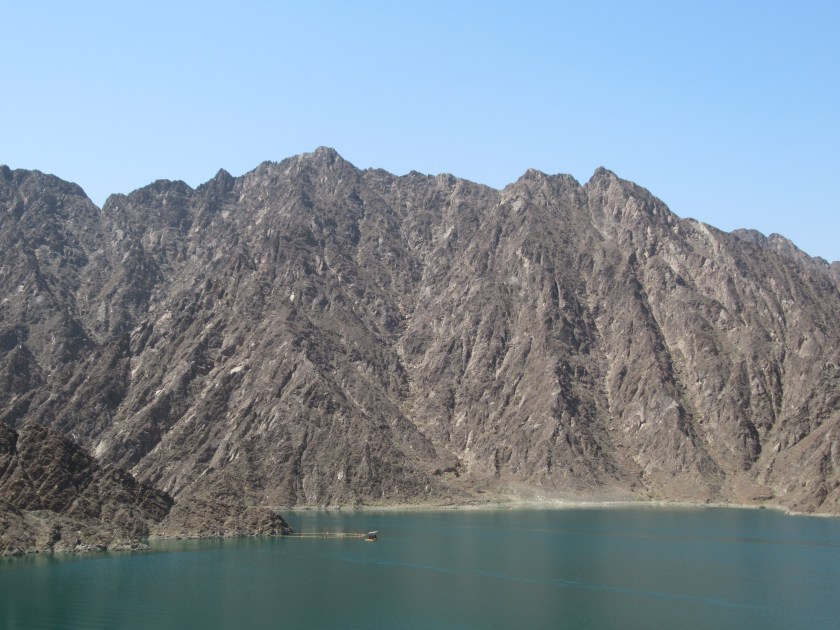
Hatta is a popular getaway from the city for those who want to see an quieter, more natural part of the emirate. The Hajar Mountains, a chain of sharp, jagged outcrops of red-grey and blackish rock, has periodic water holes, which make village life and mountain farms possible in the area. The small village of Hatta (50 sq. miles) is best known for two things: Hatta Dam Reservoir and Hatta Heritage village.
Hatta Dam is a beautiful reservoir with sparkling blue-green water surrounded by stunning mountains. The dam was built in the 1990’s and took two years to fill with rainwater. This makes water available year-round for the area. Previously, residents had to rely on deep wells and scattered springs. Although the mountain climate is supposedly cooler than the surrounding desert, it was 102 degrees Fahrenheit on the spring day in March when we visited. In spite of the heat, kayaking or paddle-boating on the reservoir is a great way to spend a morning.


The other major attraction in Hatta is the Hatta Heritage village. Here there are some 30 reconstructed buildings showing centuries-old styles of rural mountain desert life. The buildings are constructed of traditional materials including mud, date palm trunks, fronds, reeds and stone.


Within the Heritage Village lies Al Husan Fort. The fort was built in 1896 for both surveillance and defense. High mud-brick and mountain stone walls surround the fort, which includes a luxurious residence and a large internal courtyard. Ceilings are made of palm trunks supporting fronds and mud.
Outside the fort, stand two round watchtowers, built in the 1880’s. Each tower has a small door a bit more than 8 feet above ground level. In the old days, the guard would use a rope to climb the tower to reach the door. Once inside, the guard could use the semi-circular staircase to reach the roof.
 As I scrambled up the steep, rocky path to the watchtower, I thought about why such a defensive tower was needed in such a remote place. Were they looking out for raiding tribesmen? Or perhaps, hoping for a desert caravan seeking a watering hole before reaching the Gulf of Oman? From the hilltop at the base of the tower, it’s easy to see why Hatta was important. Water is available here, a scarce commodity in such a barren part of the world. For now, the village is quiet and peaceful, Still, though the watchtowers are deserted, they remain standing, a stark reminder that the history of humanity is a story of conflict, even in the most remote places.
 BRIC-A-BRAC