Experiments in cookery
 Sometime in the middle of the eighteenth century, an adventurous (or careless) housewife added pearlash to her dough and the first chemical leavening was discovered. Before pearlash found its way into food, housewives had to use yeast or egg whites if they wanted their baked goods to rise. But it takes a long time to whip egg whites to a froth, and the resulting mix is not very stable. Yeast also takes a long time to work. Thus with the new chemical leavener, pearlash, cooks could bake ‘quick’ breads, a great convenience in the labor-intense colonial kitchen.
Historically, pearlash has had many uses including soap and glass making. Various cuisines around the world use pearl ash in traditional dishes. (For instance, German gingerbreads and Chinese mooncakes.) It has also been used in the production of cocoa, wine and mead.
But be aware, pearlash is potassium carbonate, a caustic substance made by refining potash, which in turn is made by soaking plant-based ash in pot of water. This is the same way that lye is produced. Like lye, pearlash is caustic, and must be used in the right proportions.
While the lye has been used in cooking for a long time, (for instance in ramen, hominy, and lutefisk), pearlash wasn’t used as a leavening agent in dough until about 1740. The potassium carbonate mixed with acid (like sour milk or vinegar) creates pockets of carbon dioxide. These bubbles are trapped, making the dough rise and the resulting bread lighter.
In fact, pearlash can even be used to freshen yeast. Mrs. Child recommends mixing pearlash in with yeast that has soured, and using it when it ‘foams up bright and lively” (79) and suggests that “everything mixed with pearlash be put in the oven immediately” (71).
Though pearlash works well enough as a leavening agent, it can leave a bitter taste in baked goods. In fact, many colonial recipes I found using pearl ash, also use molasses, which not only masks the bitterness, but also provides citric acid to activate the pearlash. Of the sixteen colonial recipes I found with pearlash, only two had neither molasses nor some other strong spice like nutmeg, ginger, or coriander.
As chemistry advanced, new chemical leaveners were developed. Pearlash went out of fashion around 1840, in favor of saleratus, which is closer to today’s baking soda.

With this knowledge, I cautiously began experimenting with pearlash in cooking. Since none of the colonial I found gave directions on making your own pearlash, I purchased some online. (Even the food grade variety comes with a warning label.) (Food grade potassium carbonate).
First I made a tea cake, one of the few recipes that did not have a great deal of spice. Add old recipe and my version
Tea Cake

There is a kind of cake still cheaper. Three cups of sugar, three
eggs, one cup of butter, one cup of milk, a spoonful of dissolved
pearlash and four cups of flour, well beat up. If it is so stiff it
will not stir easily, add a little more milk. (Child, 71)

Modern version:
Mix  4 c. flour (half whole wheat)
     3 c. sugar
Cut in 1 c. butter
Add 1 c. milk
     ¼ t. pearlash dissolved in 2 T. water
Bake at 350 degrees until a pick comes out clean.
This makes a heavy loaf cake, similar to a pound cake in texture and taste. Quite delicious!
I had only used a 1/4 of a teaspoon pearlash in this, which may account for the heaviness of the loaf and the lack of any bitter aftertaste. I decided to be a bit bolder in the next attempt and made gingerbread.
Molasses Gingerbread
One tablespoon cinnamon, some coriander or allspice, put to four
teaspoons of pearl ash dissolved in half pint water, four pound flour, one quart molasses, four ounces butter, (if in summer rub in the
butter, in winter, warm the butter and molasses and pour to the
spiced flour,) knead it well 'till stiff, the more the better, the
lighter and whiter it will be; bake brisk fifteen minutes; don't
scorch; before it is put in wash it with whites and sugar beat
together. (Simmons, 36)

A modern version:

Mix: 1 pound flour (approximately 3 1/3 cups)
     1 teaspoon cinnamon
     1/4 teaspoon allspice
Warm: 1 cup molasses with 1 ounce (two tablespoons) butter
Add to the flour mixture
Dissolve one teaspoon pearlash in 1/4 cup water
Add this to the flour and molasses mixture.
Beat the dough well, then roll it out on a floured board to about
1/4" and cut in shapes as desired.
Bake at 425 degrees for 12 to 15 minutes.
Note: I skipped the egg white and sugar wash, but that could easily
be added to the modern version of the recipe.
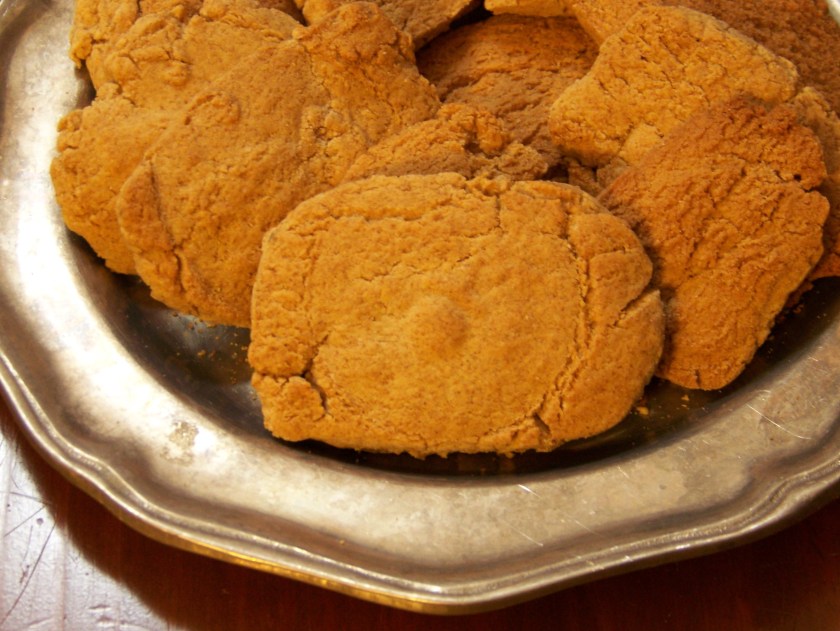
Still cautious, I tasted these the cookies myself before offering them to anyone else. These had a nice light texture, with a hint of crunch, and a good molasses flavor. Still wary, my husband and I limited our own consumption to one or two a day. When neither of us had any ill effects from eating these cookies, we threw caution to the wind and enjoyed them to our heart’s content.
While I don’t recommend cooking with pearl ash, I do urge you to do your own experiments with historical cookery. Who knows what delights you will concoct?
__________
Child, Mrs. The American Frugal Housewife. Carter, Hendee and Co., 1833 (12th edition)
Simmons, Amelia. The First American Cookbook: A Facsimile of “American Cookery,” 1796. Dover Publications,1984.
 BRIC-A-BRAC
One thought on “On cooking with Pearl Ash”