 September is the harvest month–the time to gather the abundant bounty from our summer gardens . And nothing demonstrates abundance quite so well as zucchini squash. It’s so easy to grow that even a complete amateur gardener can produce more zucchini than any family can reasonably eat in one season. Zucchini grows well in almost any soil, survives drought and neglect and even produces when choked by weeds left by the lazy gardener. But zucchini is a relative newcomer to the panoply of summer squashes. It is a hybrid variety of Cucurbita pepo (all summer squashes belong to this family), developed in Italy in the second half of the 19th century. The first records of zucchini in America are not quite a hundred years old, dating from the 1920’s.
So this summer, I decided to explore the summer squashes more likely to appear on Colonial tables. Of course all squashes are native to the Americas, where they have been eaten since prehistoric times. The word ‘squash’ even comes from the native word ‘askutasquash’–which means the fruit eaten green or immature (that is, summer squash).
The earliest European explorers noticed native-grown squash, though they often thought of this novel food as varieties of cucumbers or melons. Good things travel fast and so by the 16th century, squash was commonly found in European gardens.
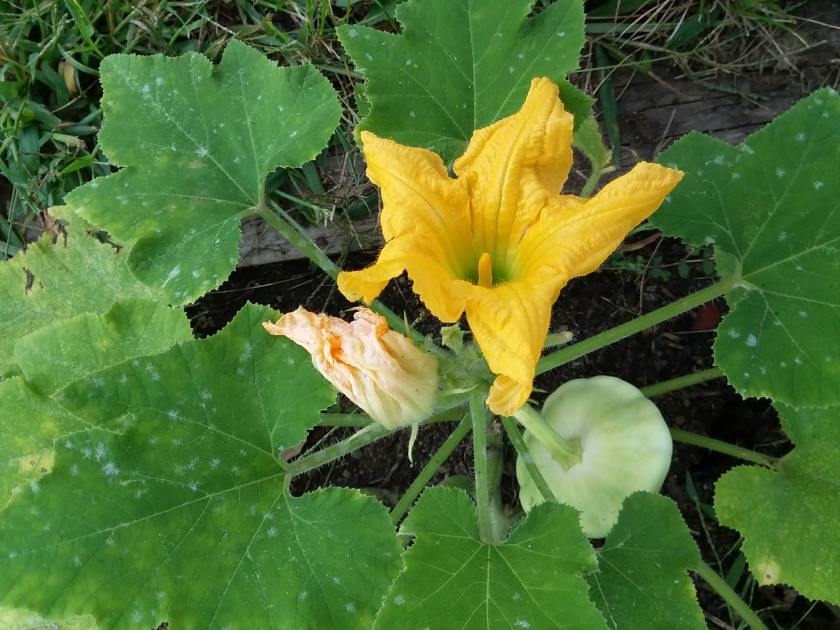
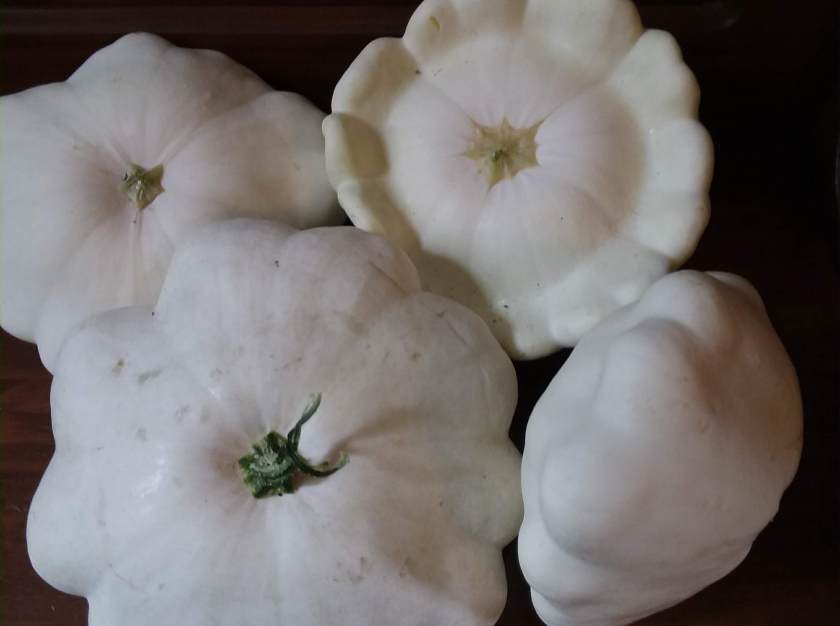
Squash hybrids easily, sharing traits with neighboring squashes, which explains why there are so many varieties. One of the earliest mentions of summer squash I found was in 1562, in Fuch’s Vienna Codex. He described what he called cucumer paniformis, so named because the pale green squash resembled a scalloped-edge baking pan. You might recognize this as patty pan squash.
The patty pan squash was one of Thomas Jefferson’s favorites. He said they were “one of our finest and most innocent vegetables.” (seed packet) Patty pan squash were grown in Jefferson’s gardens at Monticello, in the gardens of enslaved African-Americans, and in kitchen gardens throughout the colonies.
This popular colonial-era squash had many different names based on its distinctive shape, including buckler squash, for its resemblance to a buckler-type shield. One of the most interesting names I came across was cymling (pronounced sim-lin) and also spelled symnel, simlin, or cimlin. The Oxford English Dictionary lists the earliest recorded use of this word for pattypan squash from 1648, in Beauchamp Plantagenet’s A Description of New Albion. Symnels or simnels were a Lenten cake, made for Mothering Sunday, the fourth Sunday of Lent. The day originated as a day to return to one’s ‘mother’ church, although in recent times it has become more like the American Mother’s Day. So how does a name for a cake get transferred to a squash? It turns out that simnels are a circular cake, with small round balls of almond paste decorating the circumference. Indeed, that’s a good description for a large pattypan squash.
Recipes from the 16th through the 18th centuries use pattypan squash in soups and stews. The most common suggestions are for boiling it and serving it with butter or cream. Pattypans were often harvested and eaten while they are very small, the size of large walnuts. The pattypan squash I used were larger, ranging from the size of an apple to the size of eight inch layer cake (because, like zucchini, pattypan squash seem to grow into giants overnight).
The following recipe comes from The Virgina Housewife (p. 110)
Squash or Cimlin
Gather Young squashes, peel, and cut them in two, take out the seeds, and boil them till tender; put them into a colander, drain off the water and rub them with a wood spoon through the colander; then put them into a stew pan with a cup full of cream, a small piece of butter, some pepper and salt–stew them, stirring very frequently until dry. This is the most delicate way of preparing squashes. (p. 110)
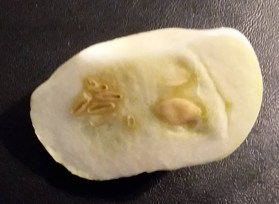 This original recipe calls for peeling the pattypan squash. I found that it is very difficult to peel because of the irregular shape. In the days of modern appliances, peeling the squash is unnecessary. Placing the boiled, unpeeled squash in a food processor and processing it for 2 minutes produces a sauce just as smooth as the colonial method of forcing the cooked squash through a colander.
My modern recipe for Pattypan Squash Puree:
3-4 large pattypan squash ¾ c. cream 3 T. butter Salt and pepper to taste
Wash the squash. Remove the seeds and stem ends. Cut into chunks. Cover with water and boil for twenty minutes, or until tender. Drain well. Puree in a food processor for two minutes. Add cream, butter, salt and pepper to the squash and simmer another ten minutes or until the mixture is as dry as you like it. The pureed squash can be eaten as a side dish. It also makes an excellent soup base. 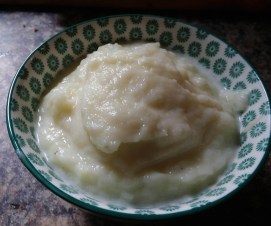
I’ve eaten pattypan squash many times, but I’d never grown it before. Using seeds from The Thomas Jefferson Center for Historic Plants, I planted seven hills of cymlings.
They all grew. They all produced a prodigious number of pale green scalloped edge squash.
Obviously, pattypans are just as abundant as zucchini. Anybody want some?
Sources:
Cymling or Pattypan Squash. Seed packet from The Thomas Jefferson Center For Historic Plants. 2016
Curcurbits. Colonial Williamsburg. The Colonial Williamsburg Foundation, 2018. Colonial Williamsburg: That The Future May Learn From The Past
Randolph, Mary. The Virginia Housewife Or, Methodical Cook. T. E.H. Butler and Co. : Philadephia, 1860.
Simnel. The Compact Edition of the Oxford English Dictionary. 1971.
 BRIC-A-BRAC
Pattypan squash is one of my favorite types! I’ve prepared it several different ways, but never with cream. I’ll have to try that! I appreciate you including the original recipe preparation, since I don’t own a food processor!
LikeLike