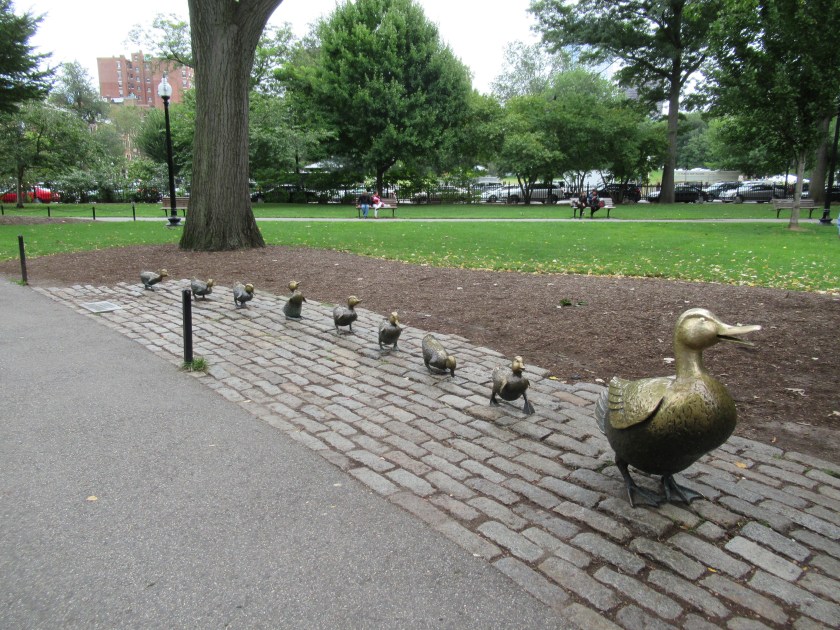
Since its debut in 1941, Robert McCloskey’s Make Way for Ducklings has delighted millions of readers, both young and old. In the story, Mrs. Mallard must navigate the busy streets of Boston to guide her eight ducklings to their new home in the Boston Public Garden. McCloskey won the Caldecott in 1941 for this book, which remains popular today. While not exactly historical fiction, the story evokes an earlier era, nearly eighty years ago, when the world had time to stop for kindness. One of my favorite illustrations in the book is the one of the portly policeman blowing his whistle and holding up his hand to halt traffic.
It is fitting that the Mallard family finds their new home in Boston Public Garden, a place even more historic than the book. The garden was built on reclaimed land: salt marshes filled in with gravel and dirt taken from a hill in the Beacon Hill area of Boston. In 1837, the land was set aside to become the first public botanical garden in the United States, under the planning and vision of Horace Gray. For many years, the city of Boston, the state of Massachusetts, and private developers argued over what should be done with the land. There were several attempts to build housing there. Finally, in 1859, the 24 acre plot was permanently designated as parkland.

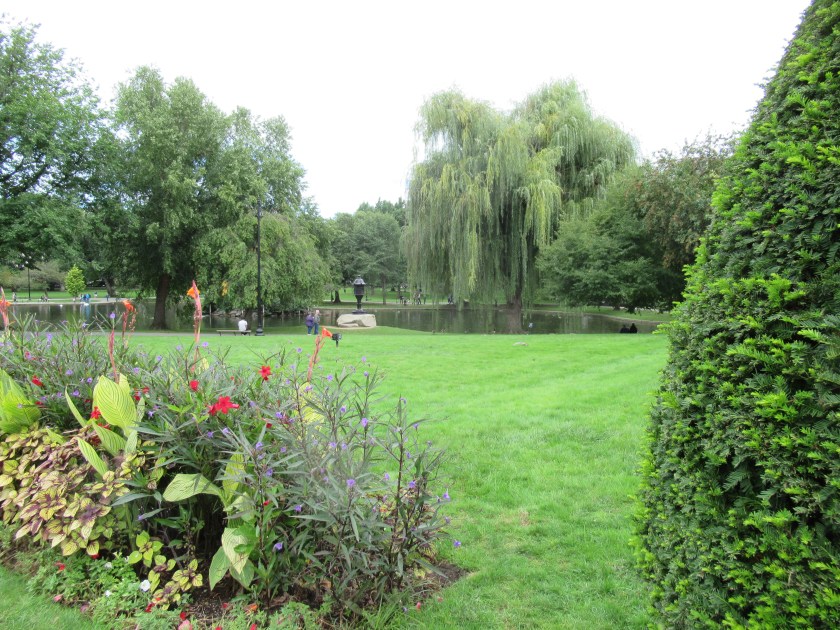
The Public Garden features a Victorian landscape design with meandering paths, shady trees, and colorful and exotic plantings. The pond with the small island where the Mallard family finds a home was completed in 1859. Curiously, the island was originally a peninsula, but was detached from the mainland because too many lovers found the soft gas lights and alluring space too tempting. Now countless ducks inhabit the island as part of long-standing tradition.
And so, as part of this tradition, the Mallard family settles on the island in the pond within the very first Public Garden. It seems both Mrs. Mallard and the good people of Boston recognize the value of green spaces, even in big cities. Mr. McCloskey’s timeless story serves as a pleasant reminder of everyone’s need for peaceful shelter in an oft chaotic world.


 BRIC-A-BRAC