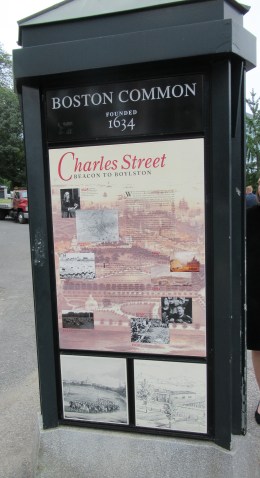
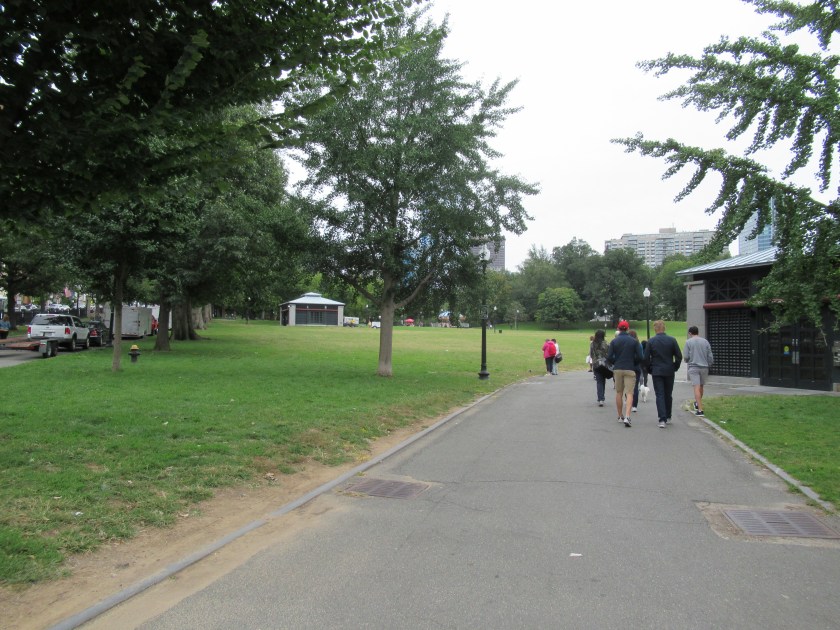
 On a crisp fall day in 2018, Boston Common plays host to all sorts of people. Though the sky is overcast, tourists stroll along the winding paths pst the Frog Pond, Children play . and old men park on benches to read the newspaper. Along the north side of the park a musician strums his guitar, the open case in front of him inviting donations. In another corner, several dozen people gather for an ecumenical outdoor church service led by a woman with a microphone. In short, the oldest public park in America is the heart of Boston, providing a free, open, space for the people to use as they will, just as it has done for the last 384 years.
Amidst the modern bustle, it’s hard to believe all that has happened here in this space. The Common began as land held in common by the people of Boston, set aside for common usage, primarily for grazing the animals of the city inhabitants. This idea of common pasturage dates from at least the middle ages. The early inhabitants of Boston brought the practice with them from the old world. But such open land lent itself to other purposes, such as a place for the militia to gather and practice. In fact, The British used the Common for their military camp when they occupied the city in the years before the Revolution. On an even more gruesome note, a huge ancient elm located in the Common became the hanging tree, where miscreants were executed in public view. (In 1769 a gallows was erected, replacing the elm for public executions.)
Over the years, activities in the Common have evolved and the needs and character of the inhabitants has changed. In 1646, twelve years after the Common was established, public grazing was limited to 70 cows at a time. Richer families had acquired too many cows and the area was becoming overgrazed. Public grazing was banned altogether in 1830.
Just over a hundred years later, in 1756, the Central Burying Ground was established in what is now a shady spot along Boyleston St. The other three burying grounds in the city were overcrowded and this fourth burying ground was meant to alleviate the problem. In 1749, the first corpse was interred here, seven years before the area officially became a burying ground. From the start Central Burying Ground was not as popular, though some 5000 people are buried there. (There are only 487 tombstones.) Among the few famous people buried there lies Gilbert Stuart, the artist who painted the most famous pictures of George Washington. However, most of the people buried here lie in unmarked graves, mingled with the remains of countless other anonymous dead. The burying ground holds the remains of many French Catholic immigrants, British soldiers who died during the Revolution, and American Revolutionary soldiers from the Battle of Bunker Hill. Some of the victims of hanging (not everyone executed would be considered a criminal today; a law banning Quakers carried with it a death sentence for anyone violating the law.) were buried in here too.
The Common was used for other public gatherings besides hangings. In 1713, two hundred Boston citizens rioted here to protest a food shortage. The Boston Common has kept up the tradition as a place for public protest. In 1965 one hundred people protested the Vietman War and in 1969, one hundred thousand people took up the same cause.
Gatherings of a more peaceful nature have also taken place in the Common. Martin Luther King, Jr., Pope John Paul II, and Mikhail Gorbachev have all given speeches there, and many concerts, including one by Judy Garland, have brought thousands into the Common.
While it is true that many places on earth hold the memories of centuries of human activity, the Boston Common seems particularly steeped in history. You need only to sit quietly in the park, and close your eyes. In the mind’s eye, you can see the ghosts of all those who have crossed this common ground.
 BRIC-A-BRAC