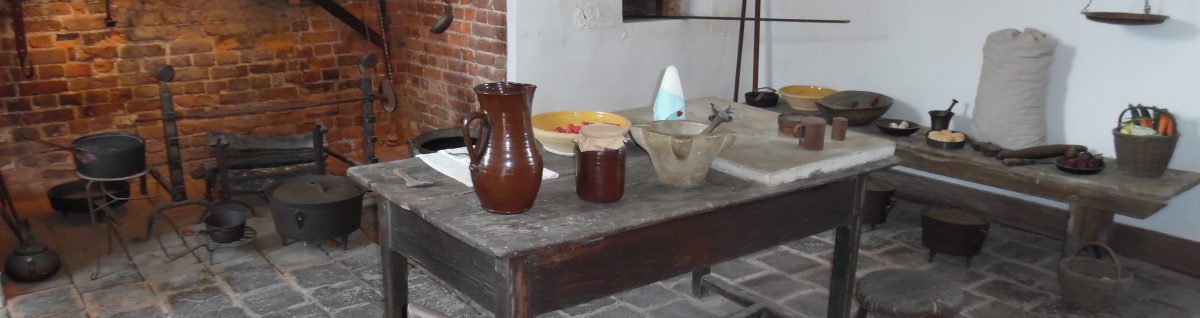

What makes an old house spooky? You know, the house that children run past, holding their breath in a sort of delightful dread?
The house my kids called the witch’s house was a dingy, slate blue, with small, dark windows. It stood tall and square right at the edge of the sidewalk, looming as if ready to grab the unwary child. We never knew who, if anyone, lived in this house, but something about its aspect frightened all the neighborhood children.
For many spooky houses, it is the mysterious or odd inhabitants who ‘haunt’ the house and make it frightening. Witness Boo Radley’s house in To Kill a Mockingbird, so scary it could only be passed at a dead run.
Nathaniel Hawthorne explores this idea of the haunted house (‘haunted’ by fear, sadness, and tragedy, not by ghosts) in his novel, The House of Seven Gables (1851). Hawthorne describes the house thus: “Halfway down a by-street of one of our New England towns stands a rusty wooden house, with seven acutely peaked gables, facing towards various points of the compass, and a huge clustered chimney in the midst” (1). He goes on to say the house seems like a “human contenance, bearing the traces not merely of outward storm and sunshine, but expressive also of the long lapse of mortal life, and accompanying vicissitudes that have passed within” (1). The exterior of the house is decorated with figures ”conceived in the grotesqueness of a Gothic fancy” (7). Hawthorne continues with more vivid description stressing the house’s mysterious and unusual character. He says, “the second story, projecting far over the base and itself retiring beneath the third, threw a shadowy and thoughtful gloom into the lower rooms”(7). 
The House of Seven Gables takes on the role of a character in the novel, based partly on its odd architecture and gloomy aspect and partly on the miserable inhabitants of the house. The two principal characters in the novel are Hepzibah and Clifford Pyncheon, sister and brother, descendents of the original owner of the house. Hepzibah is a lonely, bitter, old woman, made ugly by her sorrow. Clifford is a sensitive, unstable man, broken by the injustice of his incarceration for a murder he did not commit.
In some ways, the house itself is the cause of Clifford and Hepzibah’s misery, since, as Hawthorne explains, it was built by their ancestor under a curse. The old Colonel Pyncheon claimed the land occupied by the humble Matthew Maule. When Maule was executed as a witch (during the famous Salem witch trials), he cursed the Colonel for his part in the condemnation. Though the Pyncheons continued to occupy the house, from that moment on, the family was beset with tragedies and sorrows. The curse of the house carried on through the generations until landing on poor Hepzibah and Clifford.
Nathaniel Hawthorne is quite wordy in his writing (sentences of 50-60 words are common.) Most of the novel is taken up with long explanations of the tragedies of the house–that is the backstory or history of the house and its inhabitants, leading up to the current situation where Hepzibah is penniless and Clifford returns home from prison unable to cope with life. In many ways The House of Seven Gables serves as a series of character sketches. Hepzibah’s loyalty to her brother, her bitterness to the cruel world, her discomfort with outsiders, and her indecision in times of crisis show her as a real, flawed, human being. She, along with her brother, Clifford, haunt the reader’s memory as much as they haunt the old house that seems to be their refuge as well as their prison. And the house itself is a character that sparks the imagination and haunts my dreams.
The strength of the novel is not in its plot, but in its character descriptions and its thoughtful exploration of the human condition. In the end, Hawthorne addresses the question: Can there be redemption for these people wracked by ancient sorrows and cursed by their ancestor’s greed? Can light be brought into the gloom of a ill-fated house so that justice be served and happiness return?
In the fall, I visited Salem and went to the House of Seven Gables on Sale
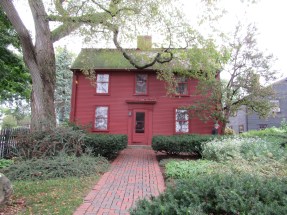
m Harbor. In his introduction to his novel, Hawthorne claims that no single house in Salem was the model for the house in his book. Nevertheless, this house on Turner Street is most often considered the inspiration for Hawthorne’s story. The original house here was built in 1668 by John Turner, a prominent merchant and ship-builder in Salem. Today, several other historic buildings have been moved to the site, including the housewhere Nathaniel Hawthorne was born in 1804, the Hooper-Hathaway House built in 1682, and a counting house from 1830.
I visited on a grey day, with intermittent rain showers spitting across the harbor. The House of Seven Gables is impressive, but I did not find it spooky. Perhaps it was the cheerful voices of the tourists, or the lush green gardens surrounding the house, or the bright fresh wood of new roof and repaired siding.
Or perhaps, like poor Hepzibah and Clifford, the house truly has made peace with the past and is ready to face the world.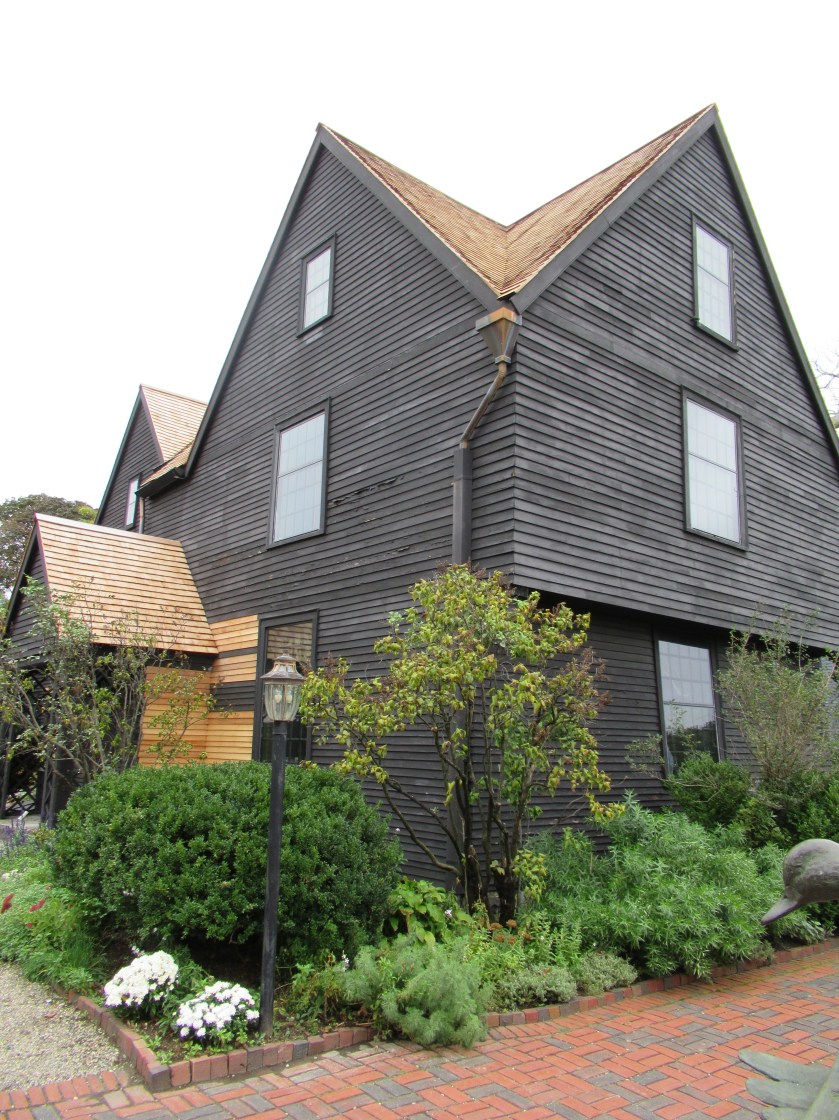
Hawthorne, Nathaniel. (1998 reprint) The House of Seven Gables. Rhode Island: North Books.
 BRIC-A-BRAC