Seppman Mill, Minneopa State Park, MN
“Who has seen the wind?” Christina Rossetti asks in her famous poem. “Neither you nor I,” she answers. It’s true we can’t see the wind itself, but we can certainly feel it. Whether it is a gentle breeze bringing cool relief, or a violent tornado ripping through town, that unseen wind has power. Not surprisingly, people learned to harness wind power for their own purposes many centuries ago.
My own fascination with windmills began when I was a child, watching Chitty Chitty Bang Bang. How exciting to actually live in a windmill! I could only dream about such an opportunity. Later I read about Don Quixote in his hopeless quest, tilting at the great giants. The windmill seems to be a romantic symbol, recalling bygone days as well as the relentless march toward the future.
Persians made the first known windmills around 500 CE, for milling grain and pumping water. Even before that, circa 2000 BC, Hammurabi is said to have planned a windmill, but there is no evidence if it was completed. Windmills spread throughout Europe and Asia in the 12th and 13th centuries. The first windmills in the United States were built in the middle of the 19th century.
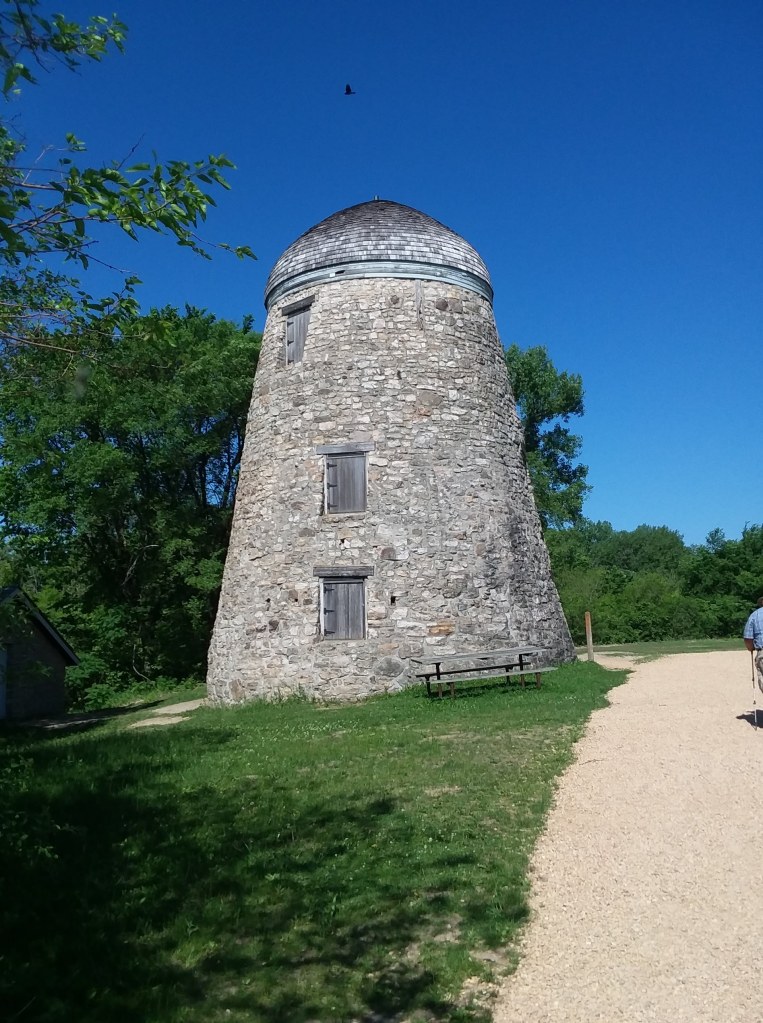
As pioneers moved westward, spreading out to farm the rich land, they needed a means to grind the grain into flour. One such wind-powered grist mill is the Seppmann Mill in Minneopa State Park. The mill was built of stone in 1864 by Albert Seppmann. He modeled it after the windmills from his birthplace, Germany. On a good, windy day, the mill could grind 150 bushels of wheat into flour.
This massive stone building still remains, though it ceased working in 1890 after a tornado ruined the windmill’s arms. (How ironic to be destroyed by the very wind the mill was designed to harness!) It was too expensive and unprofitable to replace the arms.
Windmills have changed in the century after this windmill was last used. Solid stone buildings like this are now rare, replaced by cheaper, metal frames. Today great wind farms sport sleek silver posts that are 212 feet high with steel blades of 116 feet or more. Instead of a single windmill for an entire town, some of these wind farms have hundreds of wind turbines. Instead of turning grain into flour, modern windmills mostly use the power of wind to create electricity.
What hasn’t changed is the wind. Who has seen the wind? Not us perhaps, but we need only watch the slowing churning blades of a windmill to see its force.
 BRIC-A-BRAC