Diverse ways to enjoy apples
This fall my son’s mother-in-law gifted me with a bagful of apples, a tart, crisp variety ideal for eating fresh or cooking. Apples are an immensely versatile fruit with a myriad of recipes for enjoying them. While I never get tired of apple pie, apple crisp, apple pancakes, or even applesauce, this unexpected abundance of apples gave me the opportunity to try a couple of new recipes: apple puddings, from The American Frugal Housewife, from 1833. At this time, pudding does not always refer to the modern, creamy concoction we know in America, but refers to a variety of dishes both savory and sweet, not necessarily reserved for dessert. (See the link below for more about puddings).
Bird’s Nest Pudding
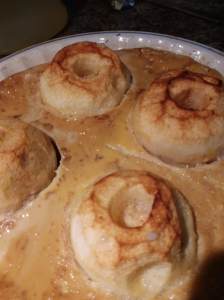
The first recipe I tried is a Bird’s Nest Pudding, which is also called Crow’s Nest Pudding. As with so many apple recipes, there are a great many variations of this popular 19th century dish. Laura Ingalls Wilder describes a dish of baked apples served with cream as ‘birds nest pudding’ in Farmer Boy published in 1933. The earliest recipe I have found so far is from 1833 (though I believe it was included in an earlier -1830- edition of the same book.) Mrs. Child seems confident that her readers will know what to expect from a bird’s nest pudding. Her recipe calls for cored and peeled apples to be baked in a custard. Depending on how sweet you make the custard, this pudding makes a lovely dessert or a delicious accompaniment to pork.
Mrs. Child’s recipe: “If you wish to make what is called ‘bird’s nest pudding’ prepare your custard, — take eight or ten pleasant apples, pare them, and dig out the cores, but leave them whole, set them in a pudding dish, pour your custard over them, and bake them about thirty minutes.”(63)
Mrs. Child tells us that puddings good enough for common use need only five eggs for a quart of milk. She suggests sweetening the pudding with brown sugar and seasoning it with cinnamon, nutmeg, or peach leaves (62). In my version I opted for cinnamon.
Modern Recipe
Pare and core four apples. Put these in a 10 inch pie pan or 8 inch square pan. Mix 3 eggs with 2 cups of milk. Add ¼ cup of brown sugar (more if you want it sweeter) and2 teaspoons of ground cinnamon. Stir well. Pour the mixture over the apples. Bake at 350 for 30 minutes. (Note baking time will vary depending on the variety of apples.)


The second pudding I made wasquie a bit more challenging, primarily because it is the first boiled pudding I’ve tried.
Mrs. Child calls this “a plain, inexpensive pudding” (63.) Her recipe calls for apples tied up in a common crust and boiled, like dumplings. Her variations include quartering the apples into one crust or wrapping a single cored and peeled apple in a crust and tying each one up separately (63). Her common crust calls for a quarter pound of butter for a half pound of flour, and she advises, “Always roll away from you. Pie crust should be made as cold as possible, and set in a cool place, but be careful it does not freeze. Do not use more flour than you can help in sprinkling and rolling. The paste should not be rolled out more than three times; if rolled too much it will not be flaky” (69). Using her method, I rubbed most of the butter into most of the flour, added water, then rolled it out. She tells us to dot the crust with butter, sprinkle with flour, and roll again, repeating until all the butter and flour is mixed in. I’ve never had much success with this method of making crust. The dough tends to crumble and is tough, not flaky. However, since this crust is meant to be boiled, not baked, a thicker, tougher crust works.
Modern Recipe
Set out ½ cup and 2 Cups os flour. Rub together ⅔ cup of the butter into 1 ½ cups of the flour. Mix until crumbly. Add 5 T. water and gather into a ball. Roll out thick (½ “). Dot with half of the remaining butter and sprinkle with half of the remaining flour. Gather and roll out again. Repeat until all the butter and flour have been used. Roll out the dough to about ⅛ inch thick. Peel and core 4 apples. Cut the crust into squares large enough to wrap each of the apples. Tie each wrapped apple in a section of cheesecloth. Bring a large pot of water to boil. Drop the wrapped apples in the water. Boil about 30 minutes.

The resulting apple dumpling is best served warm. Modern diners may prefer sprinkling the dumpling with cinnamon sugar.
Source: Child, Lydia Marie. The American Frugal Housewife. Dedicated to those who are not ashamed of economy. 12th Edition. Boston: Carter, Hendee, and Co. 1833. (First published 1828)
 BRIC-A-BRAC