Teton National Park

Although many of us can swim, water is not the natural habitat for humans. But for people, like for the proverbial chicken faced with a road, the urge to cross is overwhelming. A restless bunch, we humans are forever trying to get to the other side, where the grass just might be greener.
Rivers pose a particular difficulty in the face of this insatiable desire to go on, travel forth, get to that other side (and often back again.) Instrumental for long distance transportation and as a source of water, rivers offer ideal places to settle. Soon, homes and work, food and safety can develop on opposite banks. Short of swimming, there are only a limited number of ways one can cross. If a place that is shallow and smooth bottomed can be found, the river might be forded, which means wading, riding, or driving a wagon across. Rougher rivers require a bridge or a ferry. Bridges take time, money, and skill to build. That means that from ancient times and in countless tales, the ferry is of utmost importance.
For instance, Charon of Greek mythology, ferries the dead across the River Styx. Urshanabi is the Mesopotamian equivalent, ferrying the dead across the River Huber.
Far more recent, and much less lethal, is Menor’s Ferry, built in 1894 to cross the Snake River in Jackson Hole, Wyoming. William (Bill) Menor took advantage of the Homestead Act of 1862 to ‘squat’ on 149 acres on the west side of the river. (He secured legal title in 1908.) Most settlers, including Bill Menor’s brother, Holiday Menor, settled on the east side of the river. The Snake River had a few fords, but these became impassable whenever the water was high. Menor’s Ferry soon became the most reliable way to cross, allowing residents of Jackson Hole to hunt, forage, and cut lumber in the mountain foothills on the west side. A wagon and team cost fifty cents for the crossing, while a horse and rider cost half that. Menor didn’t charge pedestrians, as long as there was a wagon crossing.
Menor’s Ferry is an ingenious design. The platform, large enough for a wagon and team, floats on two pontoons. The ferry is attached to a cable overhead to prevent it being carried downstream by the strong current of the river. The ferry can be angled toward the opposite bank by means of the pilot wheel, which tightens the rope to point the pontoons in the right direction. The force of the current pushes against the pontoons, driving the ferry across the river, much like a sailboat angling the sails to take advantage of the pressure of the wind. Although Charon’s Ferry is usually depicted as being poled across the river, the type of ferry Menor built was known in ancient times and in many places.

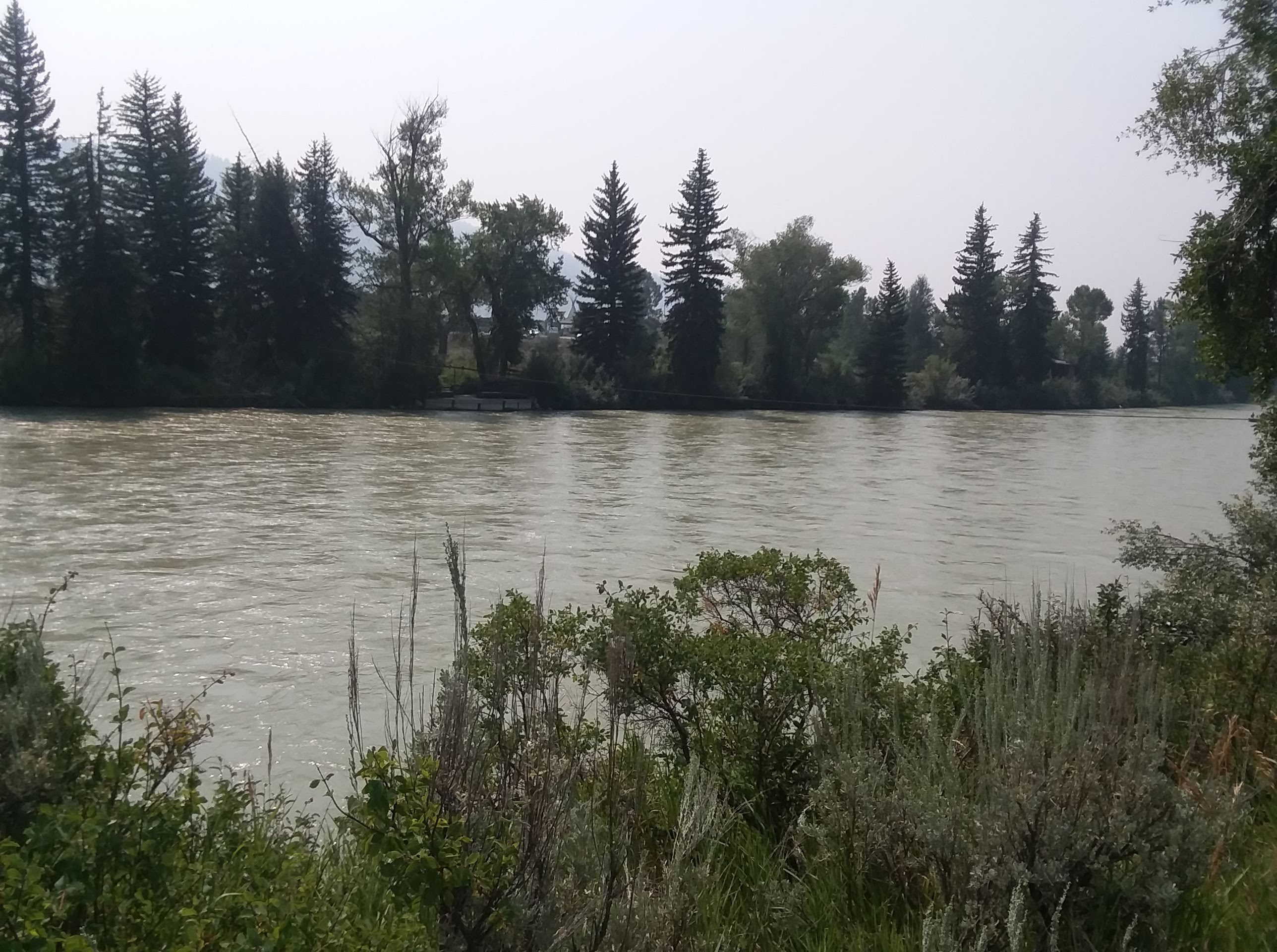
The Snake River can be wild and erratic at times, but at other times the level of the untamed river dropped too low to operate the ferry. Menor rigged up a suspended platform from his cable system, and transported up to four passengers across in this makeshift cable car. In winter, Menor and his neighbors cooperated to build a temporary bridge for crossing. The bridge was taken down each spring.
Menor operated the ferry until 1918, when he sold it to Maude Noble. An astute business woman, she immediately doubled the prices. By this time, cars were bringing more and more tourists into Jackson Hole. In another bid for increased revenue, she charged $1.00 for cars with Wyoming license plates, and $2.00 for out of state plates. Maude operated the ferry for almost 10 years, until 1927 when a steel truss bridge was built. Although the urge to get to cross never went away, Menor’s Ferry became obsolete with the completion of the bridge.
Bill Menor’s ferry and homestead are now a part of Grand Teton National Park, a tribute to the men and women who made it possible to get to the other side.
 BRIC-A-BRAC