
Summer brings the delight of fresh raspberries. They grow wild in all the woods near me, and even in my own backyard. They are easy to grow and easy to pick (though the spiny canes are a bit tricky.) Both red and black raspberries are members of the rose family, and can be found throughout Asia, Europe and North America. Botanists have discovered that red raspberries are native to Turkey and spread throughout Europe by Romans. Black raspberries are native to North America, or at least brought here by prehistoric peoples long before any settlers from Europe arrived.
No one knows for sure why they are called raspberries. The name possibly comes from raspise (sweet, rose colored wine) from Anglo-Latin ‘vinum raspeys’. Another suggestion is that the word comes from the Germanic word for thicket, ‘raspoi’. A third option is the word comes from the sense of rasp, coming from Old Germanic through Old French into English. Rasp has the sense of grating or rough, and may serve as a description of the fruit. This last suggestion is unlikely, apt though it seems, because most old recipes spell ‘raspberries’ without the ‘p’.
Whatever the origins, raspberries are remarkably good for you. They are chock-full of antioxidants and nutrients, high in fiber and low in sugar. On top of that, they taste really good.
Other parts of the raspberry plant might also offer health benefits. Raspberry leaves can be steeped in hot water to make a tea that is said to ease menstrual cramps, pregnancy and labor. And gargling with raspberry juice to relieve a sore throat is much more pleasant than some of the modern mouthwashes, though I can’t vouch for its efficacy. Another remedy I wouldn’t recommend is rubbing sore joints with raspberry canes to relieve pain. Raspberry canes are remarkably thorny, so any joint pain relieved is likely to be replaced by the pain of upbraided skin.
In spite of the spiny canes, the only real drawback to raspberries is that they don’t keep for very long. Recipes for preserving this delicate fruit often call for a great deal of sugar to make a jam or jelly.
The following two colonial recipes for raspberries intrigued me. The first is for raspberry seed cakes. Many people don’t mind the very seedy nature of raspberry jam, raspberry tart, or other raspberry confections, but removing at least some of the seeds makes them easier to eat. This first recipe is for the frugal cook, who hates to waste food of any sort, even extra raspberry seeds. The recipe calls for mixing raspberry seeds strained from the raspberry juices with their ‘downe weight in lofe sugar and a quarter and then make a candy & when your candy is very high put in the seeds of raspberries after som of the juice is strayned out…” (—-, Martha Washington’s…, 306). This mixture is then boiled until thick and dropped into molds or onto a board. What is very interesting about this recipe is the direction to ‘make a candy’. Karen Hess, who transliterated and commented on the manuscript of Martha Washington’s cookbook, explains that the colonial cook knew several stages of syrup making: including Manus Christi Height (215 degrees), Candy Height (220 degrees), and Casting Height (232 degrees) (Hess, 226-228).

When I made this, the ‘cakes’ turned out to be sticky, globs of sweetened seed, more gummy than jam, but not as dry as fruit leather. While I applaud the frugality of this recipe, I found the result disappointing.
The second recipe for raspberries made a much better confection. I like this recipe because of the intriguing measurement for raspberries: a pottle. A pottle is two quarts, or a half-gallon. Pottle means a small pot, using -le as the diminutive, as in puddle ( a small pudd or waterfilled ditch) or sparkle ( a small spark).
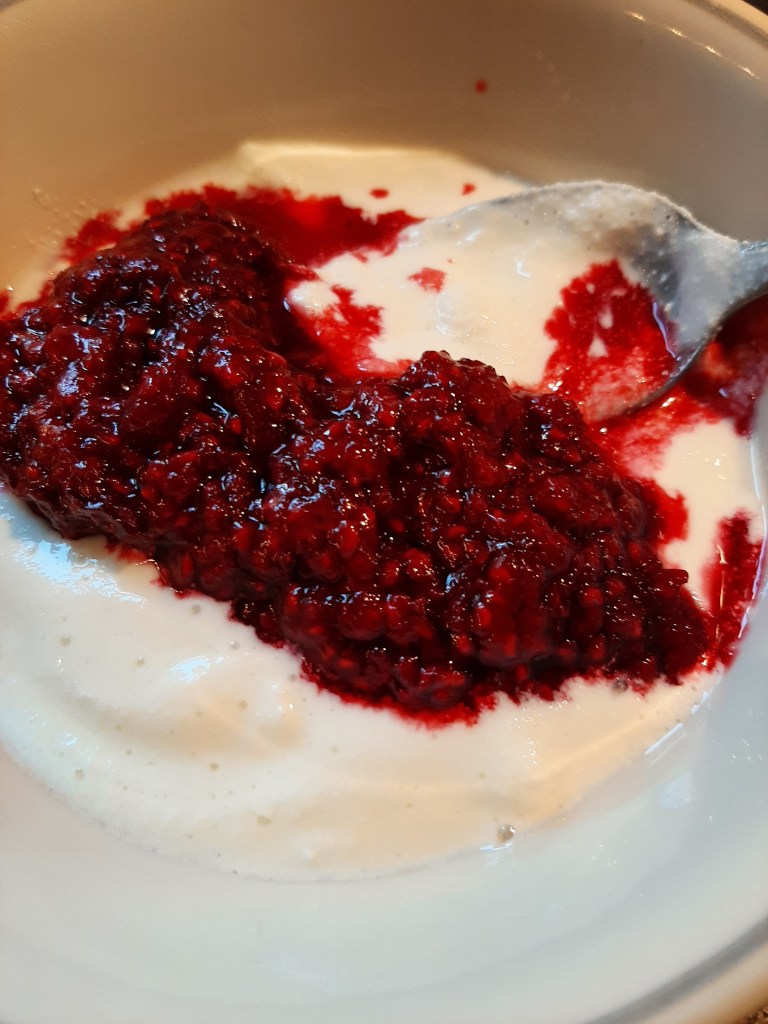
To Make Rasberry Jamm.
Take a pottle of rasberries, put to them two pounds of sugar, press the rasberries and boil them together to a strong substance, and put them to pots. (Townshend, 164)
This recipe is fairly straight-forward. Just mix equal weights of raspberries and sugar. Bring it to a boil. Boil, stirring constantly, for 2 to 3 minutes. The result is a delicious raspberry mixture with the texture of a thin jam or thick fruit soup. For a modern take, try it mixed with yogurt or oatmeal.
Sources:
—–. Martha Washington’s Booke of Cookery and Booke of Sweetmeats. (A Family Manuscript, Hand written circa 17th century. Transcribed and annotated by Karen Hess, New York: Columbia University Press, 1995).
Townshend, John. The Universal Cook or Lady’s Complete Assistant. S. Bladon: LOndon, 1773 (facsimile).
 BRIC-A-BRAC