
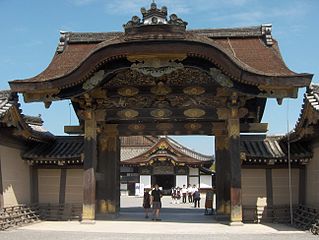
Let me explain. The great castles of Europe were massive stone structures, built for defense against large groups of marauders. Many are also beautiful, but the aesthetic is not the primary goal.
On the other hand, while Nijo-jo was also built for defense, beauty, peace, and serenity are equally valued. In this way, it is more like the later, ornate palaces of Europe’s 18th century, built at least in part to show off to other nobles.
Nijo-jo was planned and constructed in the early 17th century, at the beginning of the Edo period, when Japan was ruled by the Tokugawa family–the Tokugawa shogunate- and Kyoto was the Imperial Capital of Japan. The first shogun of the Tokugawa shogunate, Ieyasu Tokugawa, used it as his residence whenever he was in Kyoto.
Though lighter and airier than some of its European counterparts, Nijo-jo has its share of fortifications. The castle complex has an inner and an outer ring of defense, each ring consisting of a stone wall and a moat. Originally, the outer wall had four watchtowers, but only two of these remain. These tall, white buildings with distinctly Japanese curved roofs are landmarks in Kyoto.
Three gates in the outer wall provide access to the Ninomaru area, which includes the Ninomaru palaces and gardens. The five interconnecting buildings of the palace are mostly made of cyprus wood and are decorated with gold leaf. Elegant wall and screen door paintings and ornate carvings were meant to further impress visitors with the shogun’s power and wealth.
There are two gates in the inner wall, leading to the Hon-maru area. When first built, his inner palace was similar to the 1603 Ninomaru palace, but in 1893 some of the buildings from the Katsura Palace in theKyoto Imperial Enclosure were moved here, replacing the older buildings.

Between the inner and outer walls, visitors can stroll through the 400 year old Zen Buddhist gardens. This garden features a small lake, with three islands and several artfully placed stones.
The most unusual defensive aspect of Nijo-jo are its Nightingale Floors. How are squeaky (singing) floors defensive? Well no one can walk on them without making noise, thus alerting the guards within the castle. The floors were designed so that the nails of the slightly curved floor boards would rub on the joint clamps. It’s possible that the resulting chirping was an accident of design, but I prefer the legend. After all, floors that sing a warning add an aura of magic to an already awe-inspiring place.
 BRIC-A-BRAC