From healthful to harmful, sugar has undergone a remarkable journey in the perceptions of its users.
Sugar originally comes from New Guinea, where it was first cultivated around 8000 BCE. For several thousand years people chewed on sugar cane to savor the sweetness. Gradually cultivation of sugarcane spread to India and the Philippines. People in India were the first to refine sugar, and developed the first sugar mill about 100 CE. Greeks learned of sugar from the Indians. By 500 CE Arab scholars were studying sugar as a powerful medicine, and Arab cooks were using it in all sorts of meat, nut, and grain recipes
In medieval and renaissance Europe, the general opinion was that sugar had strong medicinal virtues and was especially good against cough and sore throats, and was also useful against sourness and bitterness. Indeed, sugar was used to make other medicines more palatable- much like the sugary sweet cough syrups marketed today.
It is difficult to determine how much sugar was used in early English cookery. Elizabethan England average consumption was 1 pound per person per year (MW p. 11). But only the wealthy had easy access to sugar and sugar was used primarily for preserving fruits, making sweets, and brewing medicines. The growing use of sugar led to blackened, rotting teeth, at least among the wealthy, who were the only ones who could afford the luxury of sugar. Queen Elizabeth I was well known for her love of sugar and sugary products. Her teeth fell out by the time she was fifty. Although I have not found any actual evidence for the practice, several websites claim the wealthy Tudors used a sugar paste to clean their teeth.
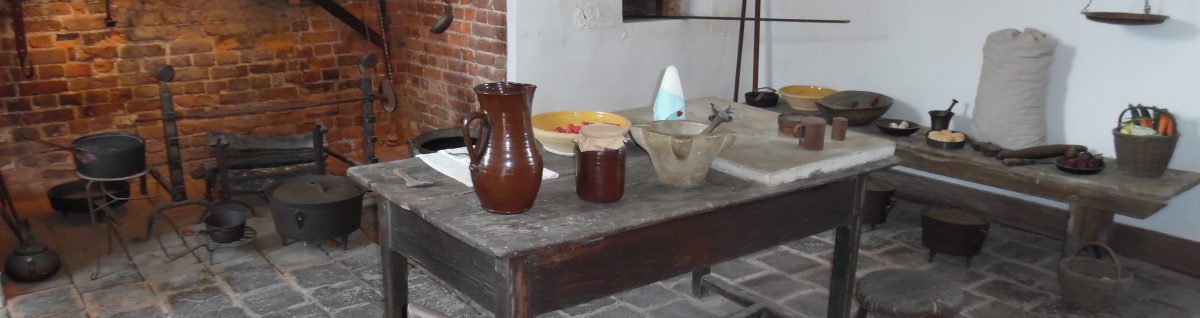
By colonial times sugar manufacture was greatly improved and expanded (in large part due to enslaved workers in North American Colonies). In spite of import duties, (Molasses Act of 1733 and Sugar Act of 1764), sugar was much more affordable for the growing middle class. While many early recipes are quite sweet, sugar was mostly used in small quantities as a spice or flavor enhancer, like salt. Still, more and more recipes specifically meant to offer something sweet appear in early cookbooks.
In spite of protests against sugar production because of its reliance on slaves, (see https://bricabrac164.blog/2018/05/04/the-maple-sugar-scheme-in-the-early-united-states-a-failed-plan-to-end-slavery/ ) sugar consumption soared. Efforts to substitute maple syrup for sugar didn’t catch on, since sugar is cheaper and requires less energy to produce.
Nowadays, high fructose corn syrup replaces cane sugar in many processed foods, to the detriment of the modern diet. Even though we know too much sugar of any kind is bad for a person, humans are hard-wired to seek high-calorie foods and many of us have a strong ‘sweet tooth.’ I know I’m not the only one in the US who consumes too much sugar. Efforts to have both a healthy diet and a steady supply of sweet treats have led to many sugar substitutes, including artificial sweeteners (aspartame, Saccharin, or Sucralose,…) and natural ones (Stevia, monk fruit…)
As for me, I still remember the 1960’s jingle advertising sugar: “C&H, C&H—pure cane sugar from Hawaii”. Hawaii was only recently a state at the time (it became a state in 1959) and was considered somewhat exotic. I didn’t recognize the advertising ploy to increase sales and push sugar usage. I just liked to watch the cute Hawaiian kids dancing in the commercial.
Attitudes toward sugar have definitely changed over the centuries. Although sugar is no longer seen as a healthy food, the modern world has a love/hate relationship with it. We crave it even though we know it’s bad for us. Personally, I’m not ready to give up on sugar, but I wholeheartedly advise against using it to brush your teeth.
Recipes:
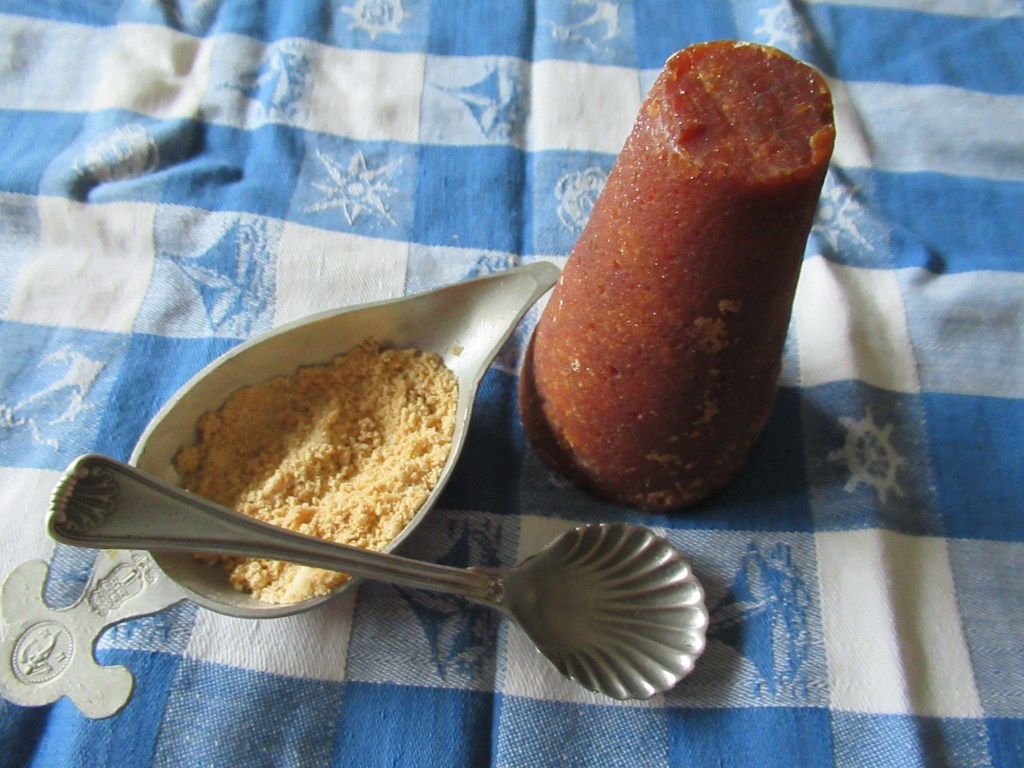
In Colonial times, sugar came in cones, and needed to be clarified with egg white and boiled water. Martha Washington’s Booke of Cookery gives instructions at the beginning of the section on sweetmeats.

To know how to clarify your Sugar
Take a pinte of faire water & beat the white of an egg into it to a froth, then put a pound of sugar in to it, & let it boyle very fast, & there will rise a black scum on ye top of it. As it riseth, take it of till it is very clear, & then streyne it through a Jelly bagg or wet cloth, & soe use it as you pleas. To every pound of sugar as you clarify, you must put a pinte of faire water, & ye white of an egg. ye white of one egge will clarefy 2 pounds of sugar as well as one pound. (MW 225)
Sugar is so well refined today there is no longer any need to clarify it, so to try this out, I used reproduction cone sugar. The recipe above is quite clear and easy to follow. I cut it in half, using 1 cup of water and ½ pound of sugar with one egg white.
After clarifying your sugar, here is one way to use it.
To candy Ginger
Get the fairest pieces, pare off the rind, and lay them in water twenty-four hours; then boil double-refined sugar to the height of sugar again, and when it begins to be cold, put in your ginger and stir it till it is hard to the pan; then afterwards put it into a warm pan, tie it up close, and the candy will be firm. (Townshend, 261)
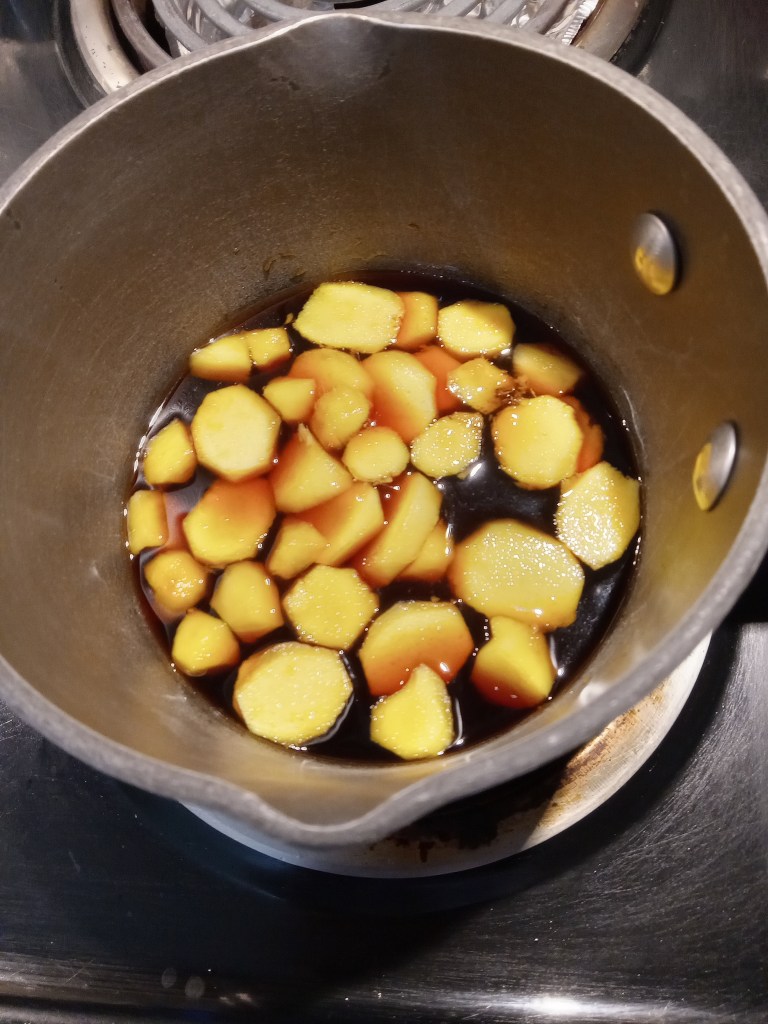
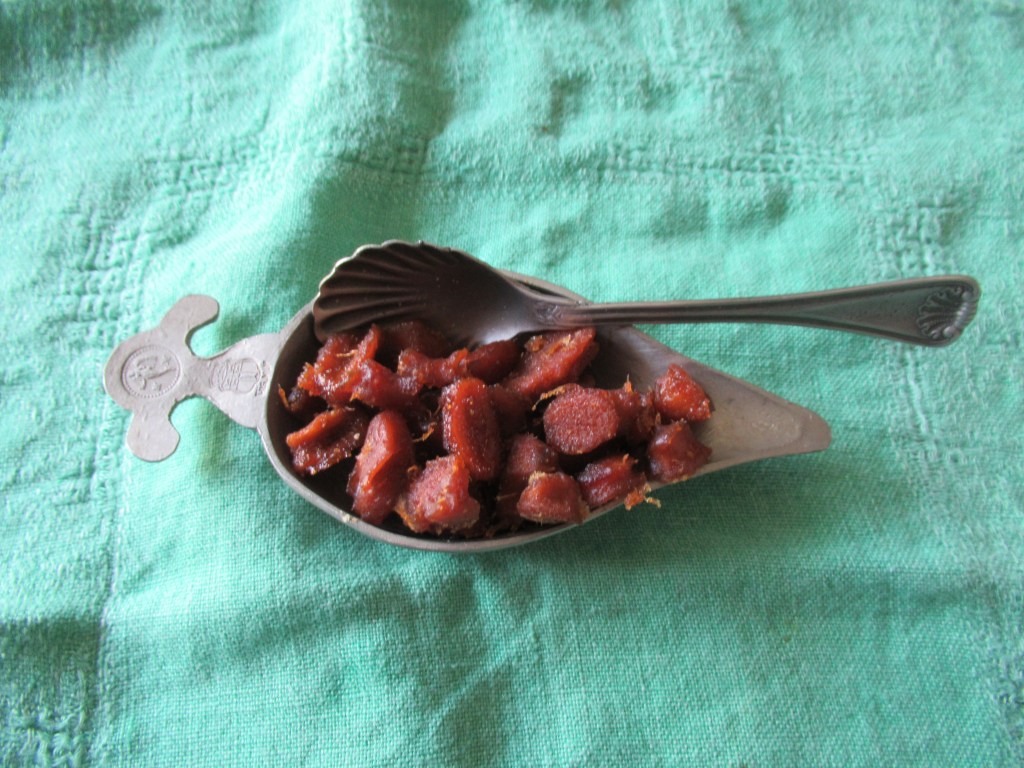
Although this recipe seems simple, there are several confusing phrases. First, ‘double-refined sugar’ means clarified sugar, but I have not been able to find what ‘to the height of sugar’ means. Martha Washington’s Booke of Cookery gives several stages of candy making, roughly corresponding to modern stages. However, neither her directions nor any modern cookbook gives ‘sugar’ as one of the stages. I experimented with boiling the ginger in clarified sugar syrup to different heights. I found that bringing the syrup to a soft ball stage of 235˚ produced the best candy as lower temperatures were too sticky. The candied ginger at this stage cooled to create a product similar to crystallized ginger.
The second phrase that gives me pause is ‘stir it till it is hard to the pan’. I was not able to find any further information on what this means. It sounds like the cook recommends boiling until all the liquid is used up and the ginger slices stick. That seems impractical to me, so I just boiled the ginger slices until the syrup reached the desired temperature.
For the modern version of this recipe, peel and slice 4 oz. of ginger. Soak the ginger in water for 24 hours. Drain the water. Next boil the slices of ginger in ½ c. of clarified sugar syrup, to 235˚. Stir occasionally, and watch carefully as the syrup can easily boil over. Remove the ginger from the syrup and lay out in a single layer to dry for a few days. The resulting candy is slightly chewy, and has a very strong, (peppery hot) ginger flavor.
Sources
—–. Martha Washington’s Booke of Cookery and Booke of Sweetmeats. (A Family Manuscript, Hand written circa 17th century. Transcribed and annotated by Karen Hess, New York: Columbia University Press, 1995).
Townshend, John. The Universal Cook or Lady’s Complete Assistant. S. Bladon: London, 1773 (facsimile).
 BRIC-A-BRAC