In my mind, few things are more delightful than climbing an old tower, winding up narrow, spiral steps, treading on stones, hundreds of years old, scrambling up creaking wooden staircased , all to reach the top platform and the amazing view spread out below. For centuries, people have built upward, both for better protection from enemies, and for the desire to feel closer to God. Whatever the original purpose, these monuments lure me to them, beg me to climb. And if you, like me, delight in such heights, Prague is the ideal place to visit.
Nicknamed the city of 100 spires, Prague actually has over 500 such steeples and towers reaching toward the skies. Since my recent visit to Prague was only a few days, I can’t claim to have climbed all, or even most of these. Instead, I managed these few.
Old Town Hall Tower
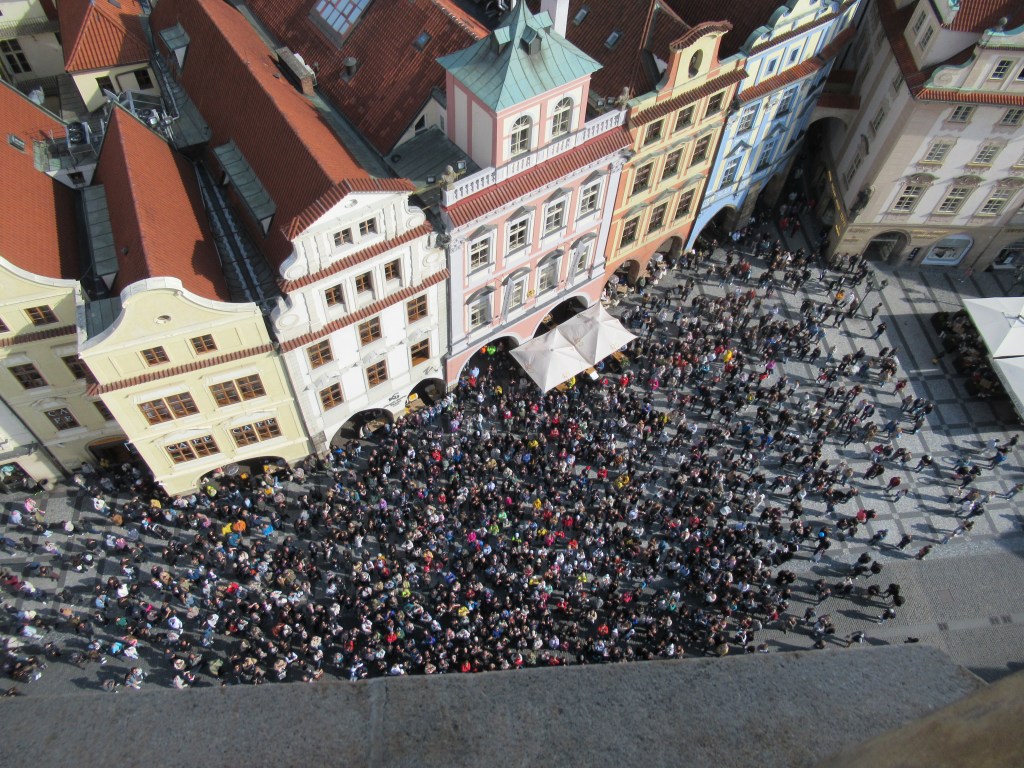
The Old Town Hall is best known for the Astrological Clock, which puts on a show every hour. This tower was built in the 14th century and is about 230 feet tall. The clock, built in the 15th century, is amazing, but the show is rather anticlimatic, lasting only a few minutes. We took a series of elevators to reach the top in time to look down upon the crowd gathered to watch the twelve apostles rotate. The picture on the right is a view of the city from the tower.
Powder Tower
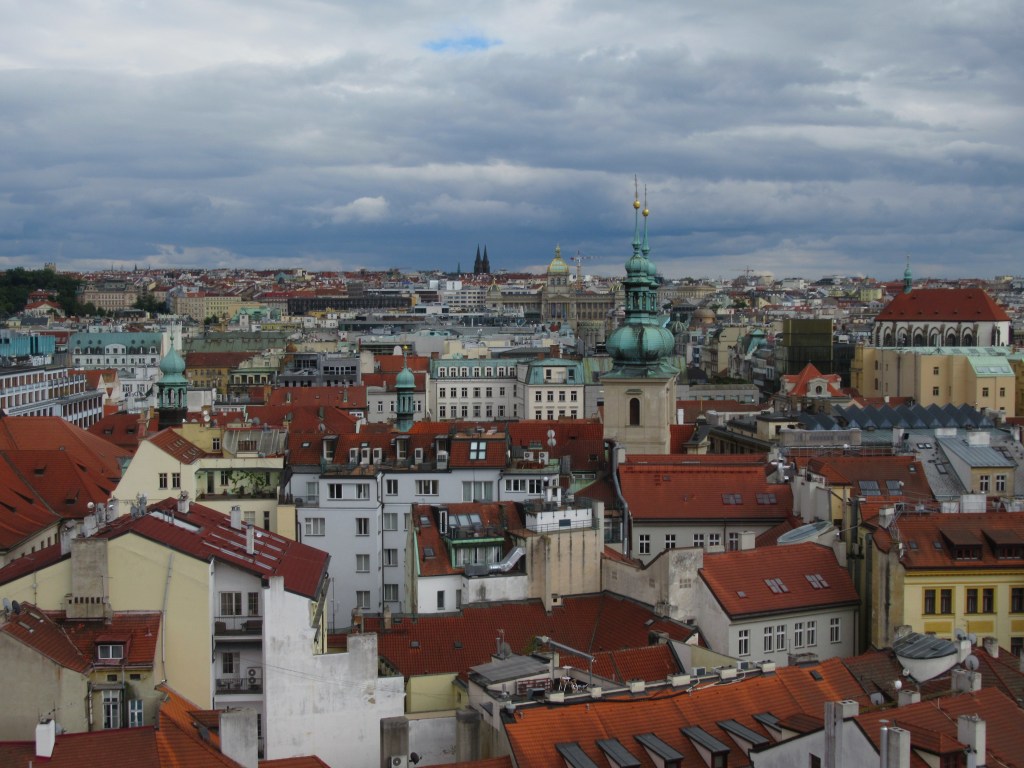
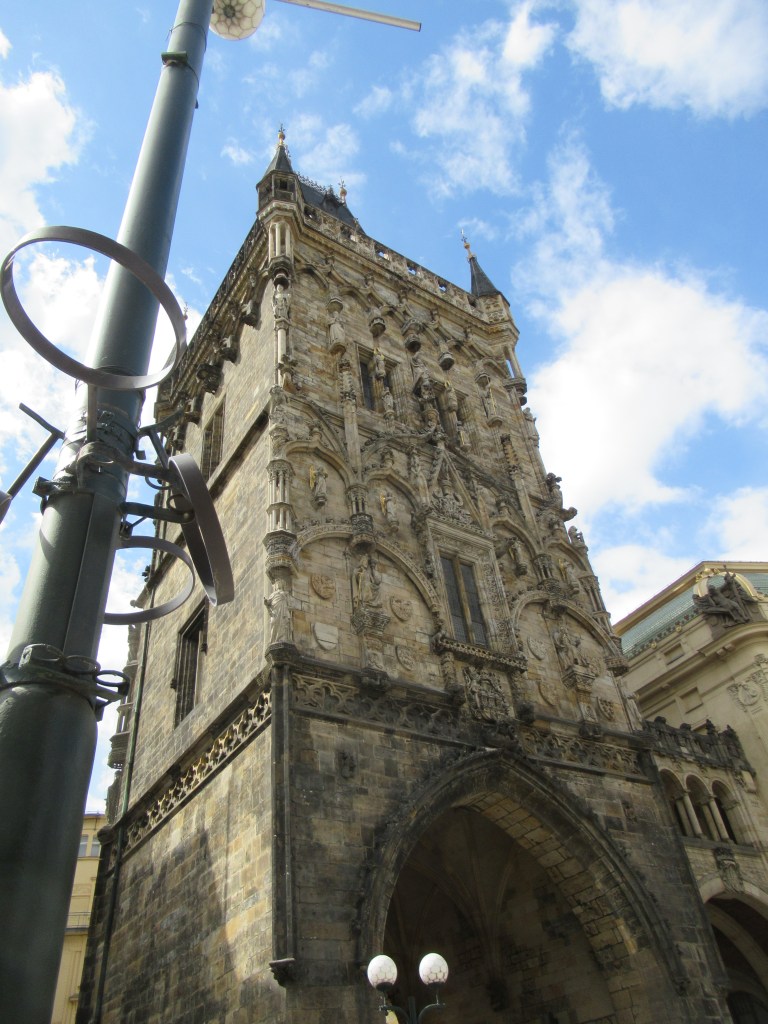
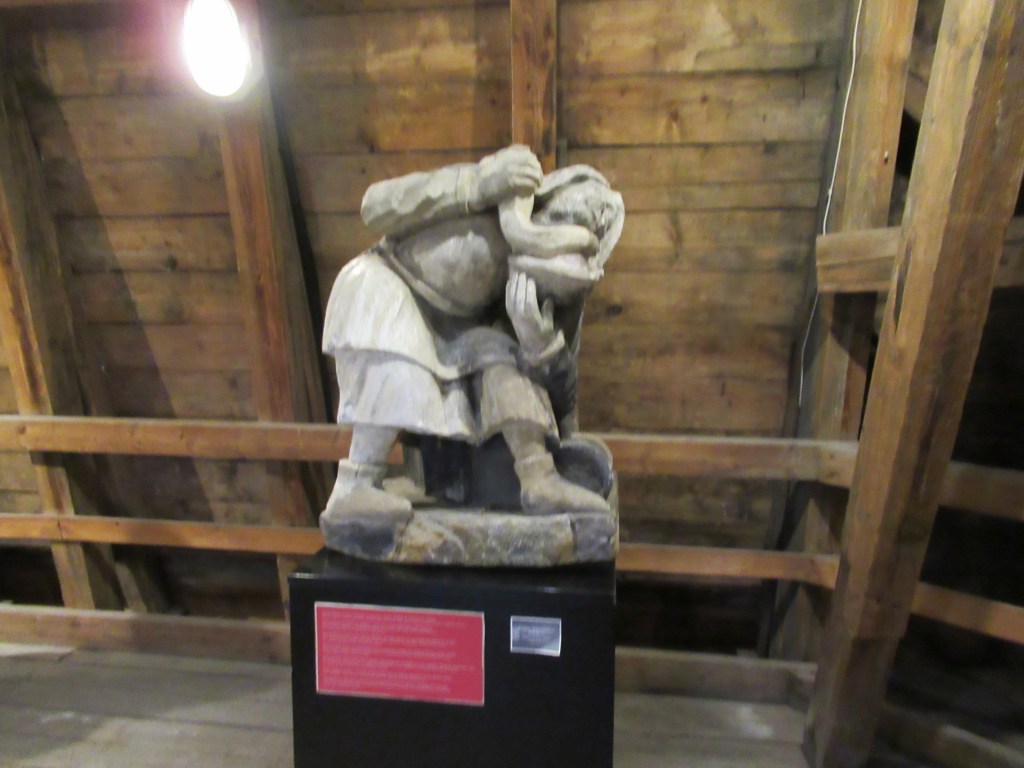
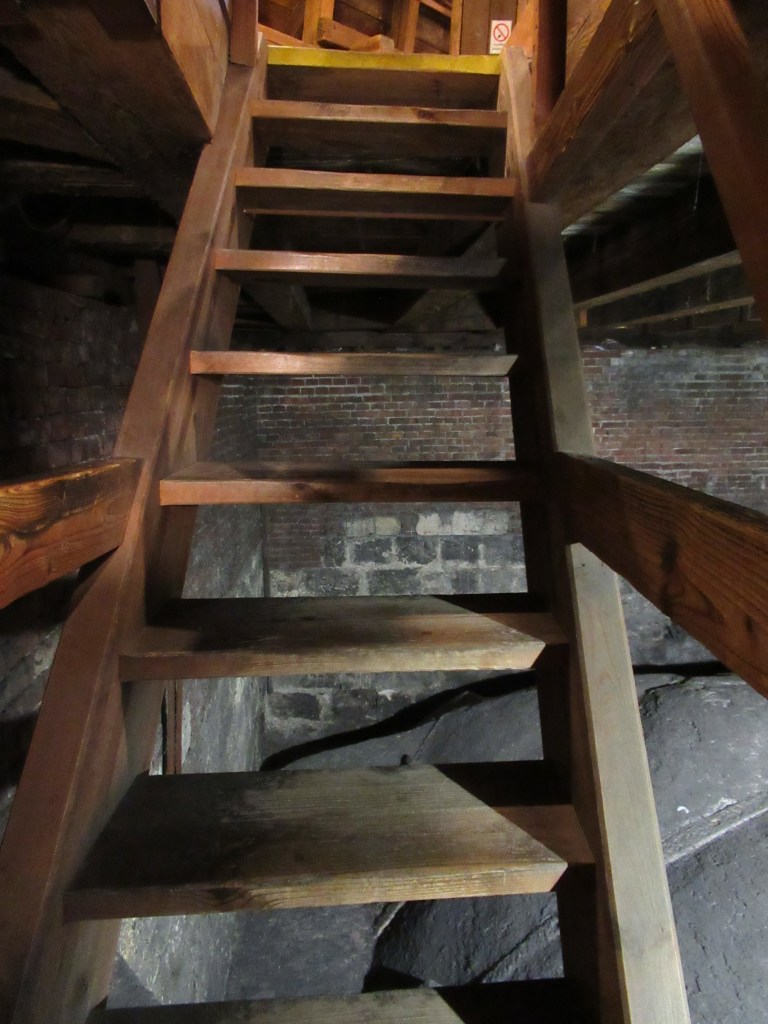
The Powder Tower is one of my favorites. The entrance is a tiny door leading to a spiral stone staircase which you must climb to reach the first floor, where there is a guard/guide to check your ticket. The tower was built in the late 15th century. It stands as the entrance to the Royal Route, leading to Prague Castle. The tower includes wooden stairs as well as the stone steps. Inside there are several unusual statues. The view at the top is magnificent. Pictured here is a view including the Old Town Hall on the left, Our Lady of Tyn Church in the center, and St. Vitus Church at Prague Castle in the distance on the right.
Old Town Bridge Tower
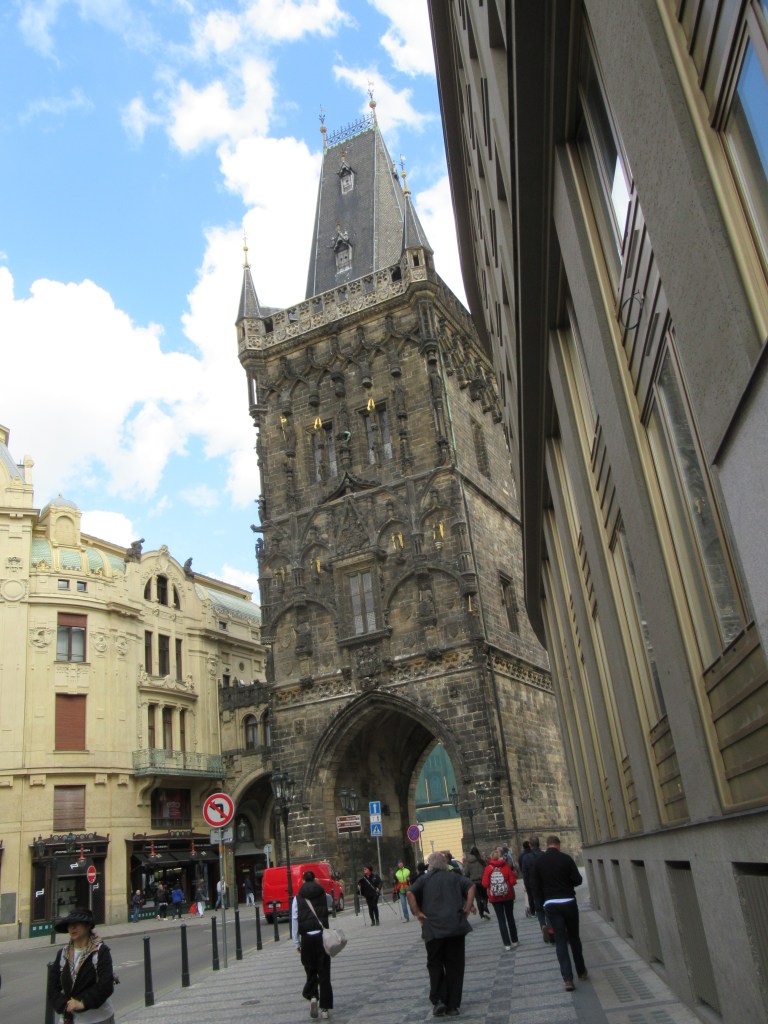
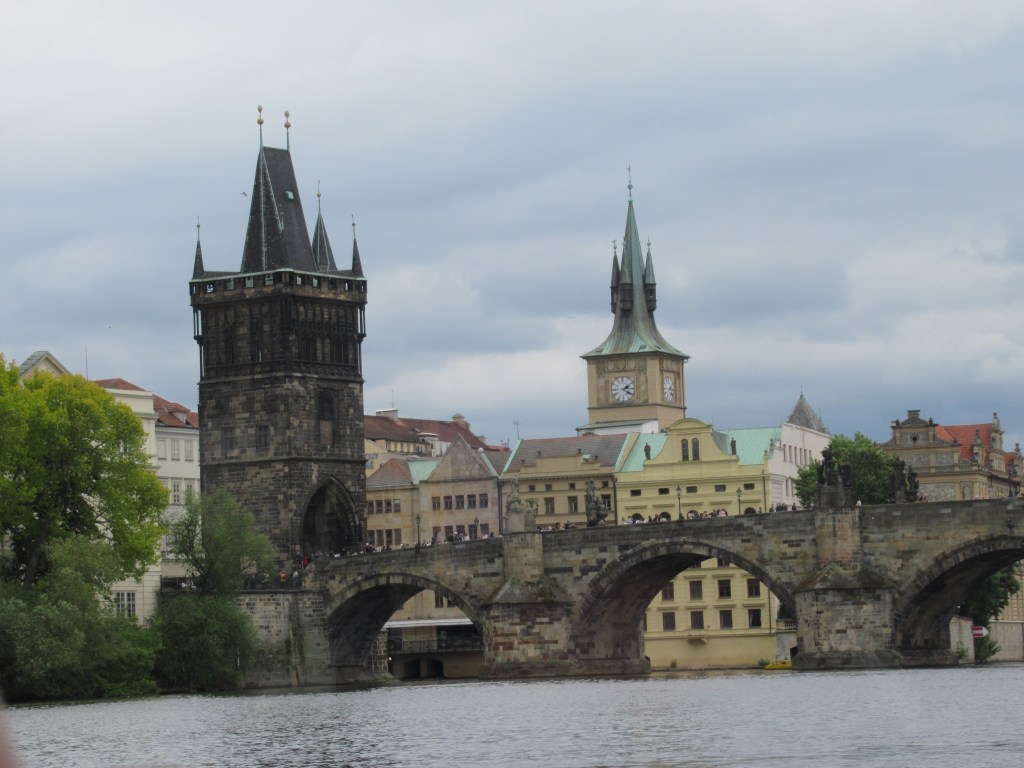
Old Town Bridge Tower is a magnificent Gothic tower from the 14th century at one end of the Charles Bridge. It served as a triumphal arch for the Royal Route and as part of the city’s fortifications. Partway up there is a room decorated with the coats of arms of lands of the Holy Roman Empire. The mysterious statue of an old man, possible a warden is found near the top of the climb up to the viewing platform.
Lesser Town Bridge
At the opposite end of Charles Bridge is the Lesser Town Bridge Towers. This is a set of two towers, joined by a gallery and battlements. The smaller tower (the Judith Tower) was built in Romanesque style in the 12th century, and remodeled for a Renaissance look in 1591. The taller tower is late Gothic. It originally built in 1464. Together the two towers served as part of the town fortifications until the whole town was encircled by bastion fortifications in the 17th century.
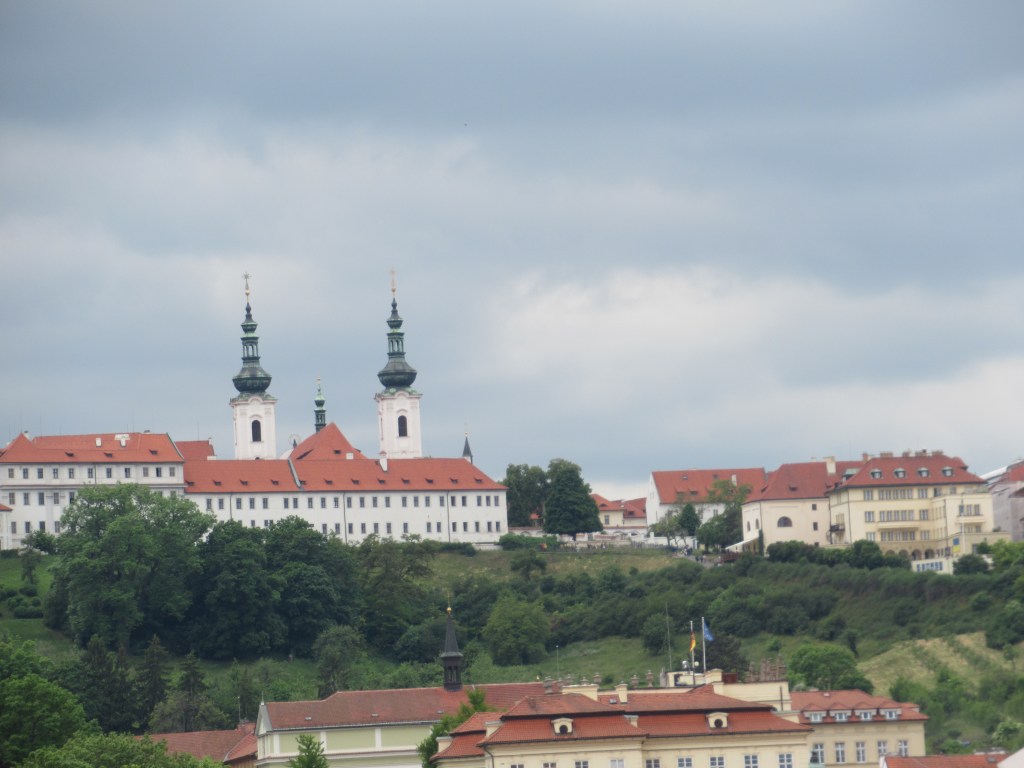
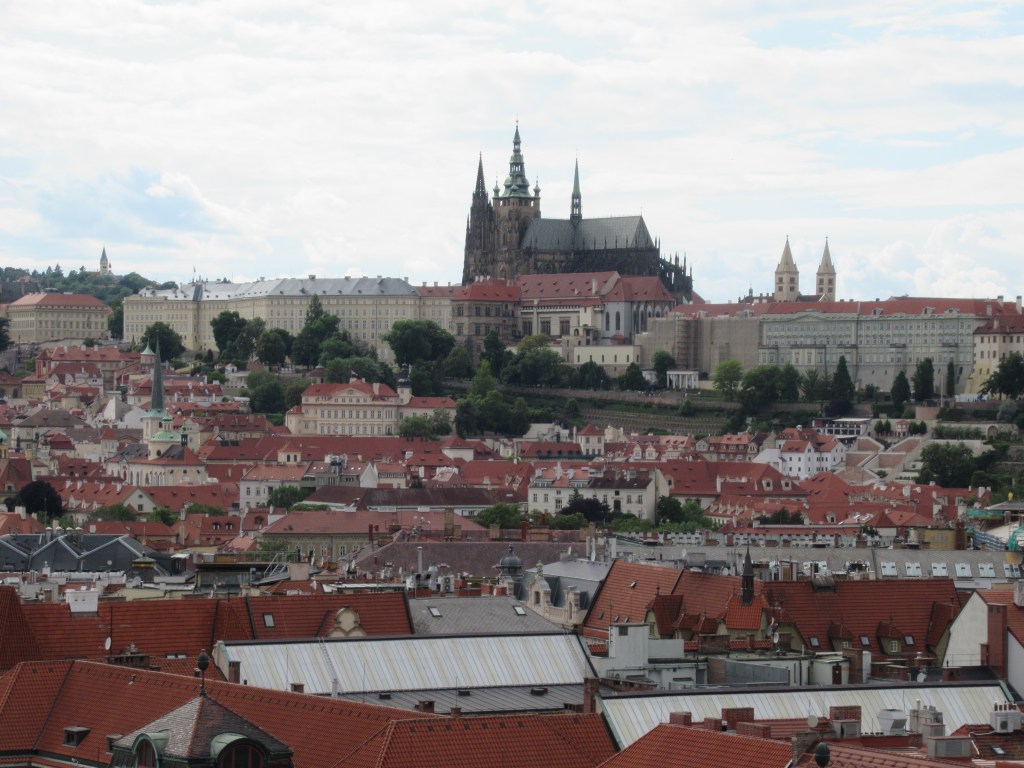
I didn’t climb these towers, but they are visible from almost any other tower in the city. On the left is Our Lady before Tyn, right on the Old Town Square. The church was built in the Gothic style from the 14th to the 16th century. The interior was remodeled in the Baroque style in the 17th century. On the right is St. Vitus Cathedral in the Prague Castle complex. It is the largest and most important religious building in Prague. It was built starting in 1344 in the Gothic style. The main tower is 337 feet tall.
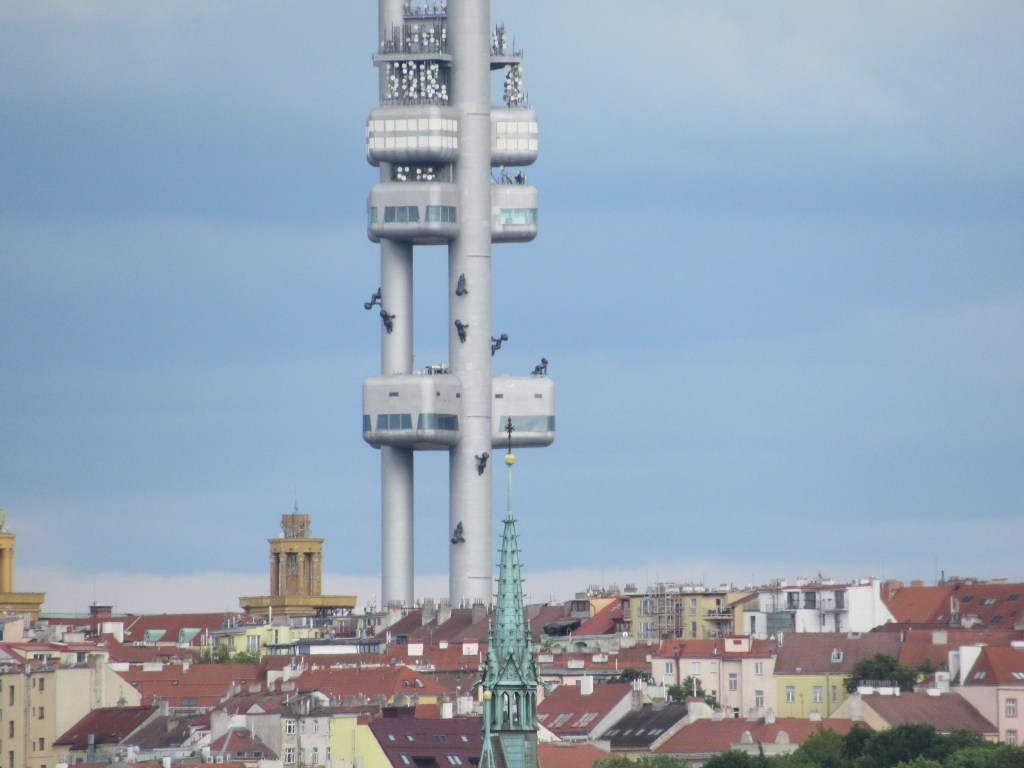
And finally, lest one think all the towers in Prague are centuries old, here is the Žižkov Television Tower, built between 1985 and 1992. At one time it was voted the ugliest building in Prague. In 2000, ten fiberglass babies by the sculptor, David Černý were added. These babies have a bar code instead of a face. The babies were replaced with identical, more permanent sculptures in 2017.
Obviously, these are just a few of the hundreds of spires and towers in Prague. Perhaps I’ll have a chance to go back someday and climb a few more. Afterall, didn’t Robert Browning say, “Ah, but a man’s reach should exceed his grasp, Or what’s a heaven for?”
Most, perhaps all, American high schools have required American history classes. In fact, when I was curriculum director for a small rural school, American history was taught in elementary, middle, and high school. In all those classes, the progression was the same. A nod to the pilgrims, time spent on the revolutionary war and the civil war, The world wars were covered, and often the Vietnam war was squeezed into the end. No matter the grade level, the high points were the same. In all this study of American wars, the War of 1812 was barely mentioned. We might hear about Dolly Madison and the burning of the white house, but little of the far-reaching consequences of this conflict.
And yet, in some ways the war of 1812 was one of the most consequential and darkest of wars, especially for the indigenous population, with brutal and horrific acts perpetrated on all sides.
This war was fought on many fronts, from the Eastern seaboard to New Orleans to the Great Lakes. In the area around Detroit, British, Indigenous, and United States forces struggled for the control of the Great Lakes, a crucial area for trade and commerce. In 1812, war was declared. In August, US General Hull surrendered Detroit and the Michigan territory to the British. Soldiers from the Native and British alliance occupied the River Riasion settlement, a small village established by land grants from the Potawatomi to the French.
Less than a year later, on Jan. 18 1813, US forces attacked the village and retook it in the first brutal battle of the River Raisin. Four days later, the alliance of British and Native troops defeated the Us forces, in what was the deadliest defeat of the War of 1812. Of the nearly 1000 US soldiers holding the town, only 33 escaped capture or death. Even after the battle, the killing went on, with Native warriors taking revenge on the wounded prisoners, killing scores and burning homes and crops.
Throughout the United States, people were horrified by this ‘massacre’. “Remember the Raisin” became a battle cry, and a political slogan fueling violence and outrage toward Native people and helping put William Henry Harrison in the White House.
But the defeat and slaughter of the American forces only tells half of the story, the winner’s half. The battle cry does not ask listeners to remember the first battle of the River Raisin, where American forces were equally inhumane and savage, firing on the wounded and committing other heinous war crimes. American history books call the first battle a ‘victory’ but it was just as much a massacre as the second, only a ‘massacre’ perpetrated by the winners of the war. The cry does not ask us to remember that the Native people were fighting against a vicious, inexorable invader. They were fighting for their homes, their lives.
The real tragedy of the Battle of the River Raisin is in the aftermath. In the years following, this fight was used as justification for the removal of Native peoples from their homeland. Native nations were forced to cede more and more land. Any hope for stopping US expansion disappeared.
In 2010, the River Raisin National Battlefield park was established. With the cooperation of many Tribes, nonprofit groups, and government organizations, the park works to tell the story, the full story of the Battle of the River Raisin, not just the ‘winners’ side.
So we should indeed Remember the Raisin, all of it, not as the heroic winners of a long ago battle, but as a warning against the inhumanity of war, and a reminder that the victors in any war are not always the ‘good guys.’
Almost 5000 years ago, before the pyramids were built in Egypt, before Stonehenge was erected on the Salisbury Plains, a group of farmers settled in a village on the coast of Orkney, not far from the crashing waves of the ocean. It might seem strange to establish their community on this wind swept, treeless island in the North Atlantic, but at the time Orkney was an important power center in Europe. There is ample evidence of extensive trade of goods and ideas between the nearby islands and the mainland of Scotland, England and the continent. Orkney Island was strategically located for trade back then. (And the island was equally important in World Wars I and II.)
Skara Brae is by far the best preserved Neolithic village in Northern Europe. It has been designated as a World Heritage Site. The exhibition hall, the replica house, and the site itself all help us understand what life was like for the people living here so long ago.
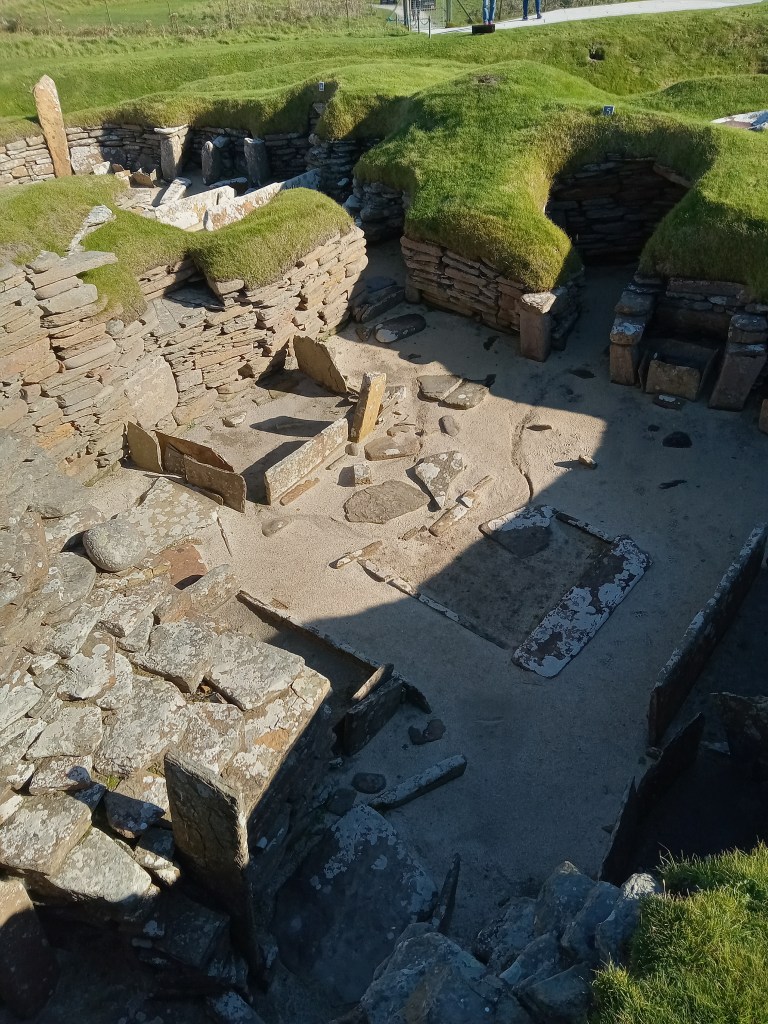
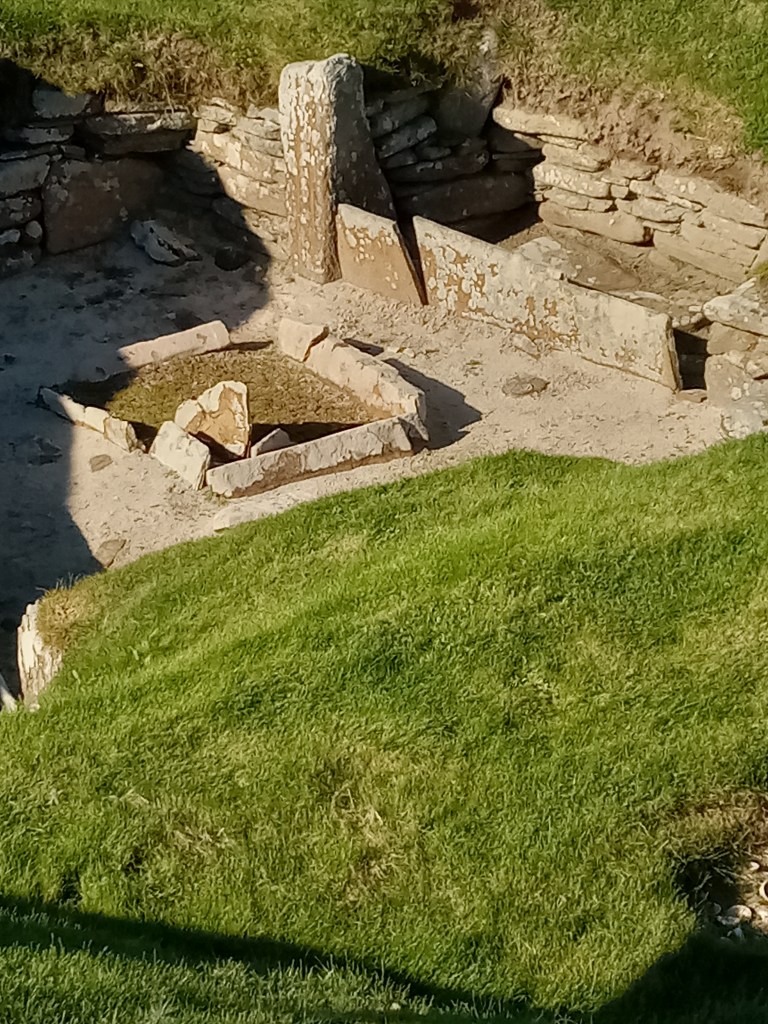
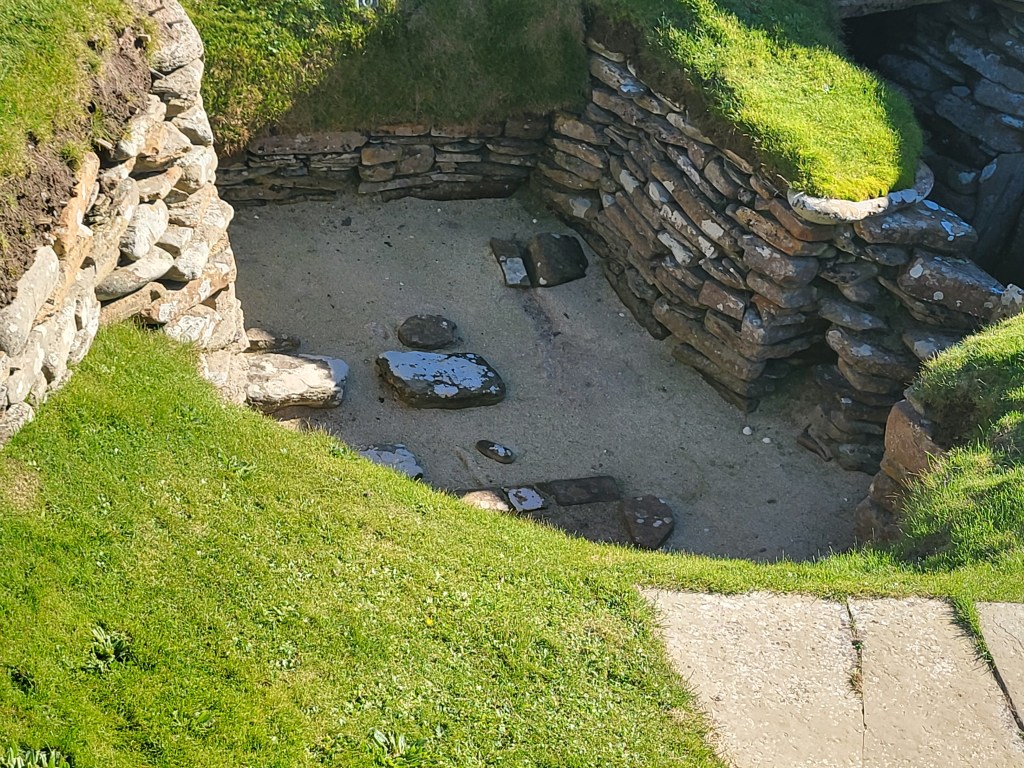
Much has been learned from studying this remarkable place, but much still remains unknown, and perhaps, unknowable. Though the roofs are long gone, we can see the layout of the stone furniture, the hearths and bed boxes, the latrines and live catch basins, all of which offer clues to life here. However, much of the ‘stuff’ that makes life comfortable is perishable–the food, the clothing, the bedding, …the list goes on. For a writer, Skara Brae provides an ideal setting to let the imagination soar.
Using facts gleaned from archeologists’ studies and reasonable guesses, here is one version of a day in the thriving village of Skara Brae. I imagine…
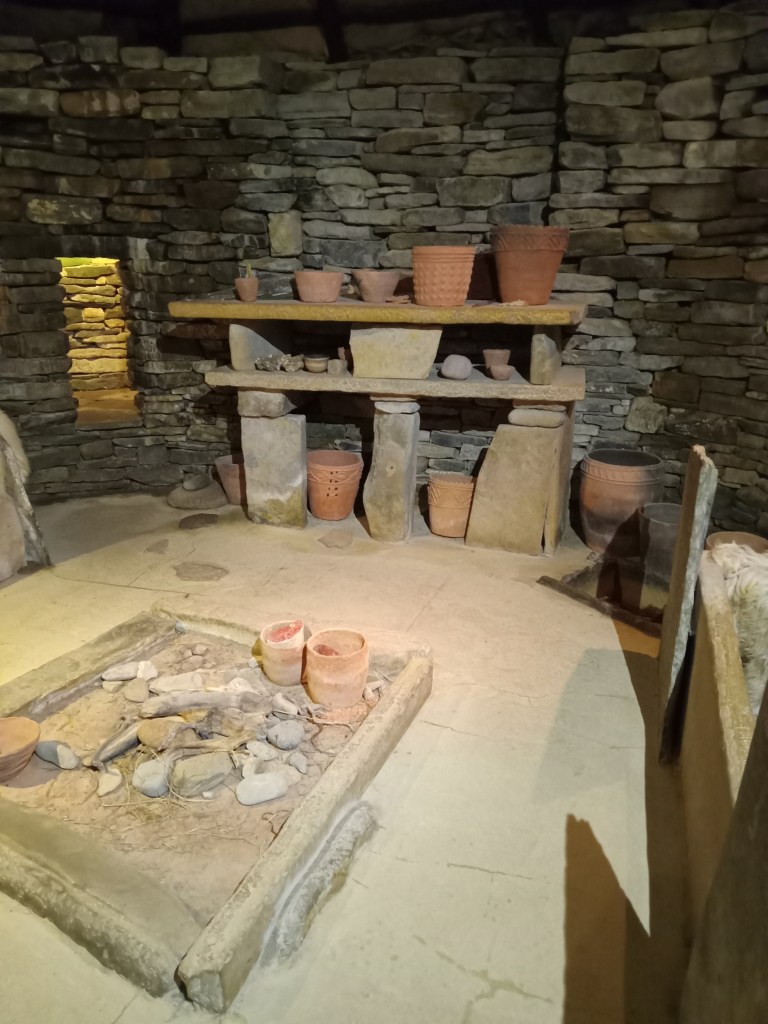
Bed box and hearth
A young mother, we’ll call her Lin, wakes early to nurse her baby. Sleepily, she crouches in the stone bed box alongside her two older children, her old father, her husband, and her sister. The stone floor of the bed is cushioned by bracken and skins, and Lin is comfortable surrounded by her family.
The room is dark and smoky.. There are no windows. The hearth fire has burned low overnight, but thick stone walls with piles of midden surrounding them keep out the chill wind and deaden the sound of the sea.
Shelf unit and door to latrine
Lin rises and settles the baby in her sister’s arms. After a quick visit to the corner latrine with its drain under the settlement, she builds up the hearth fire, burning dried seaweed and animal bones. As the rest of the family wakens and joins her by the hearth, she prepares a meal to break their fast. She heats stones in the fire and drops them in a pottery jar containing a pottage of grain and berries, along with some limpets the children gathered yesterday. Her oldest son cracks some hazel nuts to add to the meal. The mixture has fermented slightly, giving it a tangy, earthy taste. It’s fall so food is plentiful and the family will eat well today.
After eating the family scatters to their chores. Lin’s father-in-law is a master carver. He’ll spend the day in the workroom at the far end of the passage connecting the houses in this village. As he carves the walrus tusks into pins and cattle teeth into beads, he’ll teach the craft to the older children of the village. They expect to trade these carvings with visitors before winter closes them off for a time.
Lin’s husband goes outside to inspect the corbelled stone roofs of his and his neighbors’ houses to make sure the last storm did not cause any damage. He’s the best builder in this community, with knowledge and practice of fitting the stones together. Many of the men will fish today, but he and a few others have planned a hunt for red deer which roam the island.
One of the old grandmothers of the village takes the younger children to the beach. She’ll guide them in gathering limpets, and other shellfish. Carrying her baby in a deerskin sling, Lin goes with her friend to milk the sheep clustered in a pen not far from the village. They’ll use the milk to make cheese which can be smoked and saved for use all winter. Later she’ll join the other women of the village to harvest the crop of bere (an ancient type of barley) they have planted a little way from the village.
Days have been growing shorter as winter approaches. After working all day with their neighbors, the family gathers again in their one room house. Lin’s daughter has found a handful of white feathers from the sea birds on the beach. Lin carefully arranges them in a display on the stone shelf opposite the doorway. In the soft light of the fire, the family eats the evening meal enjoying the remains of the same pottage that they had in the morning and will add to again the next day. Lin takes the set of dice her father-in-law carved from the shelf, and they enjoy a lively game. The grownups laugh and joke with each other while the children fall asleep.
Finally Lin banks the hearth fire and they all settle into the bracken lined bed box, happy and cozy after their productive day.
Workroom
Skara Brae was inhabited for 300 or 400 years, and then the place was abandoned. We don’t know why people stopped living there, whether it was a sudden departure, or a gradual one. Perhaps a terrible storm brought too much sand or perhaps the younger generations gradually moved away, looking for a better place. What we do know is that after the village was abandoned, it was buried by the blowing sand and forgotten. Until centuries later, in 1850 another storm revealed part of the hidden village. So much that is unknown… so much for the visiter to imagine.
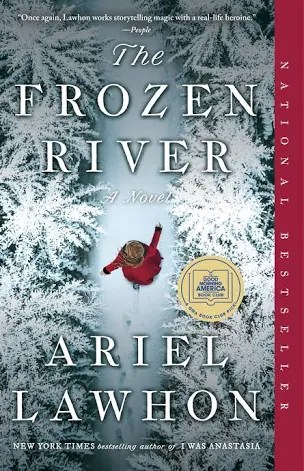
The Frozen River by Ariel Lawhon gets high marks on all aspects of what makes good historical fiction. The story is a fictionalized account of 6 months in the life of Martha Ballard, with forays into her past. The real Martha Ballard, a 18th century midwife who kept a daily journal, serves as a springboard for a cozy mystery set in Maine just after the American Revolution, a time when the United States was in its infancy. Using meticulous research, Lawhon skillfully weaves a compelling narrative. Martha is an accomplished midwife who has delivered hundreds of babies, and cared for the women before and after their children were born. She is a healer. When called to examine the body of a man caught in the ice at the beginning of winter, Martha works to find the truth of his death. Through the course of the novel, readers see her as a mother, a wife, a neighbor. In many ways she represents the ordinary woman, caring for family, keeping house, looking after her friends, all the things women of today do. The details of how such tasks are done, and what chores and pleasures fill our time have changed over time, but the goals of happiness, health, safety, and fulfillment are the same.
One of the strengths of this book is the way Lawhon explores what it meant to be a woman at a time when men’s and women’s rights were different, and a woman’s voice could be ignored in any court of law. Women were not allowed to testify without a husband or father present, and had little recourse against any attacker. Yet the women in this book, especially Martha, are not helpless. They have agency in their own lives, even within the strictures society puts on them. Martha makes her own decisions and acts as she sees fit.
Through Martha’s story, Lawhon addresses the theme of justice. What is justice? Is it simply revenge for a wrong? Punishment for the perpetrator so the victim feels better? An attempt to prevent further crimes? A dictionary definition looks at ideas of fairness, due process under the law, and impartiality. But in a legal system where more than half the population (women, people of color, etc) have different rights, how can any kind of fairness be achieved?
Even though in the 21st century we come closer to equal rights than Martha’s world did, these questions remain and inequities remain. Martha’s efforts to bring about justice can help readers today think about these same questions. To be civilized means to live under a system of law. But when the law does not protect the innocent and allows the guilty to freely commit more crimes, how can justice be achieved?
That’s a question just as relevant today as it was 200 years ago.
Imagine a scribe 4000 years ago, perhaps someone much like myself, interested in what foods go together and how they might taste. This person, who must have really existed, had a clay tablet and a stylus to write down the most important combinations, leaving for posterity a record of what was eaten in Ancient Mesopotamia.
My interest in this food tradition started when my six year old granddaughter was reading about ancient civilizations in her first grade class. Mesopotamia really caught her interest. She wanted to know how they lived and what they ate. So my son decided to make a Mesopotamian meal. Since he is an archeologist he did some research to find out what foods were available. That’s when I learned of several clay tablets written in cuneiform nearly 4000 years ago, around 1750 BC. That is around the time of the Old Babylonian empire and the reign of Hammurabi. The tablets are now part of the Yale Babylonian Collections. Translations reveal they are the earliest known ‘cookbooks’, listing ingredients and offering some directions for preparation. Ancient cookbooks? Of course I’m intrigued.
Very few people in Ancient Babylon could read or write, so these tablets must have been for the scrubs and the royalty. There are recipes for stews and breads and grain products, but what intrigued me the most was the reference to a special cook who prepared pastries (mersu) for the king– a professional pastry chef, if you will. Something very like mersu is still consumed in the Middle East. In Turkish, it’s called cevizli.
The ancient tablets don’t tell quantities or methods for mersu. I’ve only seen the recipes in modernized form. One variety is very simple with only two ingredients: dates and pistachios.
Dates have been cultivated in this region for millenia–at least as long ago as 3000 BC. Pistachios, originating in what is now Syria, are even older, with evidence of their consumption from 9000 BC. So while I’m not sure this is exactly what is meant by mersu in the ancient cookbooks, I am confident the ingredients were available, and the ancient Mesoptamians used them together.
Recipe:
¾ c. dates
1/2 c. pistachios
Mash the dates. Chop and mash the pistachios separately. Mix the date mash with half of the pistachios. Make into small balls, (Wet your fingers to make them easier to roll) Roll the balls in the remaining pistachios.
Back when my kids were little, we often made peanut butter balls, in much the same way: using a mixture of nuts, honey, and wheat germ. I can imagine a royal Mesopotamian mother offering her child a snack of mersu, and popping one in her own mouth at the same time. Plus ça change…
Historic food – A Mesopotamian sweet from 1750 BC. despite the snow. January 17, 2019. Retrieved Dec. 21, 2024. https://despitethesnow.wordpress.com/2019/01/17/a-mesopotamian-sweet-from-1750bc/
Oats and Beans* and Barley Grow
Oats and Beans* and Barley Grow
But you nor I nor anyone know
How Oats and Beans and Barley Grow
(Children’s rhyme and circle game first mentioned in Joshua Cushing’s The Fifer’s Companion (1790)
*In some versions peas or wheat is substituted for beans.
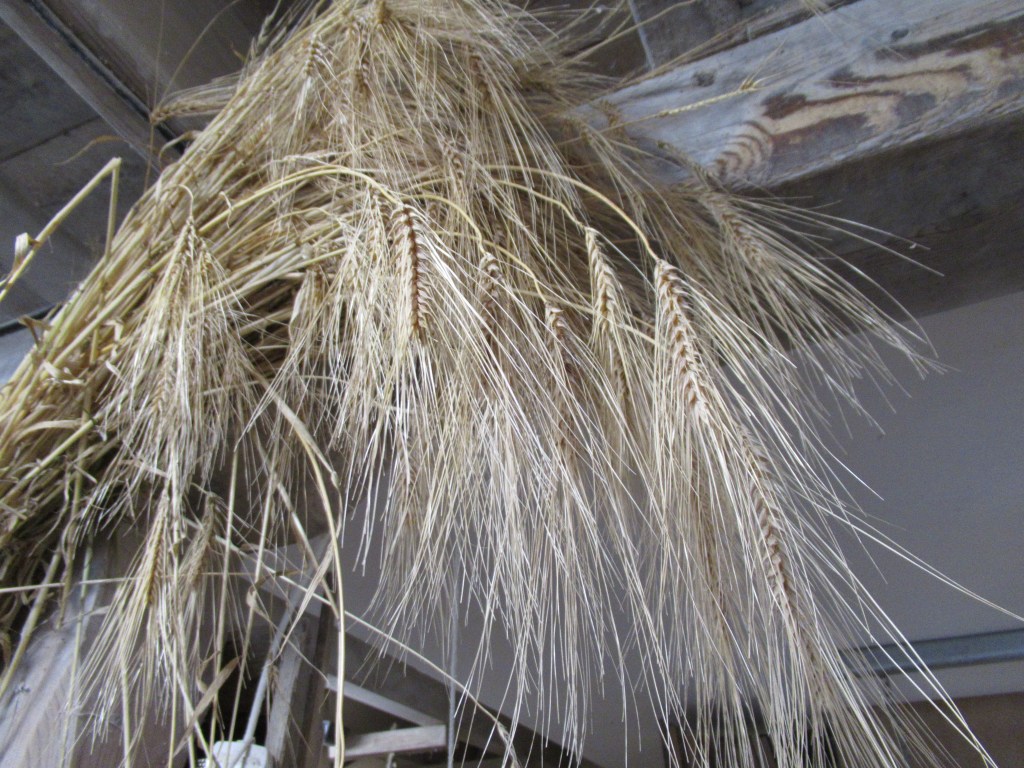
We don’t hear a lot about barley these days, but it is, in fact, one of the oldest grains, first cultivated around 9000 BC in the Fertile Crescent. From there, barley diverged and spread through Asia, Europe and Africa with different varieties thriving in different places. I came across one such variety on a recent visit to Orkney.
Bere (pronounced close to bear or bare) is a six row barley variety that has been grown in the Orkney Islands of Scotland, for around 5000 years. It is a fast growing barley, sometimes called 90 day barely, well suited to the long summer days and longer winters in Northern climates. Besides growing well in the Orkneys, bere is very nutritious, having more protein than modern two row barleys.
Reconstructed neolithic house in Skara Brae
Early neolithic sites in Orkney include evidence of bere cultivation and processing. Centuries later, Pictish farmers grew bere. When the Nore came, the discovered bere was very similar to their barely variety which they called bygg.
A conversation with my son, an archeologist, leads me to hypothesize that the neolithic farmers did not bake bread or bannocks with bere, but made a grain porridge, either boiling bere meal and water in a clay pot on the hearth fire, or adding hot stones to the water and meal in the clay pot. It is likely they added other things to this porridge also, probably berries, seaweed, small rodents, fish, or anything else they planned to cook and eat. My son also reminded me that a pot of grain porridge left unrefrigerated ferments. These fermented porridges were mildly alcoholic and led to some of the first beers produced. I find it interesting to note that beer, potion, and poison probably all come from the same proto-indoEuropean root *po(i) to drink.
Neolithic people used a saddle quern to grind the grain. The grinder, probably a woman, would kneel, and rub a stone back and forth over the grain in the bowl of a larger stone. The oldest saddle quern found in the Orkeneys was dated to 3,600 BC and found at Knap of Howar on Papa Westray.
By the iron age, the saddle quern was replaced by a pair of flat mills stones, in which the upper one rotates. And then by the viking era, some mills were converted or built to use water power .
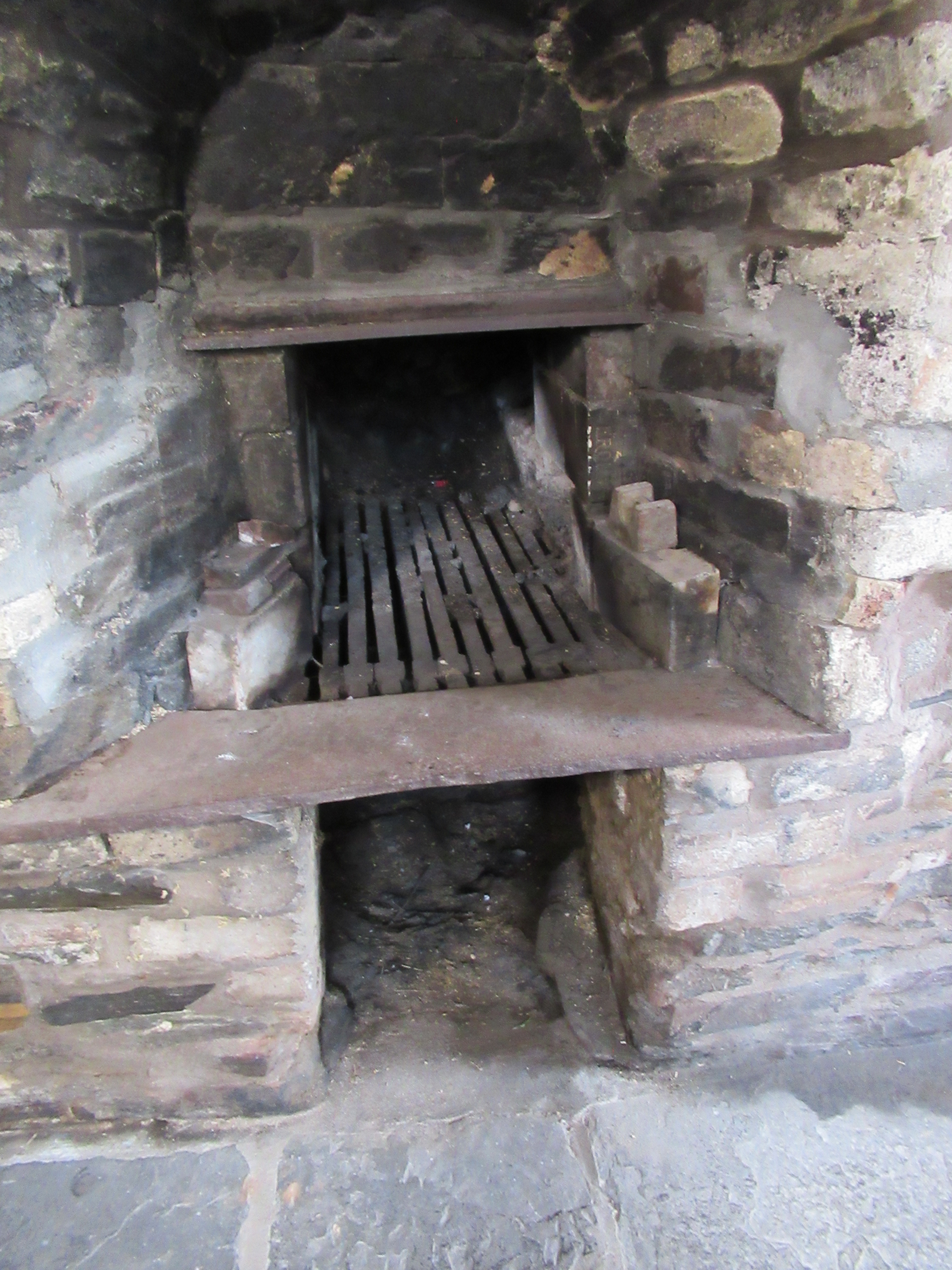
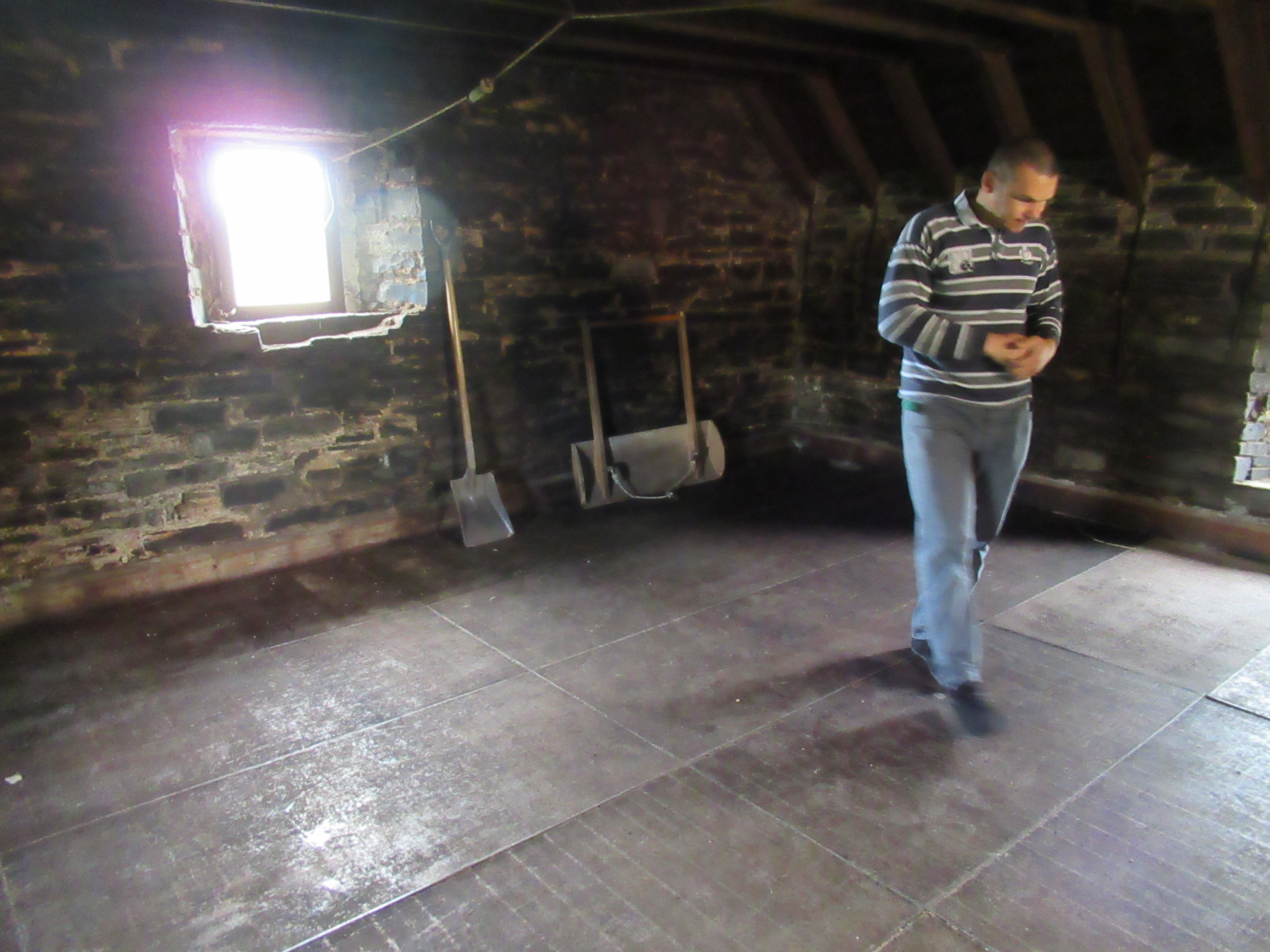
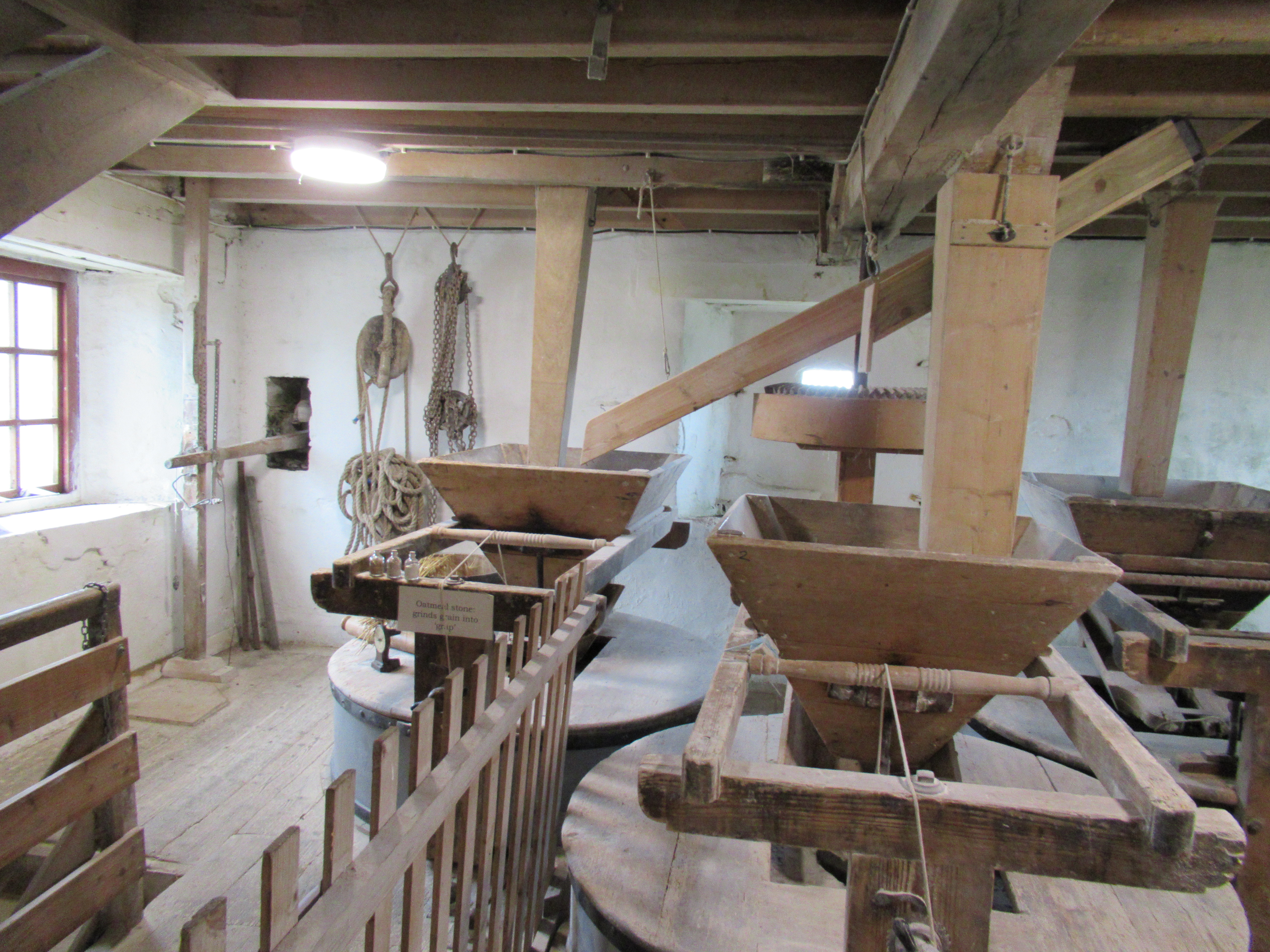
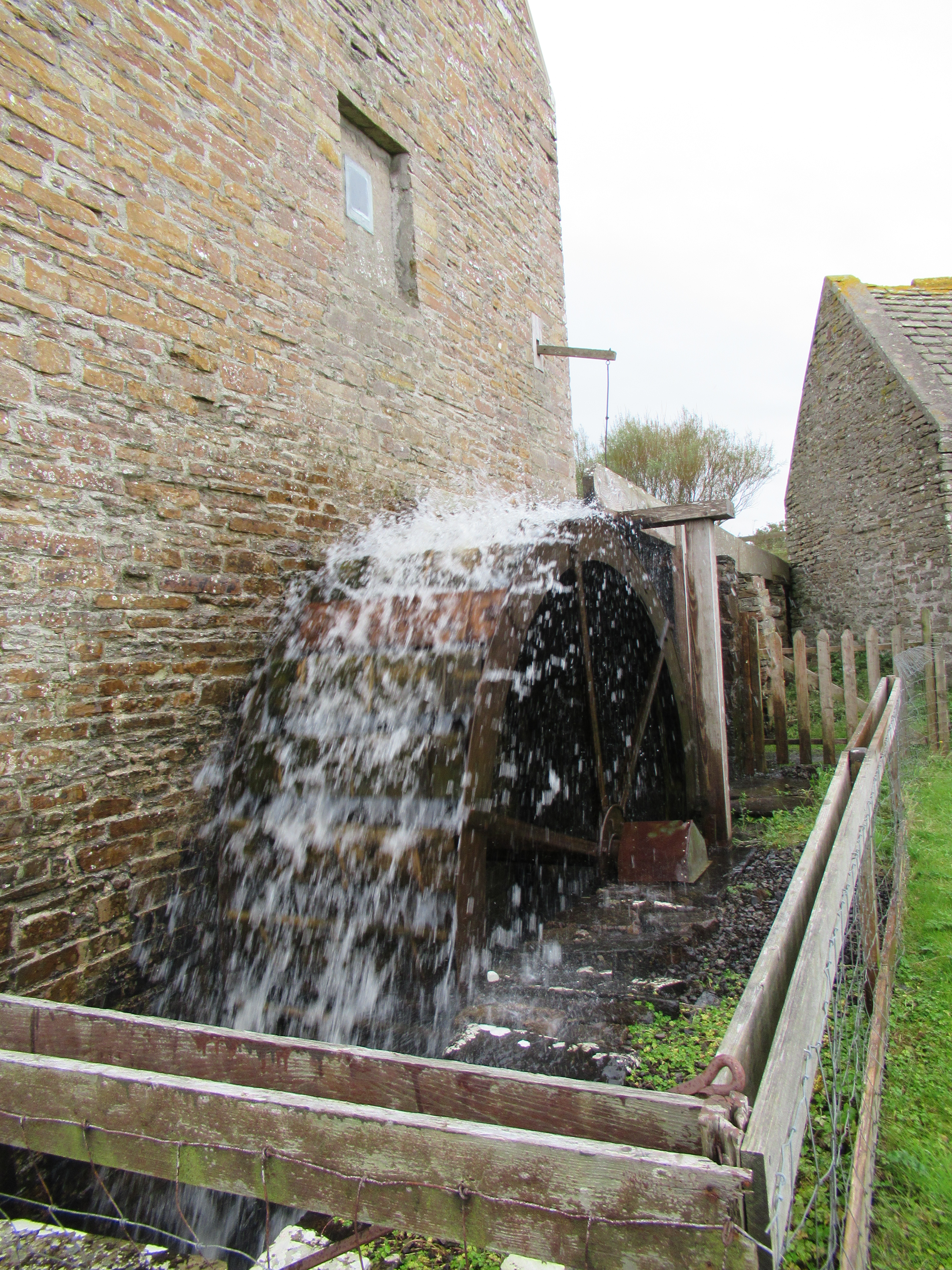
Nowadays, the Barony Mill, run by the Scottish Heritage Trust in Birsay, Orkney is the only mill still processing bere. The mill here has been in operation for over 300 years using an overshot waterwheel. I learned it takes two and a half days to process a load of bere. It must be dried, then ground through 3 wheels to remove the husk, crush the grain, and finally grind it into flour.
Views of Barony Mill: Drying oven, drying floor, grinding wheels, water wheel
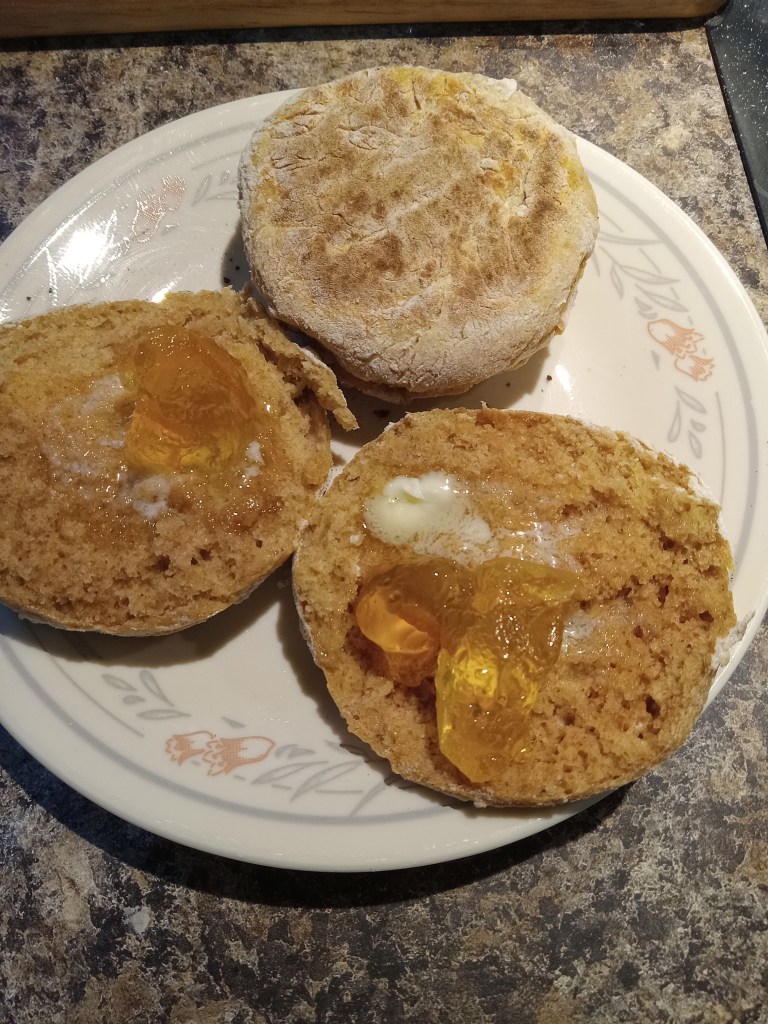
Of course, I had to buy some bere flour, and bring it home to try out. So far I’ve made an apple cake and several types of bannocks. Bannocks, originally unleavened, flat cakes of barley or oat baked like pancakes on a flat stone, that had been heated in the fire.(later a griddle was used)
Early 1800’s unleavened bannocks:
300 ml (½ pt.) milk
25 gr. (1 scant oz) butter
230 gr. 8 oz. bere meal
1/4t. Salt.
Heat the milk and butter, add salt and meal to make a soft dough. Knead lightly, roll out about ¼” thick. Fry in a lightly oiled pan or griddle. Flip to finish. Makes 2 small bannocks
After baking soda and cream of tartar came into common use in the middle of the19th century, bannocks, along with all other quick breads, underwent a major revolution. Bere Bannocks made today are light and airy like a scone. There are several recipes available for bere bannocks, One of the best sources is Barony Mills: https://baronymill.com/orkney-bere-bannocks/
Unfortunately, as far as I know, bere meal is unavailable in the United States as it is only sold in the UK. Perhaps that’s one more good reason for a trip to Scotland.
Sources: Ashworth, Liz. Book of Bere. Berlin LTD, Edinburgh, 2017.
Anyone living in Southwest Wisconsin or Southeast Minnesota is likely to have heard of The House on the Rock. The place was even featured in Neil Gaimon’s American Gods. Not exactly museum, not quite an art gallery, this one-pf-a-kind house is an architectural wonder, full of …things. All kinds of things. Ships models and doll houses, Automated musical instruments, clocks and gears. Crown jewels and weapons of all types. The largest carousel in the world.
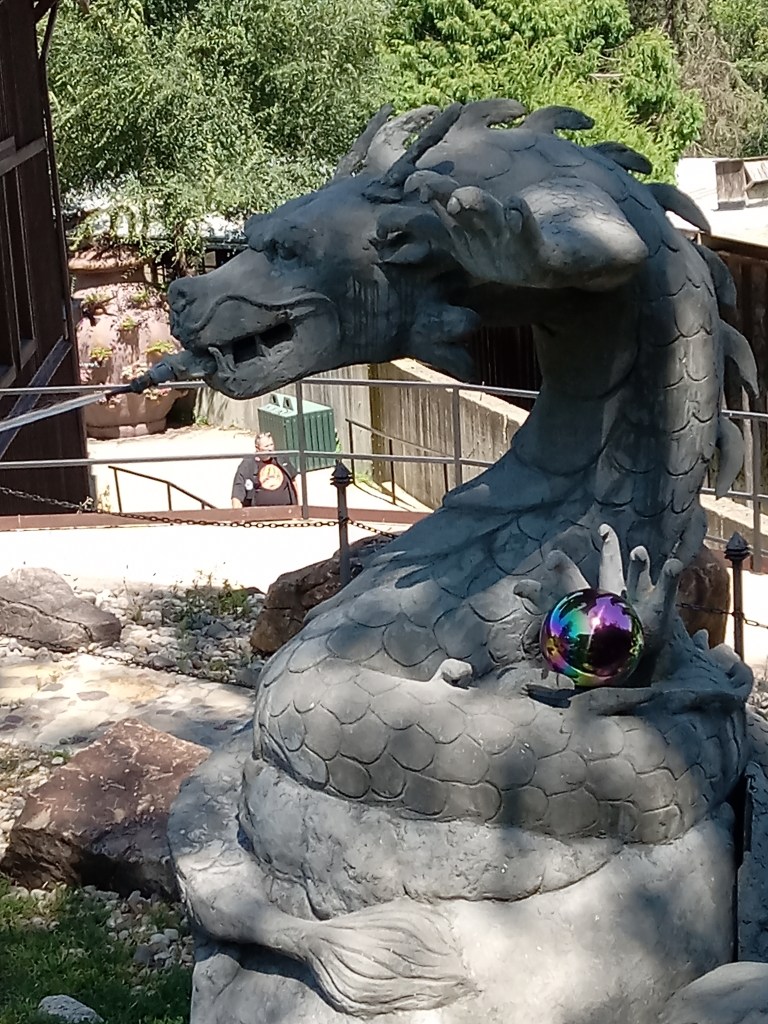
And dragons.
The house is built on a chimney of rock in rural Wisconsin. It features incredible views from cozy rooms using the natural rock to guide the size and shape of the structure. Alex Jordan, creative architect and collector extraordinaire began building it in 1945. It was opened to the public in 1960 and has attracted millions of visitors since then. Until his death in 1989, Alex kept adding onto the complex. The items within are a unique, and often unlabeled, collection of antiques and reproductions, a curious mix illustrating the wide-ranging interests of the creator.
To me , the most surprising feature is the vast number of dragons within the complex. Not a separate ‘dragon’ section, but the ubiquitous inclusion of dragons and dragon themed objects.
Though I suppose I really shouldn’t be surprised. After all, if a dragon were to find itself in Southwest Wisconsin, what better place to perch and build a nest than the quirky house on a rock, overlooking the vast fields and woods of the surrounding valleys?
The Blossom and the Firefly tells the story of two Japanese teenagers who meet in the waning days of World War II and fall in love despite the forces meant to keep them apart. Taro, seventeen, is a kamikaze pilot. He is ready to die to protect his country from the threat of the Americans. Hana, fifteen, is one of the Nadeshiko girls, whose job it is to wave goodbye to the pilots meant to fly to their deaths. “Nadeshiko’ refers to the delicate pink flower that symbolizes the perfect Japanese woman. But Hana feels far from perfect. She questions the demands her country makes for blind loyalty and sacrifice, but she worries even more about her own inadequacy to be so strong.
There are many books written about World War II, and many of these focus on the tragedy of war. The Blossom and the Firefly stands out because it is told from the point of view of the loser. Smith deftly invites readers to consider these young people as just as idealistic in their own ways as the young men fighting for the Allied powers. Both Taro and Hana believe in the wisdom of their leaders and try hard to have the moral fortitude to save their homeland, no matter what they must give up to do so. They believe they are on the side of good. But as the tides of war drive Japan to more and more drastic responses, Taro and Hana are forced to give up their own dreams in order to serve their country. Every hope either of them had for their own future must be put aside.
And then the unthinkable happens. Japan surrenders. Their choices are stripped away, and their world is shattered, turned upside down. Everything they held as true must be re-examined in the face of such loss. The end of World War II was not a celebration for Japan.
And yet, the war was crippling Japan’s people as well as their enemies. I once talked with a woman who survived the bombing of Hiroshima when she was seven. When she was asked if she hated the Americans for what they had done, she replied, “After the bomb, we had food.”
I’m not naive enough to think her answer is the complete truth. At the very least, she must have felt great sorrow over the loss of her home and the death of her sister. But she chose not to focus on blame. Hana and Taro, along with all the people of Japan, had to learn a new set of guidelines for life.
In fact, one reason why this book is so memorable is because Smith shows Japan’s decline and then the aftermath of the war. She shows how the losing country had to dig deeper and deeper for the resources needed to keep on fighting. She lets readers see Taro and Hana’s lasting pain after losing everything they ever thought was right, of losing their ideals, their faith in the moral strength of their cause. Beyond that, Smith shows the courage it takes to go on living after such a deep and lasting loss.
Smith’s prose is so lyrical, it might be called poetry. Her writing draws us in, creating a deep intimacy with the characters. Smith invites readers to care about Hana and Taro, to feel their pain, experience their emotions, and believe in their struggles. Smith challenges readers to recognize that even those we call ‘enemy’ have strong feelings and high ideals. They are equally brave and heroic as our own heroes. They struggle to protect their families. More than anything else, Smith never lets readers forget that the people on all sides of a war are human.
That’s something worth remembering in the world today.
You know how some words just mean what they sound like they should mean? I’m not talking about onomatopoeia, where the word imitates a sound. I’m talking about a certain mouthfeel where the sound and the meaning align perfectly. Maybe its just me, but I think steeple sounds pointy and blubber sounds bouncy.
Flummery is such a word. I think it sounds delicious, like a fluffy, sweet treat. But the problem with my whole theory is that such sound and meaning correlations are entirely subjective.
I discovered this with flummery. When I first proposed making it, my friend, without knowing anything about what it is, was decidedly uninterested. She thought it sounded horrible.
So I conducted a very informal survey, asking a little over a dozen people what they thought flummery means.
Answers varied from scam artist and buffoon to a fluffy dessert and a dish with barberries to everything in between. Turns out, most of them were at least partly right. Flummery is one of those words that has acquired a great many diverse meanings. Etymonline says flummerymeant a sour oatmeal jelly (from the Weslh ‘llymru’) in the 1600’s, then a sweet dessert in the 1700’s and flattery or empty talk, also in the 1700’s. Dictionary.com gives several meanings including boiled oatmeal, fruit custard, or foolish humbug.
There are as many variations in flummery recipes as there are in flummery definitions. The main thing all the flummery recipes have in common is that the dish is usually some sort of custardy gelatin, with more emphasis on either the custard or the gelatin, depending on the recipe. Even boiled oats have a custardy, gelatinous or even gooey texture. Flummery may or may not include any of the following ingredients: oatmeal, harsthorn, cream, almonds, jelly, calves feet, isinglass, eggs (yolks and/ or whites), wine, rose water, orange flower water, or sugar.
The first flummery I made was a sort of overnight (or over three days) oatmeal, using a recipe from John Towhnshend (p. 202). It involved soaking oatmeal in water for three days, straining off and replacing the water every day. After this soaking, the oatmeal is boiled until thick, put in molds, and served cold with wine and sugar. (The recipe also suggests beer and sugar or milk.) Even though I never would have associated oatmeal with wine, this dish was surprisingly good. Not great, but good enough to enjoy.
Another simple recipe for flummery is in Mary Randolph’s The Virginia Housewife Or, Methodical Cook (p.119) This is more pudding than jelly, and involves mixing equal measures of cream and jelly with half a measure of wine. This produces a very soft custardy dish that is very rich. I think it is best used as a sauce.
Since I didn’t have hartshorn or calves feet, I decided to try one of the isinglass recipes, such as French Flummery.
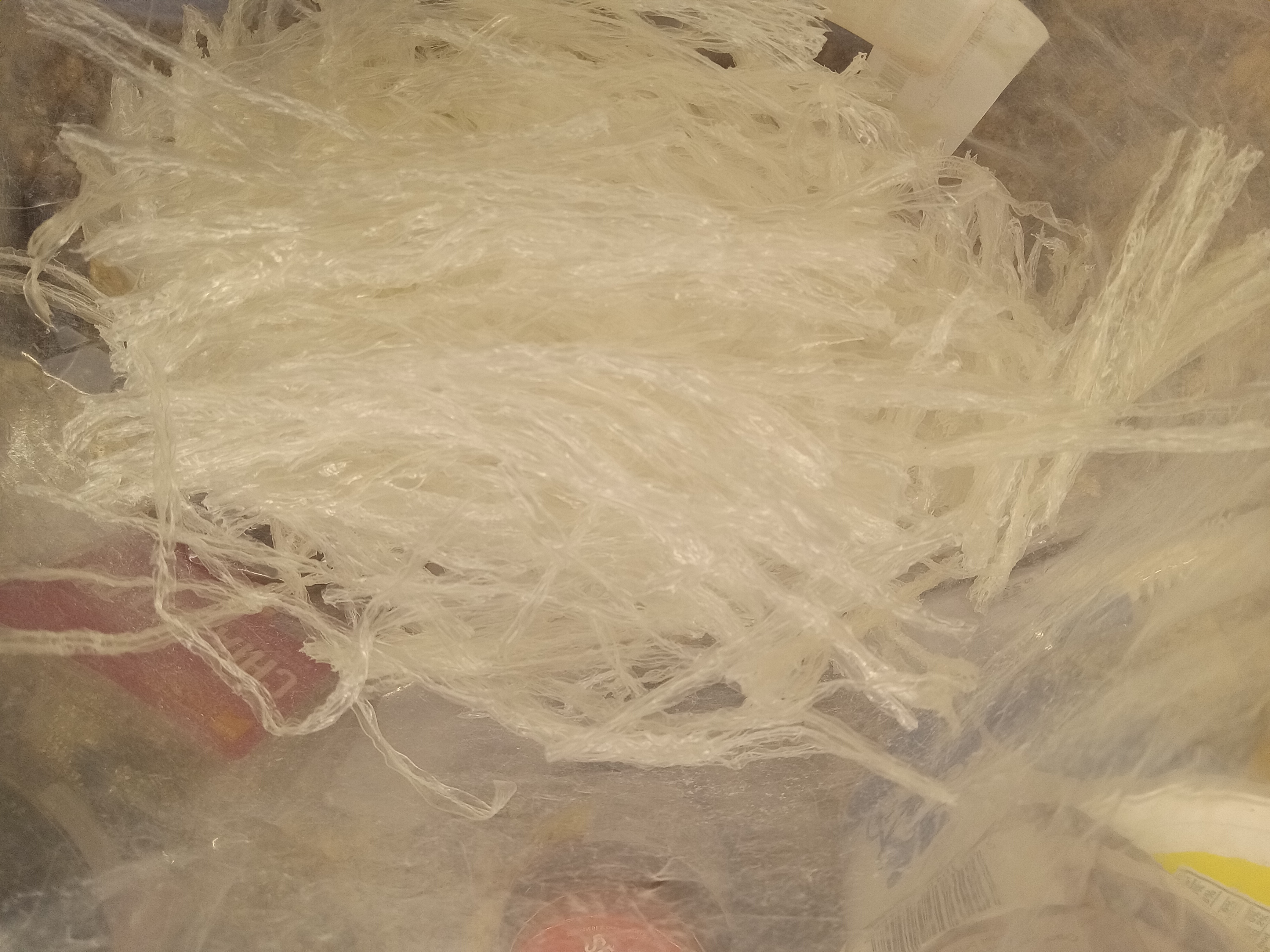
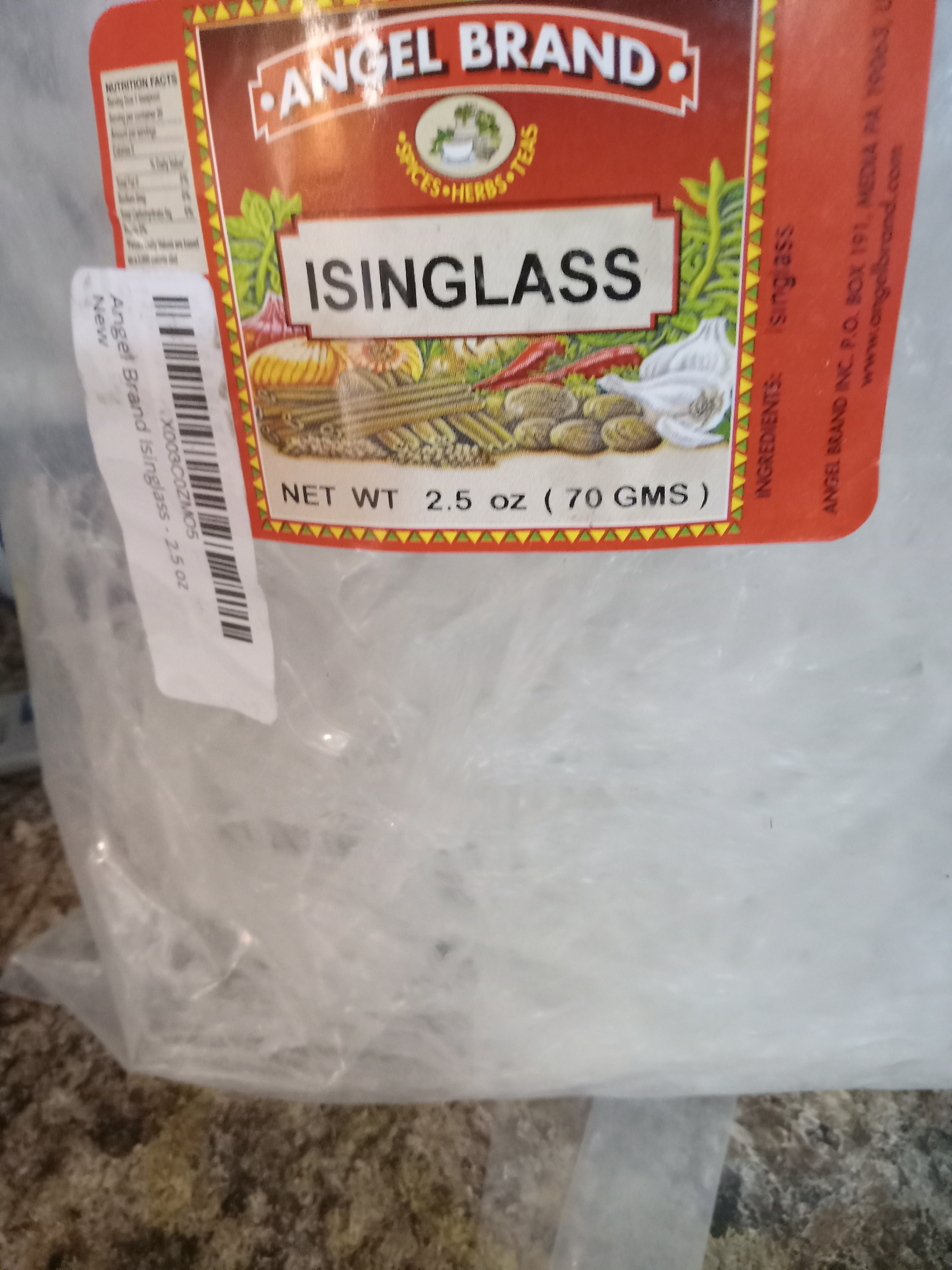
Identical recipes for French flummery appear in both John Townshend’s and Hannah Glasse’s books. (Many cookbooks following Glasse copied her recipes, often word for word, as does Townshend’s recipe) French Flummery is made with isinglass. I had no idea what that was. A little research taught me that isinglass is the dried swim bladders of fish, especially sturgeon. It has been used for centuries in making jellies (and coincidentally, glue). Today isinglass is available from the Amazon marketplace.
To Make French Flummery
Take a pint of cream and half an ounce of isinglass, beat it fine, and stir it into the cream. Let it boil softly over a slow fire a quarter of an hour, stirring all the time; then take it off, sweeten it to your palate and put in a spoonful of rosewater, and a spoonful orange-flower water; strain it and pour it into a glass or basin, or what you please, and when it is cold, turn it out. It makes a fine side dish. You may eat it with cream, wine, or what you please. Lay round it baked pears. It both looks very pretty, and eats fine. (Glasse, 186, Townshend,203)
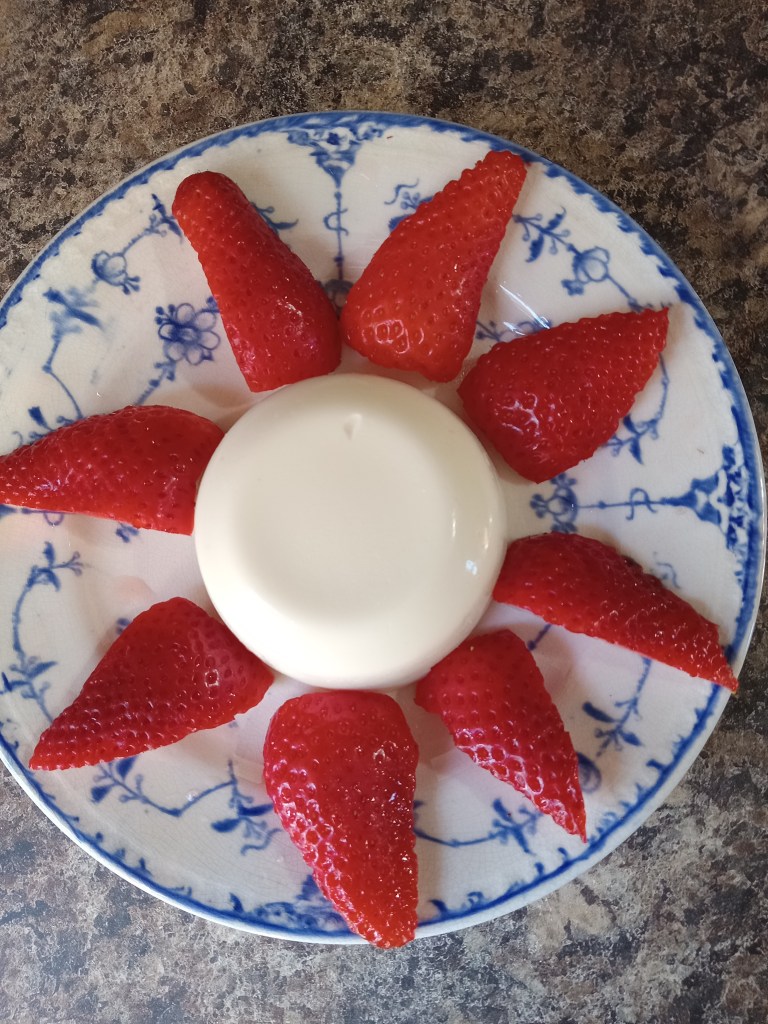
I used 2 cups of cream, ¼ cup of sugar, 1 teaspoon each of rosewater and orange flower water, and ¼ ounce of isinglass. The first step was to powder the isinglass. It comes in 3 -4 inch long translucent ribbons. They are slightly rubbery, which meant that trying to powder them in a mortar was an exercise in frustration. I resorted to using a blender. My ¼ ounce of isinglass made 2 Tablespoons in powdered form. I cooked the cream and isinglass mixture long enough that the powdered isinglass had been absorbed. (about twenty minutes.) Then I added the sugar and waters, and cooked it until the sugar was melted. I put the mixture in custard cups and cooled them. As it cooled, the pudding separated into two layers, making an interesting appearance.
I made this in spring, when strawberries were in their prime, so I used them instead of baked pears. I expect Hannah would approve.
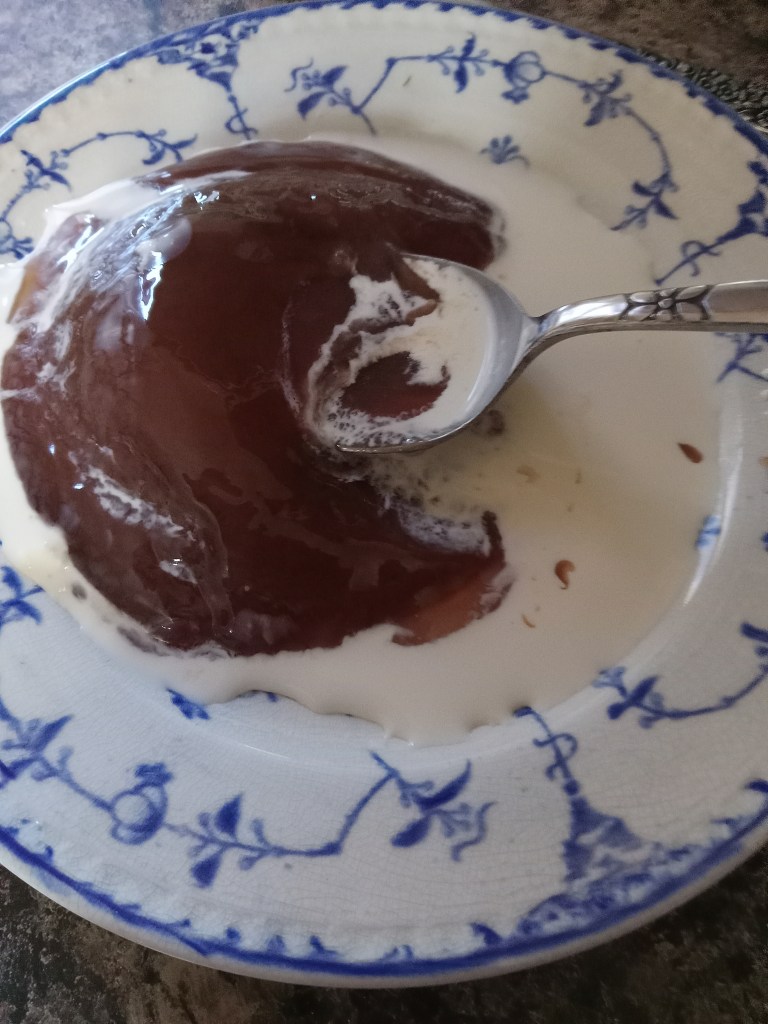
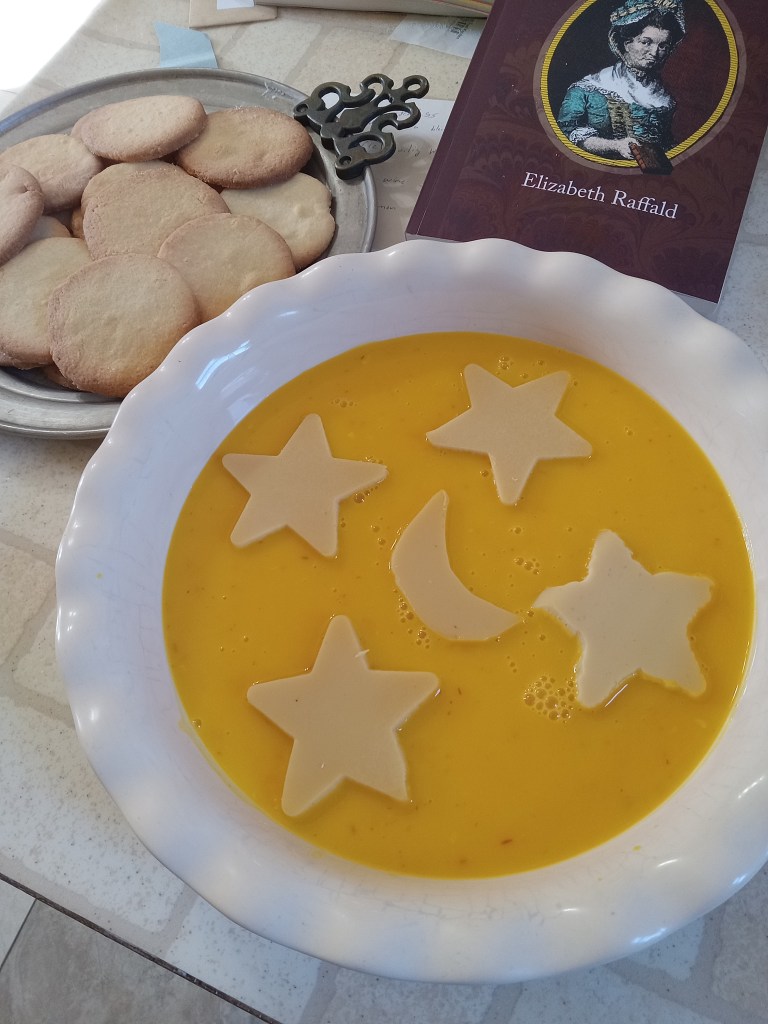
Flummery in many forms graced some fancier tables. Elizabeth Raffald, an English housekeeper who worked in Lady Warburton’s home for many years, gives several recipes for coloring flummery so that it could be used in many decorative dishes. In addition to the Moonshine described below, she has recipes for Eggs and Bacon Flummery, Solomon’s Temple in flummery, and Cribbage Cards in Flummery, among others. In medieval times, this use of food to create an edible centerpiece was called a subtlety.
I decided to make the Moonshine, as the name conjures up a more potent drink rather than a sweet dessert.
Moonshine Note Hannah Glasse has a moonshine recipe that is similar to, but not the same as, the one I made.
To Make Moonshine
Take the shapes of a Half-moon, and five or seven stars, wet them and fill them with Flummery, let them stand ‘till they are cold, then turn them into deep China Dish, and pour Lemon cream round them, made thus: Take a pint of Spring Water, put to it the juice of three Lemons and the yellow Rind of one Lemon, the Whites of five Eggs, well beaten, and four Ounces of Loaf Sugar, then set it over a slow Fire and stir it one Way till it looks White and thick; If you let it boil it will curdle, then strain it through a Hair Sieve, and let it stand ‘till it is cold, beat the Yolks of five Eggs, mix them with your Whites, set them over the Fire, and keep stirring it ‘till it is almost ready to boil, then pour it into a Bason; when it is cold pour it among your Moon and Stars: Garnish with Flowers.
It is a proper Dish for a second Course, either for Dinner or Supper. (p. 178)
For the Flummery, I used Raffald’s recipe for Yellow Flummery.
Take two Ounces of Isinglass, beat it and open it, put it into a Bowl, and pour a pint of boiling water upon it, cover it up ‘till almost cold, than add a Pint of White Wine, the Juice of two Lemons with the Rind of one, the Yoiks of eight eggs beat well, sweeten it to your Taste, put it in a Tossing Pot and keep stirring it, when it boils strain it thro’ a fine Sieve, when almost cold put it into Cups or Moulds. )p. 172)
Both of these recipes use a lot of eggs, so I cut them down.
First I made the Flummery:
1 ounce isinglass (powdered in a blender)
1 cup boiling water
1 cup white wine (choose a sweet rather than dry white)
Juice of 1 lemon and the yellow rind of half of it
4 egg yolks
½ c. brown sugar
Pour boiling water on the isinglass, and stir until the isinglass dissolves. Add the remaining ingredients and bring it slowly to a soft boil. (Don’t let it boil hard.) Strain it through a fine strainer. Pour it into a flat dish, either 8 by 8 or 9 x 13”. Let it cool, then cut it into the shapes of stars and moons. ) Cookie cutters or a drinking glass works well.
While it is cooling, make the lemon cream.
2 cups water
½ cup lemon juice
2 Tablespoons grated lemon peel
2 eggs, separated
1 cup sugar
½ teaspoon saffron (optional)
Mix the water, lemon juice, lemon peel, sugar and egg whites in a saucepan. Cook slowly, stirring constantly until thick. Do not let it boil. Mix a little of the hot mixture into the egg yolks, (to prevent curdling) then add the egg yolks to the saucepan. Cook, stirring constantly, until it is almost ready to boil. Note: in order to make a greater contrast between the flummery moon and stars and the lemon cream, I added a half teaspoon of saffron to the lemon cream along with the egg yolks. Saffron was not included int the original recipe, but it was known and used as a coloring agent in Raffald’s time, so I feel she would approve..
Put your flummery cut-outs in a flat dish or pie plate, and pour the lemon cream around them. Let cool and serve.
This was the tastiest of the flummery dishes, but the flummery shapes were quite rubbery. I think the same recipe with less isinglass would work as well, or better.
In spite of its versatility, I don’t see a resurgence of flummery is likely. All of the flummery dishes I made tasted interesting, and some were even pretty good. However, we have easier methods of making jellied desserts. Still, flummery is such an intriguing word, perhaps its meaning will evolve again. Can you imagine marshmallow flummery?
Sources:
Glasse, Hannah. The Art of Cookery Made Plain and Easy: Excelling any Thing of the Kind ever yet published. Alexandria: Cottom and Stewart. 1805. (First Edition published in London, 1747. This edition reprint of 1st American Edition, 1805, by Applewood Books, 1997).
Raffald, Elizabeth.The Experienced English Housekeeper. Originally published 1769, Manchester, England. This reprint published 2024, Townsends.
Randolph, Mary. The Virginia Housewife Or, Methodical Cook. Philadelphia: E. H. Butler & Co., 1860. (Facsimile by Dover Publications, 1993, with introduction by Janice Bluestein Longone).
Townshend, John. The Universal Cook or Lady’s Complete Assistant. S. Bladon: London, 1773 (facsimile).
Norfolk Dumplings with a lump of butter (top dumplings are with a thicker batter.)
Noodles have been eaten for millennia, probably originating in the Middle East and spreading both east and west into Asia and Europe; however, the word ‘noodle’ is first attested in English as late as 1779. Various noodle-like dishes were called by many different names, from “thin foyles [leaves] of past” in (Curye on Inglysch) in 1390 for what is basically a lasagna recipe, to “macaroni” from an Italian dialect in the 1590’s. (In the well-known Revolutionary War song about Yankee Doodle and his hat, “macaroni” refers to dandies, or overly fashionable young men, rather than any type of pasta.) Thomas Jefferson is credited with bringing the first ‘macaroni’ machine to the young United States in 1789.
In modern parlance, a dumpling seems far removed from a noodle. One is thick and doughy, the other thin and slimy. However, though their preparation is different, (noodle dough is kneaded, rolled thin, and cut in strips, while dumpling dough is dropped by lumps into boiling liquid) they share nearly the same ingredients (flour, eggs, and salt) and both are boiled in hot liquid. Besides this culinary connection, there is a linguistic overlap between the two words. The word dumpling comes from the 1600’s from a Norfolk dialect of uncertain origin. Knödel: German for dumpling, and perhaps the origin of the word noodle (first attested from 1779). It seems to me some cook mixed up the German word for dumpling with the flat, thin, pasta that came to be known as a noodle.
I could not find recipes for noodles, macaroni, or pasta in my earliest American cookbooks. Although by the 1830’s there were recipes for making and using macaroni, the first pasta company in the United States didn’t open until 1848. However I did find many different dumpling recipes, specifically Norfolk-dumplings.
Norfolk dumplings are surprisingly simple and tasty, with a texture somewhere between a slippery noodle and a biscuity dumpling. The following recipe comes from Hannah Glasse’s The Art of Cookery, page 111. book, though the exact same recipe is also found in Townshend’s The Universal Cook, p. 158.
“Mix a good thick batter, as for pancakes; take a half pint of milk, two eggs, a little salt, and make it into a batter with flour. Have ready a clean saucepan of water boiling, into which drop this batter. Be sure the water boils fast, and two or three minutes will boil them; then throw them in a sieve to drain the water away; then turn them into a dish, and stir a lump of fresh butter into them: Eat them hot and they are very good.”
I used ½ c. milk, 1 egg, ½ teaspoon salt, and 1 cup of whole wheat flour to make a batter the consistency of pancake batter and dribbled the batter into the water by spoonfuls. The result was like a thick, rather lumpy noodle. Adding more flour to make a thicker dough, resulted in a more biscuit dumpling.
So if you want something similar to a homemade noodle, but are pressed for time, the Norfolk dumpling is a reasonable alternative.
References:
Curye on Inglysch: English Culinary Manuscripts of the Fourteenth Century (Including the “Forme of Cury”) Constance B. Heiatt (Editor), and Sharon Butler (Editor). Oxford University Press; 1st Edition edition, 1985.
Glasse, Hannah. The Art of Cookery Made Plain and Easy: Excelling any Thing of the Kind ever yet published. Alexandria: Cottom and Stewart. 1805. (First Edition publishing in London, 1747. This edition reprint of 1st American Edition, 1805, by Applewood Books, 1997).
Townshend, John. The Universal Cook or Lady’s Complete Assistant. S. Bladon: London, 1773 (facsimile).














 BRIC-A-BRAC