Imagine a scribe 4000 years ago, perhaps someone much like myself, interested in what foods go together and how they might taste. This person, who must have really existed, had a clay tablet and a stylus to write down the most important combinations, leaving for posterity a record of what was eaten in Ancient Mesopotamia.
My interest in this food tradition started when my six year old granddaughter was reading about ancient civilizations in her first grade class. Mesopotamia really caught her interest. She wanted to know how they lived and what they ate. So my son decided to make a Mesopotamian meal. Since he is an archeologist he did some research to find out what foods were available. That’s when I learned of several clay tablets written in cuneiform nearly 4000 years ago, around 1750 BC. That is around the time of the Old Babylonian empire and the reign of Hammurabi. The tablets are now part of the Yale Babylonian Collections. Translations reveal they are the earliest known ‘cookbooks’, listing ingredients and offering some directions for preparation. Ancient cookbooks? Of course I’m intrigued.
Very few people in Ancient Babylon could read or write, so these tablets must have been for the scrubs and the royalty. There are recipes for stews and breads and grain products, but what intrigued me the most was the reference to a special cook who prepared pastries (mersu) for the king– a professional pastry chef, if you will. Something very like mersu is still consumed in the Middle East. In Turkish, it’s called cevizli.
The ancient tablets don’t tell quantities or methods for mersu. I’ve only seen the recipes in modernized form. One variety is very simple with only two ingredients: dates and pistachios.
Dates have been cultivated in this region for millenia–at least as long ago as 3000 BC. Pistachios, originating in what is now Syria, are even older, with evidence of their consumption from 9000 BC. So while I’m not sure this is exactly what is meant by mersu in the ancient cookbooks, I am confident the ingredients were available, and the ancient Mesoptamians used them together.
Recipe:
¾ c. dates
1/2 c. pistachios
Mash the dates. Chop and mash the pistachios separately. Mix the date mash with half of the pistachios. Make into small balls, (Wet your fingers to make them easier to roll) Roll the balls in the remaining pistachios.
Back when my kids were little, we often made peanut butter balls, in much the same way: using a mixture of nuts, honey, and wheat germ. I can imagine a royal Mesopotamian mother offering her child a snack of mersu, and popping one in her own mouth at the same time. Plus ça change…
Historic food – A Mesopotamian sweet from 1750 BC. despite the snow. January 17, 2019. Retrieved Dec. 21, 2024. https://despitethesnow.wordpress.com/2019/01/17/a-mesopotamian-sweet-from-1750bc/
Oats and Beans* and Barley Grow
Oats and Beans* and Barley Grow
But you nor I nor anyone know
How Oats and Beans and Barley Grow
(Children’s rhyme and circle game first mentioned in Joshua Cushing’s The Fifer’s Companion (1790)
*In some versions peas or wheat is substituted for beans.
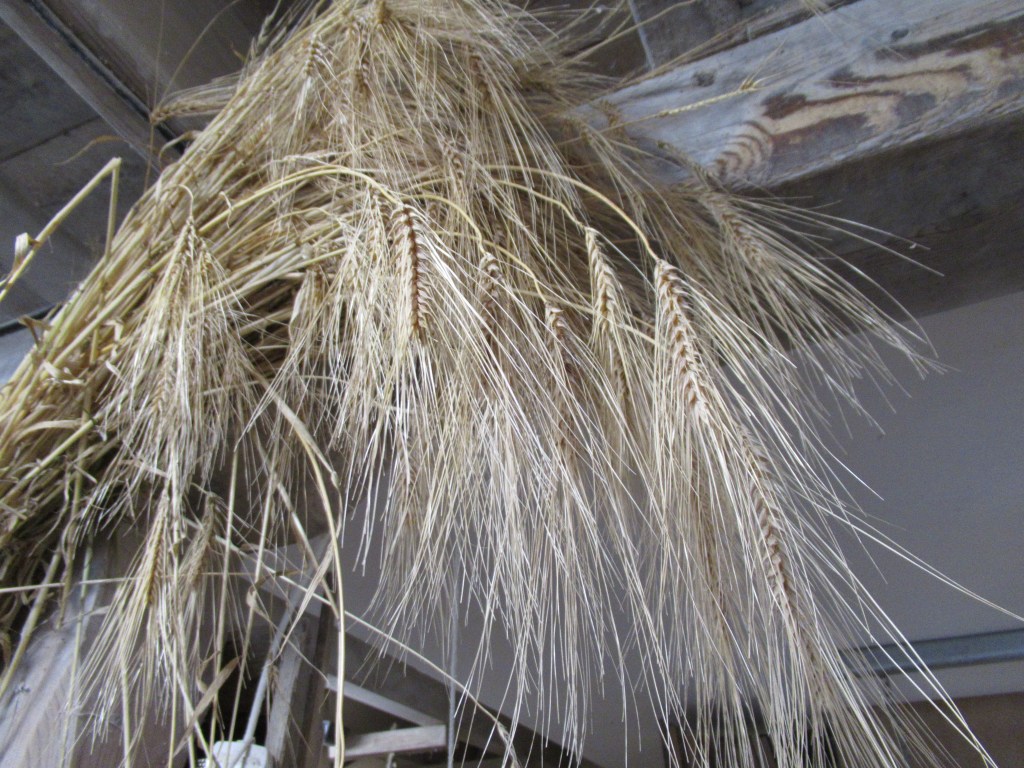
We don’t hear a lot about barley these days, but it is, in fact, one of the oldest grains, first cultivated around 9000 BC in the Fertile Crescent. From there, barley diverged and spread through Asia, Europe and Africa with different varieties thriving in different places. I came across one such variety on a recent visit to Orkney.
Bere (pronounced close to bear or bare) is a six row barley variety that has been grown in the Orkney Islands of Scotland, for around 5000 years. It is a fast growing barley, sometimes called 90 day barely, well suited to the long summer days and longer winters in Northern climates. Besides growing well in the Orkneys, bere is very nutritious, having more protein than modern two row barleys.
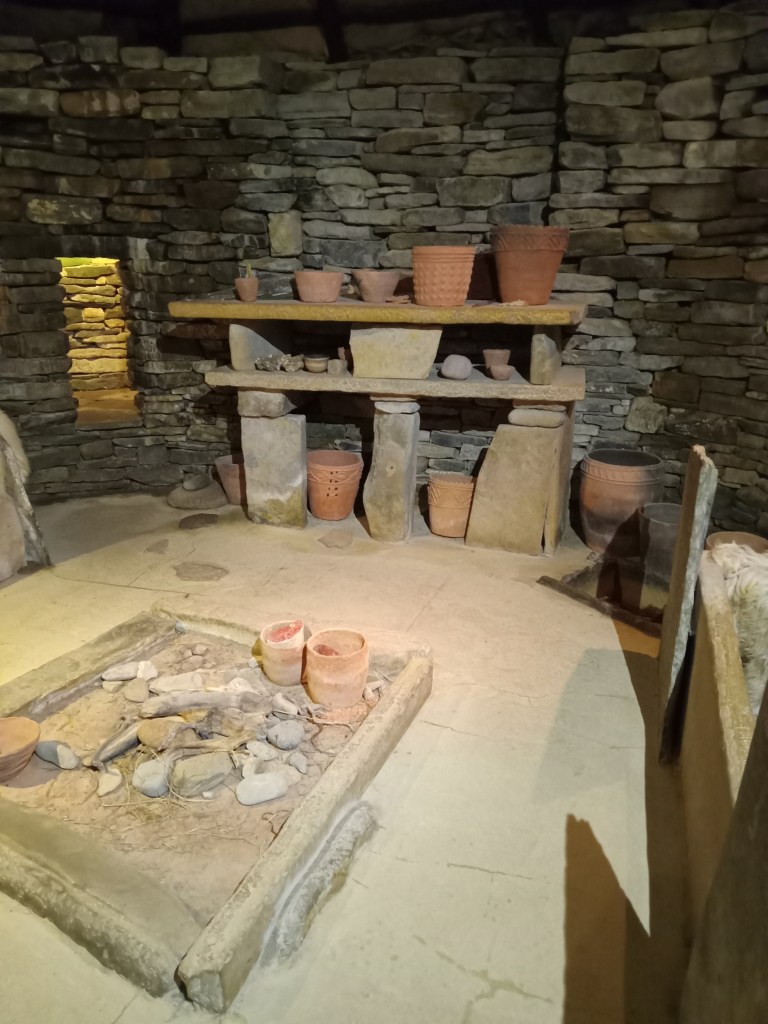
Reconstructed neolithic house in Skara Brae
Early neolithic sites in Orkney include evidence of bere cultivation and processing. Centuries later, Pictish farmers grew bere. When the Nore came, the discovered bere was very similar to their barely variety which they called bygg.
A conversation with my son, an archeologist, leads me to hypothesize that the neolithic farmers did not bake bread or bannocks with bere, but made a grain porridge, either boiling bere meal and water in a clay pot on the hearth fire, or adding hot stones to the water and meal in the clay pot. It is likely they added other things to this porridge also, probably berries, seaweed, small rodents, fish, or anything else they planned to cook and eat. My son also reminded me that a pot of grain porridge left unrefrigerated ferments. These fermented porridges were mildly alcoholic and led to some of the first beers produced. I find it interesting to note that beer, potion, and poison probably all come from the same proto-indoEuropean root *po(i) to drink.
Neolithic people used a saddle quern to grind the grain. The grinder, probably a woman, would kneel, and rub a stone back and forth over the grain in the bowl of a larger stone. The oldest saddle quern found in the Orkeneys was dated to 3,600 BC and found at Knap of Howar on Papa Westray.
By the iron age, the saddle quern was replaced by a pair of flat mills stones, in which the upper one rotates. And then by the viking era, some mills were converted or built to use water power .
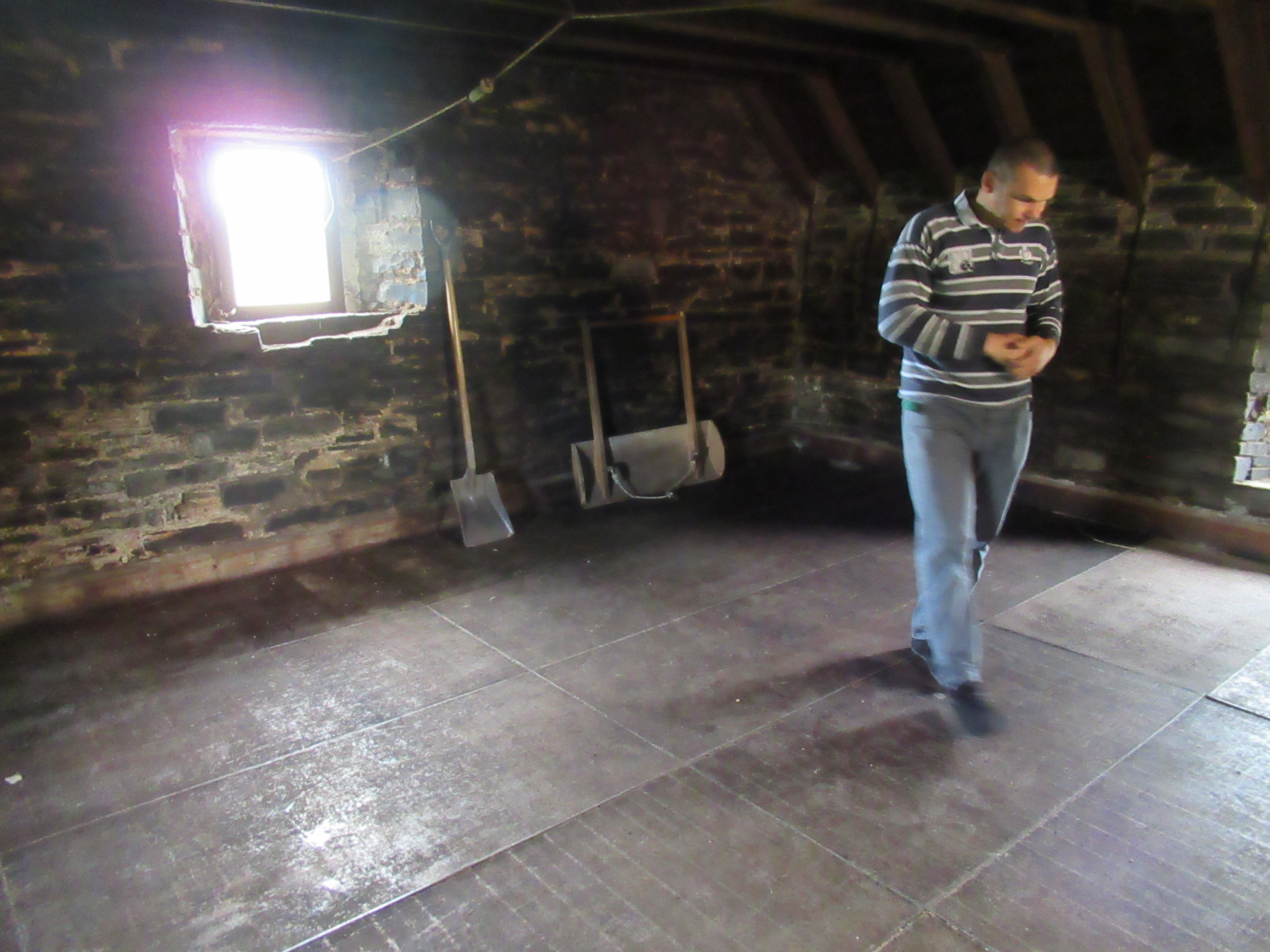
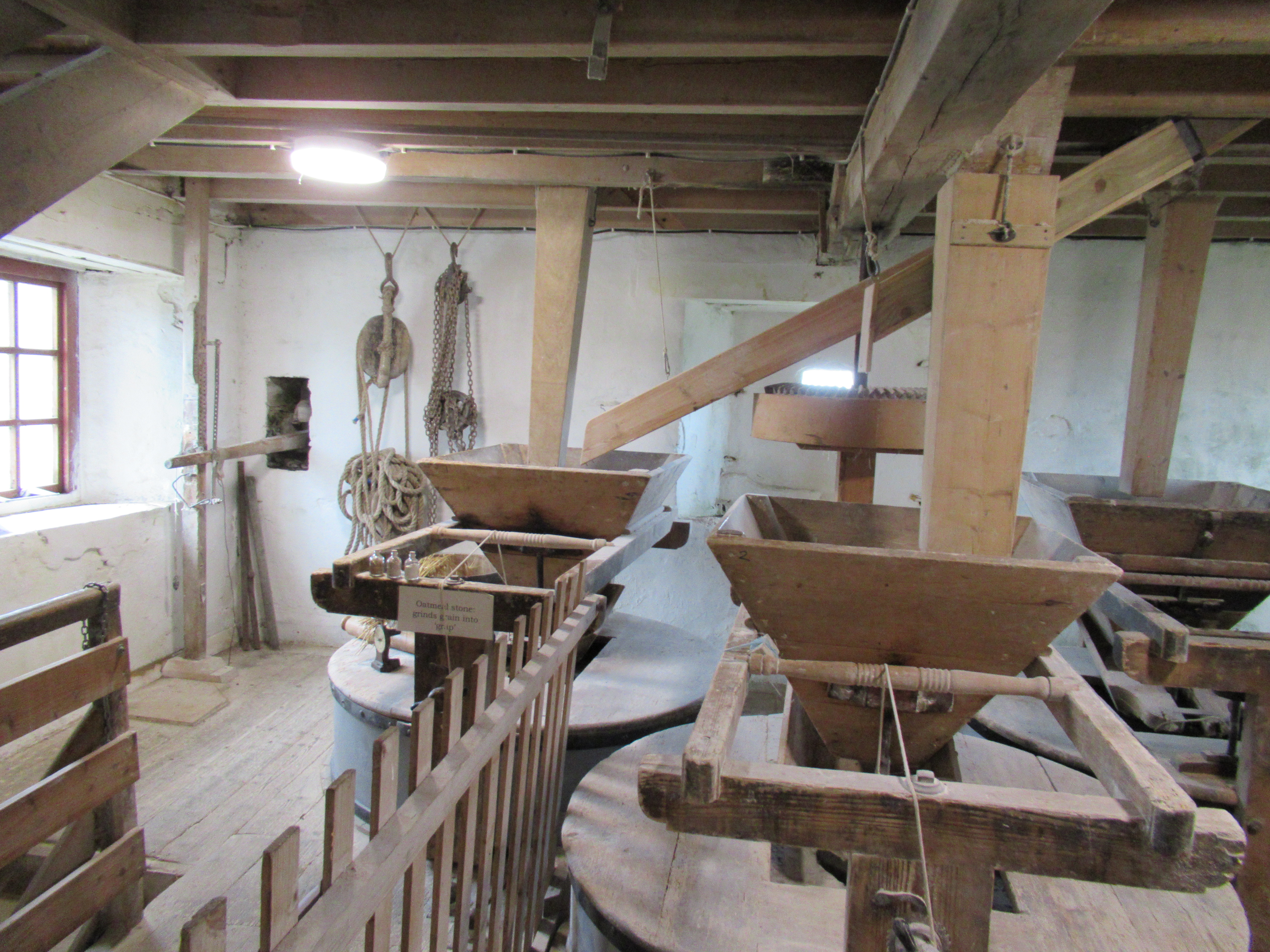
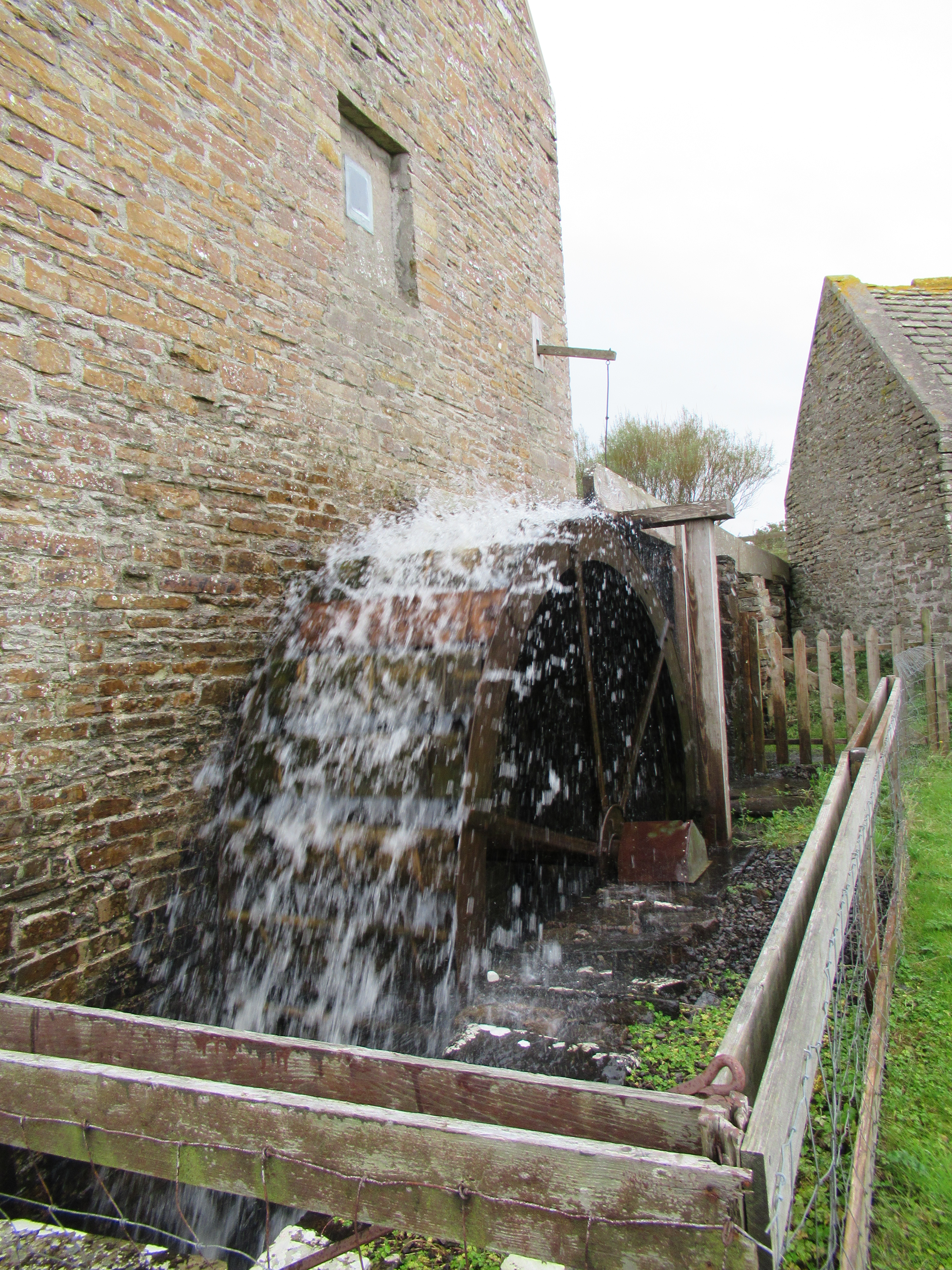
Nowadays, the Barony Mill, run by the Scottish Heritage Trust in Birsay, Orkney is the only mill still processing bere. The mill here has been in operation for over 300 years using an overshot waterwheel. I learned it takes two and a half days to process a load of bere. It must be dried, then ground through 3 wheels to remove the husk, crush the grain, and finally grind it into flour.
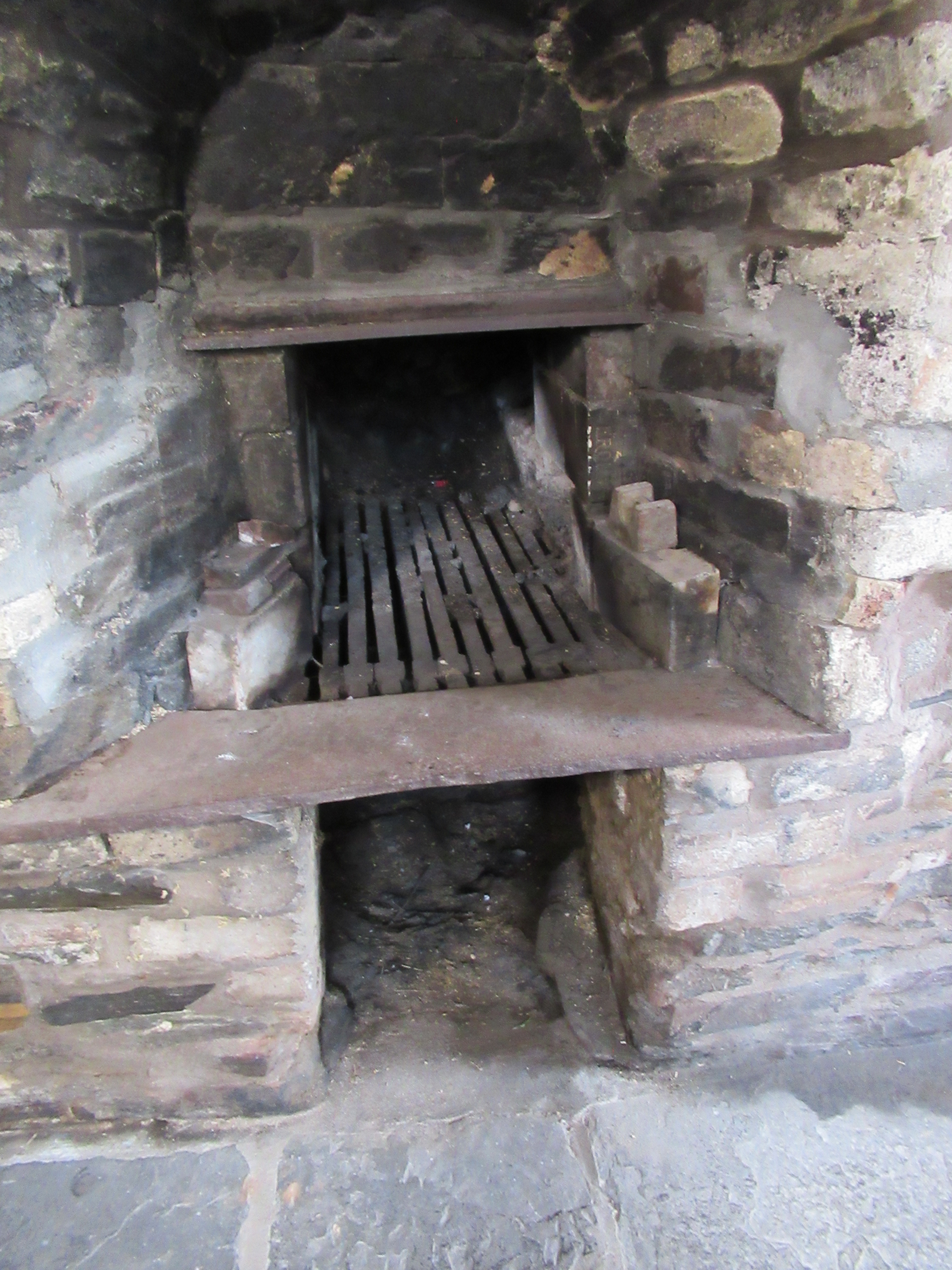
Views of Barony Mill: Drying oven, drying floor, grinding wheels, water wheel
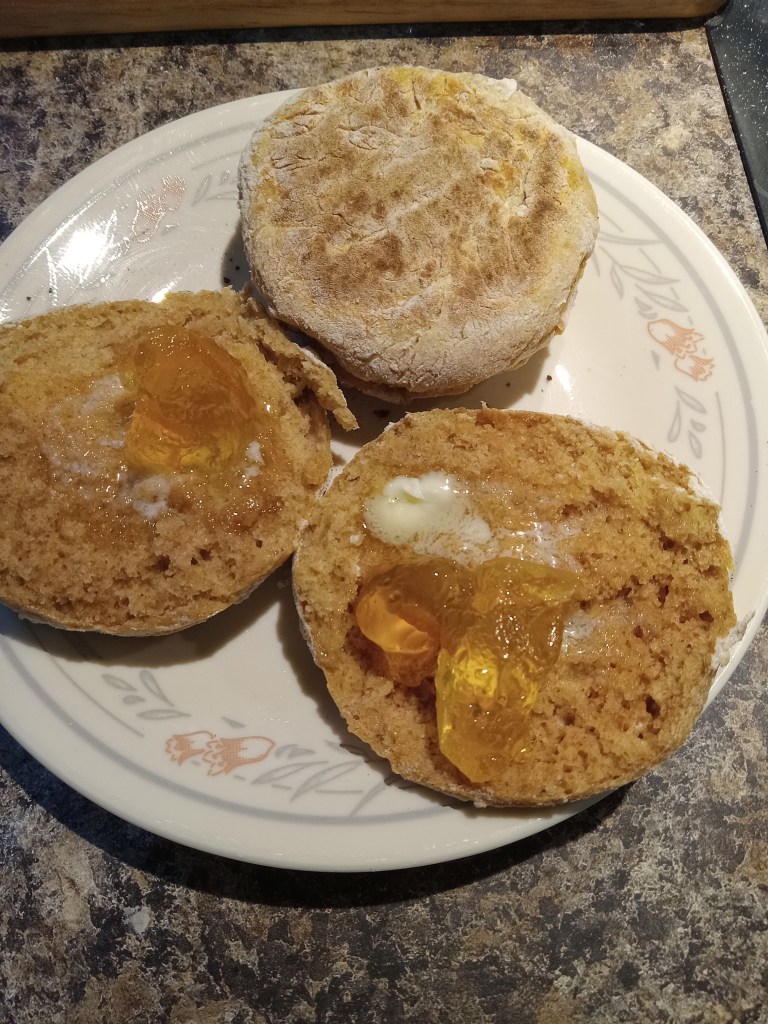
Of course, I had to buy some bere flour, and bring it home to try out. So far I’ve made an apple cake and several types of bannocks. Bannocks, originally unleavened, flat cakes of barley or oat baked like pancakes on a flat stone, that had been heated in the fire.(later a griddle was used)
Early 1800’s unleavened bannocks:
300 ml (½ pt.) milk
25 gr. (1 scant oz) butter
230 gr. 8 oz. bere meal
1/4t. Salt.
Heat the milk and butter, add salt and meal to make a soft dough. Knead lightly, roll out about ¼” thick. Fry in a lightly oiled pan or griddle. Flip to finish. Makes 2 small bannocks
After baking soda and cream of tartar came into common use in the middle of the19th century, bannocks, along with all other quick breads, underwent a major revolution. Bere Bannocks made today are light and airy like a scone. There are several recipes available for bere bannocks, One of the best sources is Barony Mills: https://baronymill.com/orkney-bere-bannocks/
Unfortunately, as far as I know, bere meal is unavailable in the United States as it is only sold in the UK. Perhaps that’s one more good reason for a trip to Scotland.
Sources: Ashworth, Liz. Book of Bere. Berlin LTD, Edinburgh, 2017.
You know how some words just mean what they sound like they should mean? I’m not talking about onomatopoeia, where the word imitates a sound. I’m talking about a certain mouthfeel where the sound and the meaning align perfectly. Maybe its just me, but I think steeple sounds pointy and blubber sounds bouncy.
Flummery is such a word. I think it sounds delicious, like a fluffy, sweet treat. But the problem with my whole theory is that such sound and meaning correlations are entirely subjective.
I discovered this with flummery. When I first proposed making it, my friend, without knowing anything about what it is, was decidedly uninterested. She thought it sounded horrible.
So I conducted a very informal survey, asking a little over a dozen people what they thought flummery means.
Answers varied from scam artist and buffoon to a fluffy dessert and a dish with barberries to everything in between. Turns out, most of them were at least partly right. Flummery is one of those words that has acquired a great many diverse meanings. Etymonline says flummerymeant a sour oatmeal jelly (from the Weslh ‘llymru’) in the 1600’s, then a sweet dessert in the 1700’s and flattery or empty talk, also in the 1700’s. Dictionary.com gives several meanings including boiled oatmeal, fruit custard, or foolish humbug.
There are as many variations in flummery recipes as there are in flummery definitions. The main thing all the flummery recipes have in common is that the dish is usually some sort of custardy gelatin, with more emphasis on either the custard or the gelatin, depending on the recipe. Even boiled oats have a custardy, gelatinous or even gooey texture. Flummery may or may not include any of the following ingredients: oatmeal, harsthorn, cream, almonds, jelly, calves feet, isinglass, eggs (yolks and/ or whites), wine, rose water, orange flower water, or sugar.
The first flummery I made was a sort of overnight (or over three days) oatmeal, using a recipe from John Towhnshend (p. 202). It involved soaking oatmeal in water for three days, straining off and replacing the water every day. After this soaking, the oatmeal is boiled until thick, put in molds, and served cold with wine and sugar. (The recipe also suggests beer and sugar or milk.) Even though I never would have associated oatmeal with wine, this dish was surprisingly good. Not great, but good enough to enjoy.
Another simple recipe for flummery is in Mary Randolph’s The Virginia Housewife Or, Methodical Cook (p.119) This is more pudding than jelly, and involves mixing equal measures of cream and jelly with half a measure of wine. This produces a very soft custardy dish that is very rich. I think it is best used as a sauce.
Since I didn’t have hartshorn or calves feet, I decided to try one of the isinglass recipes, such as French Flummery.
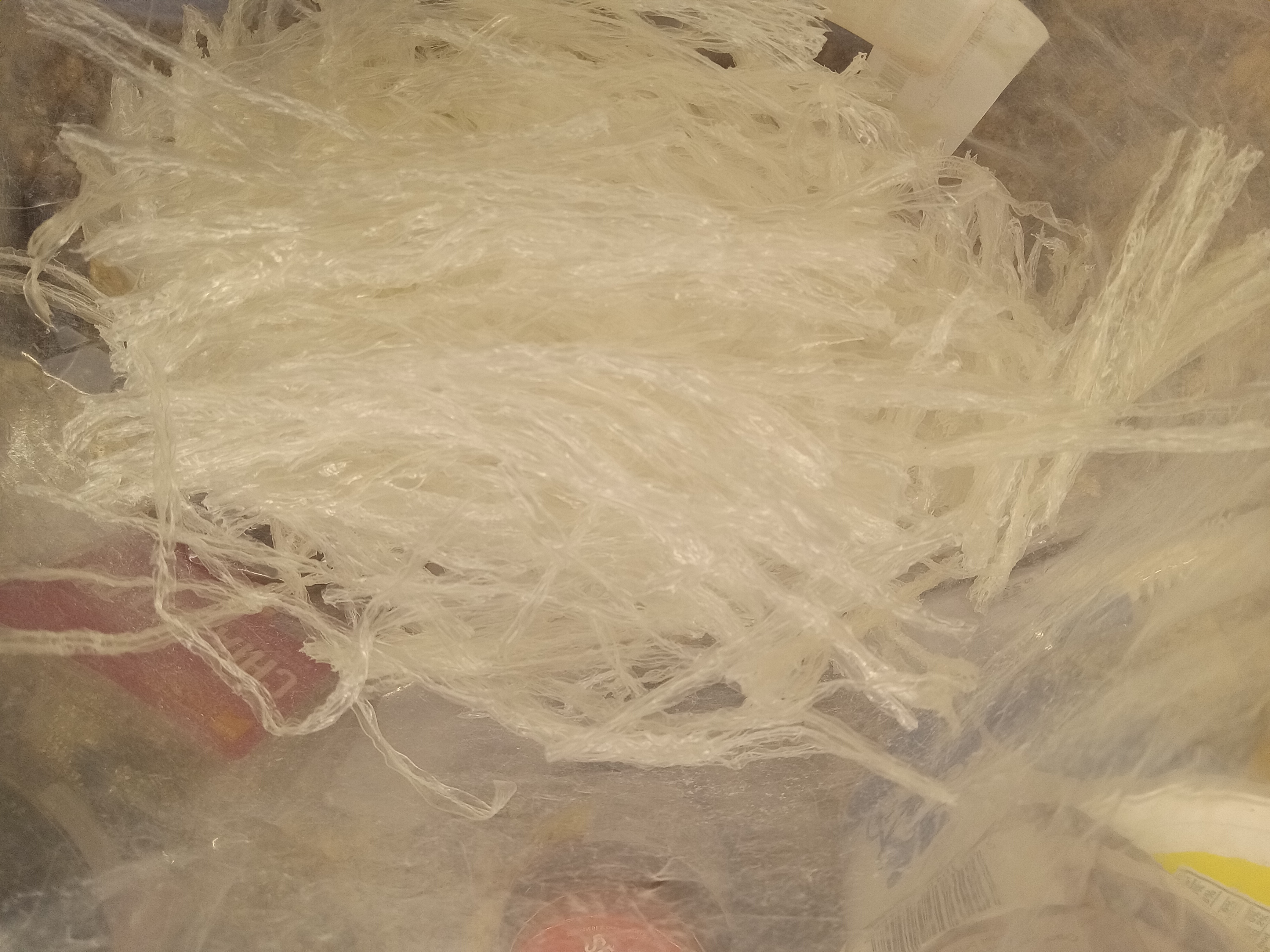
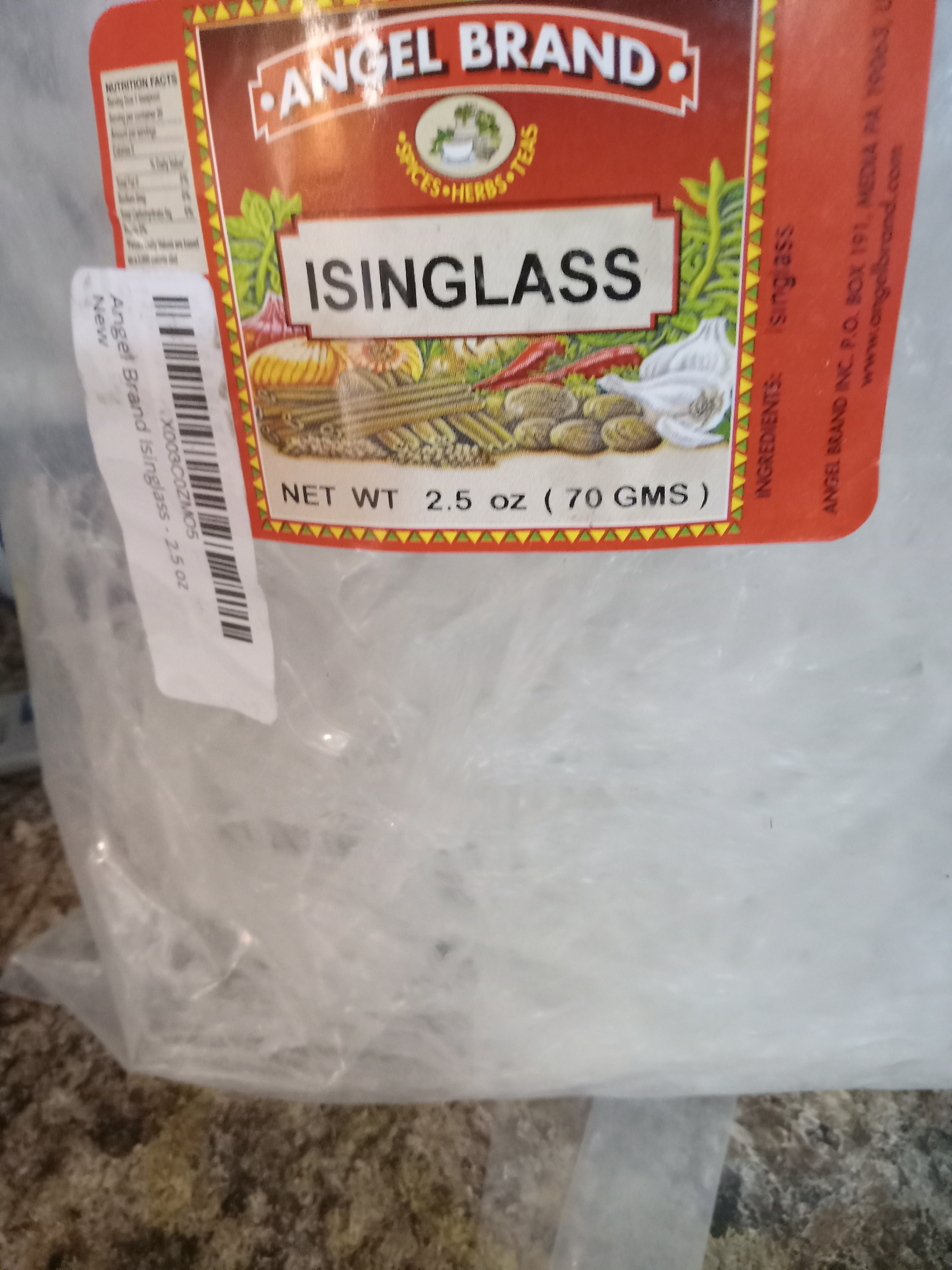
Identical recipes for French flummery appear in both John Townshend’s and Hannah Glasse’s books. (Many cookbooks following Glasse copied her recipes, often word for word, as does Townshend’s recipe) French Flummery is made with isinglass. I had no idea what that was. A little research taught me that isinglass is the dried swim bladders of fish, especially sturgeon. It has been used for centuries in making jellies (and coincidentally, glue). Today isinglass is available from the Amazon marketplace.
To Make French Flummery
Take a pint of cream and half an ounce of isinglass, beat it fine, and stir it into the cream. Let it boil softly over a slow fire a quarter of an hour, stirring all the time; then take it off, sweeten it to your palate and put in a spoonful of rosewater, and a spoonful orange-flower water; strain it and pour it into a glass or basin, or what you please, and when it is cold, turn it out. It makes a fine side dish. You may eat it with cream, wine, or what you please. Lay round it baked pears. It both looks very pretty, and eats fine. (Glasse, 186, Townshend,203)
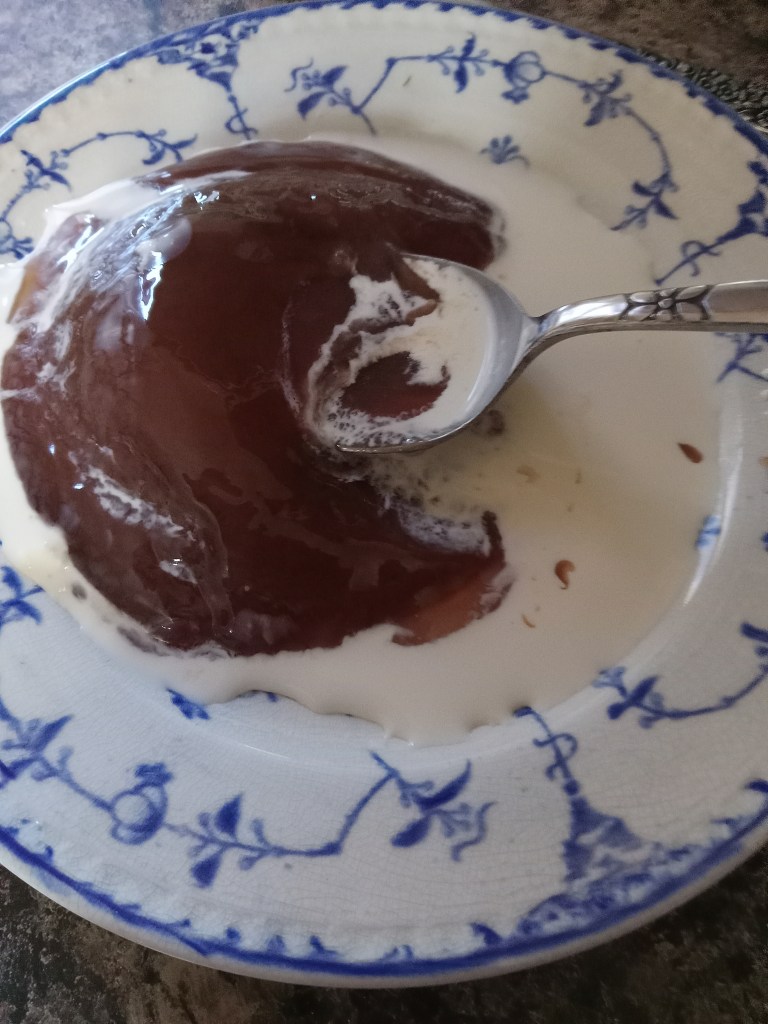
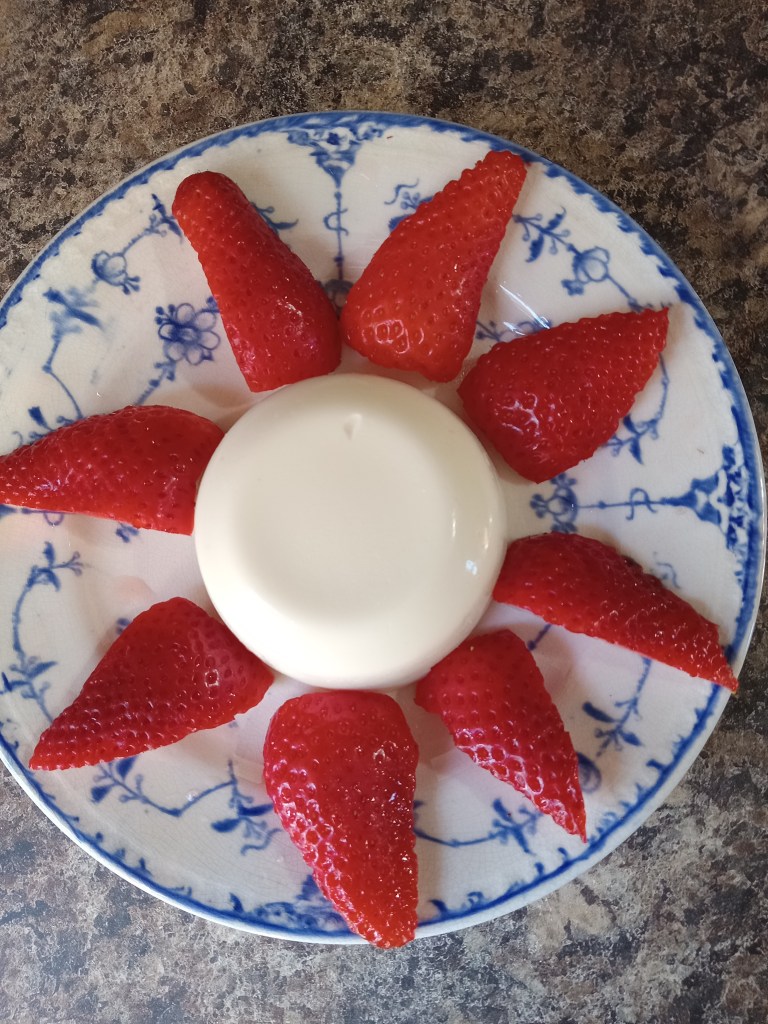
I used 2 cups of cream, ¼ cup of sugar, 1 teaspoon each of rosewater and orange flower water, and ¼ ounce of isinglass. The first step was to powder the isinglass. It comes in 3 -4 inch long translucent ribbons. They are slightly rubbery, which meant that trying to powder them in a mortar was an exercise in frustration. I resorted to using a blender. My ¼ ounce of isinglass made 2 Tablespoons in powdered form. I cooked the cream and isinglass mixture long enough that the powdered isinglass had been absorbed. (about twenty minutes.) Then I added the sugar and waters, and cooked it until the sugar was melted. I put the mixture in custard cups and cooled them. As it cooled, the pudding separated into two layers, making an interesting appearance.
I made this in spring, when strawberries were in their prime, so I used them instead of baked pears. I expect Hannah would approve.
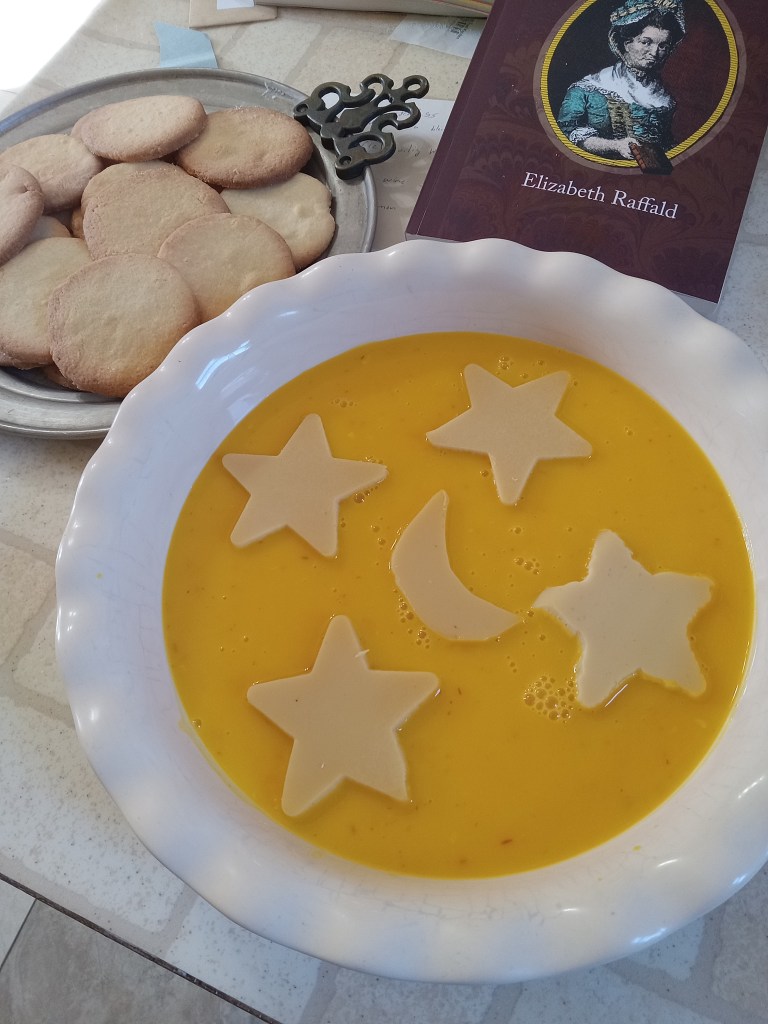
Flummery in many forms graced some fancier tables. Elizabeth Raffald, an English housekeeper who worked in Lady Warburton’s home for many years, gives several recipes for coloring flummery so that it could be used in many decorative dishes. In addition to the Moonshine described below, she has recipes for Eggs and Bacon Flummery, Solomon’s Temple in flummery, and Cribbage Cards in Flummery, among others. In medieval times, this use of food to create an edible centerpiece was called a subtlety.
I decided to make the Moonshine, as the name conjures up a more potent drink rather than a sweet dessert.
Moonshine Note Hannah Glasse has a moonshine recipe that is similar to, but not the same as, the one I made.
To Make Moonshine
Take the shapes of a Half-moon, and five or seven stars, wet them and fill them with Flummery, let them stand ‘till they are cold, then turn them into deep China Dish, and pour Lemon cream round them, made thus: Take a pint of Spring Water, put to it the juice of three Lemons and the yellow Rind of one Lemon, the Whites of five Eggs, well beaten, and four Ounces of Loaf Sugar, then set it over a slow Fire and stir it one Way till it looks White and thick; If you let it boil it will curdle, then strain it through a Hair Sieve, and let it stand ‘till it is cold, beat the Yolks of five Eggs, mix them with your Whites, set them over the Fire, and keep stirring it ‘till it is almost ready to boil, then pour it into a Bason; when it is cold pour it among your Moon and Stars: Garnish with Flowers.
It is a proper Dish for a second Course, either for Dinner or Supper. (p. 178)
For the Flummery, I used Raffald’s recipe for Yellow Flummery.
Take two Ounces of Isinglass, beat it and open it, put it into a Bowl, and pour a pint of boiling water upon it, cover it up ‘till almost cold, than add a Pint of White Wine, the Juice of two Lemons with the Rind of one, the Yoiks of eight eggs beat well, sweeten it to your Taste, put it in a Tossing Pot and keep stirring it, when it boils strain it thro’ a fine Sieve, when almost cold put it into Cups or Moulds. )p. 172)
Both of these recipes use a lot of eggs, so I cut them down.
First I made the Flummery:
1 ounce isinglass (powdered in a blender)
1 cup boiling water
1 cup white wine (choose a sweet rather than dry white)
Juice of 1 lemon and the yellow rind of half of it
4 egg yolks
½ c. brown sugar
Pour boiling water on the isinglass, and stir until the isinglass dissolves. Add the remaining ingredients and bring it slowly to a soft boil. (Don’t let it boil hard.) Strain it through a fine strainer. Pour it into a flat dish, either 8 by 8 or 9 x 13”. Let it cool, then cut it into the shapes of stars and moons. ) Cookie cutters or a drinking glass works well.
While it is cooling, make the lemon cream.
2 cups water
½ cup lemon juice
2 Tablespoons grated lemon peel
2 eggs, separated
1 cup sugar
½ teaspoon saffron (optional)
Mix the water, lemon juice, lemon peel, sugar and egg whites in a saucepan. Cook slowly, stirring constantly until thick. Do not let it boil. Mix a little of the hot mixture into the egg yolks, (to prevent curdling) then add the egg yolks to the saucepan. Cook, stirring constantly, until it is almost ready to boil. Note: in order to make a greater contrast between the flummery moon and stars and the lemon cream, I added a half teaspoon of saffron to the lemon cream along with the egg yolks. Saffron was not included int the original recipe, but it was known and used as a coloring agent in Raffald’s time, so I feel she would approve..
Put your flummery cut-outs in a flat dish or pie plate, and pour the lemon cream around them. Let cool and serve.
This was the tastiest of the flummery dishes, but the flummery shapes were quite rubbery. I think the same recipe with less isinglass would work as well, or better.
In spite of its versatility, I don’t see a resurgence of flummery is likely. All of the flummery dishes I made tasted interesting, and some were even pretty good. However, we have easier methods of making jellied desserts. Still, flummery is such an intriguing word, perhaps its meaning will evolve again. Can you imagine marshmallow flummery?
Sources:
Glasse, Hannah. The Art of Cookery Made Plain and Easy: Excelling any Thing of the Kind ever yet published. Alexandria: Cottom and Stewart. 1805. (First Edition published in London, 1747. This edition reprint of 1st American Edition, 1805, by Applewood Books, 1997).
Raffald, Elizabeth.The Experienced English Housekeeper. Originally published 1769, Manchester, England. This reprint published 2024, Townsends.
Randolph, Mary. The Virginia Housewife Or, Methodical Cook. Philadelphia: E. H. Butler & Co., 1860. (Facsimile by Dover Publications, 1993, with introduction by Janice Bluestein Longone).
Townshend, John. The Universal Cook or Lady’s Complete Assistant. S. Bladon: London, 1773 (facsimile).
Norfolk Dumplings with a lump of butter (top dumplings are with a thicker batter.)
Noodles have been eaten for millennia, probably originating in the Middle East and spreading both east and west into Asia and Europe; however, the word ‘noodle’ is first attested in English as late as 1779. Various noodle-like dishes were called by many different names, from “thin foyles [leaves] of past” in (Curye on Inglysch) in 1390 for what is basically a lasagna recipe, to “macaroni” from an Italian dialect in the 1590’s. (In the well-known Revolutionary War song about Yankee Doodle and his hat, “macaroni” refers to dandies, or overly fashionable young men, rather than any type of pasta.) Thomas Jefferson is credited with bringing the first ‘macaroni’ machine to the young United States in 1789.
In modern parlance, a dumpling seems far removed from a noodle. One is thick and doughy, the other thin and slimy. However, though their preparation is different, (noodle dough is kneaded, rolled thin, and cut in strips, while dumpling dough is dropped by lumps into boiling liquid) they share nearly the same ingredients (flour, eggs, and salt) and both are boiled in hot liquid. Besides this culinary connection, there is a linguistic overlap between the two words. The word dumpling comes from the 1600’s from a Norfolk dialect of uncertain origin. Knödel: German for dumpling, and perhaps the origin of the word noodle (first attested from 1779). It seems to me some cook mixed up the German word for dumpling with the flat, thin, pasta that came to be known as a noodle.
I could not find recipes for noodles, macaroni, or pasta in my earliest American cookbooks. Although by the 1830’s there were recipes for making and using macaroni, the first pasta company in the United States didn’t open until 1848. However I did find many different dumpling recipes, specifically Norfolk-dumplings.
Norfolk dumplings are surprisingly simple and tasty, with a texture somewhere between a slippery noodle and a biscuity dumpling. The following recipe comes from Hannah Glasse’s The Art of Cookery, page 111. book, though the exact same recipe is also found in Townshend’s The Universal Cook, p. 158.
“Mix a good thick batter, as for pancakes; take a half pint of milk, two eggs, a little salt, and make it into a batter with flour. Have ready a clean saucepan of water boiling, into which drop this batter. Be sure the water boils fast, and two or three minutes will boil them; then throw them in a sieve to drain the water away; then turn them into a dish, and stir a lump of fresh butter into them: Eat them hot and they are very good.”
I used ½ c. milk, 1 egg, ½ teaspoon salt, and 1 cup of whole wheat flour to make a batter the consistency of pancake batter and dribbled the batter into the water by spoonfuls. The result was like a thick, rather lumpy noodle. Adding more flour to make a thicker dough, resulted in a more biscuit dumpling.
So if you want something similar to a homemade noodle, but are pressed for time, the Norfolk dumpling is a reasonable alternative.
References:
Curye on Inglysch: English Culinary Manuscripts of the Fourteenth Century (Including the “Forme of Cury”) Constance B. Heiatt (Editor), and Sharon Butler (Editor). Oxford University Press; 1st Edition edition, 1985.
Glasse, Hannah. The Art of Cookery Made Plain and Easy: Excelling any Thing of the Kind ever yet published. Alexandria: Cottom and Stewart. 1805. (First Edition publishing in London, 1747. This edition reprint of 1st American Edition, 1805, by Applewood Books, 1997).
Townshend, John. The Universal Cook or Lady’s Complete Assistant. S. Bladon: London, 1773 (facsimile).
From healthful to harmful, sugar has undergone a remarkable journey in the perceptions of its users.
Sugar originally comes from New Guinea, where it was first cultivated around 8000 BCE. For several thousand years people chewed on sugar cane to savor the sweetness. Gradually cultivation of sugarcane spread to India and the Philippines. People in India were the first to refine sugar, and developed the first sugar mill about 100 CE. Greeks learned of sugar from the Indians. By 500 CE Arab scholars were studying sugar as a powerful medicine, and Arab cooks were using it in all sorts of meat, nut, and grain recipes
In medieval and renaissance Europe, the general opinion was that sugar had strong medicinal virtues and was especially good against cough and sore throats, and was also useful against sourness and bitterness. Indeed, sugar was used to make other medicines more palatable- much like the sugary sweet cough syrups marketed today.
It is difficult to determine how much sugar was used in early English cookery. Elizabethan England average consumption was 1 pound per person per year (MW p. 11). But only the wealthy had easy access to sugar and sugar was used primarily for preserving fruits, making sweets, and brewing medicines. The growing use of sugar led to blackened, rotting teeth, at least among the wealthy, who were the only ones who could afford the luxury of sugar. Queen Elizabeth I was well known for her love of sugar and sugary products. Her teeth fell out by the time she was fifty. Although I have not found any actual evidence for the practice, several websites claim the wealthy Tudors used a sugar paste to clean their teeth.
By colonial times sugar manufacture was greatly improved and expanded (in large part due to enslaved workers in North American Colonies). In spite of import duties, (Molasses Act of 1733 and Sugar Act of 1764), sugar was much more affordable for the growing middle class. While many early recipes are quite sweet, sugar was mostly used in small quantities as a spice or flavor enhancer, like salt. Still, more and more recipes specifically meant to offer something sweet appear in early cookbooks.
Nowadays, high fructose corn syrup replaces cane sugar in many processed foods, to the detriment of the modern diet. Even though we know too much sugar of any kind is bad for a person, humans are hard-wired to seek high-calorie foods and many of us have a strong ‘sweet tooth.’ I know I’m not the only one in the US who consumes too much sugar. Efforts to have both a healthy diet and a steady supply of sweet treats have led to many sugar substitutes, including artificial sweeteners (aspartame, Saccharin, or Sucralose,…) and natural ones (Stevia, monk fruit…)
As for me, I still remember the 1960’s jingle advertising sugar: “C&H, C&H—pure cane sugar from Hawaii”. Hawaii was only recently a state at the time (it became a state in 1959) and was considered somewhat exotic. I didn’t recognize the advertising ploy to increase sales and push sugar usage. I just liked to watch the cute Hawaiian kids dancing in the commercial.
Attitudes toward sugar have definitely changed over the centuries. Although sugar is no longer seen as a healthy food, the modern world has a love/hate relationship with it. We crave it even though we know it’s bad for us. Personally, I’m not ready to give up on sugar, but I wholeheartedly advise against using it to brush your teeth.
Recipes:
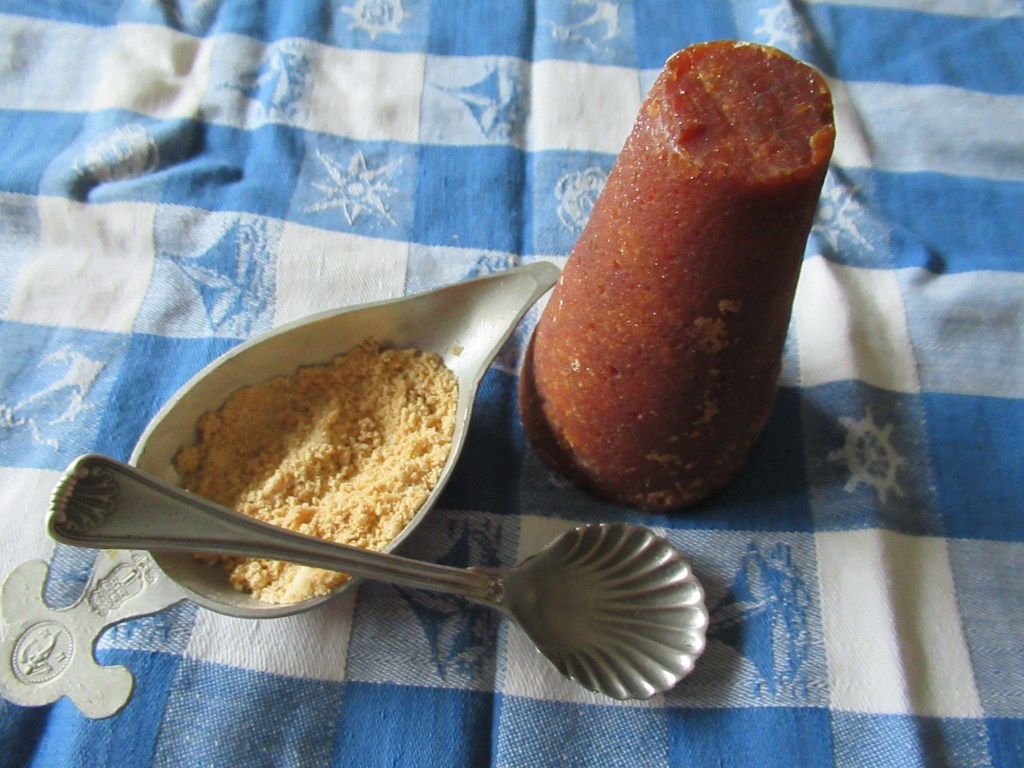
In Colonial times, sugar came in cones, and needed to be clarified with egg white and boiled water. Martha Washington’s Booke of Cookery gives instructions at the beginning of the section on sweetmeats.
To know how to clarify your Sugar
Take a pinte of faire water & beat the white of an egg into it to a froth, then put a pound of sugar in to it, & let it boyle very fast, & there will rise a black scum on ye top of it. As it riseth, take it of till it is very clear, & then streyne it through a Jelly bagg or wet cloth, & soe use it as you pleas. To every pound of sugar as you clarify, you must put a pinte of faire water, & ye white of an egg. ye white of one egge will clarefy 2 pounds of sugar as well as one pound. (MW 225)
Sugar is so well refined today there is no longer any need to clarify it, so to try this out, I used reproduction cone sugar. The recipe above is quite clear and easy to follow. I cut it in half, using 1 cup of water and ½ pound of sugar with one egg white.
After clarifying your sugar, here is one way to use it.
To candy Ginger
Get the fairest pieces, pare off the rind, and lay them in water twenty-four hours; then boil double-refined sugar to the height of sugar again, and when it begins to be cold, put in your ginger and stir it till it is hard to the pan; then afterwards put it into a warm pan, tie it up close, and the candy will be firm. (Townshend, 261)
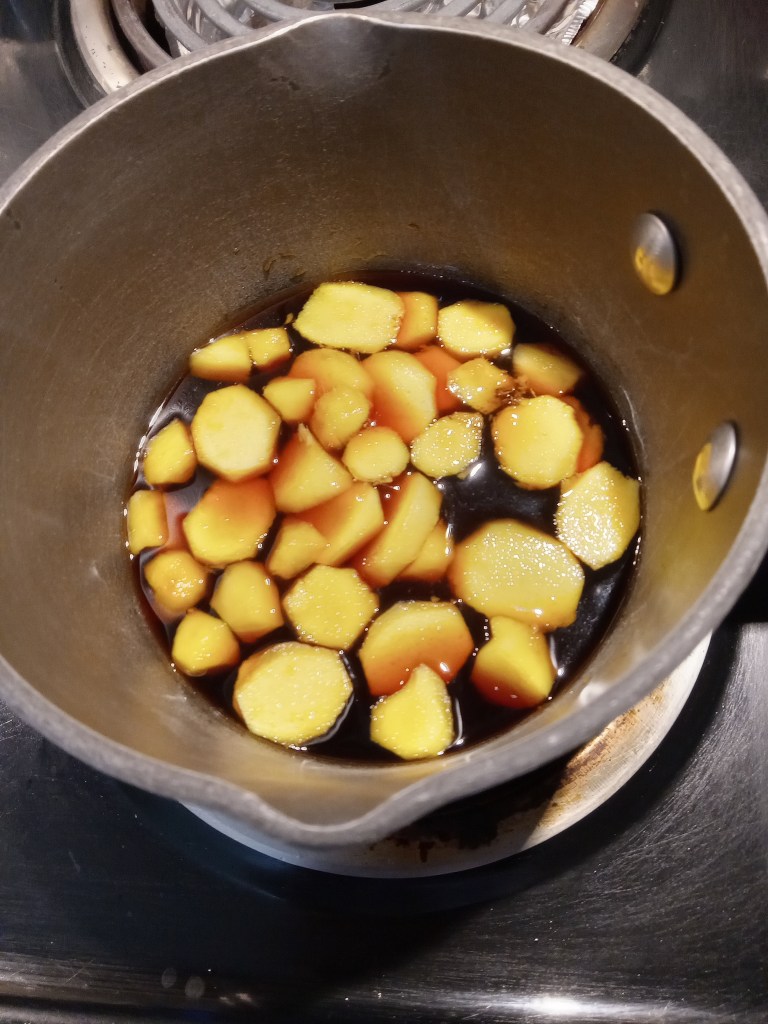
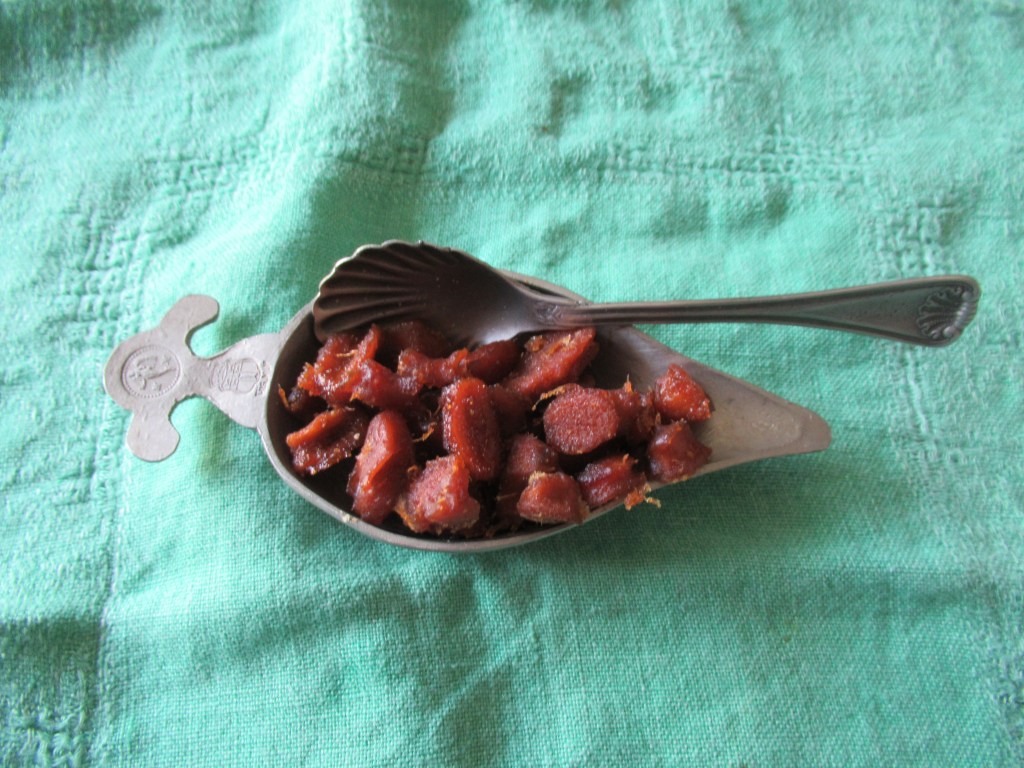
Although this recipe seems simple, there are several confusing phrases. First, ‘double-refined sugar’ means clarified sugar, but I have not been able to find what ‘to the height of sugar’ means. Martha Washington’s Booke of Cookery gives several stages of candy making, roughly corresponding to modern stages. However, neither her directions nor any modern cookbook gives ‘sugar’ as one of the stages. I experimented with boiling the ginger in clarified sugar syrup to different heights. I found that bringing the syrup to a soft ball stage of 235˚ produced the best candy as lower temperatures were too sticky. The candied ginger at this stage cooled to create a product similar to crystallized ginger.
The second phrase that gives me pause is ‘stir it till it is hard to the pan’. I was not able to find any further information on what this means. It sounds like the cook recommends boiling until all the liquid is used up and the ginger slices stick. That seems impractical to me, so I just boiled the ginger slices until the syrup reached the desired temperature.
For the modern version of this recipe, peel and slice 4 oz. of ginger. Soak the ginger in water for 24 hours. Drain the water. Next boil the slices of ginger in ½ c. of clarified sugar syrup, to 235˚. Stir occasionally, and watch carefully as the syrup can easily boil over. Remove the ginger from the syrup and lay out in a single layer to dry for a few days. The resulting candy is slightly chewy, and has a very strong, (peppery hot) ginger flavor.
Sources —–. Martha Washington’s Booke of Cookery and Booke of Sweetmeats. (A Family Manuscript, Hand written circa 17th century. Transcribed and annotated by Karen Hess, New York: Columbia University Press, 1995).
Townshend, John. The Universal Cook or Lady’s Complete Assistant. S. Bladon: London, 1773 (facsimile).
Consider the egg: A compact, portable package full of protein and other nutrients, a treasure enjoyed by humans since the first human walked the earth. It’s really not surprising that such an ancient and valuable food source has also become a symbol of life. In fact, many ancient peoples believed the egg represented the creation of the world. As such, eggs feature significantly in various origin myths.
Egg-laying jungle fowl (the ancestors of chickens) were first domesticated in Southeast Asia in prehistoric times. Eggs were eaten in Ancient Mesopotamia, Egypt, Greece, and Rome. Medieval peasants raised chickens and enjoyed whatever eggs were not owed in rent. Early American Colonists brought chickens to North America. (Native people had been eating wild bird eggs for millenia.)
One of the simplest ways to eat eggs is to boil them, but as with any food so popular and economical, fancier ways have been developed. The recipe for today is eggs á la creme, a tasty and elegant dish involving hard boiled eggs and a cream sauce. The recipe comes from Mary Randolph’s The Virginia Housewife Or, Methodical Cook (p.87).
EGGS A-LA-CREME
Boil 12 eggs just hard enough to allow you to cut them in slices–cut some crusts of bread very thin, put them in the bottom and round the sides of a moderately deep dish, place the eggs in strewing each layer with the stale bread grated, and some pepper and salt
SAUCE A-LA-CREME FOR THE EGGS
Put a quarter pound of butter with a large tablespoon of flour rubbed well into it in a saucepan; add some chopped parsley, a little onion, salt, pepper, nutmeg, and gill of cream; stir it over the fire until it begins to boil, then pour it over the eggs, cover the top with grated bread, set it in a Dutch oven with a heated top, and when light brown, send it to table
A few notes:
This recipe is fairly straight-forward, with few unfamiliar words. A gill equals approximately ¼ cup.
A oven broiler substitutes very well for a Dutch oven with a heated lid.
Toasting the bread before putting it in the dish helps keep the bread from getting soggy.
Modern version: A Tasty Dish of Eggs
¼ c. butter
1 T. flour
¼ t. Salt
¼ t. Nutmeg
¼ t. Pepper
1-2 T. onion (chopped fine)
1 T. parsley (chopped fine)
½ c. (1 gill) cream
4 hard-boiled eggs
4 toast slices
¼ c. bread crumbs
Melt the butter in a saucepan. Stir in flour, salt, pepper, and nutmeg. Add the cream. Bring to a boil and stir until thickened. (Add a little more cream or milk if the sauce gets too thick.) Remove from heat. Peel and slice your hardboiled eggs. Lay the unbuttered toast slices in a dish. Lay the sliced eggs on top. Spoon the cream sauce over the eggs. Sprinkle the bread crumbs on top. Place under a broiler for a few minutes, just until the crumbs are toasted.
This makes a very tasty dish for lunch or supper. You might even enjoy it as a change of pace for breakfast. It is very similar to Eggs Benedict, though the sauce is thicker.
Most people I know, know the day as Mardi Gras, the last day to feast and use up forbidden foods before the privations of Lent begin. Mardi Gras is French for ‘fat Tuesday.’ It is most often associated with the wild parades and parties of New Orleans.
Of course, there are other traditions surrounding this important day. Some people know it as Shrove Tuesday. ‘Shrove’ is an archaic form of ‘shrive’, which means to confess one’s sins and receive absolution from a priest. In times past, many Christians felt it was important to go to confession on the last day before Lenten fasting begins.
Still another name for this day is Pancake Day. Why pancakes? Well, in some places it became the tradition to serve pancakes on this day as a way to use up eggs and other rich foods which were not allowed. Some of the traditions associated with Pancake Day include Pancake flipping contests, Pancake races, and various other games.
In the Middle Ages, pancakes were very popular. They are quick and easy to cook over a fire, requiring few special utensils or any great skill. Various types of pancakes graced the tables of the rich nobles in their manor houses and castles, as well as the poor serfs who worked the land.
Most of us today have a fairly universal idea of a pancake—generally a mixture of flour, milk, and eggs, with a bit of baking powder and perhaps a few added ingredients. The batter is poured onto a hot skillet or griddle, flipped, and served with melted butter and maple syrup. It is most often considered proper fare for breakfast. In England, pancakes are usually very thin, similar to crèpes. However, in times past, many other combinations were also thought of as pancakes . Some of these included such ingredients as cheese, fruit, breadcrumbs, or wine.
So, on Tuesday, February 22 try something new and celebrate Pancake Day. The recipes below are from the 17th century. Both are a delicious treat, unlike any more modern concept of pancake. The first offers the harried cook of a big house an easy option. Note that in the 17th century ‘meate’ meant food of any sort.
A Fryed Meate [Pancakes] in Haste for the Second Course
Take a pint of Curds made tender of morning milk, pressed clean from the Whey, put to them one handful of flour, six eggs, casting away three whites, a little Rose-water, Sack, Cinnamon, Nutmeg, Sugar, Salt, and two Pippins minced small, beat this all together into a thick batter, so that it may not run abroad; if you want wherewith to temper it, add Cream; when they are fryed scrape on Sugar and send them up; if this curd be made with Sack as it may as well as Rhennet, you may make a pudding with the Whey thereof. (Rabisha, as quoted in Lorwin, 140)
Modern Version : Apple pancakes (Fritters)
1c. Cottage cheese
1 egg plus 2 egg yolks
1 apple, peeled and grated
2 T. brown sugar
1 T. sherry
½ t. Salt
½ t. Nutmeg
½ t. Cinnamon
¼ c. flour
Approx. ¼ c. butter for frying
Puree the eggs and cottage cheese in a blender, then add the mixture to the remaining ingredients, except for the butter. Melt the butter in a skillet and drop the pancake batter by spoonfuls into it. As bubbles rise and pop, flip the pancakes to fry on the other side. These will be a soft, moist pancake, quite delicious without any extra syrup or sugar.
The second pancake recipe is also quite different than what we are used to. This one is a sort of fried cheese fritter. (Note I made a small recipe, about one third of what is suggested here, because I didn’t want to have too many egg whites leftover.)
How to Fry a Dish of Cheese
Take quarter of a pound of good Cheese, or Parmysant, and grate it and put to it a little grated bread, a fewCaraway seeds beaten, the yolks of as many eggs as will make it into a stiff batter, so it will not run, fry it brown in Butter, and pour on drawn Butter with Claret wine when they are dished. (Rabisha, as qtd. in Lorwin, 330.)
A modern Version: Cheese Pancakes
1 ½ cups grated sharp Cheddar cheese
1 t. Caraway seeds
2 egg yolks
¼ t. Salt
¼ c. bread crumbs, plus 1 T.
3 – 4 T.. butter
⅓ c. red wine
Grind the caraway seeds and salt in a mortar. Mix them with the cheese, egg yolks, and bread crumbs and form into patties about ½” thick. Fry in butter until slightly browned on both sides. Set the pancakes aside to keep warm. Add remaining butter (at least 1 T.) to the skillet. When it is melted, add bread crumbs and then the wine. Stir until thickened. Then spread this over the pancakes to serve. This makes a lovely lunch dish.
Whether you want to flip them, race with them, or just eat them, enjoy your pancakes this season.
Rabisha, William. The whole Body of Cookery Dissected. Printed by R. W. for Giles Calvert, at the sign of the black Spread Eagle, at the West end of Pauls, 1661. Quoted in Lorwin, Madge. Dining with William Shakespeare. New York: Atheneum, 1976.
Nothing conjures the tastes and smells of the Christmas season better than gingerbread. We delight in gingerbread cookies, gingerbread spices, and gingerbread houses.
Not surprisingly, there have been many variations of gingerbread throughout the ages. In the earliest versions, gingibrati was primarily medicinal, and sometimes called for parsnips. The gingerbread we now recognize has gone through great metamorphosis, though in any given age, multiple versions of gingerbread might be known.
Version 1:
By medieval times gingerbread was a sweet dish made from breadcrumbs, mixed with spices and infused with warm honey, then smashed into the form of a cake. Variations of this type of gingerbread lasted well into the colonial era. (At least four such recipes are included in Martha Washington’s Booke of Cookery.)
The earliest recipe for this medieval gingerbread that I’ve found is from the Curye on Inglysch, Section V, which is a miscellaneous collection of recipes from around the 14th century.
To make gingerbread. Take goode honye and clarifyie it on the fere, & take fayre paynemayn or wastrel brede and grate it, & caste it into the boylynge hony, & stere it well togyder faste with a skylse that it bren not to the vessel. & thanne take it doun and put therein ginger, longe pepere & saunders, & tempere it up with thine handles; & than put hem to a flatt boyste and strawe theron sugar, & pick therin clowes round aboute by the egge and in the midas, yf it plece you, &c. (Curye on Inglysch, Sloane 121)
Interestingly enough, the recipe immediately preceding this one for making gingerbread, calls for only honey and spices and would result in a sort of ginger candy like a ginger chew or ginger drop. Not a bread or cake at all.
For modernizing this recipe, I substituted allspice for saunders (sandalwood). Also instead of placing whole cloves on the edges and middle, I used ground cloves.
Version 2: Fast forward a couple of centuries.
Gingerbread in many shapes became popular throughout Europe, especially in Germany, where cookies shaped for the various seasons were sold at markets and fairs. Germany is also where the tradition of gingerbread houses developed in the 16th century. The Grimm fairy tale of Hansel and Gretel reflects this idea of a house made of sweets.
Though honey/crumb gingerbread continued in some recipes, eventually flour replaced bread crumbs, and molasses (alternately called treacle) replaced honey. In 1775, Townshend included a couple of recipes for gingerbread, both of which include butter. One also adds eggs. Townshend suggests both of these make a stiff dough, to be rolled out and cut in shapes, or rolled into balls. The result should be very much like a modern gingerbread cookie or molasses crinkle, though he calls them cakes.
To make gingerbread cakes
Take three pounds of flour, one pound of sugar, one pound of butter rubbed in very fine, two ounces of ginger beat fine, a large nutmeg grated, some beaten mace and coriander seeds; then take a pound of treacle, a quarter pint of cream, make them warm together, and make up the bread stiff, roll it out, and make it up into thin cakes, cut hem out with a teacup , or small glass, or roll them round like nu ts, and bake them on tin plates in a slack oven. (Townshend, 266)
Since three pounds of flour is 13 or 14 cups, this makes a very large amount of cookies. The result is a rich, crisp, tender cookie, with a spicy tang, rather like a molasses shortbread.
For modern bakers, I suggest reducing the recipe to one quarter of the original.
Colonial Gingerbread

3 ½ cups flour
¼ c. sugar (I suspect sugar was added because molasses is not as sweet as    honey.)
1 t. dried ginger
¼ c. molasses (though today there are some minor differences between treacle and molasses, the words were used nearly interchangeably in the colonial period. Molasses may be safely substituted for treacle.)
½ t. Nutmeg,
¼ t. Mace
¼ t. ground coriander
2 T. cream

Mix the dry ingredients and cut the butter into the mixture. Add the molasses and cream to make a stiff dough. Roll out and cut into shapes, or roll into small balls. Bake at 350 degrees 12-16 minutes.
Version 3: About 20-30 years later
The next innovation was the use of a chemical leavening agent: pearl ash. (See On cooking with Pearl Ash .)
In 1796, Amelia Simmons leaves out the molasses entirely, and uses sugar instead. She calls for great quantities of eggs in some recipes (20 eggs for 4 pounds of flour in her Gingerbread No. 2.) She also includes pearl ash. Her recipes have far fewer spices than some earlier versions. Though called ‘soft gingerbread to be baked in pans”, all 4 of her recipes call for a stiff dough, to be shaped as it pleases. These recipes are the basis for the cookies I discussed in Dead Cakes. By the end of the 18th century Gingerbread was well-known with many varieties, from cookies to cakes, with and without eggs, molasses, and a variety of spices.
Mrs. Child’s recipe from 1833 uses pearl ash for leavening and produces a heavy, sponge-like cake. Adding eggs or a more sour cider would make it a bit lighter. Pearlash requires an acid to make it foam. Apple cider vinegar works well to dissolve it.
“A cake of common gingerbread can be stirred up very quick in the following way. Rub a bit of shortening as big as an egg into a pint of flour; if you use lard, add a little salt; two or three great spoonfuls of ginger; one cup of molasses, one cup and a half of cider, and a great spoonful of dissolved pearlash, put together and poured into the shorted flour while it is foaming; to be put in the oven in a minute. It ought to be just thick enough to pour into the pans with difficulty; if these proportions make it too thin, use less liquid the next time you try. Bake about twenty minutes.” (Child, 70).
My Recipe:
3 c. flour
¼ c. margarine or shortening
1 t. Salt
1 T. ginger (dried, powdered) or 2 T. grated fresh
1 c. cider
1 c. molasses
1 T.  pearl ash
½ c. cider vinegar
Mix flour, salt, and ginger. Cut or rub in margarine. Add molasses and cider and mix well. Dissolve the pearl ash in the cider vinegar and immediately add it to the batter (while the pearl ash/vinegar is still foaming.) Pour into a greased 8” or 9“ baking pan. Bake at 350 degrees for about 20 minutes. Test with a toothpick.
Version 4: Mid- 20th century
As I’ve noted before, pearl ash is not the best leavening ingredient because it can leave a bitter taste and does not work well. Baking soda was known by the late 1700’s, but was not in home use until the 1860’s. It quickly replaced potash as more reliable and less likely to produce a bitter taste. Baking powder, which is a mixture of baking soda( an alkaline), cream of tartar ( a an acid), and cornstarch ( a buffer to prevent premature activation), was also developed in the middle of the 19th century. This last version of gingerbread is much more like a modern cake or quick bread: light, fluffy, and delicious. Notice the use of brown sugar along with molasses.
Household Searchlight Recipe Book
1 Cup Brown Sugar
2 Eggs, Well Beaten
1 Cup Sour Milk
1 Teaspoon Baking-Soda
3 Cups Flour
1 Teaspoon Ginger
¾ Cup Molasses
1 Teaspoon Cinnamon
¾ Cup Melted Shortening
¼ Teaspoon Salt
Combine eggs, sugar, shortening, and molasses. Sift flour, measure ands sift with baking=soda, and spices. Add alternately with milk to first mixture. Beat until well blended…” (Migliario, et al., 45)
This recipe is modern enough to follow with much interpretation. It calls for a well-oiled pan, but doesn’t say what size. I made 5” x 9” loaf with ⅔ of the batter, and put the rest in a 9” x9” square pan. Bake the square for 30 minutes and the loaf for 40 minutes. Test with a toothpick. Note: to make sour milk, add 1 T. vinegar to 1 c. milk.
Whether you like cookies, or cake, or just like to use gingerbread for building houses, here’s hoping you enjoy the taste of ginger this holiday season. Merry Christmas!
Sources:
Child, Lydia Marie. The American Frugal Housewife. Dedicated to those who are not ashamed of economy. 12th Edition. Boston: Carter, Hendee, and Co. 1833. (First published 1828)
Curye on Inglysch: English Culinary Manuscripts of the Fourteenth Century (Including the “Forme of Cury”) Constance B. Heiatt (Editor), and Sharon Butler (Editor). Oxford University Press; 1st Edition edition, 1985.
Glasse, Hannah. The Art of Cookery Made Plain and Easy: Excelling any Thing of the Kind ever yet published. Alexandria: Cottom and Stewart. 1805. (First Edition publishing in London, 1747. This edition reprint of 1st American Edition, 1805, by Applewood Books, 1997).
—–. Martha Washington’s Booke of Cookery and Booke of Sweetmeats. (A Family Manuscript, Hand written circa 17th century. Transcribed and annotated by Karen Hess, New York: Columbia University Press, 1995).
Migliario,Ita, et al., editors. The Household Searchlight Recipe Book. The Household Magazine. Topeka, Kansas, 1941.
Randolph, Mary. The Virginia Housewife Or, Methodical Cook. Philadelphia: E. H. Butler & Co., 1860. (Facsimile by Dover Publications, 1993, with introduction by Janice Bluestein Longone).
Simmons, Amelia. The First American Cookbook: A Facsimile of “American Cookery,” 1796. Hartford: Hudson and Godwin, 1976. (This facsimile includes a preface by Mary Tolford Wilson, and was first published in 1958, Oxford University Press. This Dover Edition reprint was published 1984.)
In the United States today, we can eat just about anything we want whenever we want. Even with the recent supply chain issues, fresh fruit, shipped from South America or elsewhere, is available even in the dead of a Minnesota winter. We don’t have to pay attention to what’s in-season. (Although I still believe fresh and seasonal is better.)
peach chips
In any case, it wasn’t so long ago that the only way to eat fruit in winter was to preserve it, and so many historical cookbooks have a lot of recipes for preserving foods by drying, pickling, salting, or sugaring.
This month I’m thinking particularly about peaches. Peaches originated in China at least 4000 years ago, and feature heavily in many Chinese tales (including Journey to the West, arguably the most well-known Chinese story). The trees quickly spread westward. The Romans thought that peaches came from Persia, and so called them malum persicum (persian apple). This became pêche in French, then peach in English. Romans cultivated peaches in many parts of their empire, but with the fall of Rome, peach production in much of Europe declined.
The Spanish brought the peach to North America in the 16th century, where it quickly spread wildly through cultivation by Native Americans and on its own. In fact, peaches did so well in North America that some botanists assumed the peach was indigenous.
Thomas Jefferson was among the colonists who loved peaches. Peaches were widely grown in Virginia and other parts of the south, often as hog feed or to make into a fermented drink called Mobby (which could be used as cider, or distilled into brandy.)(Beverley, 260.)
As a teenager in San Jose, California, I had some interesting experiences with peaches. The first was when my younger brother and I were hired as pickers on summer day. We climbed into the back of a truck along with about a dozen other teens. We were driven to an orchard outside the city and set free to pick. The pay was .50 a lug. It soon became apparent that my brother and I were not destined to get rich from this job. The day was hot, and peaches were scarce on the trees. It turned out we’d been taken to a ‘pre-picked’ orchard to glean the remainder. I think we earned under two dollars to split between us for that day’s work. It taught me to appreciate farm labor, and convinced me to look for other work.
A few years later I gave up a remarkably fun job at Frontier Village, a local amusement theme park, to work in a peach cannery. I worked the swing shift since it paid better than the day shift. My job was to stand by a conveyor belt and remove any slices of rotten peach as they flowed by and into the cans. We were provided with plastic hair nets, gloves, and aprons, but peach juice permeated the air and seeped into our pores. Stray hairs tickled my cheek, but any casual, thoughtless attempt to tuck the hair back in only made me stickier. Possibly the worst part of this job was the dripping ceiling. The cannery was a metal pole building. In the daytime, the sun beat on the roof and the steam for the peach processing rose. When the sun went down the metal quickly cooled so that all night long, the roof rained sweet peach juice. For several years after moving on from that job, I steered clear of peaches in any form.
But I’ve come to appreciate fresh peaches all over again, especially at this time of year. August is the month when peaches are at their best. Although peaches don’t grow well as far north as Minnesota, truckloads of fresh peaches arrive in town from Georgia. I like to buy a box of them, and gorge on the delicious fruit all month. But even with a peach a day, I can’t always eat them all before they spoil. So,like my ancestors, I’ve been exploring ways to preserve peaches.
The easiest is freezing sliced peaches, a luxury the American colonists didn’t have. There are many recipes for peach marmalade in early American cookbooks. But the recipe I found most intriguing was for peach chips.
Mary Randolph’s recipe is very simple (Randolph, 156). It is basically a way to candy the peaches, thus preserving both their color and their flavor. Randolph’s recipe calls for drying the peaches in the sun, but the modern cook can easily use a dehydrator for the same purpose.
Modern version of a recipe for Peach Chips:
Slice 2 peaches very thin. Put them in a pot with half their weight in sugar (about 4 ounces or ½ c.) and a little water. Bring it gently to a boil, and boil the mixture a few minutes, until the peach slices look transparent. Stir gently from time to time, but avoid stirring too much so as not to break up the peaches. Strain off the syrup (which can be used for pancakes or as flavoring for tea or coffee). Dry the slices in a single layer either in a dehydrator or in the sun. (It’s also possible to dry peach slices without candying them–just like apples.)
And enjoy the delicious flavor of peaches year-round.
Sources:
Beverley, Robert. The History of Virginia (Richmond: J. W. Randolph, 1855), 260. Original work published London, 1705, with title: The History and Present State of Virginia
Randolph, Mary. The Virginia Housewife Or, Methodical Cook. Philadelphia: E. H. Butler & Co., 1860. (Facsimile by Dover Publications, 1993, with introduction by Janice Bluestein Longone).
Summer brings the delight of fresh raspberries. They grow wild in all the woods near me, and even in my own backyard. They are easy to grow and easy to pick (though the spiny canes are a bit tricky.) Both red and black raspberries are members of the rose family, and can be found throughout Asia, Europe and North America. Botanists have discovered that red raspberries are native to Turkey and spread throughout Europe by Romans. Black raspberries are native to North America, or at least brought here by prehistoric peoples long before any settlers from Europe arrived.
No one knows for sure why they are called raspberries. The name possibly comes from raspise (sweet, rose colored wine) from Anglo-Latin ‘vinum raspeys’. Another suggestion is that the word comes from the Germanic word for thicket, ‘raspoi’. A third option is the word comes from the sense of rasp, coming from Old Germanic through Old French into English. Rasp has the sense of grating or rough, and may serve as a description of the fruit. This last suggestion is unlikely, apt though it seems, because most old recipes spell ‘raspberries’ without the ‘p’.
Whatever the origins, raspberries are remarkably good for you. They are chock-full of antioxidants and nutrients, high in fiber and low in sugar. On top of that, they taste really good.
Other parts of the raspberry plant might also offer health benefits. Raspberry leaves can be steeped in hot water to make a tea that is said to ease menstrual cramps, pregnancy and labor. And gargling with raspberry juice to relieve a sore throat is much more pleasant than some of the modern mouthwashes, though I can’t vouch for its efficacy. Another remedy I wouldn’t recommend is rubbing sore joints with raspberry canes to relieve pain. Raspberry canes are remarkably thorny, so any joint pain relieved is likely to be replaced by the pain of upbraided skin.
In spite of the spiny canes, the only real drawback to raspberries is that they don’t keep for very long. Recipes for preserving this delicate fruit often call for a great deal of sugar to make a jam or jelly.
The following two colonial recipes for raspberries intrigued me. The first is for raspberry seed cakes. Many people don’t mind the very seedy nature of raspberry jam, raspberry tart, or other raspberry confections, but removing at least some of the seeds makes them easier to eat. This first recipe is for the frugal cook, who hates to waste food of any sort, even extra raspberry seeds. The recipe calls for mixing raspberry seeds strained from the raspberry juices with their ‘downe weight in lofe sugar and a quarter and then make a candy & when your candy is very high put in the seeds of raspberries after som of the juice is strayned out…” (—-, Martha Washington’s…, 306). This mixture is then boiled until thick and dropped into molds or onto a board. What is very interesting about this recipe is the direction to ‘make a candy’. Karen Hess, who transliterated and commented on the manuscript of Martha Washington’s cookbook, explains that the colonial cook knew several stages of syrup making: including Manus Christi Height (215 degrees), Candy Height (220 degrees), and Casting Height (232 degrees) (Hess, 226-228).
Raspberry Seed Cakes
When I made this, the ‘cakes’ turned out to be sticky, globs of sweetened seed, more gummy than jam, but not as dry as fruit leather. While I applaud the frugality of this recipe, I found the result disappointing.
The second recipe for raspberries made a much better confection. I like this recipe because of the intriguing measurement for raspberries: a pottle. A pottle is two quarts, or a half-gallon. Pottle means a small pot, using -le as the diminutive, as in puddle ( a small pudd or waterfilled ditch) or sparkle ( a small spark).
To Make Rasberry Jamm.
Take a pottle of rasberries, put to them two pounds of sugar, press the rasberries and boil them together to a strong substance, and put them to pots. (Townshend, 164)
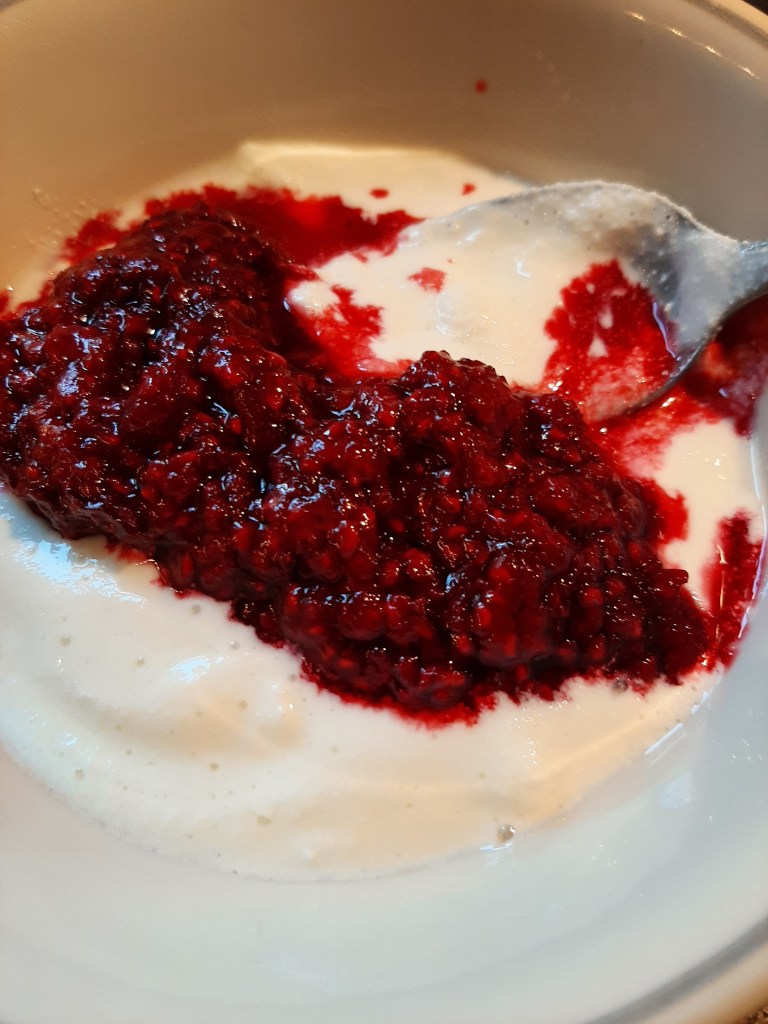
This recipe is fairly straight-forward. Just mix equal weights of raspberries and sugar. Bring it to a boil. Boil, stirring constantly, for 2 to 3 minutes. The result is a delicious raspberry mixture with the texture of a thin jam or thick fruit soup. For a modern take, try it mixed with yogurt or oatmeal.
Sources:
—–. Martha Washington’s Booke of Cookery and Booke of Sweetmeats. (A Family Manuscript, Hand written circa 17th century. Transcribed and annotated by Karen Hess, New York: Columbia University Press, 1995).
Townshend, John. The Universal Cook or Lady’s Complete Assistant. S. Bladon: LOndon, 1773 (facsimile).












 BRIC-A-BRAC