Fricassee

Such a delightful word–it rolls off the tongue with a musical quality and promises of a tasty treat. Used both as a noun (a fricassee) and a verb (to fricassee), the word is relatively old, appearing as early as 1490 in French cookbooks, and by 1568 in England, but its origin and etymology are surprisingly brief. It is speculated that it is a portmanteau word combining the French ‘frire’ -to fry with French ‘casser” to  break. Perhaps that accounts for some rather gruesome connotations the word has acquired.

First, there is Jonathan Swift’s Modest Proposal, which is anything but modest. In his biting satire of the English mishandling of Irish economy, he claims a fricassee or stew of the very young children of the poor would help solve the problem of poverty in Ireland. I can’t help but think of this preposterous idea whenever I hear of a recipe for fricassee.

While real recipes for fricassees usually call for chicken not children, one can’t ignore the giant in Jack and the Beanstalk. Was he thinking of fricassee when he said,  “Fee Fie Foe Fum, I smell the blood of an Englishman, be he alive or be he dead, I’ll grind his bones to make my bread.” You might ask, what does this have to do with fricassee?

Well, although grinding young Jack’s bones is the more common rendition of the rhyme, I’ve always heard it as ‘break his bones to make my bread.’ The connection becomes clearer when you consider the recipe in Martha Washington’s Booke of Cookery, for Frykecy (40). After killing and flaying the animal hot, the cook is instructed to break the bones of a chicken or hare with a pestle. To be fair, ‘break bones’ in cookery can mean dismember or cut apart, though I’m not sure exactly how that is done with a pestle. It seems a fairly violent method of cooking, rather in line with the giant’s idea.

So what exactly is a fricassee? It is a sort of stew made with cut up meat, and fried before it is stewed (or sometimes stewed before it is fried). It is usually made of chicken or rabbit, with varying spices. Early fricassee recipes use egg yolks to thicken the gravy. Later recipes use flour. In the 17th century fricassees could be made of eggs, lambstones, veal, or sweetbreads, or even chicken-peepers (which are young chickens) and pigeons, head and all. By the 18th century, the more familiar fricassee appeared. These recipes leave out the heads and innards and thicken the gravy with a bit of flour to help stabilize it.

So in spite of all the gruesome connotations, fricassee today is as delightful to eat as it is to say.

A modern fricassee (based on Fricasseed Chicken, Brown from Child, 54)

(Note that often cooked poultry  in the 18th century was meant to be served as white as possible (see turkey blog) This recipe browns the chicken pieces first. It is followed by a recipe called fricasseed chicken, white.)

A modern fricassee (based on fricasseed chicken, brown)
(Note that often cooked poultry  in the 18th century was meant to be served as white as possible (see turkey blog) This recipe browns the chicken pieces first. It is followed by a recipe called fricasseed chicken, white.)

1 chicken or about 8 pieces of chicken
1 onion
About 3 T. butter
About ½ c. flour
1 t. Salt
½ t. Pepper
1 t. Crushed marjoram
2 t. Crushed sage

Cut up a chicken into serving size pieces (legs, thighs, wings, etc.) Wash and dredge the chicken in a mixture of flour, salt, and pepper. Fry them in butter along with 1 chopped onion.
When the chicken is browned, remove it. Add 2 cups of water or broth to the pan, along with marjoram and sage. Bring to a boil. Mix 2 T. of the flour left from dredging with 2 T. water to make a roue. Add the roue to the pan, stirring constantly. Boil 1-2 minutes. Turn the heat down to simmer. Put the browned chicken back in the pan and simmer 20-30 minutes.

Recipes for Fricassee can be found in Martha Washington’s Booke of Cookery (pages 40 and 44) and in The American Frugal Housewife p. 54, among other cookbooks.

Child, Lydia Marie. The American Frugal Housewife. Dedicated to those who are not ashamed of economy. 12th Edition. Boston: Carter, Hendee, and Co. 1833. (First published 1828)

—–. Martha Washington’s Booke of Cookery and Booke of Sweetmeats. (A Family Manuscript, Hand written circa 17th century. Transcribed and annotated by Karen Hess, New York: Columbia University Press, 1995)

On Farming and Foraging

It’s a really good thing I’m not a farmer.

If I were, I’d starve.  

However, I do dabble a bit in gardening, and I love experimenting. So a few years ago, I decided to grow wheat. After all, I bake all my own bread from scratch. Why not try to make a loaf really from scratch–starting with wheat seeds? 

Besides the appeal of trying something new, I had acquired a small packet, about a tablespoon, of einkorn wheat seeds from a gardening program I attended. Einkorn is an ancient grain, thus even more appealing to my sense of food adventure. I couldn’t let such bounty go to waste.

The first step, preparing the ground and planting the seeds was fairly easy. I took out all the weeds and grass shoots from a 6 x10’ patch of ground in our garden, and placed the seeds neatly in 3 rows. The planting instructions said this was winter wheat, so I planted in the fall, and let it rest over winter. I have to admit I wondered if mice, rabbits, or birds would find all the seeds before they were covered in snow, but I needn’t have worried. 

Come spring, tiny green shoots poked up through the dirt in all my rows. Though heartening, this was the beginning of my trouble. Not only did shoots pop up in the rows, but all over the entire patch. At that point, I realized I didn’t actually know what wheat looks like while growing. My knowledge of wheat stemmed mostly from childhood. We had a slender grass-like weed in the backyard in California. This weed developed a lovely, pale green head of seed kernels. My sisters and I called it miniature wheat, because it grew only about 8 “ high. We loved to harvest it and feed it to our dolls and Breyer model horses.( Once, we even tried cooking and eating it ourselves, but that was not worth trying a second time.) In any case, I knew enough to recognize my memories of miniature wheat weren’t an adequate guide. I looked up wheat pictures on the internet, but only found mature wheat. Since I couldn’t tell what was weed and what was wheat among the shoots, I didn’t pull up anything. By the time I actually could tell what was wheat and what wasn’t, the weeds were nearly as tall as the wheat. I worried that I would pull up the wheat along with the weeds. I did the best I could, and the wheat did the best it could under the circumstances.

Eventually, I could see it was getting close to harvest time. The wheat was starting to look rather golden, like the pictures of wheat fields I’d seen. I figured I’d gather it in just a few more days.

Unfortunately, the local birds knew more about wheat than I did. They did their own harvesting before I got there. I did manage to glean a bit of wheat from what the birds left behind. My total harvest: about 2 tablespoons of wheat, perhaps twice the amount that I had sown.  

Obviously this wasn’t enough to make a loaf of bread, but I’m stubborn. I wanted to make at least a little flour. However,  that presented another challenge. I don’t have a threshing floor or a flail to beat the wheat and remove the hulls. I tried crushing it with a mortar and pestle, without success. The seeds just rolled around. Finally, I tried a rolling pin. That worked nicely to crush the hull, but it also crushed the kernel.  I feared winnowing it in a traditional way (tossing the threshed grain into the air and letting the chaff blow away) would lose everything. Instead I sifted the crushed wheat. The result was just over a teaspoon of very fine flour. (No need to grind this wheat- the rolling pin took care of that.)

What to do with one teaspoon of flour? Well, this spring we found only one morel mushroom. There was just enough flour to sprinkle on the mushroom and fry it. My husband and I each had two delicious bites. 

Maybe I should leave both the farming and the foraging to those who know how to do it.

Pudding or Gruel? You decide.

Imagine there is someone sick in your household. Do you feed them pudding or gruel? 

This may be harder to decide than you realize. A look at the history of each dish may help.

First: Gruel

Such an ominous, even cruel word. It conjures feelings of want and deprivation. I can’t help thinking of poor Oliver Twist, pathetically asking for ‘more’. But what exactly is gruel?

Gruel has meant a lot of things over the centuries and hasn’t always been seen with such a negative view. Etymonline gives a twelfth-century definition as fine flour or meal made of lentils or beans. According to the Oxford English Dictionary, from the 14th century, gruel is a light, liquid food, made with ground grain such as oatmeal, boiled in water or milk. Oats, wheat or barley were all considered suitable grains. Recipes in the middle ages often suggest adding meat, onions, spices, sugar, or almonds. When English colonists came to the Americas and learned about corn, that grain was added to the list of those suitable for making gruel. By this time, gruel was noted as a good food for invalids, nourishing for someone too sick to eat regular food. 

Unfortunately, it is also easy to stretch the grain by adding more water until the resulting gruel is thin, tasteless, and bland, more like a thin soup. By the 19th century, ‘take one’s gruel’ came to mean ‘take one’s punishment’ and ‘to gruel’ was ‘to punish’. Later in the century ‘gruelling’ as an adjective came into play, meaning exhausting, physically difficult, or punishing.

And so the bland but nutritious aspect of gruel morphed into the thin, watery mess we find so unappetizing.

Next we come to pudding. Here’s a word to conjure all that is good to eat. It was an essential holiday treat for Mrs. Cratchit and still is a lunchbox favorite. Of course, Mrs. Cratchit’s pudding is a far cry from the sugary custard found in pudding cups, and even further from the original puddings. So what exactly is pudding?

Back in the 14th century, pudding referred to the stomach or intestines of a cow or sheep. This was often stuffed with meat and oatmeal. So at that time, pudding meant something like sausage. By the 16th century, pudding meant any soft food, generally some vegetable mixed with grain and boiled in a bag. Gradually pudding became more and more like porridge, and  porridge originally made of pureed vegetables (think of pease porridge hot) became more grain based. Like with gruel, the pudding/porridge often had other things added, like raisins, spices, and especially, sugar. 

Though the earliest cooking methods for pudding and gurel were different, the ingredients for gruel and pudding are surprisingly similar.  For instance, take a look at the following recipes.

Recipes for gruel:

Gruel 

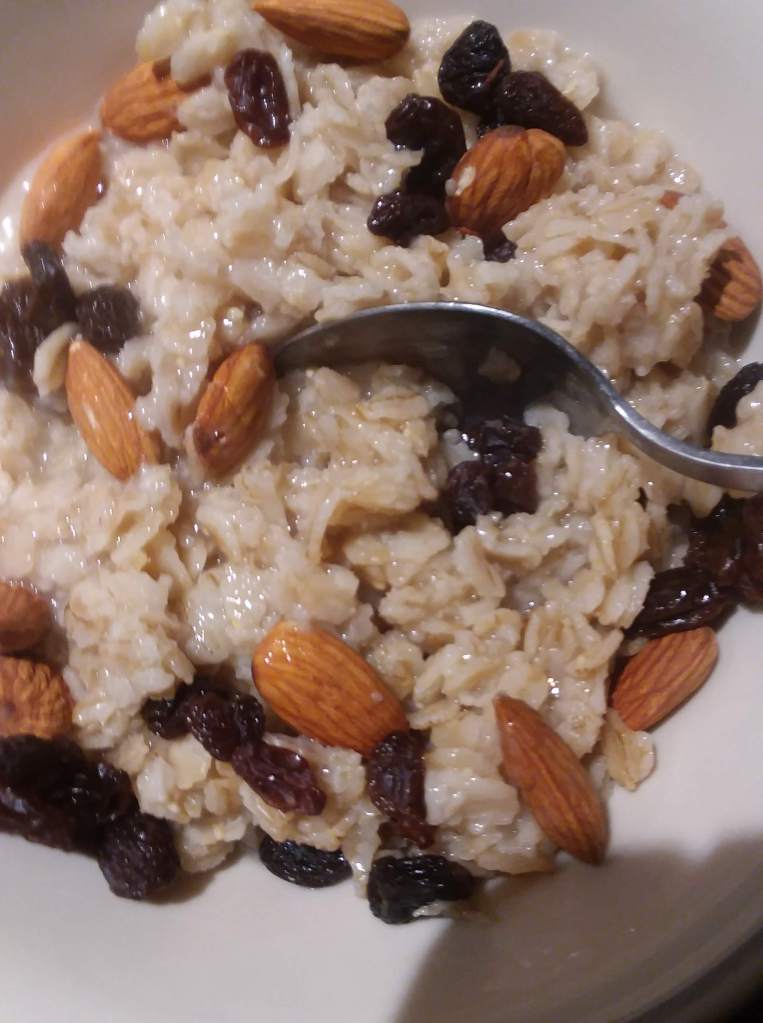
Gruel is very easily made. Have a pint of water boiling in a skillet. Stir up three or four large spoonfuls of nicely sifted oatmeal, rye, or Indian, in cold water. Pour it into the skillet while the water boils. Let it boil eight or ten minutes. Throw in a large handful of raisins to boil, if the patient is well enough to bear them. When put in a bowl, add a little salt, white sugar, and nutmeg .

Child, 36

(Note Indian refers to corn meal. This is nearly identical to the recipe found on the box for modern corn meal. Oatmeal porridge is also still made in the same way, though it is no longer called oatmeal gruel).

The barley gruel in Martha Washington’s Booke of Cookery is a bit richer, adding cream, sugar, mace, eggs and rose water to the basic gruel. (136)

Egg Gruel is even less like the tasteless images we have of gruel. Lacking any grain at all, the result is more like a warm eggnog or soft custard, and is quite delicious.

Egg Gruel

This is at once food and medicine. Some people have great faith in its efficacy in cases of chronic dysentery. It is made thus: Boil a pint of new milk; beat four new-laid eggs to a light froth, and pour in while the milk boils; stir them together thoroughly but do not let them boil; sweeten it with the best of loaf sugar, and grate in a whole nutmeg; add a little salt if you like it. Drink half of it while it is warm and the other half in two hours.

Child, 31

Now compare the gruel recipes to pudding recipes from the same sources:

Make White pudding

Take 3 pintes of milke & when it is boyled, put in tw quarts of great oatmeale bruised a little, & stirr it over ye fire till it be ready to boyle. Then take if of & cover it close all night. 3 pound of suet minced small, put in wth 3 grated nutmegs, ye oulks of 8 eggs, 2 whites, & a littel rosewater, a pound of sugar and a litel grated bread, currans, & creame as you think fit. This quantity will make 3 or 4 dosin.

Martha Washington’s Booke of Cookery, 106

(Note this is really a recipe for pudding stuffing, that is the mixture to be stuffed into  a sausage  skin. It is much thicker than gruel, but uses many of the same ingredients.)

The main difference between Mrs. Child’s pudding and her gruel is  the cooking time and method, and the proportion of meal to liquid. Her pudding is much thicker than her gruel, more like stiff cake–think plum pudding.).  

Here’s her recipe for boiled Indian pudding:

Indian pudding should be boiled for four or five hours. Sifted Indian meal and warm milk should be stirred together pretty stiff. A little salt, and two or three great spoonfuls of molasses added; a spoonful of ginger if you like that spice. Boil it in a tight covered pan or a very thick cloth; if the water gets in, it will ruin it. Leave plenty of room; for Indian swells very much. The milk with which you mix it should be merely warm; if it be scalding, the pudding will break to pieces. Some people chop sweet suet fine, and warm in the milk; others warm think slices of sweet apple to be stirred into the pudding. Water will answer instead of milk.

Child, 61

Both books have recipes for sweetened gruels and sweet puddings.

Martha Washington’s Booke of Cookery also has recipes for all kinds of meat puddings, curd puddings, almond puddings and rice puddings, etc. The almond and rice puddings have sugar added, but the majority of her puddings  are not sweet. Mrs. Child on the other hand, has recipes for apple, cherry, and other fruit or custardy puddings, none of which are savory. 

So will it be pudding or gruel? Maybe we can have it both ways. For many English speakers world-wide, pudding has come to mean any kind of dessert. In this time of rampant virus, many people find themselves eating and cooking more than ever before.  Perhaps we should all start making gruel for our pudding.

Sources:

Child, Lydia Marie. The American Frugal Housewife. Dedicated to those who are not ashamed of economy. 12th Edition. Boston: Carter, Hendee, and Co. 1833. (First published 1828)

—–. Martha Washington’s Booke of Cookery and Booke of Sweetmeats. (A Family Manuscript, Hand written circa 17th century. Transcribed and annotated by Karen Hess, New York: Columbia University Press, 1995).

The Compact Edition of the Oxford English Dictionary (OED): Complete text reproduced micro graphically. Oxford University Press, 1971. Volume 1, 2. 

Of Cleaning and Coughing and the like…

Colonial women did not know about germs or viruses, but they did know about pests and vermin. Housewives were expected to keep the home clean and provide first aid for common illnesses. Many cookbooks of the day included recipes for home remedies along with cleaning advice. As we face  the current pandemic with widespread shortages of some cleaning products, I thought it useful to take a look at how our foremothers coped. (Please note that any medicinal information in this blog is not meant to be medical advice. I cannot vouch for the efficacy of any ancient or colonial remedy.)

Homemade lye soap

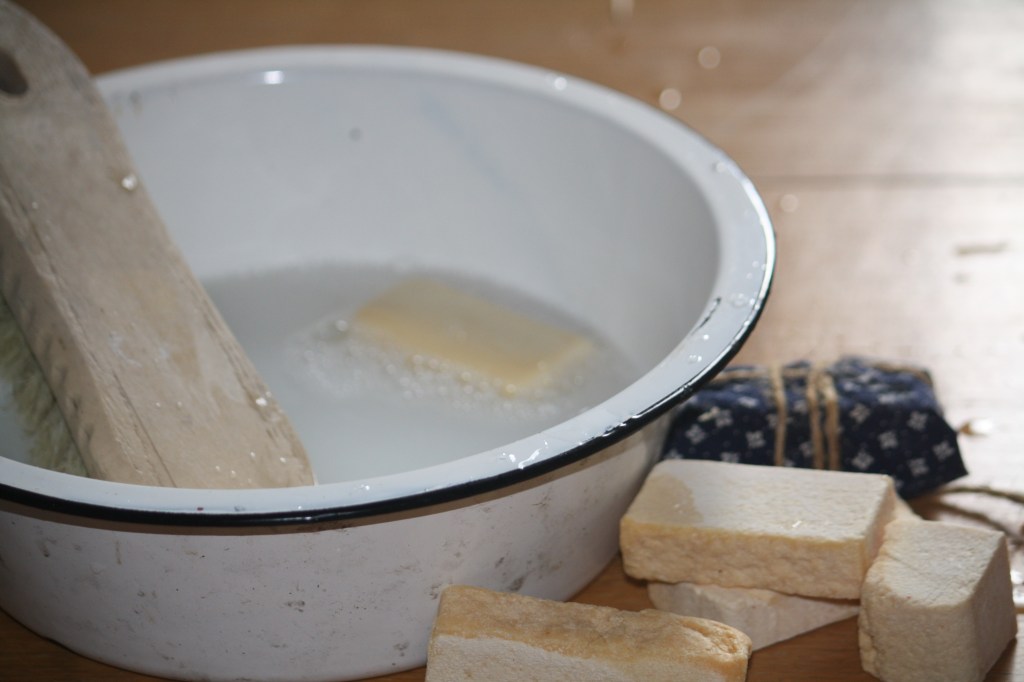
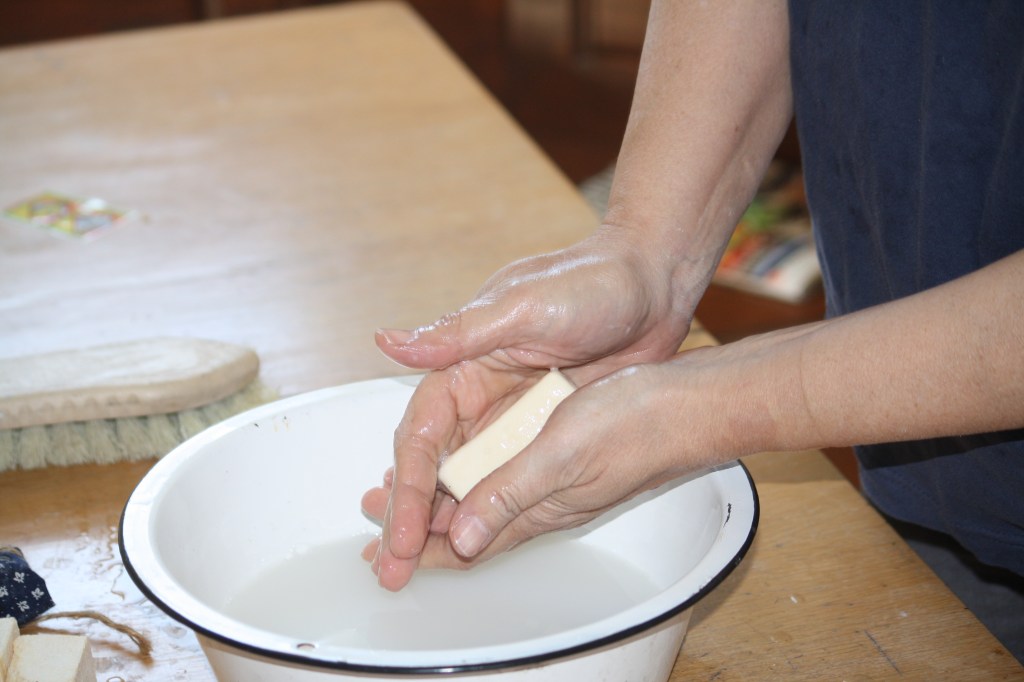
Soap and Washing: It has always surprised me that soap is made from two very ‘dirty’ substances. To make soap, you use grease and lye. Lye is made from water dripped through wood ash. The end result is a very effective cleaner. You might think that lye soap would be harsh, but the stuff I made is gentle and not at all hard on the skin. Many households made their own soap, and so soap recipes are included in nearly every cookbook. Mrs. Child claims it is more economical for people in the city to exchange grease and ashes for finished soap ,but those living in the country should make their own (22). Still, such soap is mostly used for washing clothing, hands, and dishes. Hair should be washed in New England Rum to keep it clean and free from disease (12). Perhaps in her day, rum was cheaper than it is today.

Vinegar: Widely used since ancient times, vinegar has both cleaning and medicinal properties. It cuts grease and helps preserve foods because it slows the growth of bacteria. As one of the first medicines, it was used for treating wounds and infections in Biblical times. As early as 400 B.C. Hippocrates claimed vinegar had therapeutic properties. In the seventeenth century, ladies carried vinegar-soaked sponges to mask the smell of garbage in the streets. Even today, vinegar is recommended for treating rashes and some bug bites. Mrs. Child suggests buying vinegar by the barrel or half-barrel, and adding old cider, wine settlings, or sour beer to the barrel to make it last longer, though care must be made not to add too much at a time (15-16). In times of plague, coins might be dropped in vinegar for disinfecting before handling. So, if you are having trouble finding Lysol, bleach, or other cleaners, you might just try vinegar.

Pests and Vermin: Mrs. Child has advice for keeping pests out of the house. To get rid of cockroaches, try turpentine (10). For bedbugs, use quicksilver mixed with egg whites and brushed on with a feather (10). Ants are among the worst of the vermin. Mrs. Child suggests luring them to a dish of shagbarks, then putting corrosive sublimate in the dish and painting all the cracks the ants came from with the corrosive sublimate (21). (Corrosive sublimate is mercuric chloride, a toxic, crystalline substance still used as a fungicide and antiseptic.) Not surprisingly, Mrs. Child includes a strong warning that great care should be taken with this substance, especially around children.

The listings above are all ways to promote cleanliness and prevent disease, but even under the best circumstances, disease can spread. (As it has in the last few months.)  Caring for the sick is especially challenging when no one is sure what causes the illness or how to treat it. In the 18th century, the old ideas of the four humors (blood, phlegm, yellow bile and black bile) were changing, but many of the remedies were still based on balancing the humors, or pairing things that are hot and dry with those that are cold and moist.

Fever: To prevent fevers, Mrs. Child recommends the constant use of malt beer (28), though I suspect constant beer drinking would hide a fever rather than prevent it. More useful perhaps is her entire section on the use of herbs as remedies for nearly everything. Catnip tea is thought to prevent fevers, while sweet balm tea can be given to cool a fever (37). According to the theory of humors, a person suffering from a fever should be given cooling foods, like lettuce, melon, or vinegar (Martha…, 207). White quince jelly was considered an effective remedy for fever (Martha…, 230). One of the best known and generally effective herbal remedies is willow bark tea, which has been used throughout China, Europe and the Middle East since before 400 BC. Hippocrates wrote that chewing on willow bark helps relieve pain or fever. Indeed, willow bark tea is still sold today to relieve pain and inflammation. Willow bark contains salicins (similar to aspirin)  and other anti-inflammatory compounds. Research has shown willow bark tea is generally effective for reducing pain, but not necessarily fever (“Willow bark”).

Sore throat: Many of Mrs. Child’s remedies for sore throat involve wrapping a poultice around the throat. One such poultice mashes warm apples with tobacco and wine. The mixture is spread on a linen rag and bound around the throat (27). Or else, take a stocking that has been worn all day and is still warm, and tie that around the neck (26). A third remedy is sugar mixed with brandy. (to be drunk, not used as a poultice.) Inhaling hot vinegar steam is also said to be effective, though care should be taken not to scald the throat (26).

Croup (a lung infection usually caused by a virus) or cough: For croup, Mrs. Child recommends rubbing bear grease or goose grease on the neck. In very bad cases, the warmed grease can be poured down the throat (24) Another recipe, involving camphor, wine spirits, and hartshorn (24) would have a similar effect to the vapor rubs used today. Hyssop tea is said to be  good for lung problems (36). Even better, mix the hyssop with maiden-hair, lungwort, elecampane and horehound to make tea (37). Martha Washington’s Booke of Cookery and Booke of Sweetmeats contains about 90 recipes for medicinal waters and syrups, including ‘sirrup of hyssope’ and ‘sirrup of horehound’ (375-376). 

In the modern world, we have stronger, often more reliable, medicines, along with more complete knowledge of how the chemicals work. We can go to a trained pharmacist and get a stable prescription with known qualities and precise dosages. Householders no longer have to grow their own herbs and distill their own medicines. Even so, it is worthwhile to remember some of the older remedies. You can still buy horehound cough drops (horehound candy) or try making horehound syrup.

A simple Horehound syrup recipe:

…take horehound, violet leaves, and hyssop, of ech a good handful, seethe them in water, and put thereto a little saffron, liquorice, and sugar candy; after they have boiled a good while, then strain it into an earthen vessel, and let the sick drink thereov six spoonful at a time morning and evening…” (Markham, 23).

Final parting advice: Today, times are hard. The pandemic is disrupting life world-wide. Our fears for our health are exacerbated by worry over the collapsing economy. In such times, I find a glance at history can provide a calming perspective. Consider these words, written by Mrs. Child in 1833: “Perhaps there never was a time when the depressing effects of stagnation in business were so universally felt, all the world over, as they are now.” (108)

Our forebears survived that crisis. I have no doubt we shall survive our own.

Wash your hands…

Sources:

Child, Lydia Marie. The American Frugal Housewife. Dedicated to those who are not ashamed of economy. 12th Edition. Boston: Carter, Hendee, and Co. 1833. (First published 1828)

Markham, Gervase. The English Housewife. [originally published 1615], edited by Michael R. Best McGill-Queen’s University Press:Montreal] 1994, Chapter 1, recipe 88 (p. 23) (retrieved from Food Timeline: http://www.foodtimeline.org/foodcandy.html#horehound)

—–. Martha Washington’s Booke of Cookery and Booke of Sweetmeats. (A Family Manuscript, Hand written circa 17th century. Transcribed and annotated by Karen Hess, New York: Columbia University Press, 1995).

“Willow Bark”. Penn State Hershey. Milton S. Hershey Medical Center. http://pennstatehershey.adam.com/content.aspx?productId=107&pid=33&gid=000281

The Dark Side of Nutmeg

In many ways the world of today was shaped by Europe’s desire for the ‘exotic’ spices of Southeast Asia and the Spice Islands. The quest for the control of this trade sent Portuguese, Dutch, and British explorers to all corners of the world and led to widespread colonization of distant places. Unfortunately, the thought of great gain tempted (and still tempts) people to commit great evils in the name of commerce.

Nutmeg is the classic example of this greedy quest. Although today nutmeg is second only to cinnamon as a flavoring in baked goods and drinks, centuries ago it was worth more than its weight in gold. From the seed of a tropical evergreen tree come two spices: the inner kernel is nutmeg and the thin casing on the seed is mace.The nutmeg tree is native to Southeast Asia and was specifically cultivated by the inhabitants of the Banda Islands. The Bandanese had developed important trade connections throughout SE Asia and traded regularly with both Indian and Arab traders.

As early as the 12th century Europeans valued nutmeg for its medicinal properties. The abbess, Hildegaard of Bingen discussed it, and doctors considered it helpful in balancing the body’s humors. (According to medical knowledge of the time, health depended on balancing the four humors.) As a ‘hot food’ nutmeg could mitigate the effects of cold foods like fish and vegetables. In very large quantities, nutmeg is also a hallucinogenic. It was thought to be able to ward off the common cold and even bubonic plague.

However, even though cooks, physicians, and rich people knew quite a bit about the benefits of nutmeg, no one had a clear idea of where it came from. Europeans obtained their nutmeg from Venice after the spice had been brought there by Arab traders. It wasn’t until 1511 that the Portugues ‘discovered’ the Banda Islands as the source of nutmeg. They didn’t have a large enough force at that time to take over the trade, but they could at least break up the Arab monopoly on the European market. The Portuguese tried to establish a fort on Bandaneira Island, but failed. Instead they bought nutmeg and other spices from the local growers or middlemen, paying fair prices. This system worked well for all involved for nearly a century. 

Then the Dutch came into the area. They were not interested in sharing the market. They wanted to dominate and reap all the profits. The Bandanese were used to trading with Arab, Indian and Portugues traders for practical goods like silver, medicines, certain foodstuffs, Chinese porcelain, copper or steel). They had no need for heavy woolen cloth, damask or the other Dutch items that were worthless in the tropics. The Dutch, however, were persistent in their demands. In 1609 they forced some of the Bandanese elites to sign the Eternal Compact giving the Ducth East India Complan exclusive rights to the spice trade in Banda. At the same time the Dutch strengthened Fort Nassau, their stronghold on one of the Banda Islands. The Bandanese largely ignored the treaty, that only a few of the leaders had signed. When the Dutch tried to build a fort on the island, the Bandanese killed the Dutch Admiral and several of his officers.

Meanwhile, the British were also fighting the Dutch in the area. Through the early 1600’s the two European forces had several battles with lots of death on both sides, but the Dutch eventually won, mostly driving out the British except for one small island called Run Island. 

By 1621, the Dutch wanted a more secure and more profitable hold on the nutmeg trade. Dutch forces invaded Bandaneira on the pretext that there had been treaty violations. What followed was genocide. By the end of the fierce and bloody fighting, some 14,000 Bandanese were slaughtered, leaving somewhere around 1000 natives. Many of these people were enslaved. The Dutch divided the islands into plantations, brought in slaves from other places and took complete control of the nutmeg production, selling nutmeg at about 300 times the production costs. The enslaved Bandanese, with their knowledge of nutmeg cultivation, were important in this new system, but kept in limited positions by the Dutch. Some of the remaining Bandanese escaped and established communities on nearby islands. Some of them even became nutmeg smugglers. This system lasted about 45 years.

By 1665-67, during the second Anglo Dutch war, the British remained in control of Run Island one of the smallest of the Banda island, but nevertheless important enough to prevent the Dutch from having a complete monopoly. Through the Treaty of Breda at the end of the war in 1667, The Dutch traded the island of Manhattan (considered distant and worthless at the time )for the Island of Run. Finally the Dutch had a complete nutmeg monopoly, which they kept for about 150 years. During this time cooks at all but the poorest levels of society from Europe and the Americas prized nutmeg and used it in everything from cookies and puddings to fish pies and mincemeat.

Finally during the Napoleonic wars from 1803-1815, Britain had an excuse to attach the Dutch at Fort Nassau on Bandaneira because the Dutch were part of Napoleon’s empire and, therefore, enemies to the British. British troops captured the Dutch fort in 1810 and held it until 1814. During this time the British developed nutmeg cultivation in many other British held colonies in Southeast Asia and in the Caribbean. By the time the Dutch regained control of the Spice Islands, nutmeg was no longer the scarce commodity it had been.

There’s a pretty good chance that the nutmeg you sprinkle on your French toast or your eggnog came from Southeast Asia. Indonesia is still the largest producer (up to 50%) of the world’s nutmeg. It’s heartening to think that just as the Dutch monopoly on nutmeg eventually failed, so did their attempt to wipe out the Bandanese. Bandanese culture, language, and traditions still exist in these islands. And the nutmeg they first cultivated still tempts palates worldwide.

Guy Fawkes and Shrewsbury Cakes

This week, on November 5th, parts of the British empire celebrated a curious holiday: Guy Fawkes Day. The day is marked with parades, bonfires, the burning of an effigy, and children begging for “a penny for the guy.”  Though I’ve paired Guy Fawkes with Shrewsbury Cakes, in reality the two have nothing to do with each other beyond the fact that both existed in the early 17th century. Let’s start with Guy Fawkes, the unfortunate man for whom the day is oddly dedicated.

Guy Fawkes was Catholic in Prostestant England. As such, he joined with a group of dissenters who wanted to get rid of the Protestants and restore a Catholic monarch to the throne. In 1605, these misguided men decided the best way to accomplish this was to blow up Parliament on a day when King James and his son would be there. This was not Guy Fawkes’ idea, nor was he any kind of leader in the plan. He was a flunky whose task was to guard and then set alight the gunpowder which had been secreted in the cellars under Parliament.  Fortunately for Parliament and the king, the plot was discovered and thwarted. Unfortunately for Guy, he was the conspirator who was caught. He was tortured until he revealed the names of the co-conspirators. Then he was executed (hung, drawn, and quartered.) Most of the others were then rounded up and executed as well.

Today we would call this Gunpowder Plot the act of a terrorist group. In their defense, Guy and his associates did not consider themselves either traitors or terrorists. They were only trying to see justice done and fight for religious freedom.

That is to say, their own religious freedom, not anyone else’s. They were as willing to jail, torture and execute Protestants as the Protestants were willing to suppress Catholicism (or ‘popery.’) In the United States today, where interfaith councils are common, and Christians often share a meal with non-Christians, it is hard to imagine the hostility between Catholics and Protestants 300 years ago. During Guy Fawkes’ life, the monarch was Protestant and the persecution of Catholics was severe. It was illegal to attend Mass, and refusing to go to Protestant services resulted in heavy fines and other punishments. During the reign of Elizabeth I, many Catholic priests were executed. Because James I’s mother (and possibly wife) had been Catholic, the beleaguered Catholics of England hoped for a change when James ascended to the throne in 1603 after Elizabeth I died. But James ordered all priests to leave England, said Catholicism was mere superstition, and continued the persecution of Catholics. The famous Gunpowder Plot was one of many unsuccessful attempts to oust James and get a Catholic monarch.

After the foiled plot was discovered, the kingdom celebrate James escape with bonfires. Some communities burned effigies of the Pope. Later, effigies of Guy Fawkes were burned.

This lack of religious tolerance continued well into the 19th century, by which time the 5th of November was securely established as a National Holiday, celebrated with fireworks and bonfires.

Now, you might ask, what does tall his have to do with Shrewsbury cakes?

Not much really, but in my mind the two always go together. For many years I taught Macbeth in my high school English classes. Macbeth was a play Shakespeare wrote to please James (complete with a warning of the chaos engendered by regicide.)  In order to develop more interest in Shakespeare’s works, I talked about James, and Guy Fawkes, and I brought cookies or ‘byskettes’ for the class. (see blog post for Applemoyse https://bricabrac164.wordpress.com/2019/10/11/applemoyse/)

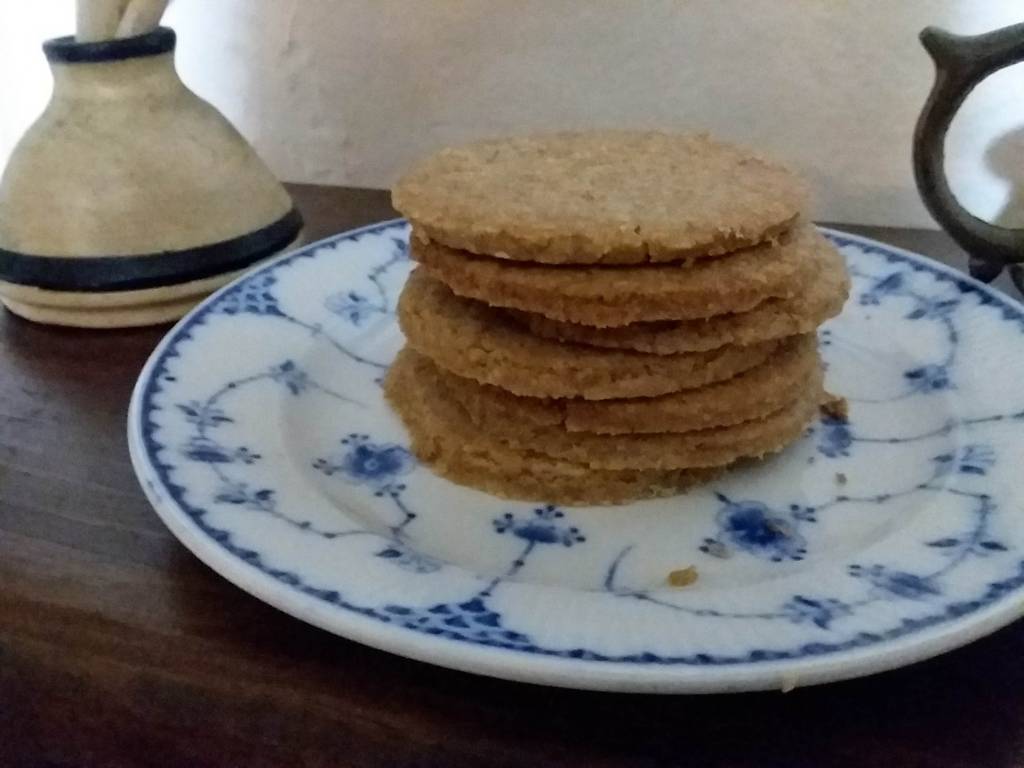
Shrewsbury cakes, to be exact, because I have great medieval recipes for Shrewsbury cakes. Though there are many versions, a Shrewsbury Cake during the 16th and 17th centuries was a spicy shortbread cookie. This was a medieval food that students invariably liked.

John Murrel, wrote the following recipe  in A daily exercise for Ladies and Gentlemen, … (1617) (reprinted p. 317 in Dining with William Shakespeare and in Sallets, Humbles, and Shrewsbury Cakes, p, 64).

Take a quart of very fine flower, eight ounces of fine sugar beaten and ciersed, twelve ounces of sweete butter, a Nutmegge grated, two or three spoonefuls of damaske rose-water, worke all these together with your hands as hard as you can for the space of halfe an houre, then roule it in a little round Cakes, about the thickness of three shillings one upon another, then take a silver Cup or glasse some foure or three inches over, and cut the cakes in them, then strowe some flower upon white papers and lay them upon them, and bake them in an Oven as hot as for Manchet, set up your lid till may tell a hundreth , then you shall see them white, if any of them rise up clap them downe with some cleane thing, and if your Oven be not too hot set up your lid again, and in a quarter of an houre they will be baked enough, but in any case take heede your Oven be not too hot, for they must not looke browne but white, and so draw them foorth and lay them one upon another till they be could, and you may keep them half a yeare, the new baked are best.

Modern Version: Shrewsbury Cakes

  • ½ c. white flour
  • 1/2 c. whole wheat flour
  • 1/2 c. butter or margerine
  • 1/4 c. white or brown sugar
  • 1/2 T. ground nutmeg
  • 1/2 T. rosewater (or vanilla)

(Note that the proportion of sugar to flour in the modern version is less than the original, but I find the original is too sweet. For sweeter cookies, double the sugar)

Cut the butter into the flours,nutmeg, and sugar as for pie crust. Sprinkle the rose water over the mixture. Work the dough just enough to form it into a ball. Roll it out to ⅛-¼ inch thick. Cut in 3 inch circles. Bake for 12 minutes at 400 degrees.

I’m convinced you will enjoy your Shrewsbury cakes as much as my students did. And as you celebrate think of this:

Please to remember 
the 5th of November,
Gunpowder Treason and Plot.
I see no reason 
Why Gunpowder Treason
Should ever be forgot.

Sources:

Beebe, Ruth Anne. Sallets, Humbles, and Shrewsbury Cakes. David R. Godine Publisher, 1976.

Lorwin, Madge. Dining with William Shakespeare. New York: Atheneum, 1976.

Applemoyse

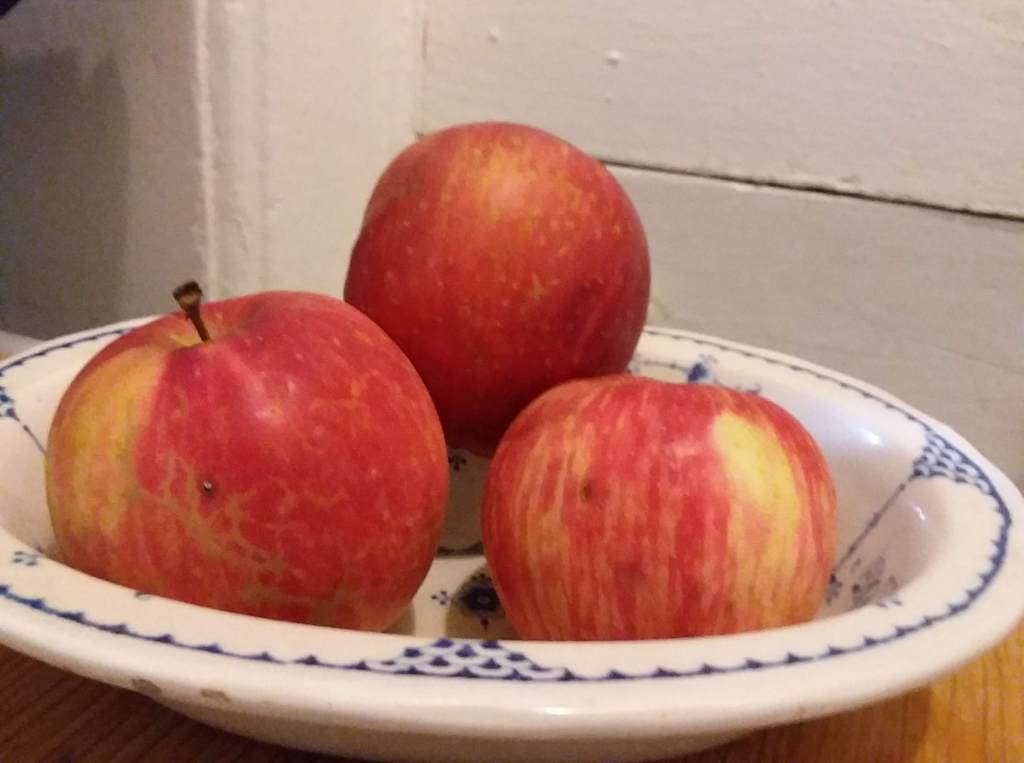
The iconic apple- symbol of hearth and home, health and all good things. America’s favorite fruit, right?

Well, not quite. Americans actually eat more bananas per year than apples, but apples still hold an important place in our food culture.

Indeed, apples have been enjoyed world-wide for thousands of years. They are among the oldest foods cultivated by humans, with more varieties than can be counted. Originally, the apple developed in the Caucasus Mountains. Alexander the Great is said to have found apples in Kazakhstan in 328 BCE.  The earliest apple recipe on record is for a pork and apple dish, attributed to Apicius in De Re Coquinaria (written c. 300 CE, some 200 years after Apicius lived).

In fact, the apple has been so widespread in popularity, it is perhaps not surprising that the Old English word aepel meant any fruit (just as the OE word mete meant any food). This is evident in the names of various other medieval foods: fingeraeppla (finger apples or dates), appel of paradis (banana) and eorthaeppla (earth apple or cucumber). The same thing was true of the Latin word pomun, meaning fruit which become pomme meaning apple in French.

Recipes for apples abound. This fall, with apples plentiful in markets, roadside stands, and the neighbor’s back yard, try this medieval recipe for applesauce. In my mind, it’s much better than bananas.

Take a dosen apples and ether rooste or boyle them and drawe them thorowe a streyner, and the yolkes of three or foure egges withal, and, as ye strayne them, temper them wyth three or foure sponefull of damaske water yf ye wyll, than take and season it wyth suger and halfe a dysche of swete butter, and boyle them upon a chaffyngdysche in a platter, and caste byskettes or synamon and gynger upon them and so serve them forthe.  (from Dining with William Shakespeare p.172, originally from A Proper newe Booke of Cokerye, 1575)

Translation into modern English:

Take a dozen apples and either roast or boil them. Mash them through a strainer, and add the yolks of three or four eggs. As you strain them, flavor them with three or four spoonfuls of damask water (rosewater) if desired. Then season it with sugar and half a dish of unsalted butter. Boil them in a chaffingdish. Sprinkle with biscuits or cinnamon and ginger and then serve.

A modern version:

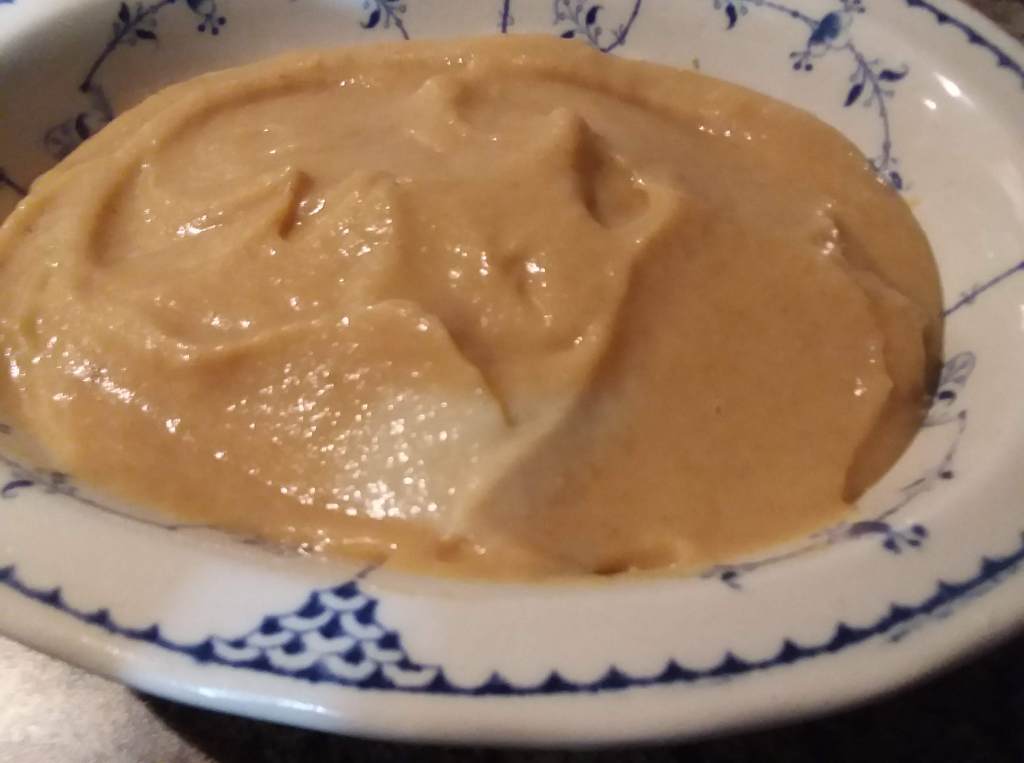
Peel and core 8 apples. Put in a pot with ½ cup water. Simmer until apples are soft. Add ¼ cup brown sugar, 1 t. Ginger, 1 t. Cinnamon and 2 T. rosewater (vanilla may be substituted, but will taste somewhat different). Blend on high speed until smooth. Return to pot and add 2 egg yolks (beaten) and 2 T. butter.  Cook on low heat, stirring occasionally, about 10 minutes until butter is melted and egg yolks have had time to cook. Serve warm or cold, with shortbread cookies or Shrewsbury Cakes.

(Note: byskette is an earlier spelling of biscuit, coming the the Latin for ‘twice-baked.’ In medieval times byskettes were generally flat and crisp, like a modern cracker or hard cookie,  and may or may not have been sweetened. Look for a discussion of Shrewsbury cakes coming in November.)

References:

A Proper Newe Booke of Cokerye.  1575. Imprinted at London in Fleetstreete, by William How for Abraham Veale.

Lorwin, Madge. Dining with William Shakespeare. New York: Atheneum, 1976

The Compact Edition of the Oxford English Dictionary (OED): Complete text reproduced micro graphically. Oxford University Press, 1971. Volume 1. Pages 101-102, 220.

Full of Beans

This post starts with a fair warning: I don’t like beans. With the notable exception of various kinds of green beans (that is, beans with minimal seeds and edible pods), I dislike all types of the actual bean seeds. Dislike is perhaps too mild a word. My mother’s famous bean soup, relished by all other members of my family, always made me gag. I know that beans are nutritious, a valuable source of vegetable protein, and fairly easy to grow. They are eaten with gusto in many parts of the world. The fact remains, however, that in spite of years of trying to learn to like them, I still don’t like beans.

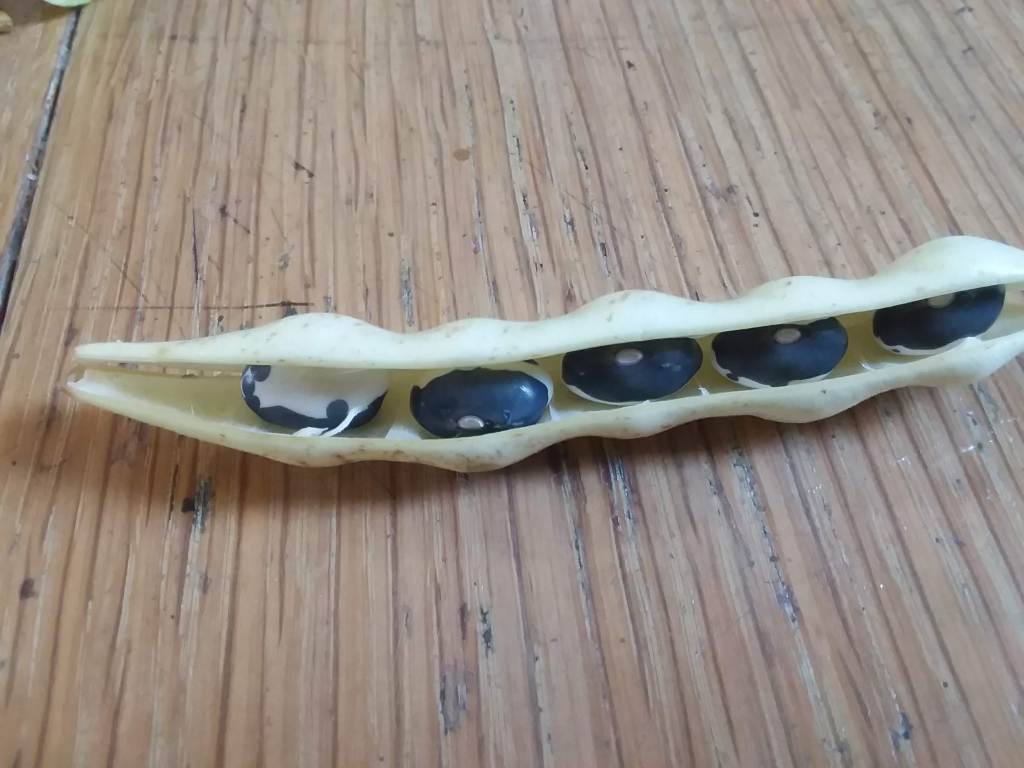
So, you might reasonably ask, why write a blog post about beans? The answer is a bit complicated. Due to vacation travels, benign neglect of the garden, and a misunderstanding, (I thought the beans we planted were green beans) I ended up with a good quantity of beautiful Heritage Calypso Beans. It turns out I hate wasting food even more than I hate beans. So I decided to find a way to cook these beans and enjoy eating them.

Easier said than done. I started by reading up on beans. Beans have been cultivated for thousands of years in both the Old and New Worlds. Broad beans, also called fava beans, were known in Asia, the Middle East, and Europe. The common bean originated in the Americas. Suffice it to say, beans have enjoyed world-wide popularity since ancient times.

With this information in mind, I searched my older cookbooks for bean recipes. Most of the Colonial-era cookbooks suggested cooking beans with pork or bacon. Older, medieval-era books had more variety in method and seasoning.

I settled on three methods of cooking the beans:

1.To Dress Beans and Bacon (18th century)

Mary Randolph suggests using tender, fresh beans (the seed portion), picked in the morning. These are to be boiled with a flitch of bacon, and served with butter. (Randolph p.106-107)

 Child recommends cooking beans with pork, but calls for soaking the beans overnight, and seasoning the pork and beans with pepper. (Child p.51)

Glasse also pairs beans with pork, but insists the two be boiled separately, then served together with butter and parsley, and topped with toasted bread crumbs. (Glasse, p.35-36)

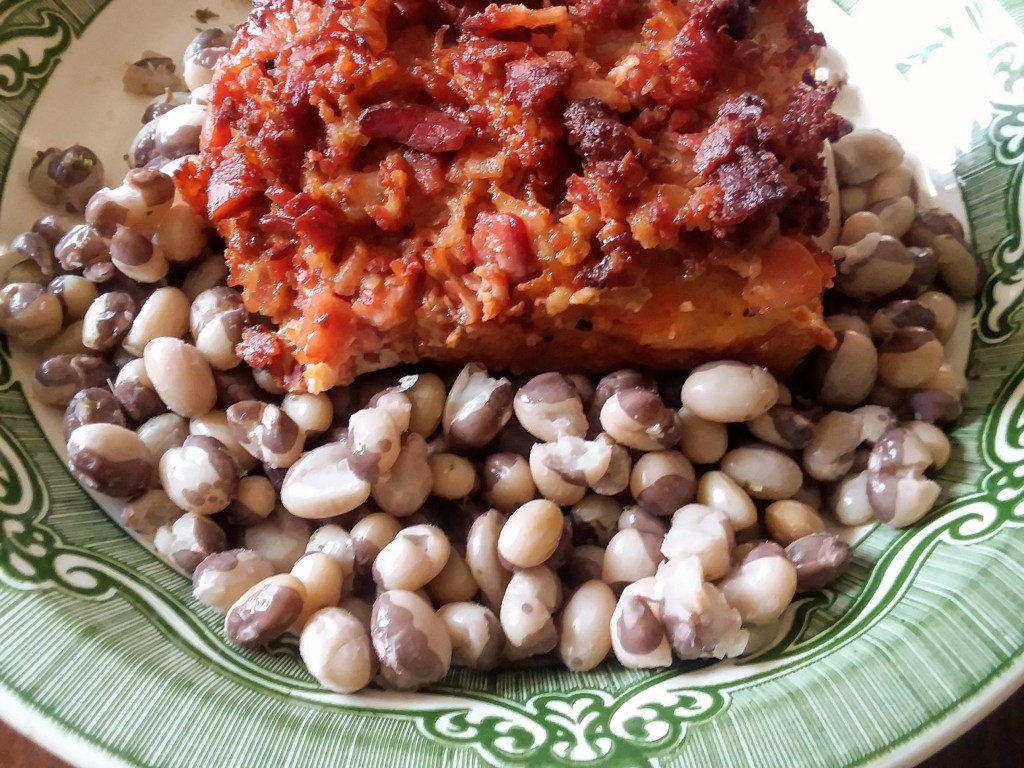
My version: Colonial Pork and Beans

Soak 2 cups fresh Calypso beans overnight. (This step is probably not necessary with fresh beans.)

Boil the beans for 45 minutes, until they are soft.

Meanwhile, roast a pork tenderloin or pork tenderloin crusted with bacon for 1-1½ hours (depending on size)(Note- all the colonial recipes called for boiling the chunk of bacon or pork, but I felt that roasting the meat would produce a better flavor.)

Drain the beans. Add butter and salt to taste. Serve them in a dish with the pork.

The result: This dish was very nice to look at, but the beans still tasted like beans to me. I could eat them if the flavor was disguised with enough of the pork. My daughter, who likes beans, thought the beans were fairly bland this way, and suggested they would be better if the beans and pork or bacon were cooked together.

2. For to make drawen benes (14th century)

“Take benes and seethe hem, and grynde hem in a morter, and drawe hem vp with gode broth; & do oynouns in the broth grete mynced, & do therto; and colour it with saffroun, and serue it forth.” (Curye on Inglysch, p. 98)

My version: Medieval Bean Dip

This is very much like a modern bean dip. 

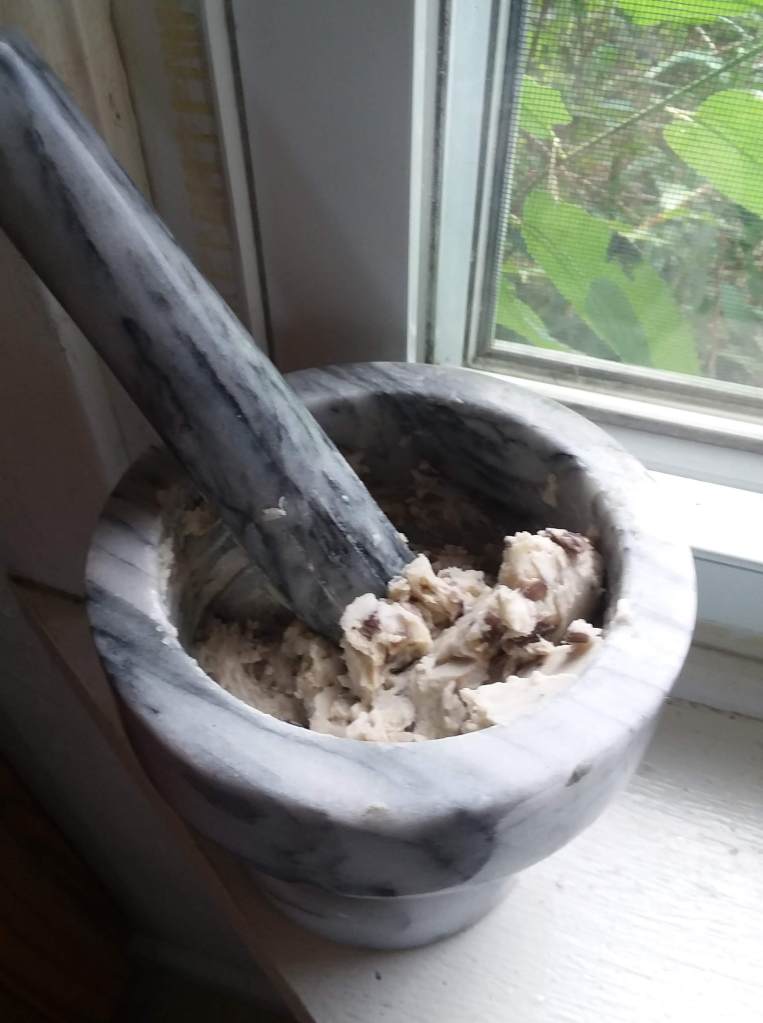
Take 1//2 c. Calypso beans, boiled until they are soft. Mash them well. Simmer ¼ c. chopped onion and a pinch of saffron in 3 T. beef broth. Add the broth mixture to the bean mixture. Season to taste.

The result: This is also a very bland dish with a strong bean flavor.

3. For to make a potage  (14th century)

“Tak wite benes & seth hem in water, & bray the benys in a morter al to nought; & lat them sethe in almande mylk & do therein wyn & hony, & seth reysouns in wyn & do therto & after dresse yt forth.” (Curye on Inglysch, p. 77-78)

My version: A Sweet Bean Soup

A potage is a soup, so I had serious doubts about this recipe, remembering my experience with my mother’s bean soup. However, this recipe is quite different from any other bean recipe, so I was willing to try it.

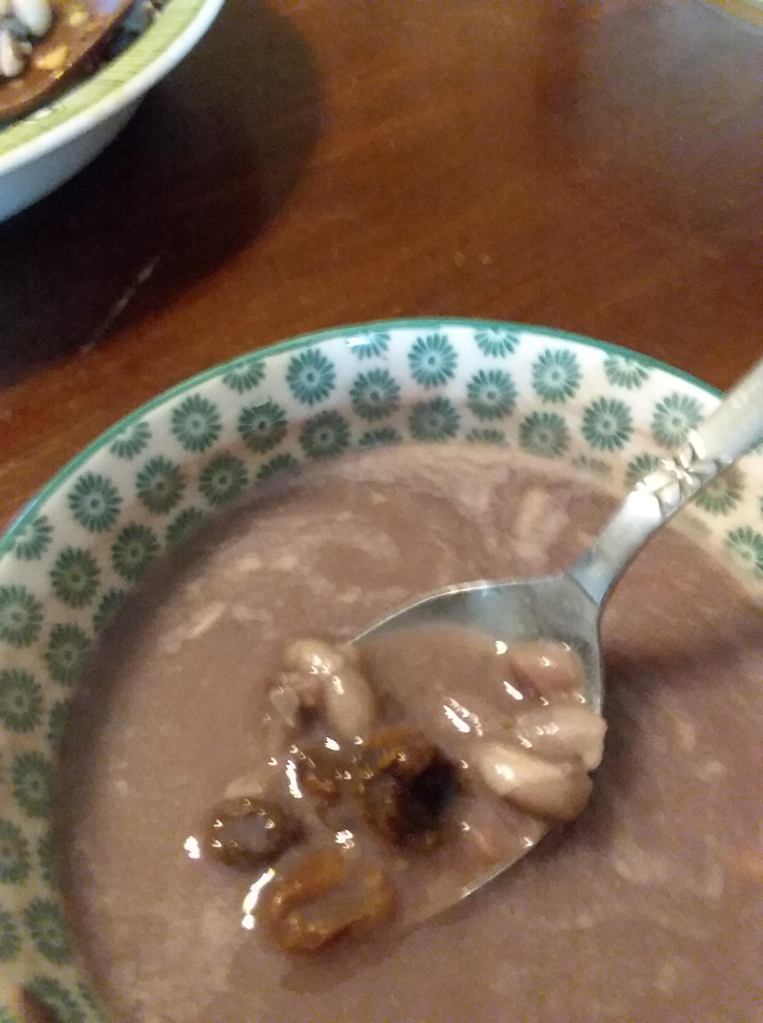
Boil ½ c. Calypso beans until they are soft. Mash them. Stir in 1/2 c. almond milk. Soak ½ c. raisins in ½ c. red wine for 10 minutes. Mix the wine and raisins into the bean and milk mixture. Add !/4 c. honey. Heat and serve.

The result: In this recipe, the sweetness of the honey and raisins completely masked the bean flavor, and I actually liked the dish. Unfortunately, no one else did. 

In the end, my experiment with Calypso beans was only partially successful. Although at least one person liked each of the three dishes, no one begged for seconds. I’m happy to say, none of the beans were wasted. 

But next year, I think I’ll plant green beans.

Sources:
Child, Lydia Marie. The American Frugal Housewife. Dedicated to those who are not ashamed of economy. 12th Edition. Boston: Carter, Hendee, and Co. 1833. (First published 1828)

Curye on Inglysch: English Culinary Manuscripts of the Fourteenth Century (Including the "Forme of Cury") Constance B. Heiatt (Editor), and Sharon Butler (Editor). Oxford University Press; 1st Edition edition, 1985.

Glasse, Hannah. The Art of Cookery Made Plain and Easy: Excelling any Thing of the Kind ever yet published. Alexandria: Cottom and Stewart. 1805. (First Edition publishing in London, 1747. This edition reprint of 1st American Edition, 1805, by Applewood Books, 1997).

Randolph, Mary. The Virginia Housewife Or, Methodical Cook. Philadelphia: E. H. Butler & Co., 1860. (Facsimile by Dover Publications, 1993, with introduction by Janice Bluestein Longone).


Puff Kids and Serendipity

I know it sounds like some sweetened breakfast cereal, but it’s nothing of the kind. You know how one thing leads to another? Making Puff Kids was a classic case of such serendipity.

It started with peaches. I had an abundance and decided to look for a colonial recipe to use them.  I found a promising recipe for peach preserves in Mary Randolph’s . At the end of the recipe, Mrs. Randolph suggested the peach preserves taste quite nice with any sort of puffs.

Intrigued I began looking for puffs. First I decided that ‘puffs’ refered to puff pastry. I found many variations on puff pastes, a kind of pastry which works the butter into the wet flour by rolling the dough out several times, adding butter each time. In my search for puff pastes, I came across a recipe in Martha Washington’s Booke of Cookery for puff kids.

This recipe is interesting on several levels. To start, the name is surprising. I thought perhaps puff kids were cut outs, like gingerbread men, or perhaps the name referred to a savory pastry of baby goat meat. It turns out both guesses are wrong. “Kids’ are a sort of basket (and an earlier meaning of coffin is also basket) It is obvious from this that in this context, ‘kids’ means a pastry or pie crust.

Some of the recipe’s quantities are also interesting. For instance, a quartern of flour has various meanings, depending on the time and material weighed.  A quartern can be ¼ of a pound, a ¼ of a peck, a ¼ of a stone, or a ¼ of a pint. (a peck measures volume rather than weight. Four pecks make a bushel. In the 13th century,  peck was a measure for oats or flour, about 2 gallons (roughly 14 pounds or one stone), but the weight measurement has varied from 8-14 pounds in various times and places. In Victorina times, a quartern loaf of bread was a ¼ stone, using about 3.5 lbs of flour, with a finished weight 4.33 lbs. As long as we’re talking old measurements and very large loaves of bread, two quartern loaves equalled the older gallon loaf. Imagine an 8-9 pound loaf of bread! During the Reformation, bakers were forbidden to sell quartern loaves. I have not discovered why this prohibition was put in place.

Nowadays  a peck is more commonly used to measure apples), Considering the number of eggs in this recipe, I took the quartern of flour to mean a quarter of a peck, or 3.5  pounds of flour. Flour measured by pounds is a more accurate measure than measuring flour by volume. However, 3.5 pounds of flour is about 12 cups of all-purpose flour. 

Finally, the recipe directions for a puff pastry is interesting in the method. Most puff paste recipes mix the flour and water, then roll in the butter. This is a more modern method, cutting the butter into the flour, and then additng the liquid. In my experience this method produces a lighter, flakier pastry.

You never know where a bit of research will take you. In this case, a simple quest for a peach recipe lead to a delightful pastry. Here’s how to enjoy them.

Original recipes:

Peach Marmalade
Take the ripest soft peaches (the yellow ones make the prettiest marmalade,) pare them, and take out the stones; put them in the pan with one pound of dry light coloured brown sugar to two of peaches: when they are juicy, they do not require water; with a silver of wooden spoon, chop them with the sugar; continue to do this, and let them boil gently till they are a transparent pulp, that will be a jelly when cold. Puffs made of this marmalade are very delicious. (Randolph, 156)

To Make Puff Kids
 Take a quartern of flowre & beat in 10 eggs, & keepe out 4 of the youlks. break in 2 pound of butter, & crush these together lightly. put in cold milk & work it up very gently. Use this paste for pasties, dishes, or patty pans. (Booke of Cookery, 158)
Modern Versions

Peach Marmalade
4 cups peaches, peeled, stoned and cut into chunks
 1 cup brown sugar (more or less depending on taste and how sweet your peaches are.)
 Cook over a medium heat, stirring frequently to prevent them from sticking and burning. Bring the mixture to a gentle boil, and cook to 220 degrees (Fahrenheit)..

 Puff Kids

 (Note that the original recipe, calling for 10 eggs and 12 or so cups of flour would make a lot more puff kids than we could possible eat. This recipe is a quarter of the original. Also, the original recipe does not tell us how to make the dough into baskets. My attempts to make free-standing baskets are rather uneven and lumpy. I found that sandbaekelser tins  worked very well.)

 3 c. flour
 2 eggs (leave out 1 yolk), 
 ½ lb butter 
 Enough milk to make about 1 cup when mixed with the eggs

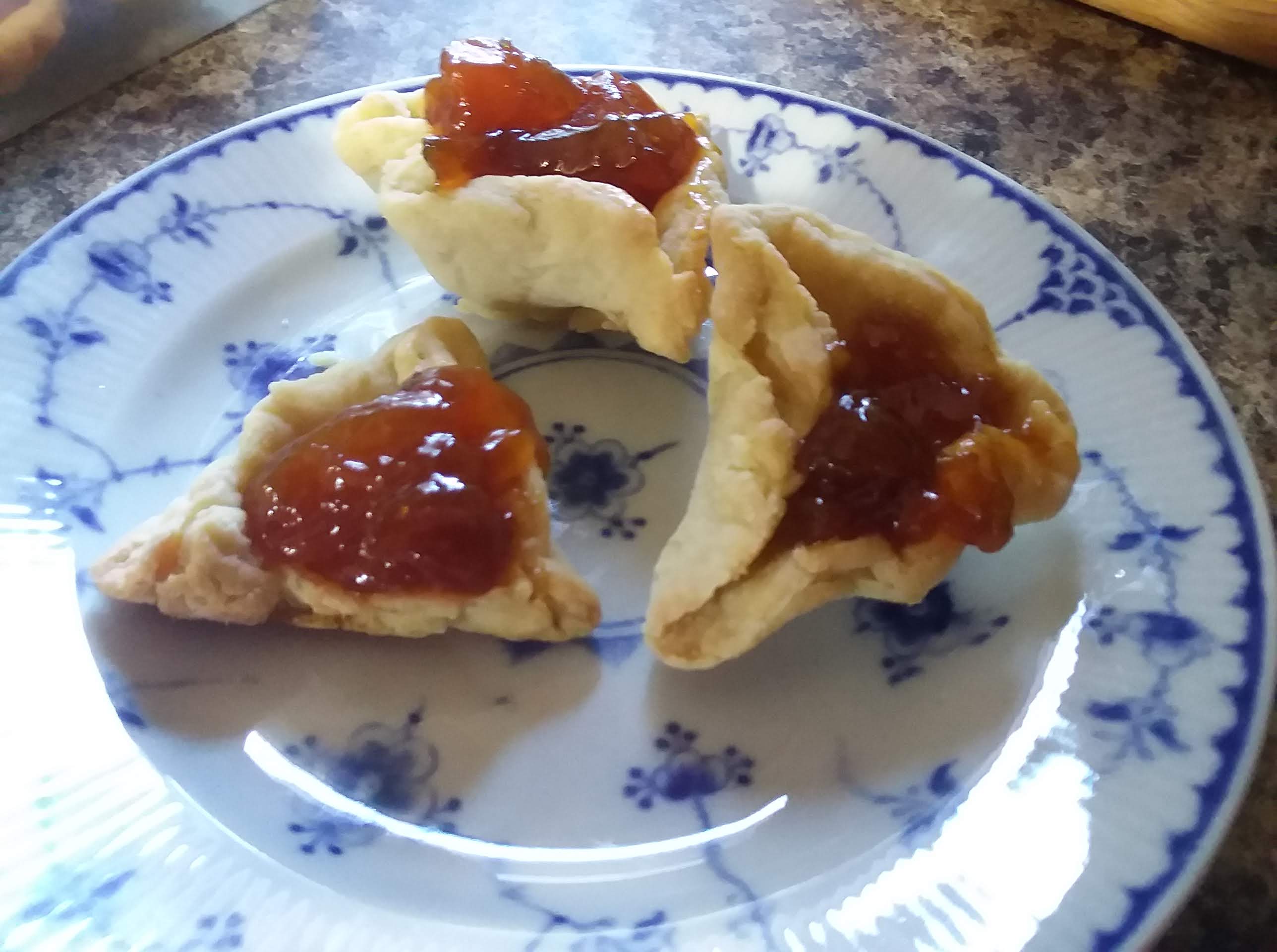
 Cut the butter into the flour until the mixture is crumbly.  Beat the eggs lightly and mix with enough milk to make about 1 cup. Gently mix the liquid into the flour. Form into a ball, and roll out ⅛ inch thick. Cut into 2 inch circles. Form triangular baskets or press the circles into fluted cookie tins to make cups. Bake 12-15 minutes at 400 degrees until lightly browned. Allow to cool, then fill the pastry with the peach marmalade. 

The Season for Sparrow Grass

20190605_173744Of all the lovely vegetables that pop up in the spring, my favorite is sparrow grass, more commonly known now as asparagus. This delightful vegetable has been popular since ancient times, appearing in the first known cookbook  (Apicus’s De Re Coquinaria Book III, 3rd Century BCE). It was undoubtedly cultivated even earlier, perhaps even as early as 2000 BCE in Egypt, where asparagus seeds have been found in tombs.

Asparagus was popular  in the Ancient Mediterranean world. Both Greek and Arab writers claimed it was an aphrodisiac, possibly due to the shape. Romans dried it, froze it, cooked it, and ate it fresh, claiming the shoots were good for the digestion. For a time in the late middle ages, asparagus was considered a delicacy, eaten primarily by royalty. However, common people enjoyed it too. In 1677, Samuel Pepys wrote that he had purchased a bundle of sparrow grass from the market in Fenchurch Street, London, for 1s 6d*. (Brunning). Nearly all of my period cookbook (reprints and facsimiles from the 18th and 19th centuries) offer recipes for asparagus.

In addition to the delicious taste, asparagus is also known as a diuretic. Less appealing is the effect asparagus has on the urine of many, but not all eaters. Ben Franklin wrote about the ‘disagreeable odor’ of urine after consumption.

Prior to the Norman Invasion in 1066 CE (Old English) what we know as asparagus, was called eorthnafela (earth navel). The name ‘asparagus’ is Latin, coming from Greek ‘aspharagos’, possibly deriving from the Persian word, ‘asparag’, meaning ‘shoot’. By the14th century (Middle English) it was called asperages. Sometimes, people assumed that ‘asperages’ was plural, and left off the ‘s’ for the singular form, calling a single green spear  ‘aspergy’. By the 16th century (Early Modern English) the word had morphed into ‘sperach’ or ‘sperage’. Around this same time, educated writers went back to the Latin form, asparagus.’ but common folk began pronouncing it ‘sparrow grass’, since that is what it sounds like, and the tall, slender shoots are somewhat grass-like. Though the edible shoots of asparagus do indeed look like some grasess, it turns out that this plant is actually a distant cousin of leeks and onions. Surprisingly, the Latin name won out in the end, so that now ‘asparagus’ is the most common word for this vegetable.

The following recipe is one of many similar examples for cooking asparagus in the 18th and 19th centuries.

Asparagus

Set a stew-pan with plenty of water on the fire, sprinkle a handful of salt in it, let it boil, and skim it, then put in the asparagus prepared thus: scrape all the stalks till they are perfectly clean; throw them into a pan of cold water as you scrape them; when they are all done, tie them in little bundles, of a quarter of a hundred each, with bass,* if you can get it, or tape*; cut off the stalks at the bottom, that they may be all of a length; when they are tender at the stalk, which will be in from twenty to thirty minutes, they are done enough. Great care must be taken to watch the exact time of their becoming tender; take them just at that instant, and they will have their true flavour and colour; a minute or two more boiling destroys both. While the asparagus is boiling, toast a slice of a loaf of bread, about a half an inch thick; brown it delicately on both sides; dip it lightly in the liquor the asparagus was boiled in, and lay it in the middle of a dish; pour some melted butter on the toast, and lay the asparagus upon it; let it project beyond the asparagus that the company may see there is a toast. Do not pour butter over them, but send some in a boat. (Randolph, 100-101)

This recipe seems unnecessarily complicated for the modern cook. Scraping the asparagus may be more useful with garden fresh asparagus, when the little leaves on the stalks are more likely to harbor dirt. Hannah Glasse suggests scraping the stalks so that they look white (35), though she is undoubtedly talking about the white variety of asparagus. In any case, I see no need to scrape well-washed stalks, as scraping makes no real difference in taste, color, or texture.

Likewise, tying the stalks in a bundle seems unnecessary. Perhaps the purpose is to make a neater, nicer-looking vegetable for serving. I boiled the asparagus as suggested, but normally I prefer steaming it in the microwave, a method obviously unknown to Colonial cooks. Again, the taste is the same, but it is easier to make sure the asparagus is crisp-tender, not over-cooked.  Hannah Glasse reiterates the idea that all ‘garden things’ should be cooked delicately:

Directions concerning Garden Things.                                                                                             Most people spoil garden things by over-boiling them. All things that are green should have a little crispness, for it they are over-boiled, they neither have any sweetness or beauty. (Glasse, 35)

Finally, modern consumers are not likely to enjoy slightly soggy toast as a base for the asparagus. Although I found the combination surprisingly tasty, I think toasted bread crumbs as a garnish will prove more palatable to people today.  Here then is a modernized version of asparagus which our forebears would recognize and enjoy as much as we do.

Wash 1 bunch of asparagus thoroughly. Trim the ends so the spears are all the same length. Place in a microwavable dish with a little water and a ¼ t. salt. Cover and microwave on high for 5 minutes. (Microwaves vary so you might check for tenderness after 3 minutes, adding more time as necessary.) Toast some whole wheat bread. Butter it and crumble it.  Lay the asparagus on a dish. Strew the bread crumbs over it, and serve.

___________

Notes:

* 1s 6d (One schilling, six pence) was about a day’s wages for a skilled tradesman in 1670 or almost $11.00 in today’s money.) See National Archives Currency Converter for  more information. http://www.nationalarchives.gov.uk/currency-converter/#currency-result

** ‘bass’ is a type of straw of fiber used for tying, and tape is atrip of cloth for the same purpose. Surgical tape, the first adhesive-backed fabric strip, was invented in 1845)

____________

Brunning, Pam. “Asparagus: Liliaceae-Asparagacease.” Food and Wine. June 2010.page 6-7.

Glasse, Hannah. The Art of Cookery Made Plain and Easy: Excelling any Thing of the Kind ever yet published. Alexandria: Cottom and Stewart. 1805. (First Edition publishing in London, 1747. This edition reprint of 1st American Edition, 1805, by Applewood Books, 1997).

Randolph, Mary. The Virginia Housewife Or, Methodical Cook. Philadelphia: E. H. Butler & Co., 1860. (Facsimile by Dover Publications, 1993, with introduction by Janice Bluestein Longone.)