Of Parsnips and Skirrets

parsnip pieSeafood two thousand miles from the ocean? No problem. Fresh strawberries in the middle of a February snowstorm? Why not? In the modern world of well-stocked grocery stores, world-wide distribution, and a multiplicity of preservation options, we can generally eat whatever we want whenever we want. This hasn’t always been true. For centuries our ancestors relied on highly nutritious root vegetables to get through the winter. Stored in cool, dark cellars, root vegetables keep well for many months. While we still enjoy many root vegetables, like carrots and potatoes,  others have become less popular. This week’s recipe focuses on two such vegetables: the parsnip and the skirret.

CDC_parsnipThe parsnip has an unusual history. Even the name is a bit odd. The word comes from the Latin ‘pastinum’ (fork) through Old French ‘pasnaie’.  Parsnips are native to Eurasia, but have spread world-wide. In fact, parsnip’s wild cousin is a dangerous invasive posing problems for hikers. The stems and leaves contain a toxic sap that can cause a bad rash when damp skin that has come in contact with the plant is exposed to sunlight. Cultivated parsnips are harvested the first year of growth, so they are not allowed to develop the tall stems and leaves that cause the problem.

Parsnips were cultivated by the Romans, who sometimes confused them with carrots. (Parsnips are indeed related to carrots, as well as parsley. In Roman times, carrots were purple or white, hence the confusion.) The Romans held that parsnips were an aphrodisiac. Emperor Tiberius even accepted parsnips as payment for part of the tribute due from German tribes.

Parsnips can be left in the ground for storage (except in areas where the ground freezes solid) and are sweeter after winter frosts. They were used as a sweetener in Europe before cane or beet sugar was discovered. Both French and British colonists introduced parsnips to the Americas, where the root was popular in cookery for decades. (Potatoes eventually replaced the parsnip as the most popular root vegetable.)

Valued as a staple in Europe and the Americas, lauded as a sweetener for many centuries, and prized for medicinal purposes in China, the parsnip is now fed to the pigs as often as it is eaten by humans.

Sisarum_Germanicum_-_Sium_Pinn._-_Sisaro_di_Germania_-_Le_Chervi_(Skirret,_Sugar_root,_Skiwort)_(NYPL_b14444147-1130639).tiff
Skirret

Parsnip’s cousin, the skirret is another misunderstood root vegetable that has lost popularity. In fact, it is difficult to even find skirrets today. Also know as a crummock, or water parsnip, the skirret is fairly low yield, so it is rarely grown commerically. Later cooks have sometimes confused the skirret with carrots, though they are not the same. In German, the skirret is called zuckerwürzel (sugar root). By medieval times, the name had morphed into ‘skyrwates’, with the folk etymology of ‘pure whites’. Like the parsnip, skirrets came out of Asia, and were used in Europe by Roman times.

In medieval times, skirrets were considered mostly beneficial. The Benedictine Abbess/ Herbalist Hildegard von Bingen recommended they be used in moderation, as too much could cause a fever or intestinal troubles. She also suggested mashed skirrets mixed with oil made a good poultice for weak skin on the face. In Maud Grieve’s 16th century book, a Modern Herbal, skirrets are recommended for chest complaints. Skirrets remained popular at least until the 17th century, when Nicholas Culpeper recognized them as nourishing, but cautioned they could cause ‘wind’ and provoke venery and urine.

Despite my earlier claim that it is now mostly possible to what we want when we want, I could not find skirrets in any local grocery store. So the following recipe relies only on parsnips for a delicious side dish to any meal.

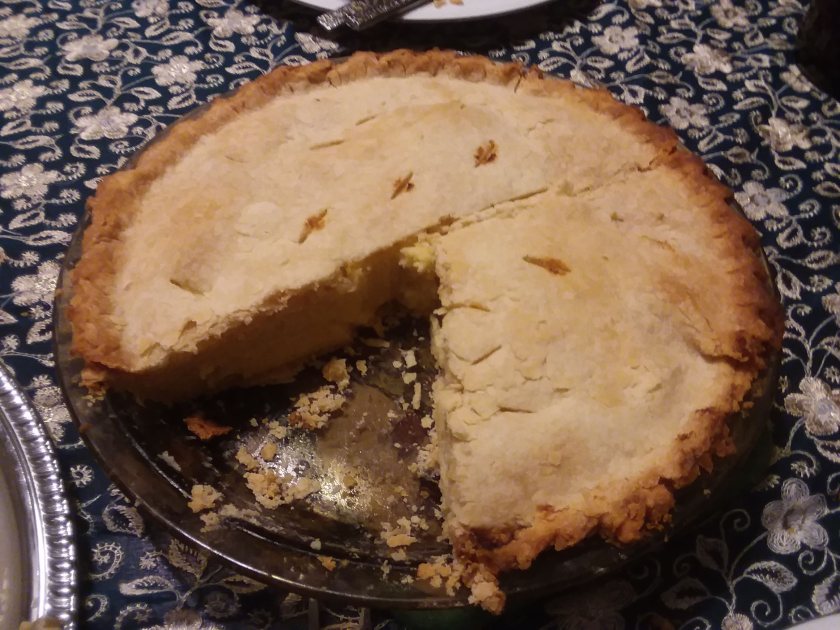
Parsnip Pie

To make a tart of parsneps & skirrits

Seethe yr roots in water & wine, then pill them & beat them in a morter with raw eggs and grated bread. Bedew them often with rose water & wine, then streyne them & put suger to them & some juice of leamons, & put it into yr crust; & when yr tart is baked, cut it up & butter it hot, or you may put some butter into it when you set it in yr oven & and eat it cold. (Martha Washington’s Booke of Cookery, 97)

My version:

Pie crust dough for 1 pie, top and bottom
4 c. mashed parsnips 
4 eggs
1 c. wine sweet white wine
Juice of 1 lemon (¼ c.)
¼ c. sugar
¼ c. bread crumbs
2 T. rose water
¼ c. butter (melted)

Roll out half of the pie crust dough and pricked pie crustplace in a deep 10” pie pan. Prick all over 
(bottom and sides) with a fork. 
Bake for 10 minutes, 425 degrees.

Meanwhile, peel the parsnips and 
cut them into chunks. Boil until 
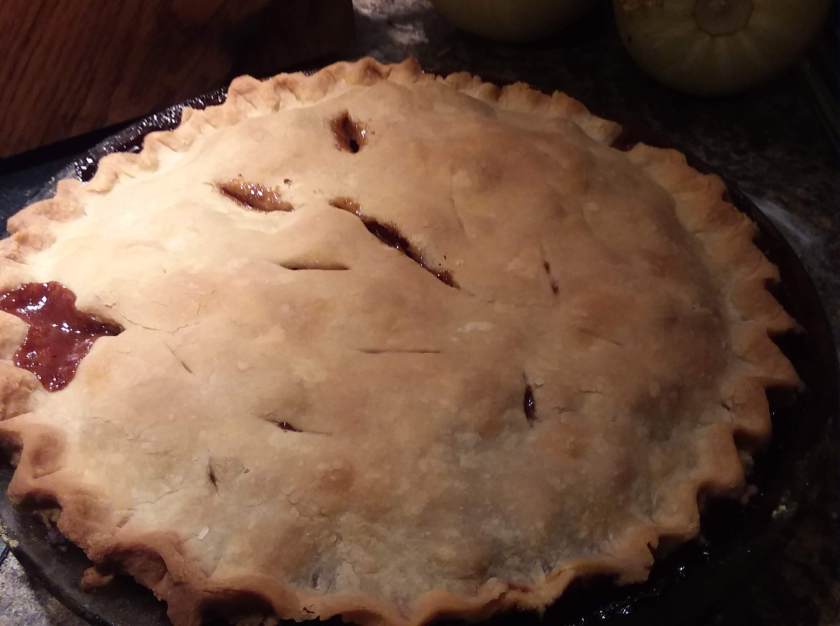
tender. Cool slightly and mash. Mix mashed parsnips with the remainder of the ingredients. Fill the pie. Roll out the top crust and cover 
the pie. Pinch it closed. (Brush the edge of the bottom crust with 
water to help seal the edge.) Cut vents in the top crust.

Bake at 350 degrees until top crust is golden (about 1 hour).
Serve warm or cold
This pie is very good, barely sweet, making a good side dish for a 
meal. For a dessert or breakfast pie, add up to ½ c. additional sugar.

References:

Culpeper, Nicholas. Culpeper’s Complete Herbal and English Physician. 1653. (Applewood Books reprint)

Grieve, Maud. A Modern Herbal. botanical.com (retrieved 4/3/2019)

Martha Washington’s Booke of Cookery. Edited by Karen Hess

Martinko, Katherine. Meet the Skirret, the long-forgotten Tudor vegetable. Treehugger.com. 3/11/2016

The Parsnip. Towne’s Harvest Garden. Montana State. University. (pdf, retrieved 4/3/2019)
 

Turkey with Oysters

20190201_140320

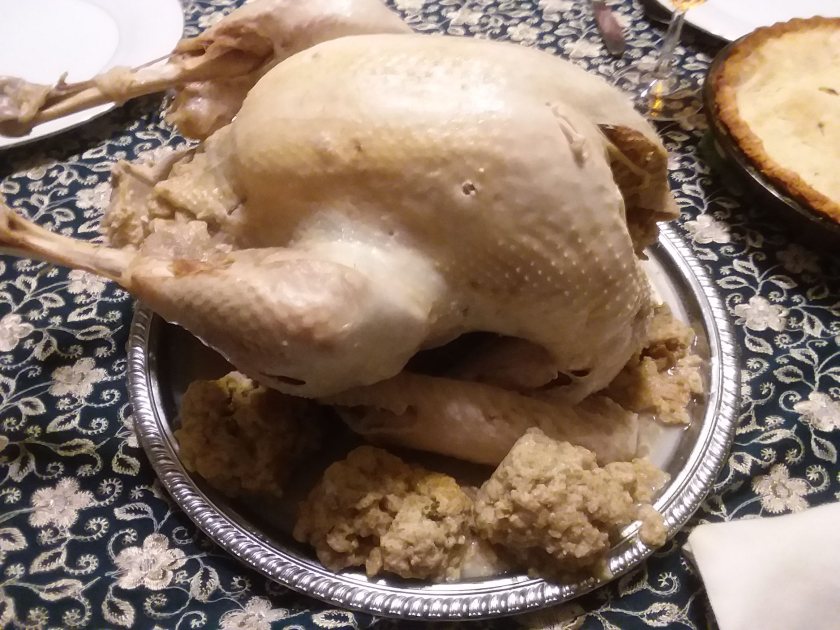
Not everyone likes oysters. In fact, I wasn’t too sure of them myself. So I wasn’t really surprised when finding guests to try turkey stuffed with oysters proved a bit difficult. Some people I asked were evasive, claiming,  “I’m not really a fan of oysters,” or “I think I’m busy. When did you say it would be?” Others were more blunt. “No way! I hate oysters.” But one couple was enthusiastic from the start. “How unusual. Count us in,” they said.

They would have fit in well back in colonial times and the early republic when oysters were quite popular, judging by period cookbooks.  There are two recipes for various ways of serving oysters in The American Frugal Housewife (1833), three in Martha Washington’s Booke of Cookery (from 1749), nine in The Virginia Housewife Or, Methodical Cook (1824), and twelve in The Universal Cook or Lady’s Complete Assistant (1733)Amelia Simmons cautions a housewife to buy only fresh fish, but allows oysters can be brought many miles inland”and retain a good relish” (6) and offers recipe for turkey stuffed with oysters in American Cookery (1796) the first cookbook printed in theUnited States.

Of course, oysters have been a healthy, popular food for many centuries. Folk-wisdom claims oysters can only be eaten in months with an ‘r’ in it. This is possibly due to the spawning season and hot weather. However, with the advent of refrigeration and types of oysters bred to be sterile, oysters can be safely eaten year-round, even though here in small-town Minnesota, it’s impossible to find fresh oysters in the spring and summer.  Around here, oysters are popular for Christmas Eve, when many people traditionally serve Oyster stew.

It is especially fitting to talk of oysters in the month of February, when oysters are at their peak and we gear up toward that most romantic holiday, Valentine’s Day. Legend has it that oysters are an aphrodisiac. (There may be some fact in this suppositon, since oysters are high in zinc, which helps stimulate testosterone production, along with other minerals that improve overall health and stimulate the libido.)

In spite of the long-time love affair America has had with oysters, pairing oysters with turkey seemed an odd combination. However, nearly all of the Eighteenth Century cookbooks I consulted put the two together as at least one of the options for preparing fowl. Obviously, common cookery practice insisted turkey should be stuffed with oyster forcement (stuffing) and /or served with oyster sauce. The recipe I followed for this dish also deviated from our usual perception of turkey because it called for boiling the bird. The goal, it seems, was to present a creamy white bird, with no browning on the skin whatsoever. Mary Randolph suggests leaving the turkey in the pot with the lid on to finish cooking from the steam will ‘keep the skin whole, tender, and very white” (71).

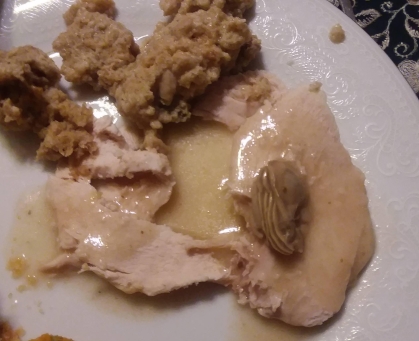
The results? The meal was surprisingly delicious. The turkey was moist and tender. The oyster stuffing with a hint of black pepper complemented it nicely, and the oyster sauce added a bit of zing to the meal. It just goes to show, that even though tastes in food have changed, it’s worth exploring flavors from the past for an unexpected treat. And thank you, to the Rethlefsons, who were willing to try.

20190201_175113

To Boil a Turkey with Oyster Sauce

Grate a loaf of bread, chop a score or more of oysters fine, add nutmeg, pepper and salt to your taste mix it up into a light forcemeat with a  quarter of a pound of butter, a spoonful or two of cream, and three eggs; stuff the craw with it, and ke the rest into balls and boil them; sew up the turkey, dedge it well with flour, put it in a kettle of cold water, cover it, and set it over the fire; as the scum begins to rise, take it off, let it boil very slowly for half an hour, then take off your kettle and keep it closely covered; if it be of a middle size, let it stand in the hot water half an hour, the steam being kept in, will stew it enough, make it rise,keep the skin whole, tender, and very white; when you dish it pour on a little oyster sauce, lay the balls round, and serve it up with the rest of the sauce in a boat. (Randolph 71)

Modern version:

Cut in small cubes 1 loaf of wheat bread (Iused a 1 lb, day old, homemade loaf). This makes about 8 c. of crumbs.

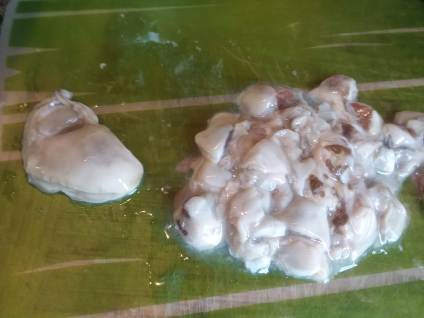
Mince about 1 lb oy oysters (20-30 oysters)

Add oysters to the bread crumbs. Mix in ½ c. butter (melted), 2 T. cream, ¼ t. Nutmeg, 1 t. Pepper, 1 t. Salt, and 3 eggs (beaten slightly).

Stuff a small turkey (10 lbs) with about half of this mixture. (Put the stuffing in the body cavity and the smaller cavity covered by the loose breast skin.) Secure the extra skin over the opening with skewers. Tie the legs and put the stuffed bird in a large kettle. Add enough water to cover the bird.

Bring to a boil, and simmer for about 2 hours. (I found the turkey was not done after the 1 hour cooking time suggested in the recipe.)

About half an hour before serving the meal, form the rest of the stuffing into small balls (about  the size of eggs). Drop these in boiling water,and boil for about ½ an hour.

Put the turkey on a platter. Drain the extra stuffing balls and place around the turkey to serve it.

I also served an oyster sauce with this, made from a combination of different Eighteenth century suggestions.

My oyster sauce:

Heat a pound of oysters in their own broth. Add 1 cup of light wine,  ¼ t. Of mace, and ¼ t. Pepper. Bring to a slow boil. Mix 4 T. butter with ¼ c. flour. Stir the floured butter into the boiling mixture. Boil, stirring constantly for 2 minutes, or until it thickens.

20190201_180053

Sources:

Randolph, Mary. The Virginia Housewife Or, Methodical Cook. Philadelphia: E. H. Butler and Co., 1860. Reprinted Dover Publications,1993.

Townshend, John. The Universal Cook Or Lady’s Complete Assistant. London: S. Bladon, 1773.

Sugarplums and ‘Orring pills’

20181228_215210Though the night when “visions of sugar plums danced” has passed, Christmas candy is still plentiful in my house. Christmas is a time of celebration, and celebration most often brings sweet treats. A little investigation shows that traditions of candy go way back.

It seems humans have always had a taste for sweet things. First honey, and later, sugar. Sugar from cane was first cultivated in India, and was kept as a closely guarded secret until Darius of Persia invaded in 510 BC and discovered the ‘reed that gives honey without bees’. Then in 642, Arabs invaded Persia and learned about sugar. As the Arab empire spread through Africa, the Middle East and Spain, so too did the growth and cultivation of sugar. Crusaders in the 11th century brought knowledge of sugar to Europe, where sugar was regarded as another exotic (and expensive) spice.

When Europeans invaded the New World, they discovered the climate in the Caribbean was very good for growing sugarcane. Even though there were over a hundred sugar refineries in Great Britain by 1750, sugar was still a luxury item partly because it was so highly taxed. (The Sugar Act of 1764 angered the Colonists so much that it was repealed in 1765, and contributed to the revolt against the Stamp Act of 1765.)

The earliest candies were comfits, which are seeds or nuts coated with layers of hardened sugar syrup. These first candies were medicines, prescribed by doctors or apothecaries to  treat stomach troubles. (Perhaps this is why candy came to be associated with Christmas — after all, indigestion is common after a hearty Christmas dinner.)

Clement C. Moore’s famous poem strengthened the connection between Christmas and candy with his talk of sugarplums. I always thought sugar plums were candied or sugar-coated plums, but it turns out they aren’t plums at all. As early as 1608, a sugarplum was something sweet or agreeable in nature, not just something to eat.  In the 17th through 19th century, sugarplums were small, flavored candies or comfits, (Some favorite fillings included cardamom, cinnamon, coriander, almonds, walnuts, and fennel.)

Making comfits was often the work of apothecaries since the layering process took time and skill, but colonial housewives made their share of sweet treats. One such treat is candied orange peel.

Like sugar, oranges originated in India, though oranges were known much earlier than sugar cane. By the 1st century, Chinese farmers were cultivating orange groves. Romans brought oranges to Europe around the same time. But these were all bitter oranges which are good for flavorings, marmalades, and perfumes. The sweet orange was brought by Portuguese traders from the Tamil Kingdom in India to Europe in the 16th century. They were quickly brought to the New World. As early as 1513. Ponce De Leon planted orange trees in Florida to help prevent scurvy among the sailors. In today’s world, oranges are one of the most popular fruits, second only to apples. However, in the 18th century, oranges had to be imported from the West Indies and so, like sugar, they  were a luxury for most American colonists.

Many of the cookery books from the 18th century contain recipes for preserving fruit. One very popular way was candying, or boiling the fruit in a sugar syrup. In that way fruit could be enjoyed even in the winter when it was no longer in season.

John Townshend’s The Universal Cook Or Lady’s Complete Assistant  (printed in London, 1773) has a fairly simple recipe for candied orange peels.

Having steep;d your orange peels as often as you shall judge convenient, in water, to take away the bitterness; then let them be gently dry’d and candy’d with syrup made of sugar. (261)

Martha Washington’s Booke of Cookery and Booke of Sweetmeats is older, with more erratic spelling. This manuscript hand-written in the 17th century and was in Martha Washington’s possession from 1749- 1799, and was transcribed and annotated by Karen Hess in 1981. This recipe provides a bit more direction.

To Candy Orring Pills

Take Civill orringes & pare them very thin, then cut them in little pieces, & lay them in faire water a day & a night, & shift them evening and morning, then boyle them, & shift them when the water is bitter into another water, & continew this till the water & boyling hath made them soft & yt theyr bitterness be gon. Then dreyne ye water from them, & make a thin sirrup, in which boyle them a pritty while. Then take them out & make another sirrup a little stronger, and boyle them a while int yt. then dreyne ye sirrup from them, & boyle another sirrup to candy height, in wch put them. Then take them out & lay them on plats on by one. When they are dry, turne them & then they are done. (284)

(Note: All of the early recipes I found for candying oranges used bitter (Seville) oranges. Since modern cooks mostly have sweet oranges, it is not necessary to boil the peels in as many water baths to remove the bitterness.)

A modern cook can use the simpler method for candying orange peels:

  • 1 ½ c water
  • 1 ⅓ c sugar
  • 3 oranges

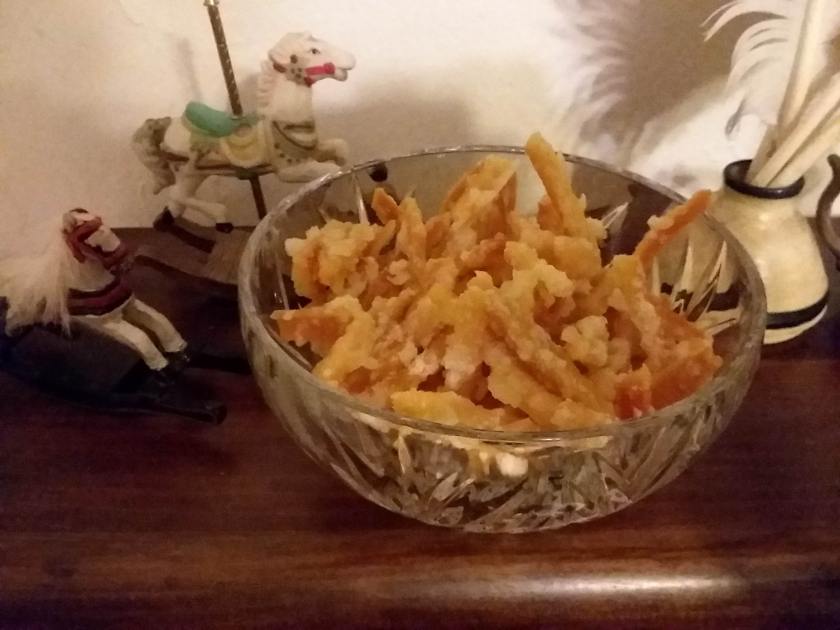
Score each orange in quarters, and remove the peel. Slice the peels ⅛ to ¼ inch wide.Bring to a boil and simmer these in clear water 10- 15 minutes. Drain and rinse. Mix water, sugar and the boiled orange peels. Simmer for 40-45 minutes, until the water is nearly gone, but before the sugar turns to hard crack stage.

Lay the peels on a flat surface to cool and dry before eating.

I can’t guarantee that candied orange peels will aid digestion, but they surely are a sweet treat for the New Year.

Sources:

Hess, Karen (transcriber and anotater). Martha Washington’s Booke of Cookery. New York: Columbia University Press, 1995.

Rupp, Rebecca. “What are Sugar Plums Anyway?” The Plate. National Geographic. December 23, 2014.  https://www.nationalgeographic.com/people-and-culture/food/the-plate/2014/12/23/visions-of-sugarplums/

Townshend, John. The Universal Cook Or Lady’s Complete Assistant . London: S. Bladon, 1773)

‘Tis the Season–for Chocolate

20181128_212345

  • A sweet treat after sledding or a hot  drink to warm up with on a chilly evening
  • Foil wrapped in balls or bells, a nearly ubiquitous stocking stuffer
  • Lauded as an aphrodisiac, a way to say “I love you,” or possibly cure smallpox
  • Historically, a form of currency and now 50 Billion dollar industry world-wide with some 50 million people employed globally

DSC00743


How does the humble cacao seed  (also called cocoa beans or nuts) from a tropical evergreen tree, native to the Americas, become all this and more? It turns out chocolate has a very long history.


People have been drinking chocolate beverages for at least 4000 years. There is evidence that the pre-Olmecs, of Central Mexico (predecessors of the Olmec, and later, the Maya and Aztec peoples) had a fermented chocolate drink. The tree was possibly first domesticated in Central America. ( Although now ⅔ of all cocoa beans are grown in Africa.) The Mayans and the Aztec both revered the cacao bean as a gift from the god. A hot spiced, (and very bitter) beverage was used in rituals and to seal agreements. They also used the bean, considered more valuable than gold, as a form of currency. One hundred beans might buy one turkey. (The practice of payment in chocolate was also used during the American Revolution.)

When the Spanish ran into (and over) the Aztec, they learned about chocolate. In 1565, explorer Girolamo Benzoni wrote about his experiences in the new world. He was one of the first describe the spicy beverage called cacahuatl. He was not a big fan, saying, “It seemed more a drink for pigs than a drink for humanity. I was in this country for more than a year and never wanted to taste it, and whenever I passed a settlement, some Indian would offer me a drink of it and would be amazed when I would not accept, going away laughing. But then, as there was a shortage of wine. . . .”(as quoted in Theobald)

He did eventually try it and described the taste as “somewhat bitter”  but conceded that “it satisfies and refreshes the body but does not inebriate.” (as quoted in Theobald).

In spite of the drink’s bitterness, the practice of drinking chocolate spread rapidly through the Spanish court. By 1585, Spain was importing chocolate. Chocolate beverages soon became popular throughout Europe. Europeans generally added some sugar to the drink. In order to melt the sugar, they generally served the chocolate hot. As Europeans spread out to colonize the Americas, they brought their newfound love of chocolate back with them.

By 1682 there were chocolate houses in Boston. In 1773, one ship alone brought in 320 tons of cocoa beans. (All of this cocoa was destined for beverages. Eating chocolate was not invented until 1847.) By the time of the Revolution, there were some 70 chocolate houses in the American Colonies.

This fall, I had the good fortune to discover Captain Jackson’s Historic Chocolate Shop, tucked away behind Old North Church in Boston. It’s named after a colonial merchant who owned a chocolate shop in the area in the 1740’s. Today, interpreters demonstrate the colonial process of turning cacao beans into a delicious and popular drink. The beans arrived in New England fermented and dried. The colonial chocolatiers roasted the beans in shallow pans. The brittle roasted beans were winnowed to separate the paper-thin shells from the chocolate nibs. (Some people, including Martha Washington, bought the shells and brewed a sort of tea from them (Theobald).)

The chocolate nibs (or broken up, roasted beans) are ground on a heated stone to a thick, dark, paste. Next, a variety of spices and flavorings are added. Each house had its own recipes, including combinations of vanilla, nutmeg, chili pepper, anise, annatto, salt, cinnamon, and orange or lemon peel. A bit of sugar might be added at this point also. The mixture is then allowed to dry in hard blocks.

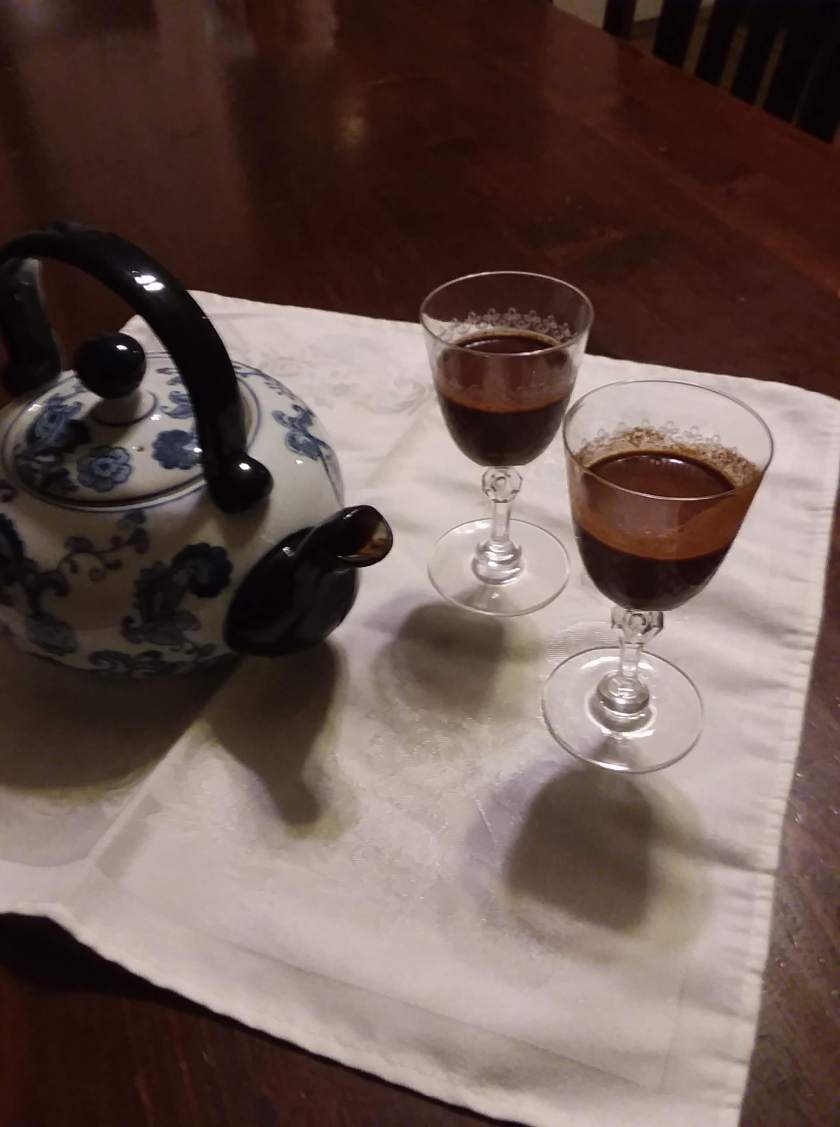
To make the chocolate drink, the block of seasoned chocolate is grated and mixed with hot water. (By 1700, it might also be mixed with milk, brandy, port, or sherry.) The water and chocolate are whipped together to make a delicious, rich frothy drink.

Because of its melting point, chocolate was not produced during the summer, and hot chocolate became associated with colder weather. As an expensive treat, chocolate also became associated with the holiday season.

By the 18th century, chocolate was sometimes shaved or grated into puddings, or made into candies for the wealthy. However, chocolate was much more common as a drink than a food until J. S. Fry and Sons developed the first chocolate bar in the middle of the 19th century. By this time, chocolate prices had dropped and nearly everyone could afford chocolate, at least once in a while. Now it’s hard to imagine a Christmas stocking without a few chocolate bells.

One reason for chocolate’s traditional popularity is that it was believed to have medicinal value. It was thought to aid longevity and digestion, alleviate coughs and lung ailments, and cure hangovers. Both Ben Franklin and Dr. Benjamin Rush even proposed chocolate as a cure for smallpox. (Theobald.) However, chocolate was not without its detractors. As a stimulant for the libido, chocolate was considered dangerous for women and children. (The same was true of novels and romances.)

I’m not sure anyone still considers chocolate dangerous (except to the waistline), but it retains is reputation as the food of lovers. Think of that as you’re indulging in your sweet chocolate treats this year, and enjoy.

20181128_213232
Using research from Colonial Williamsburg, Mars Company has created a chocolate drink to reproduce the flavor of Colonial chocolate. Called American Heritage Chocolate, it is available from various museums and historic sites.


Sources:

Theobald, Mary Miley. A Cup of Hot Chocolate, S’good for What Ails Ya.
CW JOURNAL : WINTER 2012

Traverso, Amy. The History of Chocolate in New England. New England Travel Today. January 11, 2017


Making Mincemeat

20181027_222419Ask a dozen people about mincemeat and you’ll like get one of two answers. Some will fondly remember how their mother or grandmother made mincemeat pies. Most of the rest will say, “Huh? What’s in that anyway? Does it really have meat in it?”

The answer is … complicated. Modern mincemeat is a spicy mixture of mostly apples and raisins. But if you go back a ways, mincemeat was indeed a pie made with chopped meat.

Some of the earliest recipes for mincemeat I have found date from the 14th century. These heavy, elegant pies were inspired by the Crusaders, bringing home ideas of new, exciting spices like cinnamon and nutmeg from the Middle East. It was common in the Middle East at that time to serve meat sweetened with fruits and spices.  It became popular in England to recreate these exotic dishes, especially for elegant feasts meant to impress the neighbors in the holiday season.

These medieval mincemeat pies could be made from any type of meat, including mutton, veal, pork or venison. Some recipes even call for fish in a mince pie to serve on fish days when the church forbade eating meat.  The mixture usually called for prunes, currants, raisins, and/or dates.

These pies were baked in a coffin, which is a thick, heavy crust, often rectangular shape. (Note: coffin comes from the French word for chest–like the modern word–coffer. The  word ‘coffin’ was used to mean a pie crust from as early as the 14th century. The meaning of a box for burying a dead person came later, from 1520.) Meat pies in the Middle Ages were meant to be kept for months, with the thick crust helping to preserve the pie.

One more confusing note in the history of mincemeat is the word ‘meat.’ Although the earliest mincemeat pies did have chopped veal, pork, or other meat in them, the word ‘meat’ didn’t mean what it means today. Originally, in Old English, ‘meat’ meant food, any type of food. It wasn’t until the 13th century that the sense of the word narrowed to mean flesh meant for eating. Even as late at the 15th century, vegetables might be called ‘grene-meat.’ So the name mincemeat, could easily refer to all the chopped ingredients in a mincemeat pie.

Like meatloaf today, mincemeat over the years has had many variations, in the spices used, the type of fruit, and the crust. By the 18th century, crusts were flakier and apples and raisins were usually included in the recipe. It wasn’t until the late 19th and early 20th century that mincemeat lost the meat. As late as 1941, some mincemeat recipes still cared for meat (usually beef). 

The real change came in 1898 when dried or canned mincemeat (such as Nonesuch) was developed. This mixture of apples, raisins and spices was one of America’s first convenience foods. As with many pre-packaged, prepared foods, people lost track of what exactly was in that jar or box of mincemeat.

Unfortunately, as popular tastes changed, pies were more commonly relegated to the dessert course. Homemade pies have given way to more store-bought desserts. Gradually, the taste for mincemeat has declined. Most people I talk to are leery of a sweet meat and fruit mixture.

But old-fashioned mincemeat is definitely worth trying. The recipe I’ve included here is from 1833. (Mrs. Child, The American Frugal Housewife. Dedicated to those who are not ashamed of economy). The modern version I developed makes 4-5 pies, but can be easily cut in half.

And if you still don’t want meat in your pie? That’s okay. You can omit the meat and make a spicy, apple and raisin pie –perfect for the Holiday season.

1833 Recipes: Mince Pies.

Boil a tender, nice piece of beef–any piece that is clear from sinews and gristle; boil it until it is perfectly tender. When it is cold, chop it very fine, and be very careful to get out every particle of bone and gristle. The suet is sweeter and better to boil half an hour or more in the liquor the beef has been boiled in; but few people do this. Pare, core, and chop the apples fine. If you use raisins, stone them. If you use currants, wash and dry them at the fire. Two pounds of beef, after it is chopped; three quarters of a pound of suet; one pound and a quarter of sugar, three pounds of apples; two pounds of currants, or raisins. Put in a gill of brandy; lemon-brandy is better, if you have any prepared. Make it quite moist with new cider. I should not think a quart would be too much; the more moist the better, if it does not spill out into the oven. A very little pepper. If you use corn meat, or tongue, for pies, it should be well soaked, and boiled very tender. If you use fresh beef, salt is necessary in the seasoning. One ounce of cinnamon, one ounce of cloves. Two nutmegs add to the pleasantness of the flavor; and a bit of sweet butter put upon the top of each pie, makes them rich; but these are not necessary. Baked three quarters of an hour. If your apples are rather sweet, grate in a whole lemon. (66)

Pie Crust.

To make pie crust for common use, a quarter of a pound of butter is enough for a half a pound of flour. Take out about a quarter part of the flour you intend to use, and lay it aside. Into the remainder of the flour rub butter thoroughly with your hands, until it is so short that a handful of it, clasped tight, will remain in a ball, without any tendency to fall in pieces. Then wet it with cold water, roll it out on a board, rub over the surface with flour, stick little lumps of butter all over it, sprinkle some flour over the butter, and roll the dough all up; flour the paste and flour the rolling pin; roll it lightly and quickly; flour it again; stick in bits of butter; do it up; flour the rolling pin, and roll it quickly and lightly; and so on, till you have used up your butter. Always roll away from you. Pie crust should be made as cold as possible, and set in a cool place; but be careful it does not freeze. Do not use more flour than you can help in sprinkling and rolling. The paste should not be rolled out more than three times; if rolled too much it will not be flaky. (69)

Child, Lydia Marie.The American Frugal Housewife. Dedicated to those who are not ashamed of economy. Boston, Carder, Hendee and Co. 1833.

Paste for Tarts
One pound of flour, three quarters of a pound of butter, mix up together and beat well with a rolling pin.

Glasse, Hannah. The Art of Cookery made Plain and Easy. Alexandria: Cottom and Stewart, 1805. 121.

Modern RecipesMincemeat for 4-5 pies

1 ¼ c. shortening (or suet)
21/2-3 lb beef roast (chuck roast is fine)
3 lbs apples (about 9 medium apples)
2 lbs. Raisins ( about 5 cups)
1 ¼ lbs. Sugar (about 2 ¾ c.)
½ c. brandy
¼ c. lemon juice
2 T. cinnamon
4 t. Cloves
1 T. nutmeg
1/4 t. Pepper
1 qt. Apple cider

Freeze the shortening, and dice while still frozen. Keep cold.

Cover beef with water, bring to a boil, then reduce heat and simmer for 30 minutes or until the meat tests 170 degrees. (The amount of cooking time will vary with the thickness of the beef. Let cool, then dice small. Be careful to remove all gristle, but leave in any hard fat (which is like suet.)

Peel, core and dice the apples.

Mix beef, apples, and shortening with the remaining ingredients. Fill unbaked pie shells (3-4 cups of filling per pie.)  Cover with pie crust. Cut vent slits. Bake at 375 degrees for 45 to 55 minutes. Serve warm or cold.

Pie Crust: for 2 pies

4 c. flour (approx. ½ lb.)
1⅓ c. shortening (or butter)
1 t. salt
10 T. cold water

Mix the flour and salt. Rub or cut the shortening into the flour until it resembles coarse meal. Add water. Mix lightly. Gather the mixture into a ball and press solid. Cut into 4 pieces (two for the bottom crusts two for the top crusts.). Roll each out to a circle. The circles for the bottom crusts should be about an inch larger than your pie plate. Carefully place one circle in each pan. Add the filling, and cover with the top crust. It helps to wet the edge of the bottom crust before placing the top crust on the pie. Pince the edge all around to seal the pie.

Bountiful Summer Squash

20180907_114408September is the harvest month–the time to gather the abundant bounty from our summer gardens . And nothing demonstrates abundance quite so well as zucchini squash. It’s so easy to grow that even a complete amateur gardener can produce more zucchini than any family can reasonably eat in one season. Zucchini grows well in almost any soil, survives drought and neglect and even produces when choked by weeds left by the lazy gardener.  But zucchini is a relative newcomer to the panoply of summer squashes. It is a hybrid variety of Cucurbita pepo (all summer squashes belong to this family), developed in Italy in the second half of the 19th century. The first records of zucchini in America are not quite a hundred years old, dating from the 1920’s.
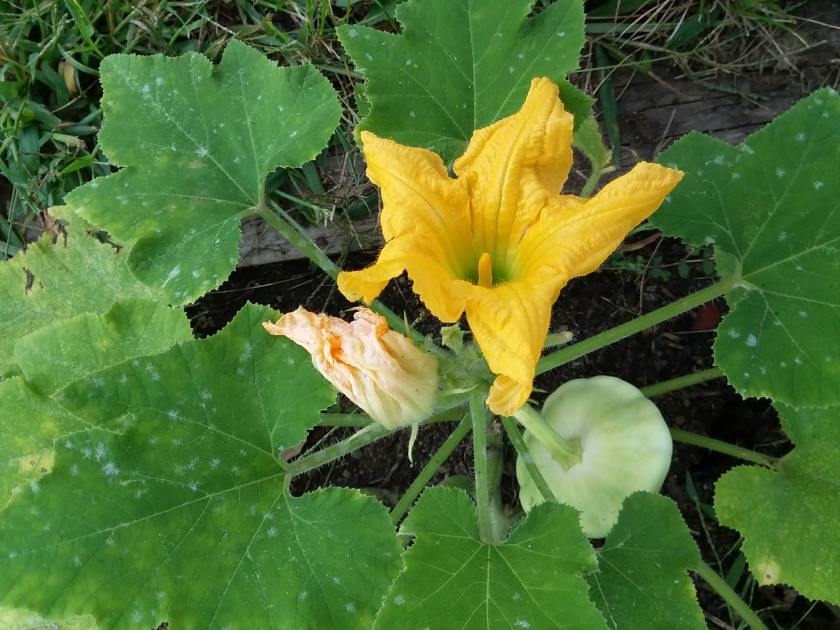
So this summer, I decided to explore the summer squashes more likely to appear on Colonial tables. Of course all squashes are native to the Americas, where they have been eaten since prehistoric times. The word ‘squash’ even comes from the native word ‘askutasquash’–which means the fruit eaten green or immature (that is, summer squash).

The earliest European explorers noticed native-grown squash, though they often thought of this novel food as varieties of cucumbers or melons.  Good things travel fast and so by the 16th century, squash was commonly found in European gardens.

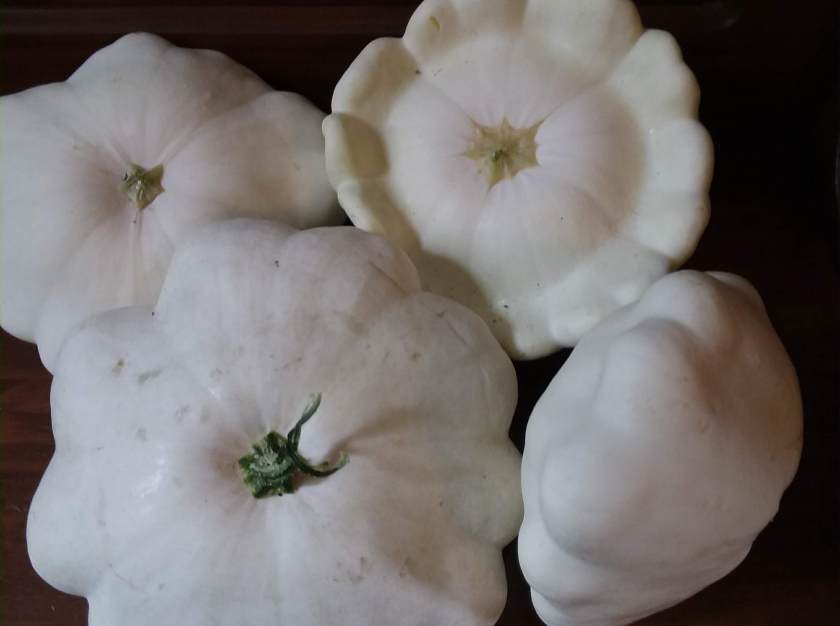
Squash hybrids easily, sharing traits with neighboring squashes, which explains why there are so many varieties. One of the earliest mentions of summer squash I found was in 1562, in Fuch’s Vienna Codex. He described what he called cucumer paniformis, so named because the pale green squash resembled a scalloped-edge baking pan. You might recognize this as patty pan squash.

The patty pan squash was one of Thomas Jefferson’s favorites. He said they were “one of our finest and most innocent vegetables.” (seed packet)  Patty pan squash were grown in Jefferson’s gardens at Monticello, in the gardens of enslaved African-Americans, and in kitchen gardens throughout the colonies.

This popular colonial-era squash had many different names based on its distinctive shape, including buckler squash, for its resemblance to a buckler-type shield. One of the most interesting names I came across was cymling (pronounced sim-lin) and also spelled symnel, simlin, or cimlin. The Oxford English Dictionary lists the earliest recorded use of this word for pattypan squash from 1648, in Beauchamp Plantagenet’s A Description of New Albion. Symnels or simnels were a Lenten cake, made for Mothering Sunday, the fourth Sunday of Lent. The day originated as a day to return to one’s ‘mother’ church, although in recent times it has become more like the American Mother’s Day. So how does a name for a cake get transferred to a squash? It turns out that simnels are a circular cake, with small round balls of almond paste decorating the circumference. Indeed, that’s a good description for a large pattypan squash.

Recipes from the 16th through the 18th centuries use pattypan squash in soups and stews. The most common suggestions are for boiling it and serving it with butter or cream. Pattypans were often harvested and eaten while they are very small, the size of large walnuts. The pattypan squash I used were larger, ranging from the size of an apple to the size of eight inch layer cake (because, like zucchini, pattypan squash seem to grow into giants overnight).

The following recipe comes from The Virgina Housewife (p. 110)

Squash or Cimlin

Gather Young squashes, peel, and cut them in two, take out the seeds, and boil them till tender; put them into a colander, drain off the water and rub them with a wood spoon through the colander; then put them into a stew pan with a cup full of cream, a small piece of butter, some pepper and salt–stew them, stirring very frequently until dry. This is the most delicate way of preparing squashes. (p. 110)

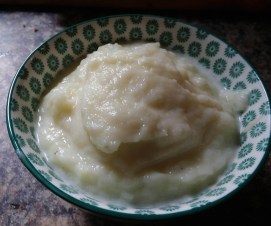
20180905_161449This original recipe calls for peeling the pattypan squash. I found that it is very difficult to peel because of the irregular shape. In the days of modern appliances, peeling the squash is unnecessary. Placing the boiled, unpeeled squash in a food processor and processing it for 2 minutes produces a sauce just as smooth as the colonial method of forcing the cooked squash through a colander.
My modern recipe for Pattypan Squash Puree:

3-4 large pattypan squash                                                                                                                       ¾ c. cream                                                                                                                                              3 T. butter                                                                                                                                                 Salt and pepper to taste

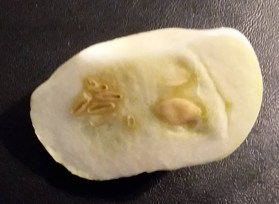
Wash the squash. Remove the seeds and stem ends. Cut into chunks. Cover with water and boil for twenty minutes, or until tender. Drain well. Puree in a food processor for two minutes. Add cream, butter, salt and pepper to the squash and simmer another ten minutes or until the mixture is as dry as you like it. The pureed squash can be eaten as a side dish. It also makes an excellent soup base. 20180810_141421.jpg

I’ve eaten pattypan squash many times, but I’d never grown it before. Using seeds from The Thomas Jefferson Center for Historic Plants, I planted seven hills of cymlings.

They all grew.  They all produced a prodigious number of pale green scalloped edge squash.

Obviously, pattypans are just as abundant as zucchini. Anybody want some?

20180921_113754
Sources:

Cymling or Pattypan Squash. Seed packet from The Thomas Jefferson Center For Historic Plants. 2016

CurcurbitsColonial Williamsburg. The Colonial Williamsburg Foundation, 2018. Colonial Williamsburg: That The Future May Learn From The Past

Randolph, Mary. The Virginia Housewife Or, Methodical Cook. T. E.H. Butler and Co. : Philadephia, 1860.

Simnel. The Compact Edition of the Oxford English Dictionary. 1971.

Lettuce: As Easy as Pie

a-salad.jpg
Everyone knows lettuce–that mundane, leafy green vegetable. It’s indispensable in fresh salad. It’s center of a BLT. It adds crunch to a tuna sandwich. It’s grown world wide and even in space on the International Space Station. For nearly 5000 years, lettuce has been a part of the human diet.


Egyptians were the first to grow lettuce, originally for the oil from the seeds. Over time, they bred lettuces for tastier leaves. Because of the milky sap and thick, upright stems of these early plants, the Egyptians associated lettuce with sexuality.

The Greeks continued breeding lettuces for more flavorful leaves, but they told various stories of Adonis being killed in a bed of lettuce. For the Greeks, lettuce signified impotence rather than prowess.

The Romans continued the lettuce-growing tradition, siding with the Egyptians on the question of how lettuce affects male stamina. Lettuce was also served before meals and after meals to improve digestion in the first case and sleep in the second. By 77 AD, at least eight different types of lettuce are recorded in Pliny the Elder’s Natural History.

Lettuce cultivation spread into Asia and Western Europe, with many more varieties developing along the way. Early lettuces were all leafy and upright, like romaine. By the 15th century, loose head lettuces were developed. By Elizabethan times, lettuce was popular throughout Europe. Gerard, a notable medieval cook, claims lettuce helps with heartburn, thirst, and sleep problems. He also says that it “maketh plenty of milk in nurses.” (as quoted by Hess, 99).

Europeans settling in America brought along their love of lettuce. Thomas Jefferson, well-known for his interest in gardens and plant varieties, recorded seventeen kinds of lettuce in his garden. This year I grew two heritage varieties of lettuce. Grandma Hadley’s is soft, slightly sweet lettuce with a bit of purple on the leaves. It comes from Emma Hadley of Illinois, stemming from 1915. The second lettuce I grew is called Tennis Ball lettuce. According to the seed saver’s packet, this type of lettuce was “often pickled in a salt brine during the 17th and 18th centuries.” (Weaver)

By this point you may be asking what does all this have to do with pie? Currently in America, we usually eat lettuce raw. Indeed, from ancient times, lettuce was often eaten as a raw salad, perhaps drizzled with oil and vinegar. One such salad is described in The Virginia Housewife or, Methodical Cook. Mary Randolph suggests mixing lettuce with chervil, pepper grass, cress and other greens and tells how to make a dressing of hard boiled egg yolks, salt, sugar, mustard, oil, and vinegar.

This all sounds familiar, but in looking at the history of lettuce, I came across a very unusual recipe for a lettuce pie, in Martha Washington’s Booke of Cookery.

The recipe (from Martha Washington’s Booke of Cookery, 98)  is a follows:

To make a lettis tart

     When you have raised the crust, lay in all over the bottom some butter, & strow in sugar, cinnamon & a little ginger; then boyle yourcabbage lettis in a little water and salt,& when the water is draynedfrom it, lay it in your coffin with some damask pruens stoned;  then lay on the top some marrow& such seasoning as you layd on the bottom.Then close it up and bake it.

Lettuce pieThere are a number of challenges in following this recipe. First I had to figure out what it means to raise the crust. A raised crust is not, as I first thought, made from a yeast dough. Rather, a raised crust is a thicker crust made without a mold. So raising the crust means pushing the sides up to make a free-standing, pie-shaped bowl, often in a rectangular shape.
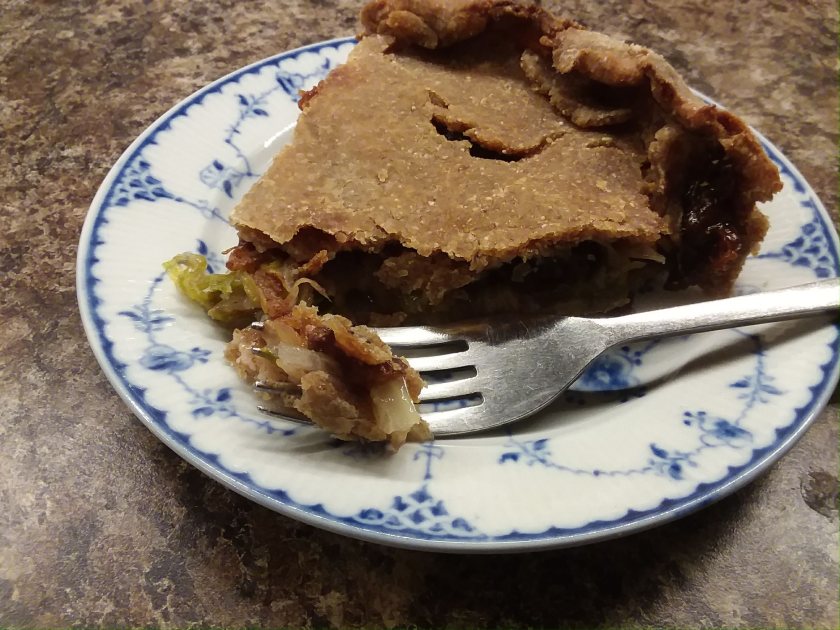
Another challenge for this crust was what recipe to use. The author calls it a tart, but tart crusts were generally rolled thinner and baked uncovered. A tart crust is too thin to be raised. Later in the recipe, the cook calls for a coffin. A coffin is generally a heavier pie crust, rolled thicker, allowing it to be raised.  With this distinction in mind, I used a heavier, thicker paste based on suggestions from Hannah Glasse and Karen Hess.

Alas, it turned out to be beyond my skill to raise a crust. I could roll the crust and form the bow shapel, but it collapsed on itself when baked. I ended up making the crust using a springform pan to hold the sides in place.

The next challenge with this recipe is the term ‘cabbage lettis.’ This is head lettuce. I used iceberg lettuce, though it was not developed until the 20th century. There were head lettuces available in Colonial America, mostly softer, looser and more flavorful than modern iceberg lettuce.

The only challenges remaining were figuring out how much of each ingredient and how long to bake it. My answers to those questions came through trial and error. In the end, I came up with a flavorful, pie unlike anything else I’ve tasted, though the cinnamon makes it slightly reminiscent of apple pie.

Here’s my modern version of Lettuce Pie:

Crust:

Melt 6 Tablespoons of shortening in ½ cup water.
Mix 1 c. rye flour, 1 c. white flour and ½ teaspoon salt in a food 
processor.
Add the melted shortening and water and pulse until well mixed. (Use a spatula if necessary to scrape the sides)
Knead the warm dough a few minutes.  Divide into two balls, one slightly bigger than the other.  Roll the large ball into a circle between ⅛ and ¼ inch thick. 
Place it in a 8” springform pan, and push the edges up the sides. You may have to repair cracks as you do so.
Reserve the smaller ball to form the top crust.

Filling:

Spread 2 T. soft butter over the bottom pie crust.
Mix 4 Tablespoons of sugar, 1 teaspoon cinnamon, ½ teaspoon ginger. 
Sprinkle half of this on the buttered crust in the pan.
Roughly chop one head of lettuce. Boil it in salted water for about 3 minutes, or until limp. Drain thoroughly and place it in the pie 
shell.

Chop ⅓ cup pitted prunes. Strew those over the lettuce. Sprinkle the remaining sugar mixture over the lettuce and prunes. 
Dot with 2 Tablespoons butter (shaved or cut in bits).

Roll out the remaining pie crust to cover the pie. Crimp the edges.

Bake 45- 50  minutes at 400 degrees. Enjoy warm or cold.

lettuce pie sliceP.S. Whoever invented the phrase ‘easy as pie,’ probably never made a scratch pie.
Sources:

Fischer, Nan. The History of Lettuce: From Ancient Egypt to outer space, lettuce is a well-traveled little plant. Heirloom Gardener, Spring, 2018. www.heirloomgardener

Glasse, Hannah. The Art of Cookery Made Plain and Easy. Cotton and Stewart, 1805. (Facsimile Reprint, Applewood Books, 1997.)

Hess, Karen, transcriber. Martha Washington’s Booke of Cookery. Columbia University Press, 1995.

Randolph, Mary. The Virginia Housewife Or, Methodical Cook. (Fascsimile reprint) Dover Publications,1993.


On cooking with Pearl Ash

Experiments in cookery

gingerbreadSometime in the middle of the eighteenth century, an adventurous (or careless) housewife added pearlash to her dough and the first chemical leavening was discovered. Before pearlash found its way into food, housewives had to use yeast or egg whites if they wanted their baked goods to rise. But it takes a long time to whip egg whites to a froth, and the resulting mix is not very stable. Yeast also takes a long time to work. Thus with the new chemical leavener, pearlash, cooks could bake ‘quick’ breads, a great convenience in the labor-intense colonial kitchen.  
Historically, pearlash has had many uses including soap and glass making. Various cuisines around the world use pearl ash in traditional dishes. (For instance, German gingerbreads and Chinese mooncakes.) It has also been used in the production of cocoa, wine and mead.

But be aware, pearlash is potassium carbonate,  a caustic substance made by refining potash, which in turn is made by soaking plant-based ash in pot of water. This is the same way that lye is produced. Like lye, pearlash is caustic, and must be used in the right proportions.


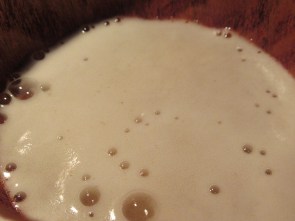
While the lye has been used in cooking for a long time, (for instance in ramen, hominy, and lutefisk), pearlash wasn’t used as a leavening agent in dough until about 1740. The potassium carbonate mixed with acid (like sour milk or vinegar) creates pockets of carbon dioxide. These bubbles are trapped,  making the dough rise and the resulting bread lighter.bubble s 2

In fact, pearlash can even be used to freshen yeast. Mrs. Child recommends mixing pearlash in with yeast that has soured, and using it when it ‘foams up bright and  lively” (79) and suggests that “everything mixed with pearlash be put in the oven immediately” (71).

Though pearlash works well enough as a leavening agent, it can leave a bitter taste in baked goods. In fact, many colonial recipes I found using pearl ash, also use molasses, which not only masks the bitterness, but also provides citric acid to activate the pearlash. Of the sixteen colonial recipes I found with pearlash, only two had neither molasses nor some other strong spice like nutmeg, ginger, or coriander. 

As chemistry advanced, new chemical leaveners were developed. Pearlash went out of fashion around 1840, in favor of saleratus, which is closer to today’s baking soda. 

warning.jpg

 With this knowledge, I cautiously began experimenting with pearlash in cooking. Since none of the colonial I found gave directions on making your own pearlash, I purchased some online. (Even the food grade variety comes with a warning label.)  (Food grade potassium carbonate).


First  I made a tea cake, one of the few recipes that did not have a great deal of spice. Add old recipe and my version

Tea Cake

There is a kind of cake still cheaper. Three cups of sugar, three 
eggs, one cup of butter, one cup of milk, a spoonful of dissolved 
pearlash and four cups of flour, well beat up. If it is so stiff it 
will not stir easily, add a little more milk. (Child, 71)

Modern version:
Mix  4 c. flour (half whole wheat)
     3 c. sugar
Cut in 1 c. butter
Add 1 c. milk
     ¼ t. pearlash dissolved in 2 T. water
Bake at 350 degrees until a pick comes out clean.
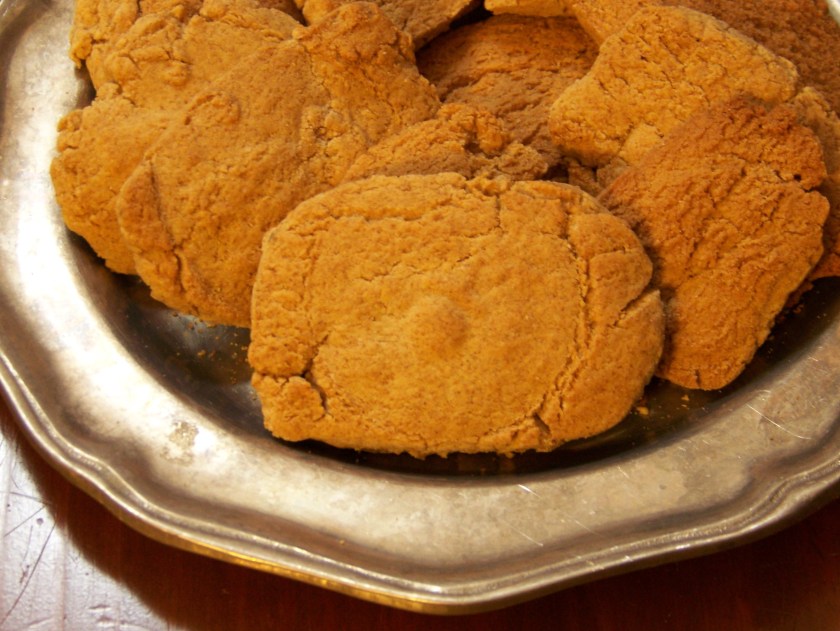
This makes a heavy loaf cake, similar to a pound cake in texture and taste. Quite delicious!

I had only used a 1/4 of a teaspoon pearlash in this, which may account for the heaviness of the loaf and the lack of any bitter aftertaste. I decided to be a bit bolder in the next attempt and made gingerbread.

Molasses Gingerbread
One tablespoon cinnamon, some coriander or allspice, put to four 
teaspoons of pearl ash dissolved in half pint water, four pound flour, one quart molasses, four ounces butter, (if in summer rub in the 
butter, in winter, warm the butter and molasses and pour to the 
spiced flour,) knead it well 'till stiff, the more the better, the 
lighter and whiter it will be; bake brisk fifteen minutes; don't 
scorch; before it is put in wash it with whites and sugar beat 
together. (Simmons, 36)

A modern version:

Mix: 1 pound flour (approximately 3 1/3 cups)
     1 teaspoon cinnamon
     1/4 teaspoon allspice
Warm: 1 cup molasses with 1 ounce (two tablespoons) butter
Add to the flour mixture
Dissolve one teaspoon pearlash in 1/4 cup water  
Add this to the flour and molasses mixture.
Beat the dough well, then roll it out on a floured board to about 
1/4" and cut in shapes as desired. 
Bake at 425 degrees for 12 to 15 minutes. 
Note: I skipped the egg white and sugar wash, but that could easily 
be added to the modern version of the recipe.

Still cautious, I tasted these the cookies myself before offering them to anyone else.  These had a nice light texture, with a hint of crunch, and a good molasses flavor. Still wary, my husband and I limited our own consumption to one or two a day. When neither of us had any ill effects from eating these cookies, we threw caution to the wind and enjoyed them to our heart’s content.

While I don’t recommend cooking with pearl ash, I do urge you to do your own experiments with historical cookery. Who knows what delights you will concoct?
__________
Child, Mrs. The American Frugal Housewife. Carter, Hendee and Co., 1833 (12th edition)

Simmons, Amelia. The First American Cookbook: A Facsimile of “American Cookery,” 1796. Dover Publications,1984.

The Maple Sugar Scheme in the Early United States: A Failed Plan to End Slavery

20180323_211017Spring is finally here. The ice is off the lake and the trees are budding out. With the end of the sugaring season, it’s time to talk about maple sap.  Maple syrup is one of the uniquely American foods. No one knows for sure when the indigenous people of North America began collecting ‘sweet water’ from maples and other native trees, but it was long before Europeans arrived. Sixteenth century French fur traders described how the natives collected sap in birch-bark baskets. When the sap rose in late winter and other food sources were scarce, Indians drank the ‘sweet water’ straight. They also boiled meat or other foods in it. Using hot rocks they boiled it down to make syrup or sugar.They even molded the sugar into decorative shapes. In other words, maple sap was an important part of the native food culture in North America.
While maple trees grow in Europe, Europeans did not discover the process. One explanation for this has to do with climate. Sap rises in trees in late winter as the temperatures vary between daytime highs of 40 degrees and lows of 20 degrees Fahrenheit. Without this fluctuation of temperature, the sap does not recede and flow. Most of the areas in Europe where maples flourish do not have the right temperature fluctuation.

Interesting, but what does this have to do with slavery?                                                        The answer is both complicated and fascinating.

In Colonial and Early America, one of the most important imports was cane sugar produced in the West Indies by slave labor. After the United States  won independence from British rule, the new nation looked for other ways to assert their self-sufficiency. Maple sugar, produced at home, was cheaper than imported cane sugar, and more patriotic.

Dr. Benjamin Rush, a prominent physician in Philadelphia, spoke out in favor of maple sugar. As an abolitionist, he hated supporting slavery through the use of cane sugar. He argued that maple sugar was both more pure in flavor and morally superior to cane sugar. In 1791, he wrote to Thomas Jefferson, “I cannot help contemplating  a sugar maple tree with a species of affection and even veneration, for I have persuaded myself, to behold in it the happy means of rendering the commerce and slavery of our African brethren in the sugar islands as unnecessary, as it has always been inhumane and unjust.”1 Other patriotic abolitionists also urged citizens to “Make your own sugar, and send not to the Indies for it. Feast not on the toil, pain and misery of the wretched,” 2.

For a time, the scheme to promote maple sugar worked. Frugal farmers found that tapping maple trees was cheaper than buying expensive cane sugar. Abolitionists rallied to support the cause. Thomas Jefferson, who hated slavery though he never figured out how to free his own slaves, joined in the effort. He became a member of the Society for Promoting  the Manufacture of Sugar from the Sugar Maple Tree, and urged farmers to plant maples and develop a large enough business to export the sugar. In this way, the Caribbean stronghold on the sugar market would be broken, and slave labor would no longer be needed. Jefferson even tried growing maple trees at Monticello, though without success.

Maple sugar became a symbol of freedom well into the 19th century. The  Vermont Almanac in 1844 urged readers “suffer not your cup to be sweetened by the blood of slaves.”3

In spite of all these efforts, maple sugar as a commodity never became more economical than cane sugar. All of the schemes to promote maple sugar failed commercially, although production in the northeast did increase. Cane sugar continued to outsell maple sugar, and slavery continued until the Civil War.

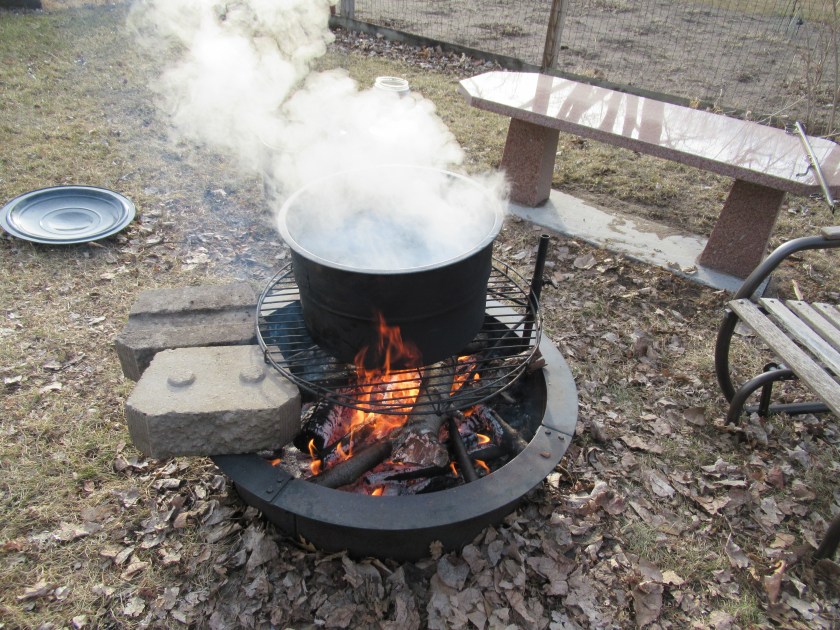
One reason for the failure of the scheme is that maple sugar production is not as easy as Rush and Jefferson suggested. Although it doesn’t require slave labor, it does require a lot of sap and fuel to make. I collected 21 gallons of sap from my maple this year, and made 6 pints of syrup from it– a thinner, less viscous syrup than found in the store.

The process is fairly straightforward. Drill a hole or holes in the tree, collect the dripping sap in buckets. Strain and boil the sap down until it is the consistency of syrup. It took me about two weeks to collect the sap, and about 17 hours to boil it down.

IMG_0553Hannah Glasse gives similar directions for making maple sugar. She claims ”This sugar if refined by the usual process, may be made into as good single or double refined loaves, as were ever made from the sugar obtained from the juice of the West India cane” (Glasse, 141). She also talks about maple molasses, which is really what we would call maple syrup today.
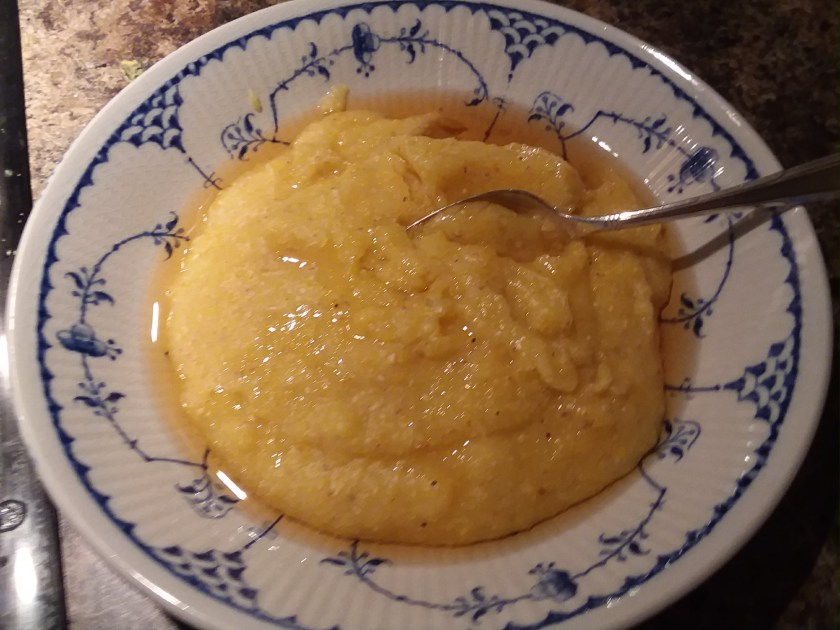
A few pages earlier Hannah Glasse gives directions for mush, made with Indian meal (now called corn meal). She serves the mush with milk or molasses. Surely she meant maple molasses. The scheme for maple sugar to end slavery failed, but the push to use maple had sweet results.

20180504_080318To Make Mush

Boil a pot of water, according to the quantity you wish to make, and then stir in the meal till it becomes quick thick, stirrintall the time to keep out the lumps, season with salt and eat it with milk or molasses. (Glasse, 137)

Modern version

  • 3 c. boiling water                                       
  • 1 c. cold water                                                                 
  • 1 c. cornmeal1 t. Salt
  • Maple syrup to taste

Add the salt to the  boiling water. Mix the cornmeal with the cold water. Stir the mixture into the boiling water. Boil 5 minutes, stirring constantly. (Be careful as the boiling mush tends to spit hot bits out as you stir.) When it is thick enough, take it off the heat and let sit a few minutes. Serve with maple syrup.

1. Rush, Benjamin. An account of the Sugar-Maple Tree, of the United States, and of the methods of obtaining sugar from it, together with observations upon the advantages both public and private of this sugar (Philadelphia, 1792).

2 Farmer’s Almanac, 1803

3 Vermont Almanac 1844

4 Glasse, Hannah. The Art of Cookery Made Plain and Easy. Cotton and Stewart. 1805.


On Corning Beef

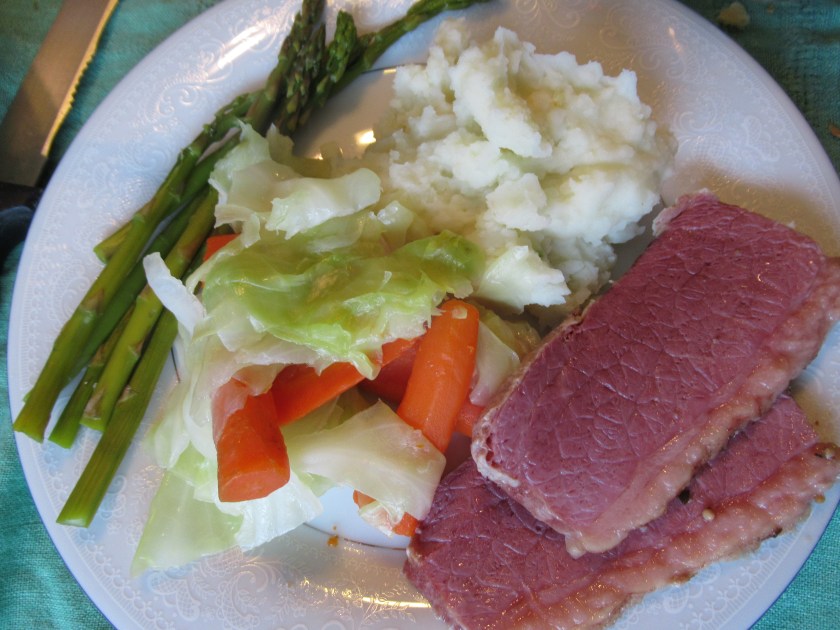
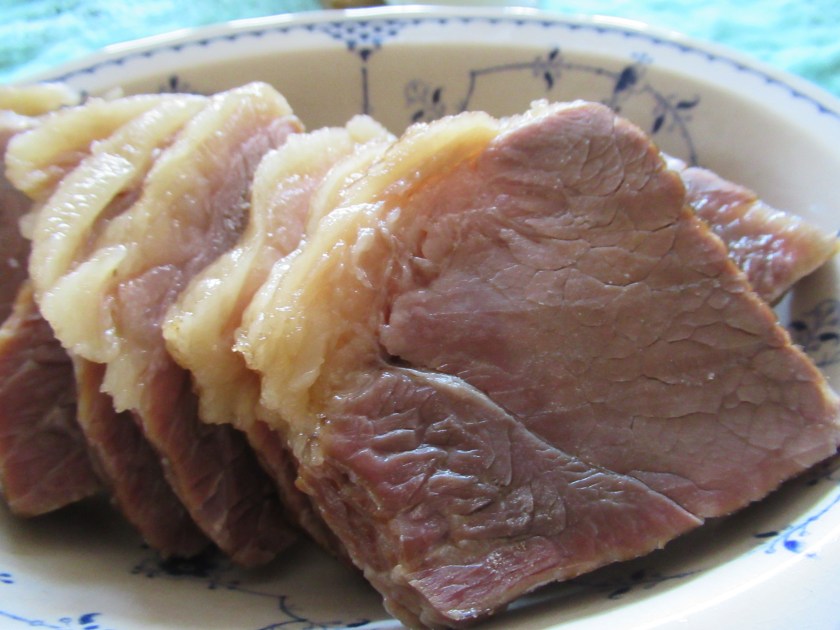
IMG_0552As March draws toward its closing, we have just finished celebrating St. Patrick’s Day, the biggest Irish-American holiday of the year, with one of my favorite meals–traditional corned beef and cabbage.
Except that it’s not.

Not traditional Irish that is. In Ireland, corned beef is not particularly special or common. So how did this iconic dish gain first class status for Irish-Americans? The story is complicated.

First of all, what is corned beef and how did it get its name? Corned beef is beef preserved with a salt brine,various spices, and saltpetre.The saltpetre gives the meat its pinkish color. (Modern corned beef uses sodium nitrite.) ‘Corn’ related to kernel, means grain and refers to the large grains of salt used in the process.

The Irish did not invent corned beef. Many cultures around the world salted beef or other foods as a way of preserving them even before the Greeks and Romans. Corned beef appears in Irish cookery as early as the 12th century. The dish is mentioned in a satiric poem, Aislinge Meic Conglinne, about a king trying to defeat gluttony. It’s interesting, because in ancient and medieval Ireland, only kings were wealthy enough to eat beef. Cattle were a mark of wealth and status. Though used for dairy products, cows were not often eaten. Most of the Irish people ate pork, salted or fresh.  

Then things changed in the 12th century, when England invaded Ireland. By the 16th century, England ruled all of Ireland. The English brought their love of beef (inherited from the Romans during that invasion centuries earlier). Ireland had wonderful pasture lands for raising beef cattle. In fact, the English overlords did such a good job of expanding beef production that in the 1660’s, the English parliament passed the Cattle Acts which prohibited exporting Irish beef since the Irish beef was hurting English farmers.

At the same time that Ireland was increasing beef production, the English navy was expanding, and English merchants (including slavers) began increased trade with the new world. Salted beef was very important for long sea voyages because it keeps well. Another factor in the rise of Irish corned beef was the tax on salt. Ireland had a much lower tax on salt imported from Spain or Portugal.

This plentiful combination of good salt and good beef meant that the Irish became known for great exported corned beef. They even sold it to both sides (French and English) during the Seven Years War. However, since corned beef was now an important trade commodity, it was too expensive for the average Irish to eat.

In another twist to the story, the demand of corned beef indirectly contributed to the Great Potato Famine in the middle of the 19th century. So much acreage was used for pasture land for beef production for export that ⅖ of the total population of Ireland relied completely on potatoes. When the blight hit the potato crop, they had nothing else to eat.

Thousands of starving Irish came to America, where they found corned beef regarded as poor food, fit mostly for slaves. For the first time, corned beef was affordable and the Irish immigrants embraced it. And so began the association of corned beef and and cabbage (another cheap food) with the celebration of all things Irish.

Most people buy packaged corned beef from the supermarket, but I found a couple of recipes from colonial times for salting your own beef.

The one I tried comes from The American Frugal Housewife, by Mrs. Child, (12th Edition) published in 1832.

It is good economy to salt your beef as well as pork. Six pound of coarse salt, eight ounce of brown sugar, a pint of molasses, and eight ounces of salt-petre are enough to boil in four gallons of water. Skim it clean while boiling. Put it to the beef cold; have enough to cover it’ and be careful your beef never floats on the top. It it does not smell perfectly sweet, thurw in more slat. If a scum rises upon it, scald and skim it again, and pour it on the beef when cold. …A six pound piece of corned beef should boil full three hours. (41-42)

Mrs. Child does not say how long to leave it in the brine, before boiling, but she does say that in summer the beef won’t keep well more than a day and a half, but will be good for a fortnight in winter. She also recommends leaving out the saltpetre in summer since it inhibits the absorption of other salts, and so the meat won’t keep as long.

For my recipe, I left out the saltpetre (because I didn’t have any) and adjusted for a much smaller piece of beef.

IMG_0550

Corned /Salted Beef
1 c. coarse salt
¼ c. brown sugar
¼ c. molasses
2 qts. water
2 lb. piece of beef (rump roast is all right, but a fattier cut works better)

First, make the brine. Pu all ingredients except the beef in a large pot. Bring it to a boil and boil until the salt and sugar dissolves. Skim it if necessary, then cool it thoroughly. Put the beef and brine in a non-reactive container. Make sure the brine can cover the beef. The beef will float, so put a weight (like a plate or inverted bowl) on the beef to hold it down in the brine. Refrigerate for 3 days, 
turning the beef daily.

To cook the beef, drain the brine, rinse the meat, and put it in 
fresh water. Boil it for about 2 hours.

Since this recipe does not include the spices of the more common corned beef, the result tastes like nicely salted roast beef- quite delicious. Other colonial recipes suggest adding various spices when boiling the beef, but I didn’t have a chance to try those. Perhaps next year.

In the meantime, I’ll keep my Irish (American) tradition. Erin go bragh (Éirinn go Brách)!