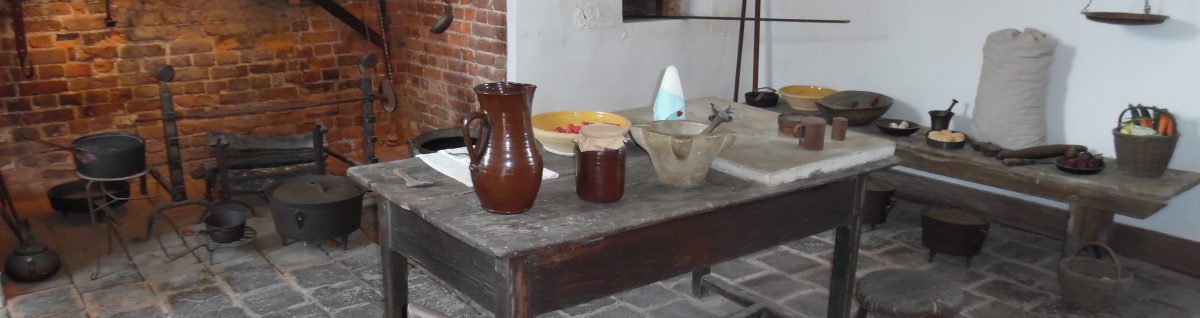
Almost 5000 years ago, before the pyramids were built in Egypt, before Stonehenge was erected on the Salisbury Plains, a group of farmers settled in a village on the coast of Orkney, not far from the crashing waves of the ocean. It might seem strange to establish their community on this wind swept, treeless island in the North Atlantic, but at the time Orkney was an important power center in Europe. There is ample evidence of extensive trade of goods and ideas between the nearby islands and the mainland of Scotland, England and the continent. Orkney Island was strategically located for trade back then. (And the island was equally important in World Wars I and II.)
Skara Brae is by far the best preserved Neolithic village in Northern Europe. It has been designated as a World Heritage Site. The exhibition hall, the replica house, and the site itself all help us understand what life was like for the people living here so long ago.
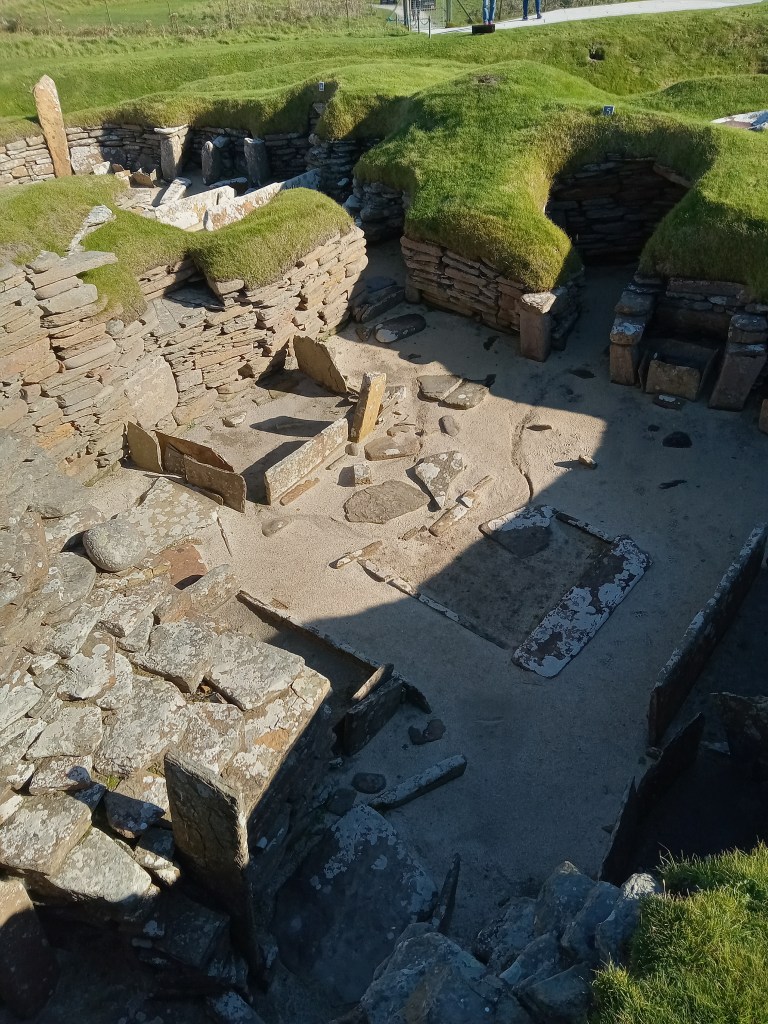
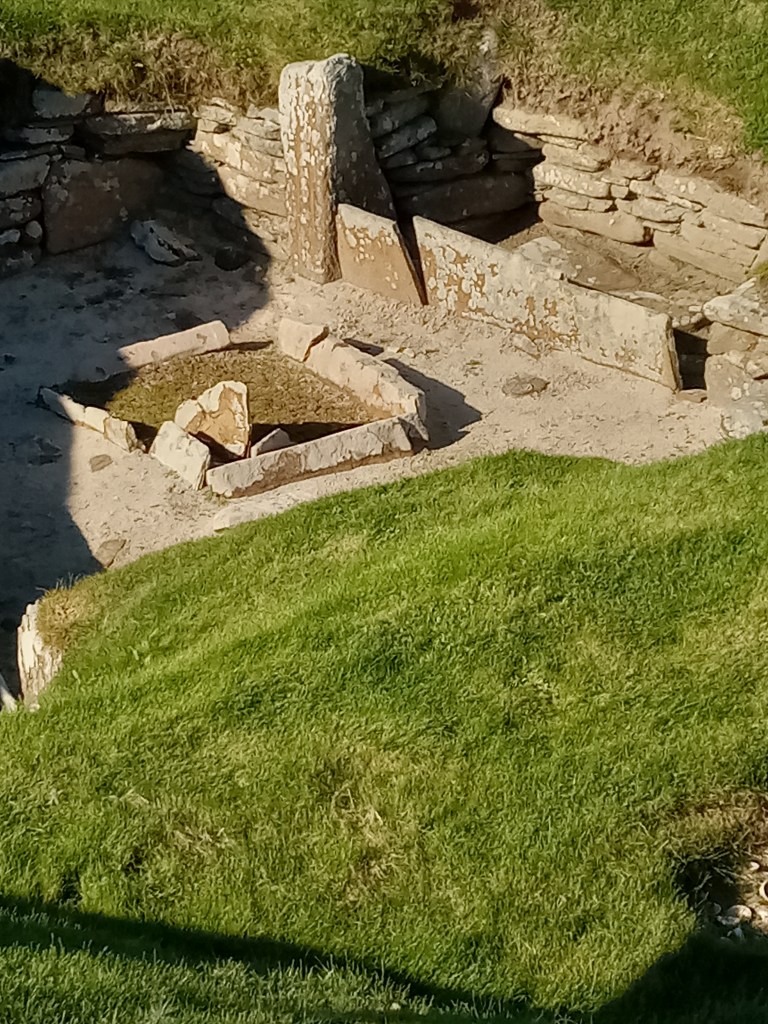
Much has been learned from studying this remarkable place, but much still remains unknown, and perhaps, unknowable. Though the roofs are long gone, we can see the layout of the stone furniture, the hearths and bed boxes, the latrines and live catch basins, all of which offer clues to life here. However, much of the ‘stuff’ that makes life comfortable is perishable–the food, the clothing, the bedding, …the list goes on. For a writer, Skara Brae provides an ideal setting to let the imagination soar.
Using facts gleaned from archeologists’ studies and reasonable guesses, here is one version of a day in the thriving village of Skara Brae. I imagine…
A young mother, we’ll call her Lin, wakes early to nurse her baby. Sleepily, she crouches in the stone bed box alongside her two older children, her old father, her husband, and her sister. The stone floor of the bed is cushioned by bracken and skins, and Lin is comfortable surrounded by her family.
The room is dark and smoky.. There are no windows. The hearth fire has burned low overnight, but thick stone walls with piles of midden surrounding them keep out the chill wind and deaden the sound of the sea.

Lin rises and settles the baby in her sister’s arms. After a quick visit to the corner latrine with its drain under the settlement, she builds up the hearth fire, burning dried seaweed and animal bones. As the rest of the family wakens and joins her by the hearth, she prepares a meal to break their fast. She heats stones in the fire and drops them in a pottery jar containing a pottage of grain and berries, along with some limpets the children gathered yesterday. Her oldest son cracks some hazel nuts to add to the meal. The mixture has fermented slightly, giving it a tangy, earthy taste. It’s fall so food is plentiful and the family will eat well today.
After eating the family scatters to their chores. Lin’s father-in-law is a master carver. He’ll spend the day in the workroom at the far end of the passage connecting the houses in this village. As he carves the walrus tusks into pins and cattle teeth into beads, he’ll teach the craft to the older children of the village. They expect to trade these carvings with visitors before winter closes them off for a time.
Lin’s husband goes outside to inspect the corbelled stone roofs of his and his neighbors’ houses to make sure the last storm did not cause any damage. He’s the best builder in this community, with knowledge and practice of fitting the stones together. Many of the men will fish today, but he and a few others have planned a hunt for red deer which roam the island.
One of the old grandmothers of the village takes the younger children to the beach. She’ll guide them in gathering limpets, and other shellfish. Carrying her baby in a deerskin sling, Lin goes with her friend to milk the sheep clustered in a pen not far from the village. They’ll use the milk to make cheese which can be smoked and saved for use all winter. Later she’ll join the other women of the village to harvest the crop of bere (an ancient type of barley) they have planted a little way from the village.
Days have been growing shorter as winter approaches. After working all day with their neighbors, the family gathers again in their one room house. Lin’s daughter has found a handful of white feathers from the sea birds on the beach. Lin carefully arranges them in a display on the stone shelf opposite the doorway. In the soft light of the fire, the family eats the evening meal enjoying the remains of the same pottage that they had in the morning and will add to again the next day. Lin takes the set of dice her father-in-law carved from the shelf, and they enjoy a lively game. The grownups laugh and joke with each other while the children fall asleep.
Finally Lin banks the hearth fire and they all settle into the bracken lined bed box, happy and cozy after their productive day.
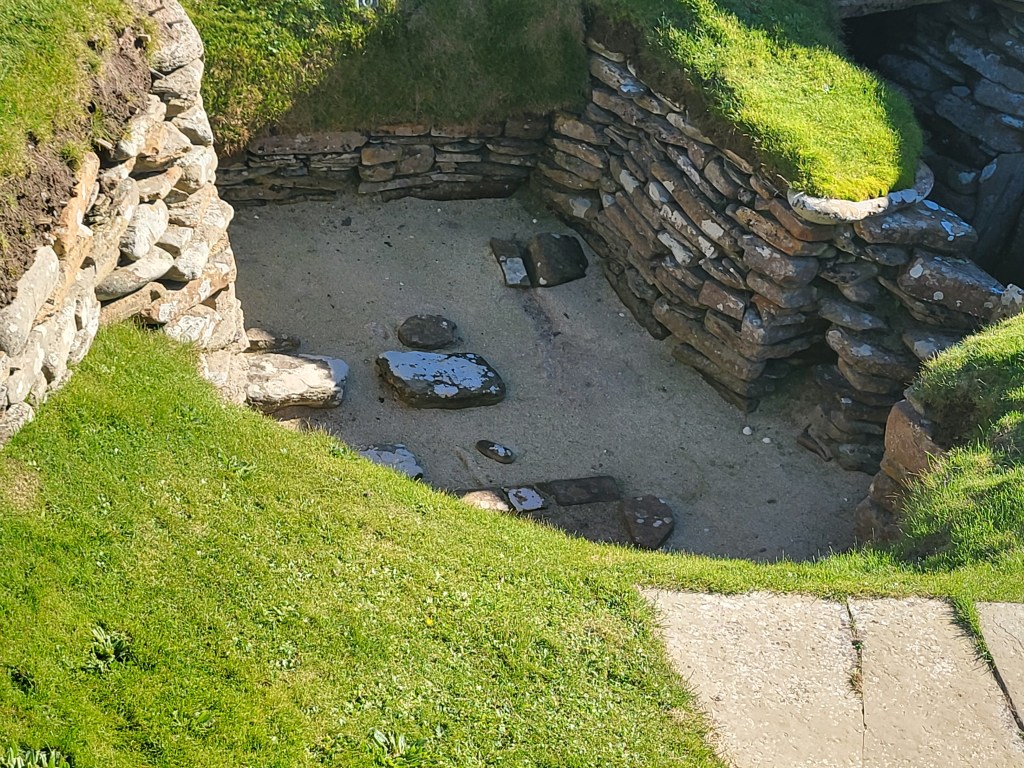
Skara Brae was inhabited for 300 or 400 years, and then the place was abandoned. We don’t know why people stopped living there, whether it was a sudden departure, or a gradual one. Perhaps a terrible storm brought too much sand or perhaps the younger generations gradually moved away, looking for a better place. What we do know is that after the village was abandoned, it was buried by the blowing sand and forgotten. Until centuries later, in 1850 another storm revealed part of the hidden village. So much that is unknown… so much for the visiter to imagine.




 BRIC-A-BRAC