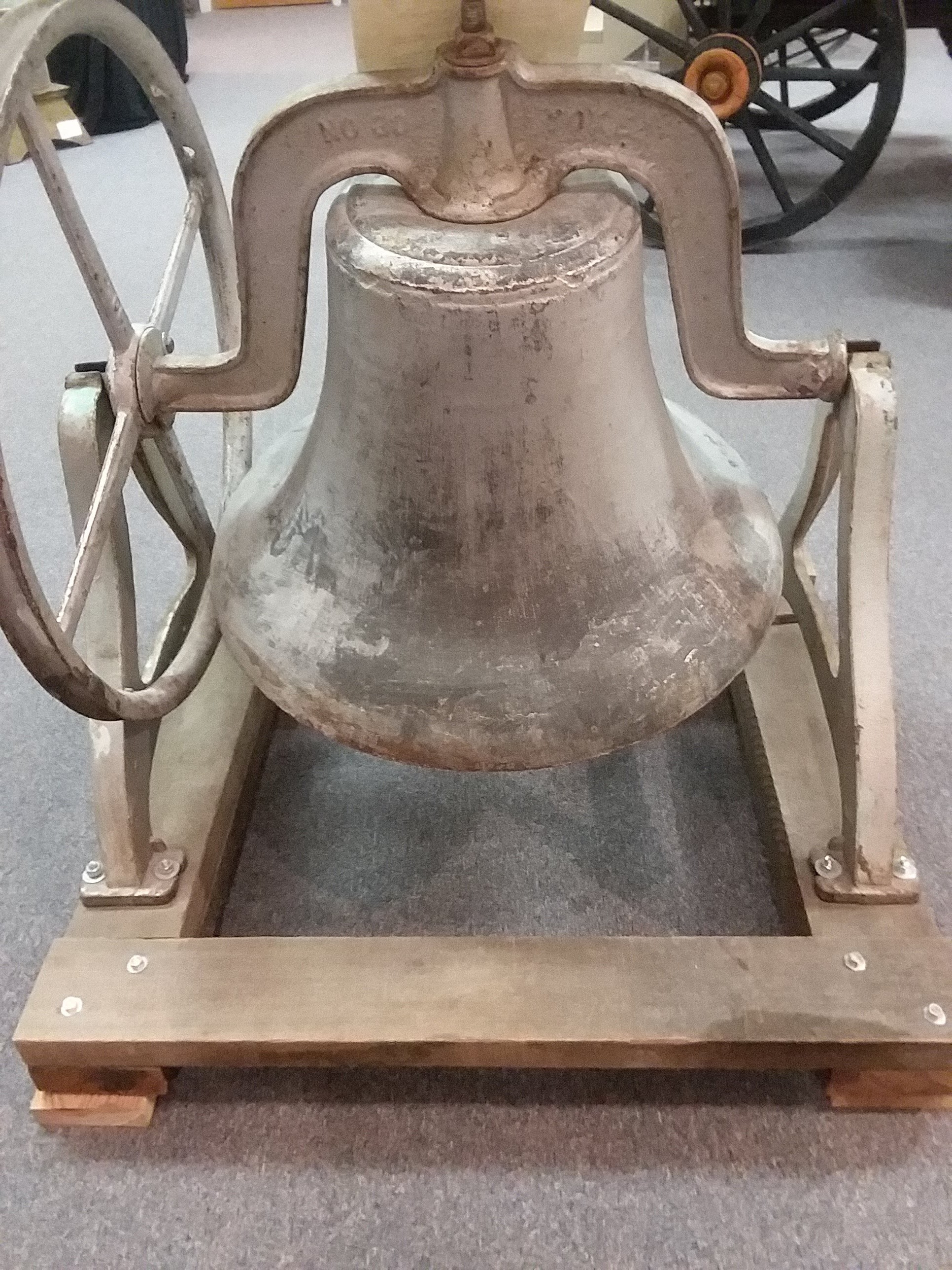
The Tetonia School Bell, currently housed at the Teton Valley Museum in Driggs, ID. The three room school house, operating from 1919 to 1953, was a consolidation of schools from Victor, Driggs, and Tetonia.
For almost my whole life, I think of the beginning of the year in September, not January. Not surprising, since from the time I was 5 years old, I’ve either been a student, a parent of young children, or a teacher, and so it seems natural to think in terms of the school year. Although many local schools start in August, September has always been the month I associate with the beginning of the academic year. But it hasn’t always been that way. In the late 1800’s, rural kids often only went to school for 5 months of the year. They had a short winter and a short summer session, and helped at home in spring and fall. In 1891 in Haden, ID, a school was required to be in session at least three months of the year. Urban students at this same time attended school much longer, in what was essentially year round school. However, event though the schools were open year round, attendance was not compulsory. During the hot summer months, many students did not attend because any family that could afford to do so left the city. Without air-conditioning, the school buildings were sweltering. Toward the end of the nineteenth century, rural and urban schools worked to make schooling more uniform. To that end, the typical 9-10 month school year, with time off in the summer gradually became the norm. (States also began passing laws that made elementary education compulsory.)
This year, 2021, the start of the school year is fraught with challenges. Covid-19 cases are on the rise again, and children under 12 are not yet eligible for a vaccine. School administrators are once again struggling with decisions about masks, social distancing, and virtual learning. I applaud all the teachers who survived the last year and a half, and are showing up again this year to face the challenges. As a former teacher, I can only imagine their struggles to work effectively in such a chaotic and ‘flexible’ environment.
Of course, teaching has never been an ‘easy’ job. It can be amusing to look at various ‘rules for teachers’ from the 19th century. (Although these ‘rules’ have not been verified as actually accurate or authentic.) One such ‘rule’ forbids teachers from loitering in ice cream shops. Another says women teachers could not ride in a carriage or motor car with any man except a father or brother. Whether or not these rules were really put in place, the challenges teachers have faced are very real. Consider trying to teach twenty or more people, ranging in age from five to twenty, all in one room.
The one-room school house was the norm in the decades before improved transportation made it possible for schools to consolidate. In the 1930’s, my mother attended a one room school house in Kansas. When she started, she was the only first grader in the school. With less work to do than the older kids, she had to go outside alone for longer recess breaks. Mom attended this one room schoolhouse through sixth grade, at which time she went to a consolidated school. This ‘big’ school had two rooms for first through eighth grades.
In September, the geese begin gathering to fly south, the leaves start to turn colors, and the school bells ring. (Although many school bells today are really buzzers that mark the beginning and end of each period.) For me, this is the beginning of a new year.
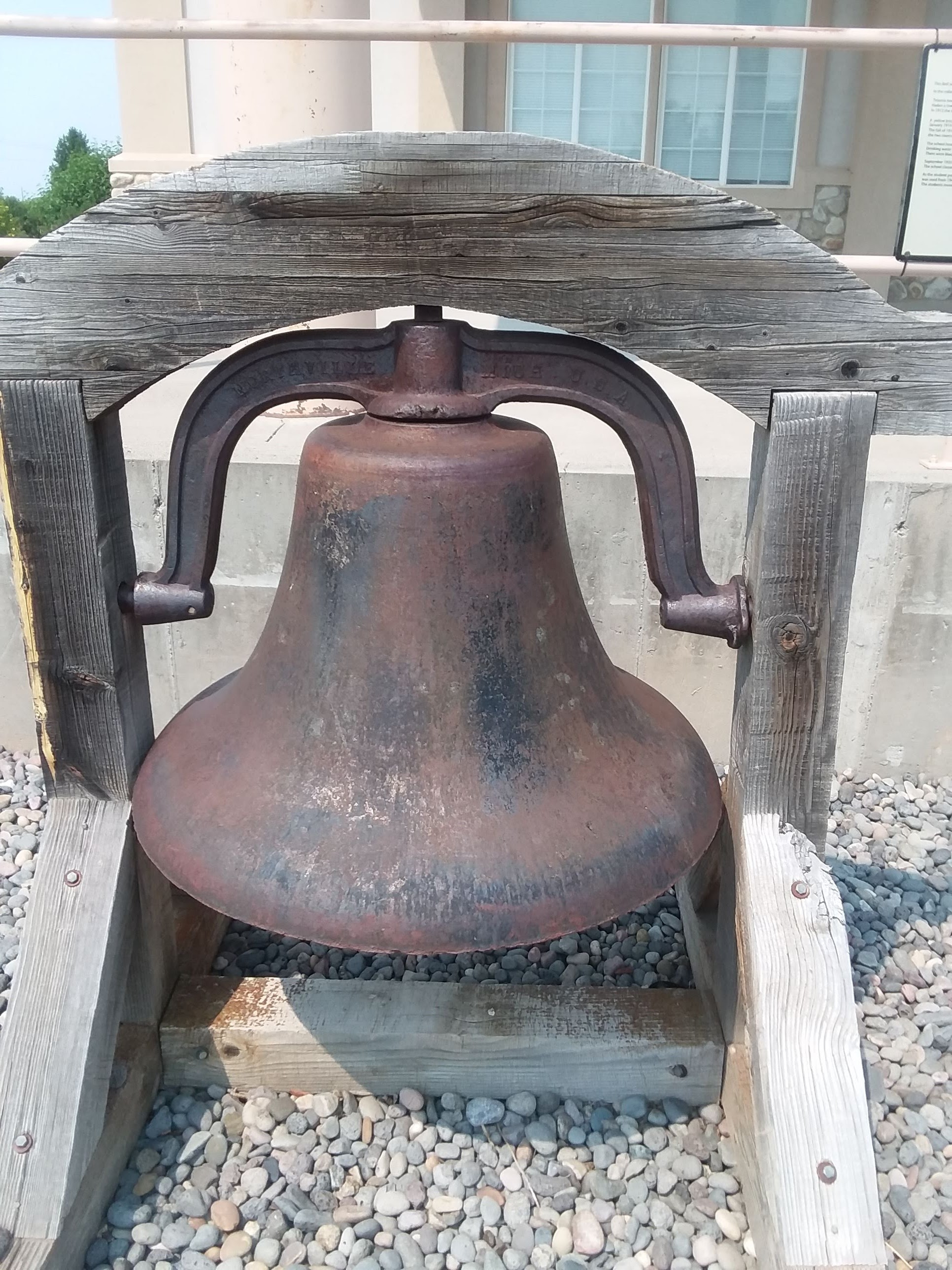
The Haden School Bell. The first permanent school in Haden, ID was opened Jan. 1892 and had 54 students by the spring of 1900. The town of Haden was formally dedicated three years later.
Since St. Patrick brought Christianity to Ireland in the 5th century, that religion has been an important part of the fabric of Irish life. Evidence of this early importance can be seen in the high stone crosses, monastic towers, and magnificent abbeys throughout the land. Even though many of these have fallen into ruin after King Henry VII dissolved the monasteries, their presence remains. One such ruin is Mellifont Abbey, located about ten kilometers northwest of Drogheda, less than an hour’s drive north of Dublin. Mellifont Abbey was built on the banks of the River Mattock in the style of contemporary French abbeys, with romanesque arches and impressive stonework. In its heyday, it must have been beautiful.
Called An Mhainistir Mhór –the big abbey– in Irish, Mellifont means ‘fount of honey’ in Latin. It was founded in 1142 by St. Malachy, the Archbishop of Armagh. St. Malachy thought the monastic orders in Ireland at the time were lax and disorganized, so he established Mellifont Abbey as a Cistercian abbey. Cistercian monks were well known as hard-working and pious.
Indeed, the abbey quickly prospered. It became the biggest, most important Abbey in Ireland, hosting kings, bishops, and papal legates at the 1152 synod. By 1170, one hundred monks and at least three hundred lay brothers lived there. Eventually, over twenty ‘daughter’ abbeys were established by monks from Mellifont Abbey throughout Ireland.
Unfortunately, the abbey’s wealth led to its downfall. King Henry was suspicious of that wealth and the power attending it. He dissolved the abbeys in Ireland in 1539. Mellifont Abbey became a fortified manor owned by various different families. William of Orange even used it for his battle headquarters during the Battle of the Boyne in 1690.
I visited the ruins of Mellifont Abbey many years ago on a drizzly day– typical Irish weather. There were few other visitors that day, and we enjoyed strolling along the gravel walkways between the stone foundations which marked the layout of the original buildings. At one end of the complex is the lavabo. The lavabo was a washroom, used by the monks for ritual (and practical) hand-washing before eating. Though it too is in ruins, three of the original eight beautiful Romanesque arches remain. Some of the ornate carvings from the lavabo and other buildings are displayed in the visitor center.
It seems fitting somehow that this spiritual place of cleansing has in some part outlasted the depredations of time, wars, and human greed. Though it’s deserted now, when I closed my eyes and listened, I could imagine the splash of water and the footfalls of the monks underneath the wind as they washed their hands, in a time-honored (and scientifically supported) ritual of purification.
If 2020 had gone as planned, I’d be coming back from Scotland right about now, with new stories and pictures. But in the words of Robert Burns, “The best-laid schemes o’ mice an’ men / Gang aft agley.” So I offer instead these memories of great castles in Scotland, 2015.
Edinburgh Castle: On a rare, clear moment
The rock that Edinburgh Castle sits atop has been fortified since before Roman times.
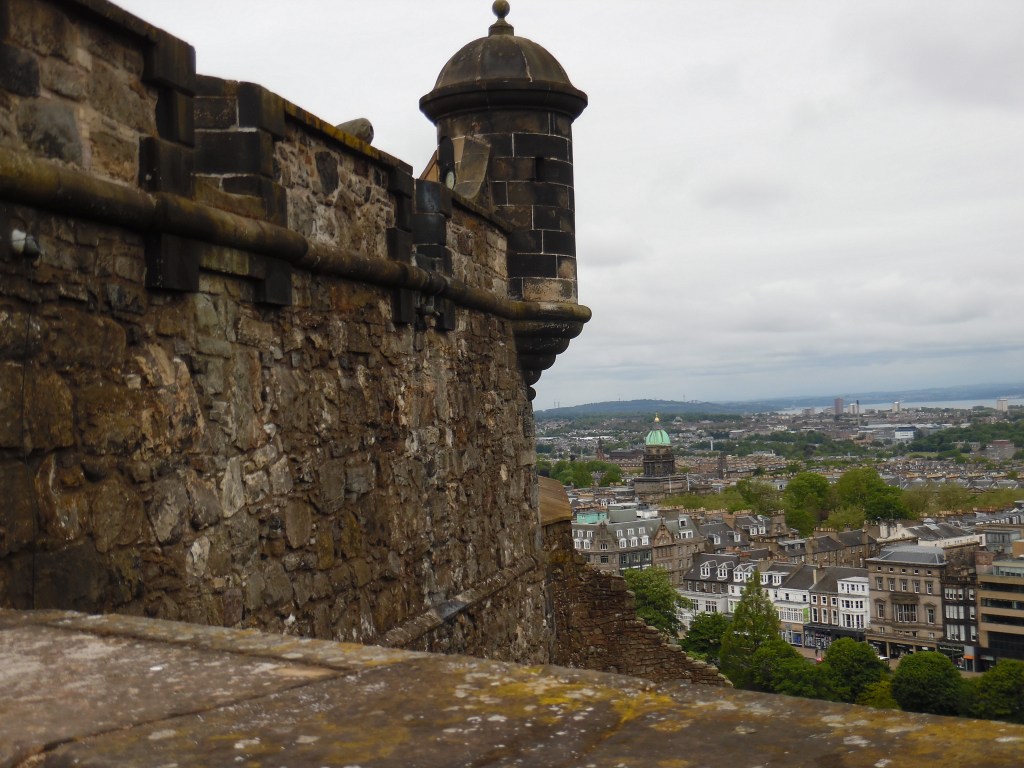
A view of Edinburgh Castle ramparts and the city below.
The oldest parts of the castle were built by King David I in 1103.
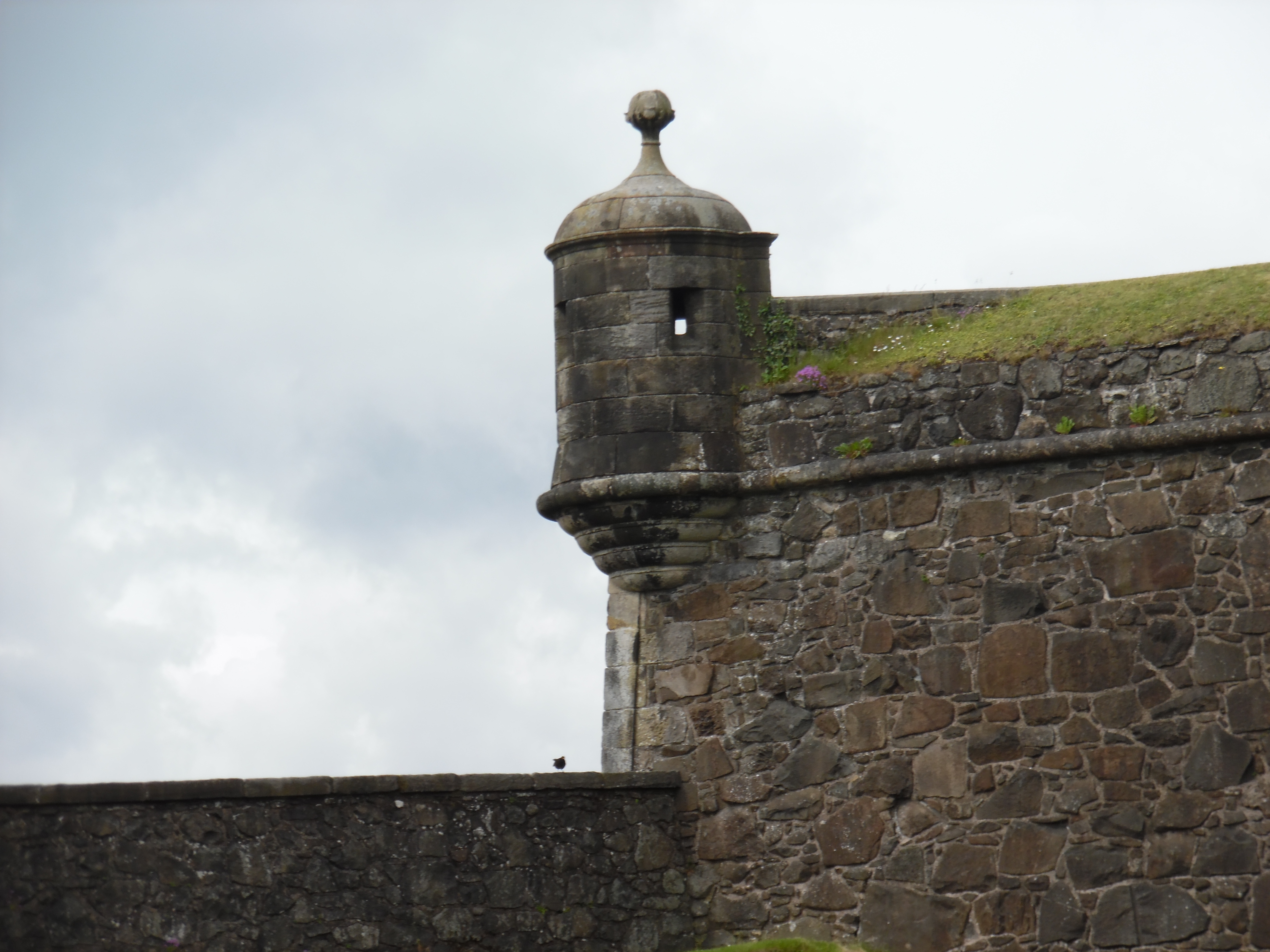
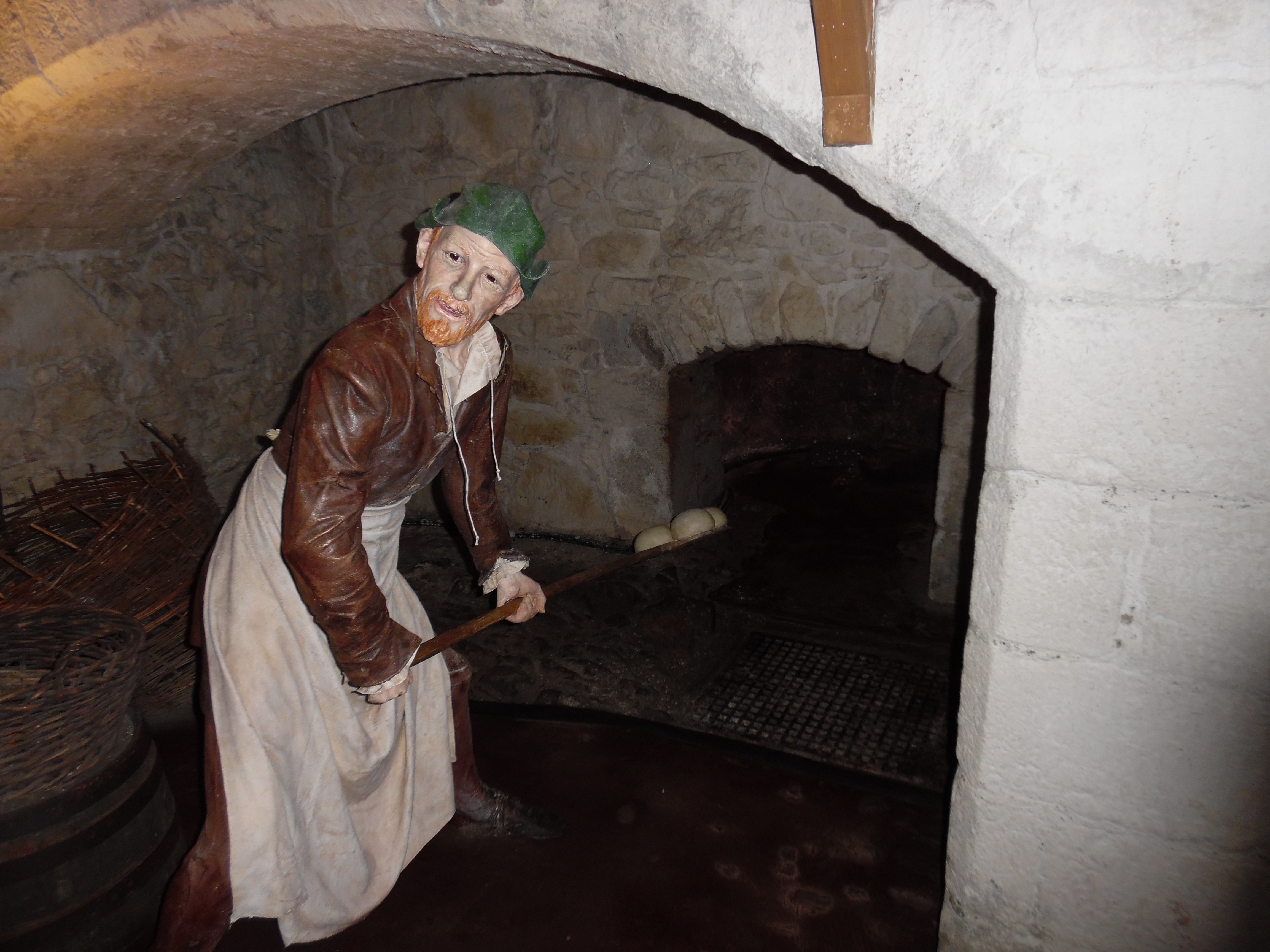
Like Edinburgh Castle, Stirling Castle, is not a single building, but a complex. Here we see the ramparts, a passage way between buildings, and life-sized model of a medieval baker in the lower kitchens. Many of the present buildings at Stirling Castle were built between 1490 and 1600.
Inverlochy Castle, Fort William
Though it is in ruins, Inverlochy Castle is unusual in that it had no additions or changes to the basic design since it was built in the 13th century by John “the Black” Comyn. It sits at the entrance to the Great Glen, a strategic passage into the Scottish Highlands.
Mansfield Castle
Mansfield Castle was built much later than the others, during Victorian times. It became a hotel after World War II. It is said to be haunted by the ghost of Mrs. Fowler, who with her husband, refurbished the place in the early 20th century. We didn’t see or hear the ghost during our lovely stay here.
Cawdor Castle
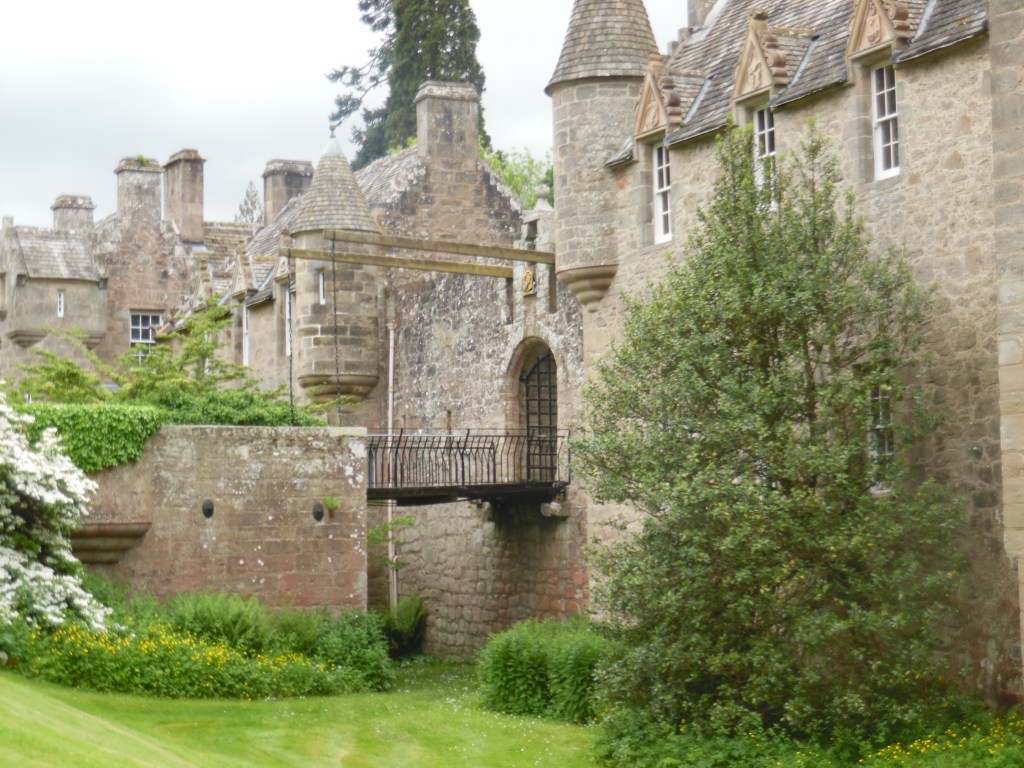
Cawdor Castle was built in the 14th century for the thanes of Cawdor. Though it is open to the public, the castle remains the home of members of the Cawdor family. For me, the castle is significant because Macbeth was awarded the title of Thane of Cawdor after the previous thane was executed for treason. The witches announce this to Macbeth as the first part of the prophecy that ultimately leads to his downfall. Visiting this castle made Macbeth’s story seem all the more real. (The real King Macbeth fought the Thane of Cawdor, but did not receive the title himself.)
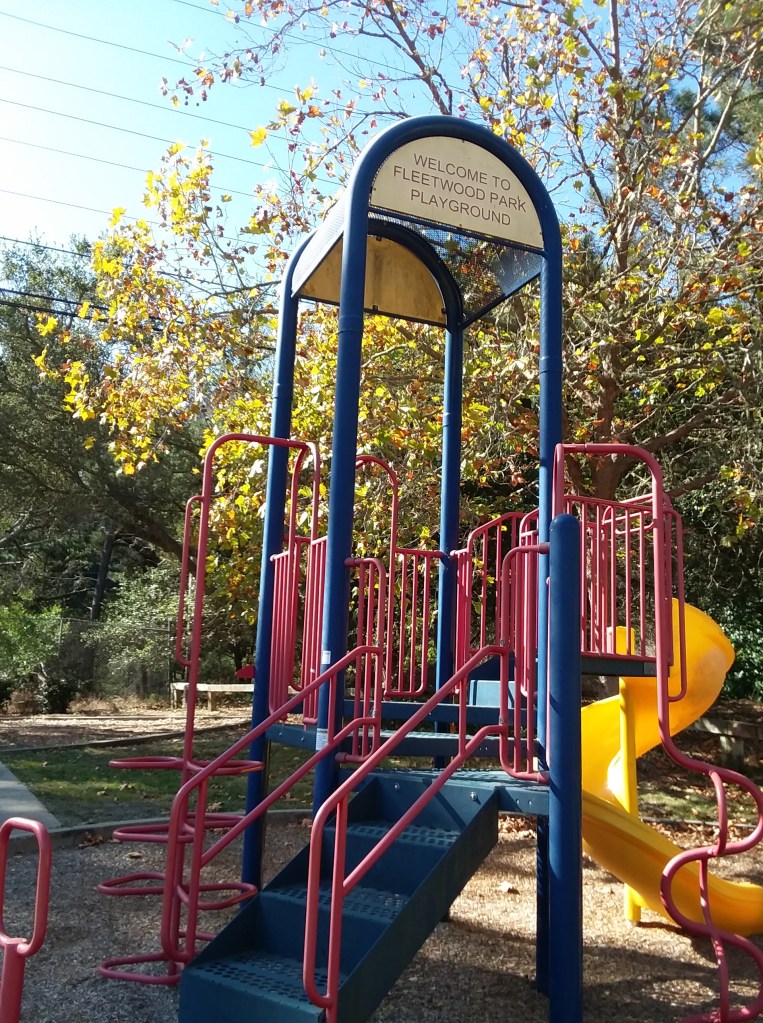
For those of us who are old enough, the places we remember from childhood are historic. I’m thinking of a place I first saw over 60 years ago, a little park nestled in the San Bruno hills. We lived on Willow Way, a few blocks from the park. My older brother used to march us there. He was the general, and we were the privates. Getting there was a great adventure.
Actually, I have few memories of the park itself. I suspect there were the standard swings, maybe a slide or a merry-go-round. What I do remember is the forbidden jungle behind the park. For a child, it was easy to slip through a gap in the chain link fence and enter the forbidden territory teeming with mysterious wildlife. There were king snakes, blue belly lizards, baby birds in need of rescue, and alligators (or crocodiles- I’ve never been sure which is which). Though I was too little to accomplish the feat myself, I clearly remember my brother swinging on a thick vine across the alligator-infested river below.
We moved away from San Bruno when I was about 7 years old, but the memories of this exotic park remained. Jungle vines and wild trees fueled my imaginary treks through the Amazon for years afterwards.
In fact, I never questioned my vivid memory of this San Bruno jungle until well into adulthood. One day, while sharing childhood stories with my own children, it occured to me that there are no jungles in San Bruno, California. As a part of Central California, less than an hour’s drive from San Francisco, San Bruno has a moderate climate rather than a tropical one. It’s cool and foggy, without a lot of rain. Eucalyptus trees grow there, but no lush tropical vines. As for the animals, I’m sure there really were king snakes, blue belly lizards, and baby birds, since my brother caught all of these critters and brought them home. However, outside of a zoo. neither alligators nor crocodiles have ever lived anywhere near San Bruno. My children, who had a better sense of geography than I’d had, laughed at another example of my overactive imagination.
There’s a word for this kind of false memory: confabulation. Confabulation is often associated with mental diseases, but it also occurs fairly often in the general population. And clearly, it’s easy for a writer to confuse reality with the stories one tells.
Last fall I had a chance to go back to San Bruno for the first time in decades. My sister and I found the house we’d lived in on Willow Way. From there I found the park. It’s not quite the park of my memory. No alligators, crocodiles, vines, or rivers. But there is a way around the chain link fence and there is a wooded area tangled with brush behind it. It’s not really a jungle, but close enough to understand why I thought so. I find it comforting to know that even though I made up many of the details, the place is real. Maybe not historic in a traditional sense, but part of my history. And real or false, I still cherish the memory of my jungle.
The Yangtze River is the most important river in China. Starting in the mountains of Tibet and draining into the East China Sea near Shanghai, it is the longest river in China, the longest river in the world to flow entirely in one country, and the third longest river in the world overall. The Yangtze River is considered the birthplace of the Chinese Civilization. People have been living along its banks for thousands of years, possibly as early as 3000 BCE. Though Westerners call it the Yangtze River, this name, meaning ‘child of the oceans,’ is technically reserved for the area near the mouth of the river. In Chinese the river is called Cháng Jiang (long river) or just Jiang (the river).
The Yangtze River is also the setting for the beloved picture book, The Story about Ping by Marjorie Flack and Kurt Weise (originally published by Viking, 1933). This is the heartwarming tale of a young duck, Ping, who lives in a wise-eyed boat on the Yangtze River with his large family. Each day the duck family forages for food and then returns at night to their home on the boat. But the last duck to return home always gets a spank. One day Ping sees he will be the last duck, so he hides instead of returning home. After a night alone on the river, Ping faces many adventures including an encounter with cormorants and capture by a young boat boy. As Ping narrowly escapes becoming the boy’s duck dinner, he is thrilled to see his home, the wise-eyed boat. Unfortunately Ping sees that no matter how fast he travels, he will once again be last. But this time he marches up, takes his spanking, and happily rejoins his family. I’ve read the story at least a thousand times and have never met a 3-year-old who didn’t love Ping.
Ping’s home, “the beautiful yellow waters of the Yangtze River” became for me symbolic of all China. So when I embarked on a Yangtze River cruise, I wondered what I might discover of Ping.
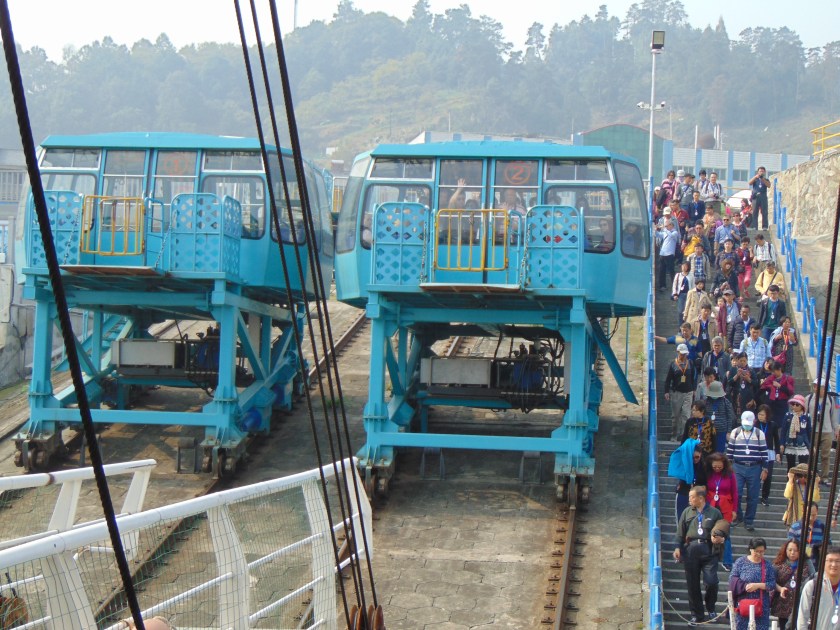
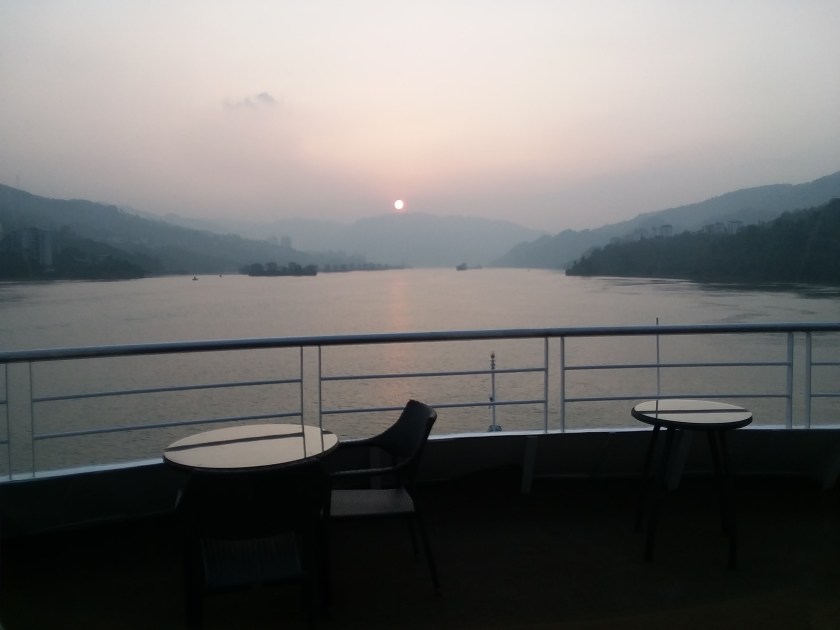
We began our cruise late at night at the dock in Maoping, which is in Zigui County, upstream from Yichang and the Three Gorges Dam. With creaking, clanking, old machinery, a big blue funicular laboriously transported us and our luggage down to the pier. Cruise boats are docked side by side, so that we had to walk through other boats to reach ours.
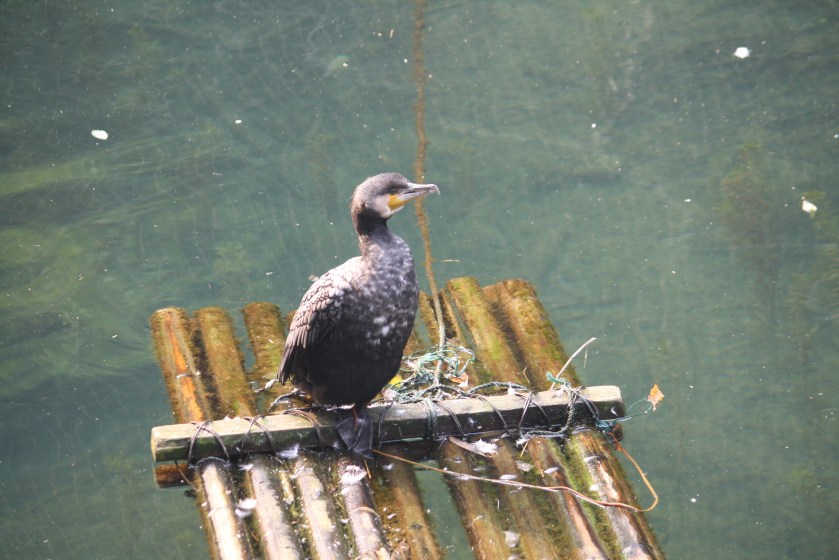
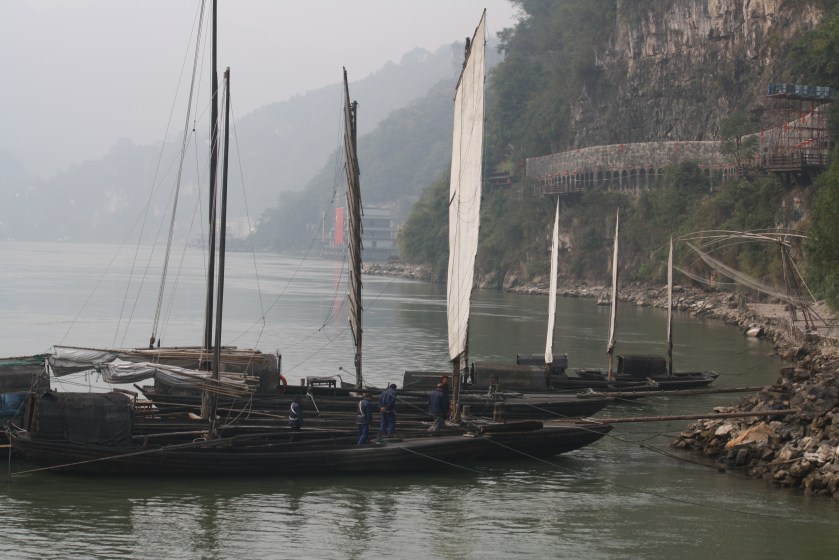
The next morning, eager to see more of the Yangtze, we went on our first shore excursion to visit the Tribe of the Three Gorges, a protected center of culture in the Xiling Gorge. This tourist attraction is located at the junction of the Longjin Brook (Jumping Dragon Brook) and the Yangzte River. It is below the Three Gorges Dam, so this large scenic area has not been affected by the dam. The site features the recreated lifestyle of the Tujia Ethnic minority. There are three “villages” along the path up the gorge: the Village on the Water, the Brookside Village, and the Mountain Top Village. Each set of houses shows traditional building styles, including houses on stilts. Hiking upstream along a paved path offers beautiful views of the river, shrouded with bamboo groves and overhung with graceful willows, surrounded by mist-shrouded jagged mountains. The path follows alongside the brook past a wooden waterwheel up to a gentle waterfall. Along the way, costumed reenactors fish, play the flute, and sing against a backdrop of sampans, junks, and houseboats. A pair of cormorants are tethered to a floating dock, and a few ducks paddle near the mouth of the stream. It could be a scene right out of The Story about Ping, except none of the boats had eyes on them.
“Strange dark fishing birds” (cormorant) and some of Ping’s relatives
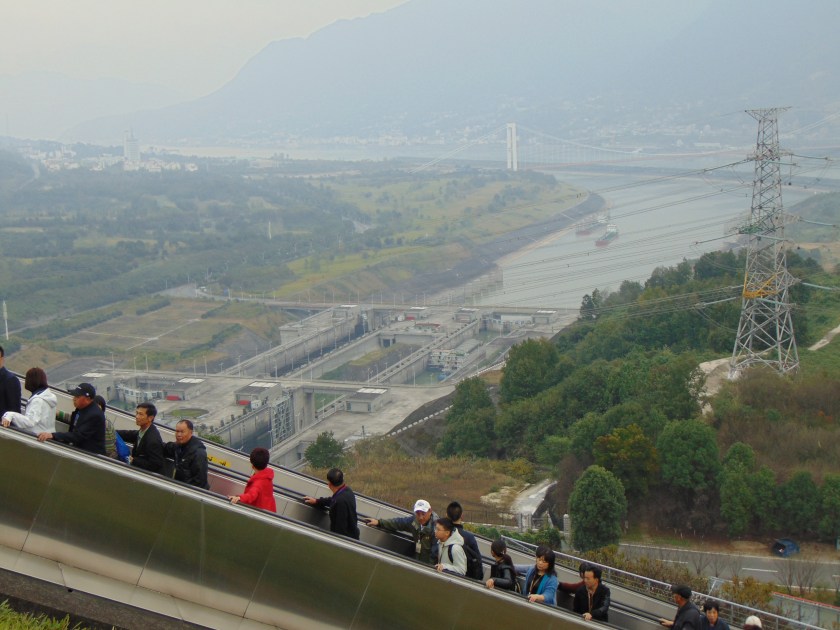
Our next excursion was to the Three Gorges Dam, the biggest hydroelectric dam in the world. The idea of a dam at this point was first put forward by Sun Yet Sen in 1919, but the actual building didn’t begin until 1993. It took 22 years to complete. The dam raised the water upstream 113 meters and required rebuilding ancient cities, moving countless artifacts, and relocating 1.3 million people (and who knows how many ducks).
The dam is big and impressive, but more interesting is the different perspectives on moving so many people and inundating so many culturally significant areas in order to build it. This huge project has been very controversial. What many people don’t realize is that the Yangzte River was extremely treacherous for thousands of years with difficult navigation and disastrous floods. Millions have died from flooding along the Yangtze. The estimated death toll from the 1931 flood alone ranges from 443,000 to 4 million. Building the dam destroyed many things, but it also is an important source of clean, renewable energy and has greatly improved the lifestyle for millions of people. Our guide today said it was mostly older people who objected and that younger people in the area were glad of the greater opportunities and chance to better their lives.
That night, we cruised through the Xiling Gorge which used to be the most hazardous section of the river, now tamed by the dam. In the morning we docked at Wushan Pier, and took another shore excursion, this time on a smaller, wooden sightseeing boat up the Shennv (Goddess) Stream. This is a narrow gorge, with towering cliffs and spectacular views. A fine mist hung over the river, giving the cliff tops an eerie, magical appearance. Ancient hanging coffins on the towering cliffs added to the sense of mystery. Our guide sang beautiful folk songs as we motored upstream and told a story of a ghost wedding. When a young man died before he could marry, a girl chosen as his bride was killed and buried with him. This gruesome practice seemed at odds with the peaceful mountains surrounding us.
Back on the cruise ship, we continued upriver, drifting through the rest of Wu Gorge and Qutang Gorge. In spite of rising water from the dam, the Three Gorges area is still spectacular. From out of the fog, towering cliffs rise in vertiginous masses, with stratifications tilted in uncanny angles. We passed peaks with lovely names such as Goddess Mountain, Opening Scissors Mountain, Flying Eagle Mountain, Morning Cloud Mountain and Holy Waterfall Mountain.
Our ship docked for the night in Fengjie, a city just west of the Qutang Gorge. Fengjie was the capital of Kui during Spring and Autumn period 722-481 BC and Warring States Period 475-221 BC. A good section of these early period town walls and gates remain. The harbor here provides docking space for many boats, large and small, including one sampan full of ducks and chickens. They were too far away to get a good picture, but they could easily have been Ping’s relatives, though this boat had no eyes.
Our last shore excursion was to Shibaozhou (Stone Treasure Stockade).This twelve-story, 56 meters, wooden pagoda was originally from the Qing Dynasty Emperor Kangxi (1662-1722).
Before the Three Gorges Dam was built, it was determined that the rising water might undermine the foundation of this building, so a retaining wall was built to protect it. Inside the temple, a series of very steep wooden steps leads past floors with statues dedicated to the Jade Emperor, the Queen of Heaven, and other beings familiar to me from Monkey, Journey to the West.
We ended our cruise in Chongqing. As we approached the city, the towering cliffs of the gorges were replaced with more and more cities crowding the banks of the river. Smog mixed with the river fog, and the pollution became noticeable. It turned out that the first excursion was the closest I got to the traditional boat culture depicted in Ping’s story. No one I talked to along the way knew of the tradition of painting eyes on a boat. I’m guessing that Ping’s journey actually took place further downstream, closer to Shanghai. After all, I travelled from the Three Gorges Dam to Chonqing, a distance of about 450 km, or 279.6 miles, only about 7% of the Yangtze’s 6378 km (3915 miles).
It’s been over 100 years since The Story about Ping was written, and the Yangtze River has changed a great deal in that time. Today the sampans are motorized, the water is not yellow but green, and the water level is much higher and more stable than before the dam. Cruise ships ply their way up and down the river carrying tourists instead of ducks. It’s easier to find Ping’s relatives in restaurants than foraging along the banks.
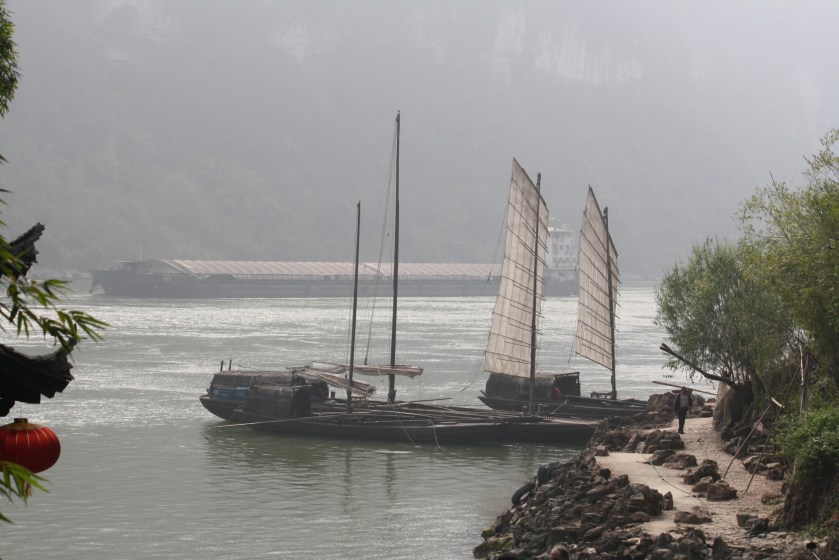
Many boats along the Yangtze River, though none of them are ‘wise-eyed’.
But the Yangtze River is still the lifeblood of China, and I’m confident Ping or his descendents are hiding somewhere in the beautiful emerald waters.
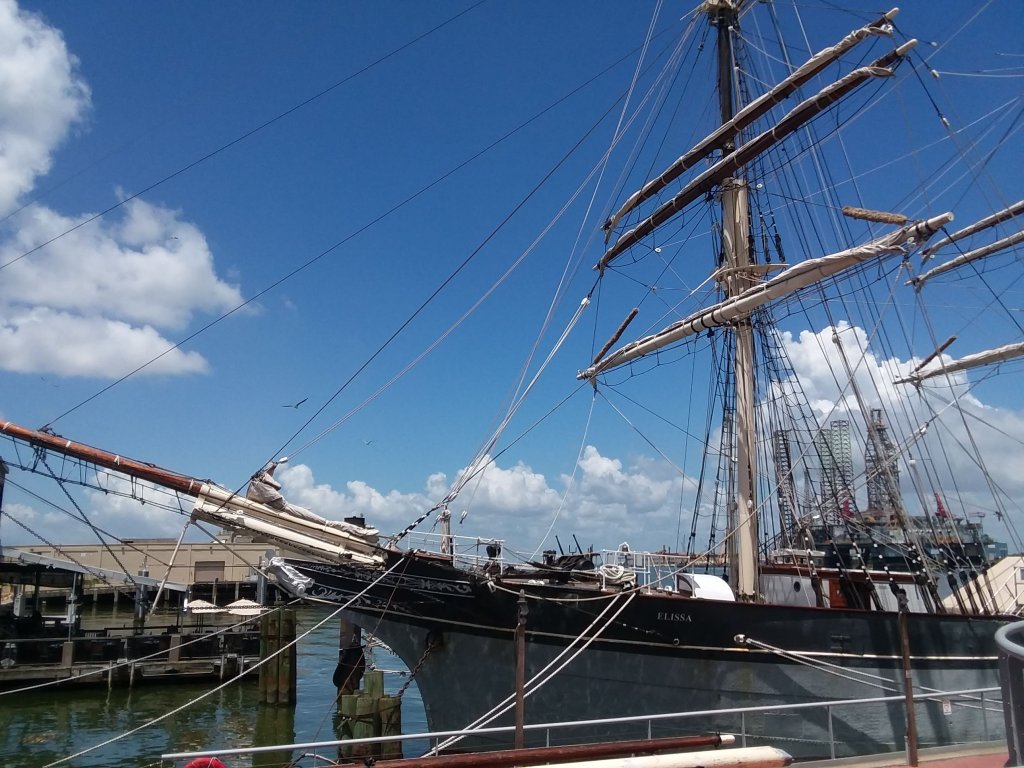
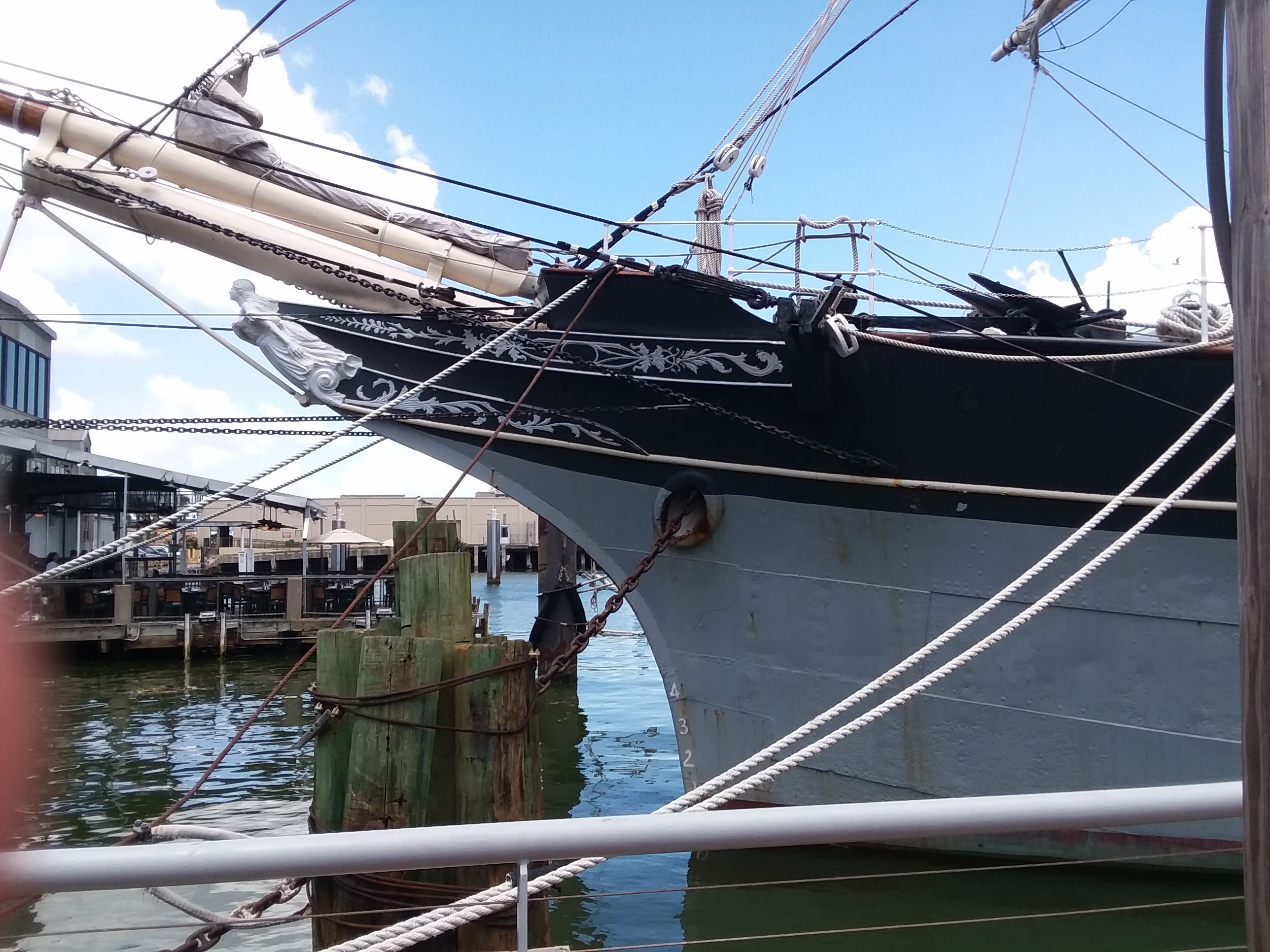
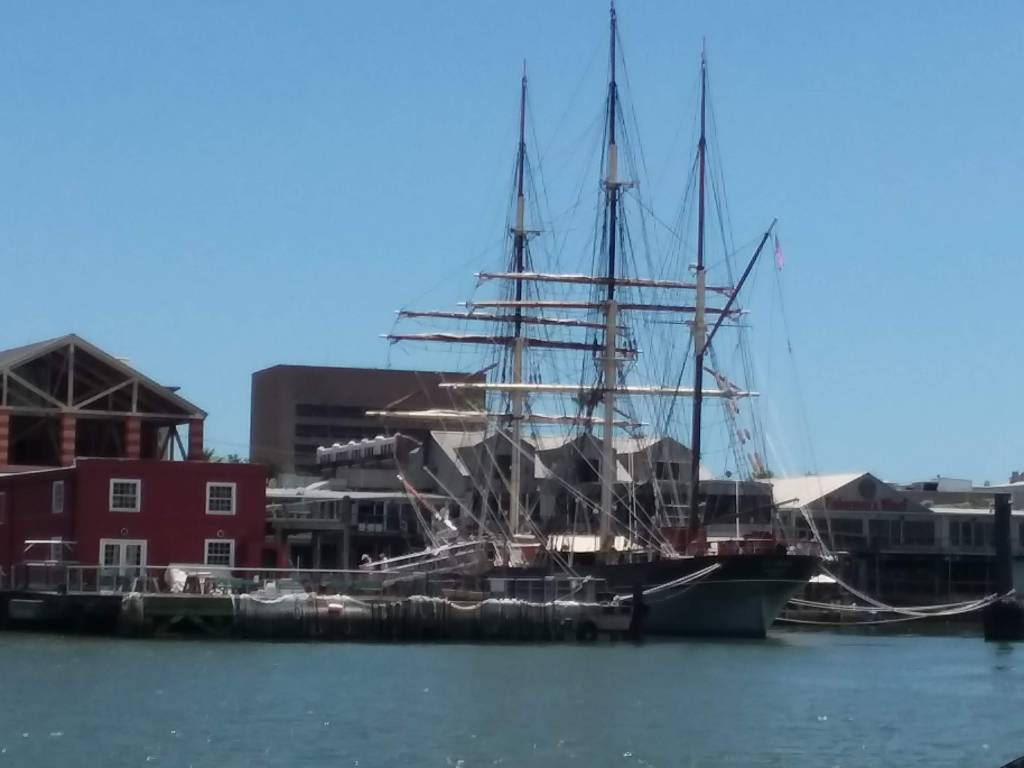
Chances are that if you ate a banana this week, (the most commonly eaten fruit in the world) you participated in a global economy. Though we are more aware of it than we used to be, such worldwide commerce is nothing new. Elissa, an iron-hulled, tall ship moored in Galveston, TX, is a beautiful reminder of such connections. Even her name, Elissa, calls to mind the movement of goods and people. Elissa, the heroine of Virgils’ Aeneid, fled from Tyre to Carthage and changed her name to Dido. With polished teak pin rails and bright work, tall masts for Douglas fir from Oregon, and billowing sails from Maine, Elissa, like Dido, is a testament not only to global shipping, but also to tenacity and the ability to reinvent oneself to meet the demands of the changing world.
Elissa is a barque, so called because of her rigging. Her three masts carry 19 sails. She has square and fore and aft sails on her foremast and mainmast, and fore and aft sails on her mizzenmast. She was built in 1877, just as the sailing era was gradually being taken over by steam-powered vessels. Elissa has truly been a ship of the world. Built in Aberdeen, Scotland, she worked for owners in Norway, Sweden, Finland and Greece before becoming an American vessel. During her shipping years she carried cotton, bananas, and many other cargoes, stopping in Galveston at least twice.
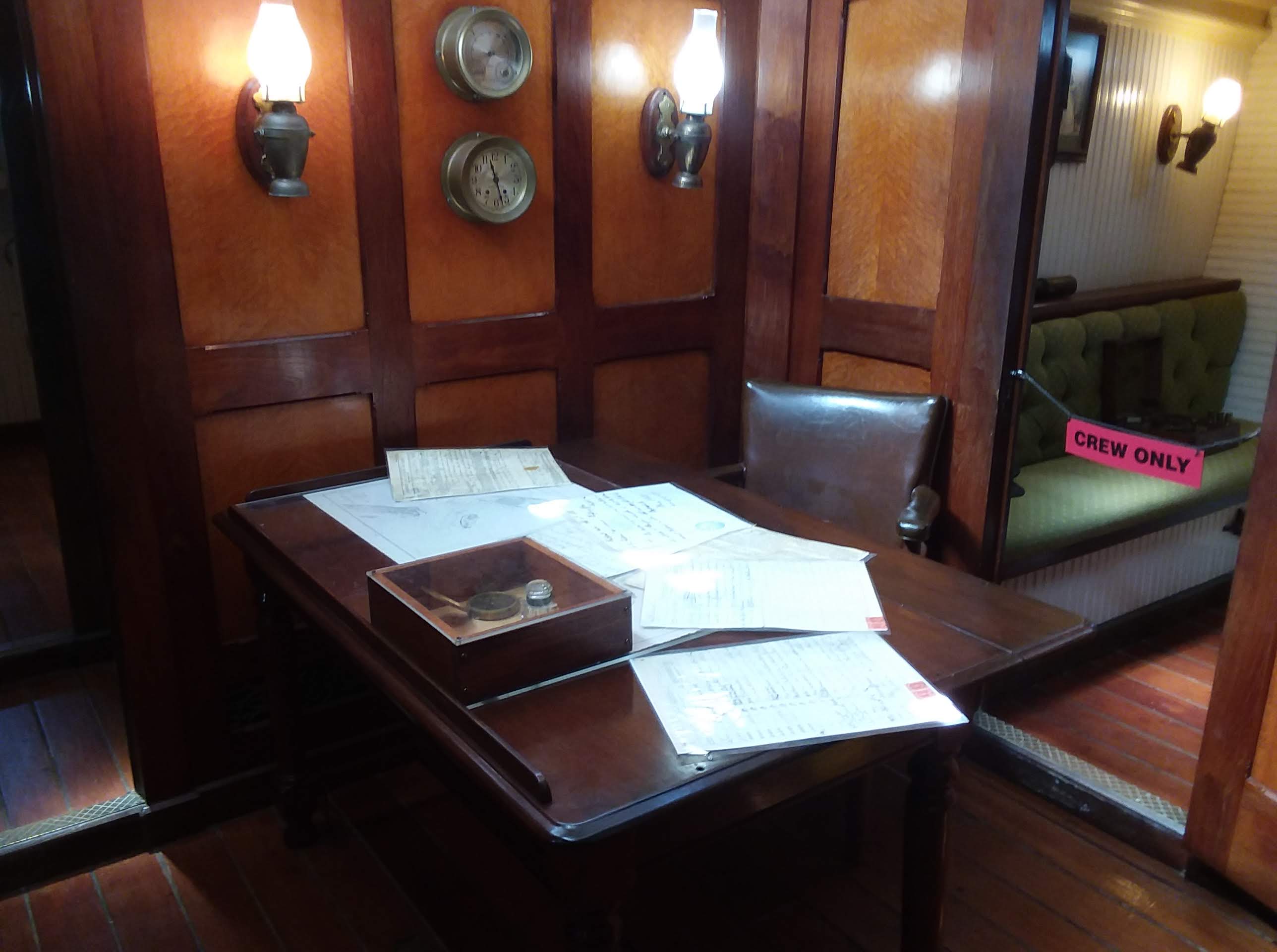
Her story serves as a chronical for changes in world wide shipping. As global shipping changed, Elissa did too.Over her 90 years as a commercial shipping vessel, she was refitted several times, including the addition of an engine. But even steam-power couldn’t bring Elissa into the modern world. In the late 1960’s she was relegated to a salvage yard in Greece. It was ten years before she was rescued, and towed across the ocean to her current home in Galveston, Texas. It took another six years to repair and restore Elissa to her former sailing glory. Now, as one of the oldest sailing ships in America (The Louis R. French is the oldest), she serves as a floating museum at the Texas Seaport Museum, in Galveston, Texas. She sails in competitions and demonstrations, and offers sail training courses each year to keep sailing traditions and knowledge alive.
Remember that banana you ate? Though they are cheap and easy to find today, back in Elissa’s prime, bananas were considered an unlucky cargo. They spoiled easily, risking the chances of profit, and when they rotted, bananas gave off noxious fumes that made the crew sick. (And those huge brown spiders often found on bananas from South America are scary enough to make anyone cringe.) I admit to taking for granted the ease in which we enjoy products from all over the world today. The Elissa evokes a bygone era where even the common banana was a luxury, and I am reminded just how lucky we are.
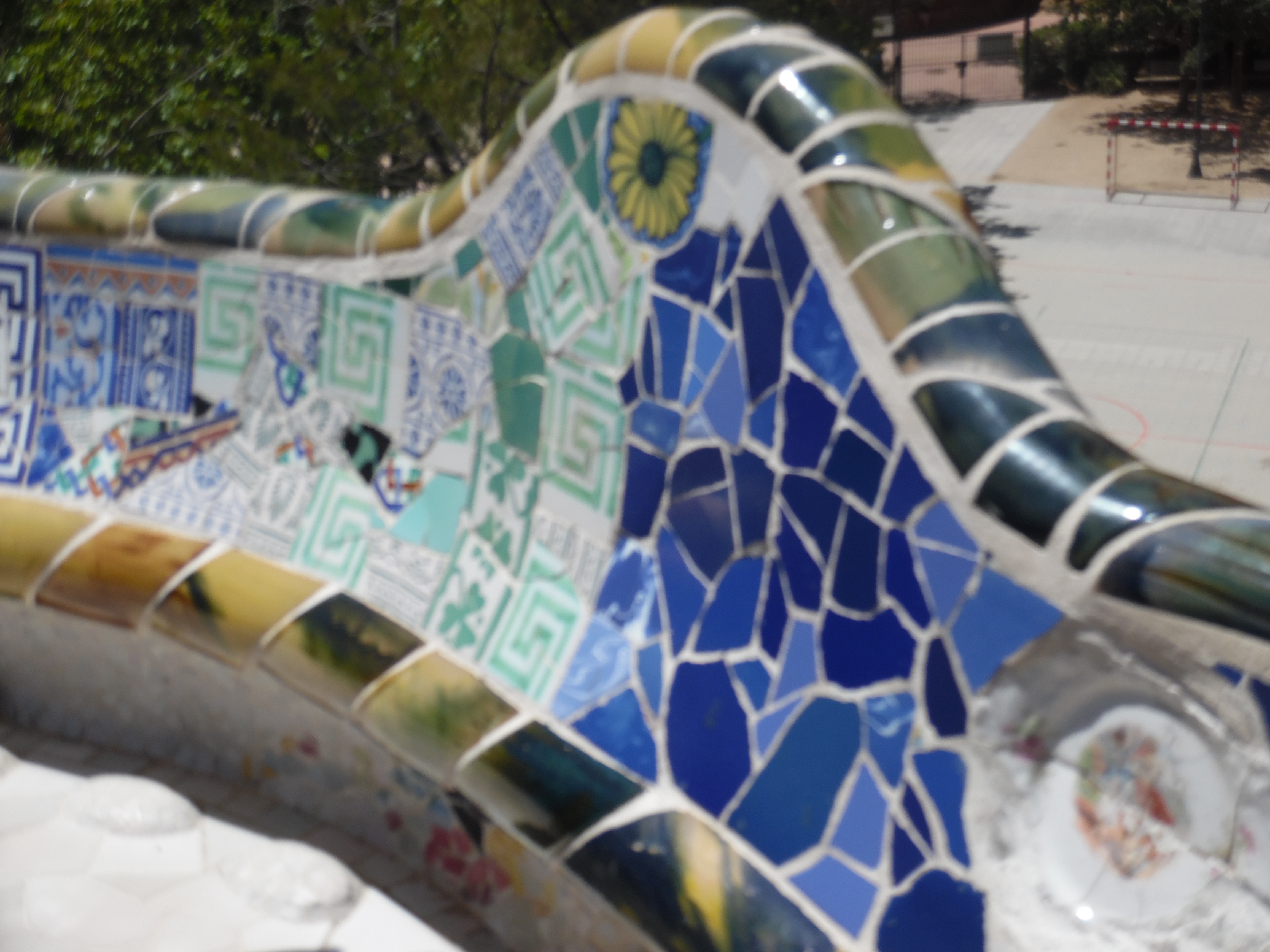
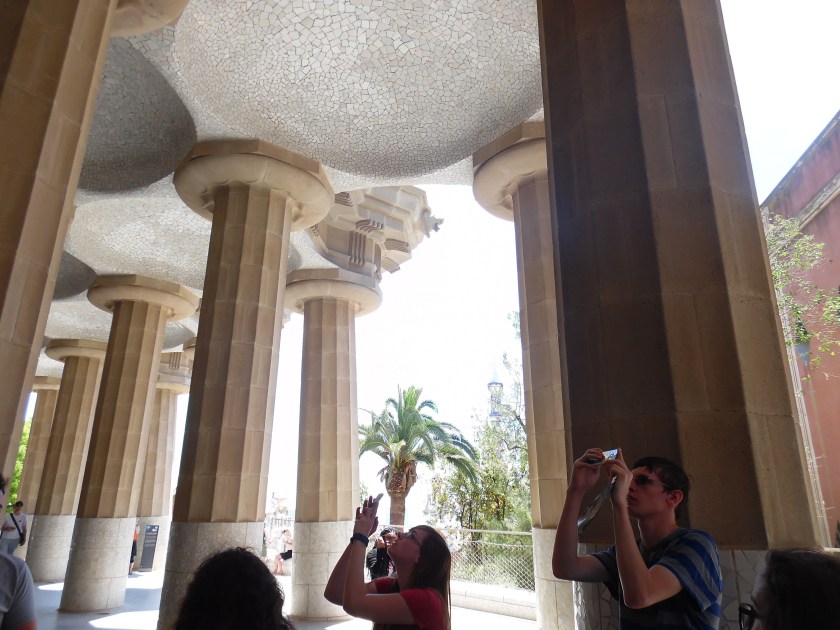
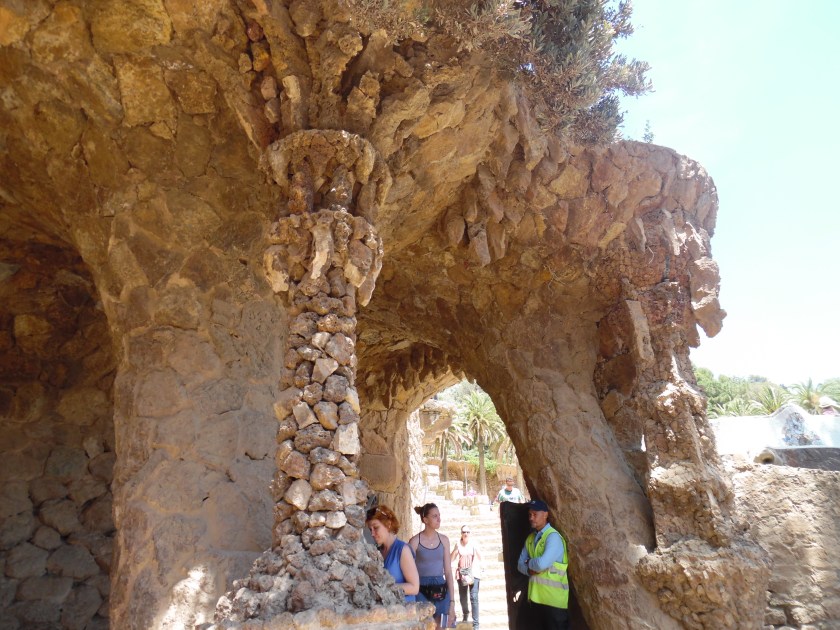
Park Güell in Barcelona is amazing–sort of like Dr. Seuss meets classical Greece. Majestic Doric columns support the roof of the terrace, which features the famous curving mosaic bench, so serpentine it seems almost to writhe and flow. Built to be ergonomically sound and quite comfortable, the loops and curls of the bench invite relaxed conversation. The park startles visitors with irregular shapes, slanted arches, and unusual creatures, such as the huge multi-colored mosaic lizard (known as Drac, the Dragon), descending the stairs near the park entrance. A mixture of the practical and the whimsical, this park is deservedly famous in Barcelona.
Yet fanciful and modern as it seems, the park was built over a hundred years ago. Starting in 1900, Gaudi built this park for M. Güell who was a speculator planning to sell houses in the park. Unfortunately for him, no one bought the houses, thinking the park was too far from the city. Eventually, as partial payment from Güell, Gaudi ended up living in the model house that he had designed there. This park exemplifies many of Gaudi’s important ideas. First, Gaudi’s deep religious convictions are apparent throughout the park. For instance, round balls lining an avenue represent rosary beads. Gaudi was also very innovative, planning for all the rainwater to be collected in great underground cisterns that could water the park for three months. Finally, as a early conservationist, Gaudi created his mosaics from recycled material, like broken wine bottles.
The day we visited Park Güell, firework stands lined the nearby streets in preparation for St. John’s Day, a holiday derived from the ancient pagan summer solstice celebration. Today festival goers unwittingly mingle ancient traditions with newer ones as they strum the guitar and sing, start a fire on the beach, drink warm rum, then jump over the fire and set off fireworks. This seems a perfect magical celebration of this surrealistic park.
Perhaps Gaudi’s work takes us far beyond the borders of this galaxy to the windswept landscapes of Tatooine. Casa Mila, also known as the Stone Quarry, is the last family home designed by Gaudi before he turned to larger projects. It was built between 1906 and 1912. The roof features a maze of bizarre shapes.
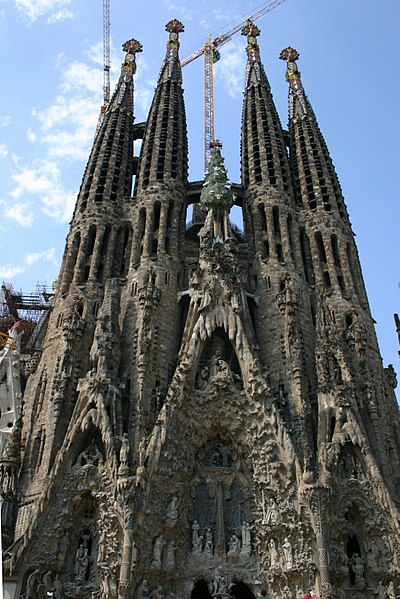
Another great monument to Gaudi’s work is La Sagrada Familia, a huge cathedral which dominates the city skyline and is able to seat over 1000 people. Building this church began in 1882. Gaudi took over the work in 1883, but it is still not finished. (Gaudi planned the entire project, which is due to be finished in 2026). It has been built from donations and more recently, entrance fees. This remarkable cathedral seems to have been built of liquid stone, like living stone formed into symbolic shapes. When it is finished, there will be 18 spires. The main tower will be 565 feet, the tallest bell tower in the world when it is done. Gaudi’s symbolism covers every inch of the building. For instance, there are 12 pillars for the 12 apostles, each with a fruit at the top, one for each month of the year, and according to the seasons (so figs and oranges in winter). The next higher set of pillars is alternating grapes and wheat for the bread and wine of the last supper.
A great many details make this church one of the most unusual combination of Gothic and inspired surrealism. For instance, there are no completely right angles in the building. The columns inside the church double in size as they go up. They are made to look like tree trunks with branches supporting the ceiling, snd the stonework looks like pale, melting chocolate.
Every detail is symbolic. For instance, the colors of the stained glass windows inside are incredibly brilliant, so translucent they glow. The glass shows sunrise on the east and sunset on the west, so the east starts with oranges and reds and moves toward blue green light of day, and vice versa on the west.
All three places, La Sagrada Familia, Casa Mila, and Park Güell, have been designated UNESCO World Heritage Sites. Perhaps that’s not surprising since it is not often a place can be securely grounded in the past at the same time it transports the visitor to such other-worldly, mystical experiences more like dreams than reality. All of Gaudi’s works in Barcelona, with their roots in the neo-Gothic and early modernism of the late 19-th century, and their forward-thinking incorporation of nature into architectural forms take visitors beyond the conventional into unearthly regions of the imagination.
“Who has seen the wind?” Christina Rossetti asks in her famous poem. “Neither you nor I,” she answers. It’s true we can’t see the wind itself, but we can certainly feel it. Whether it is a gentle breeze bringing cool relief, or a violent tornado ripping through town, that unseen wind has power. Not surprisingly, people learned to harness wind power for their own purposes many centuries ago.
My own fascination with windmills began when I was a child, watching Chitty Chitty Bang Bang. How exciting to actually live in a windmill! I could only dream about such an opportunity. Later I read about Don Quixote in his hopeless quest, tilting at the great giants. The windmill seems to be a romantic symbol, recalling bygone days as well as the relentless march toward the future.
Persians made the first known windmills around 500 CE, for milling grain and pumping water. Even before that, circa 2000 BC, Hammurabi is said to have planned a windmill, but there is no evidence if it was completed. Windmills spread throughout Europe and Asia in the 12th and 13th centuries. The first windmills in the United States were built in the middle of the 19th century.
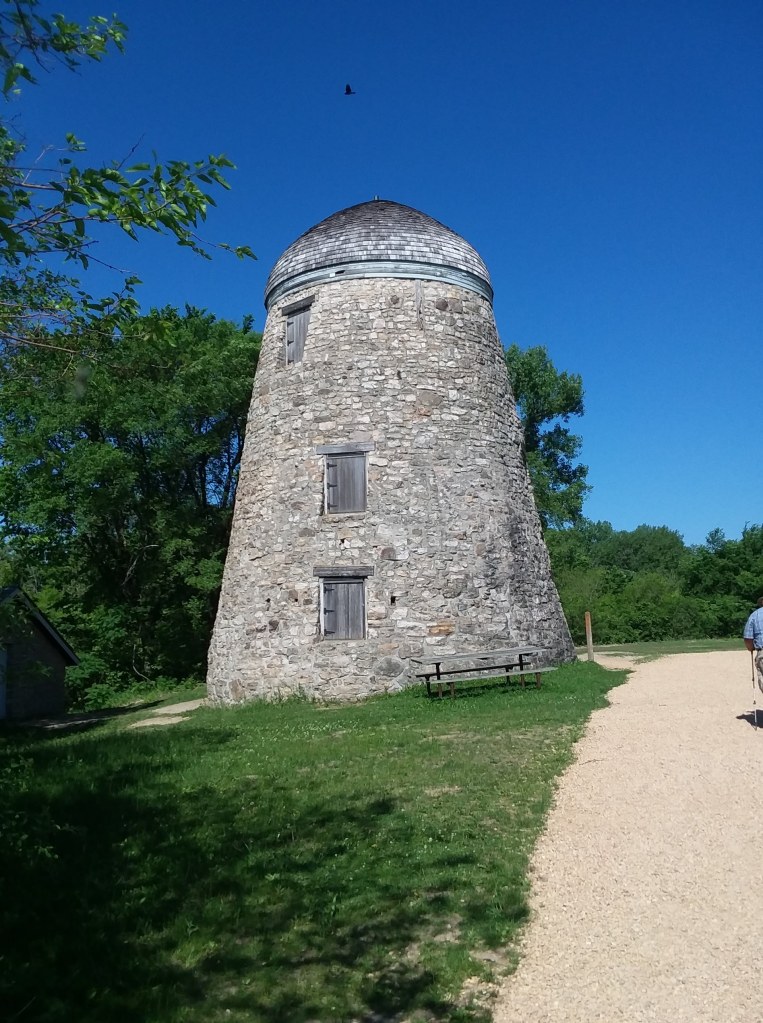
As pioneers moved westward, spreading out to farm the rich land, they needed a means to grind the grain into flour. One such wind-powered grist mill is the Seppmann Mill in Minneopa State Park. The mill was built of stone in 1864 by Albert Seppmann. He modeled it after the windmills from his birthplace, Germany. On a good, windy day, the mill could grind 150 bushels of wheat into flour.
This massive stone building still remains, though it ceased working in 1890 after a tornado ruined the windmill’s arms. (How ironic to be destroyed by the very wind the mill was designed to harness!) It was too expensive and unprofitable to replace the arms.
Windmills have changed in the century after this windmill was last used. Solid stone buildings like this are now rare, replaced by cheaper, metal frames. Today great wind farms sport sleek silver posts that are 212 feet high with steel blades of 116 feet or more. Instead of a single windmill for an entire town, some of these wind farms have hundreds of wind turbines. Instead of turning grain into flour, modern windmills mostly use the power of wind to create electricity.
What hasn’t changed is the wind. Who has seen the wind? Not us perhaps, but we need only watch the slowing churning blades of a windmill to see its force.
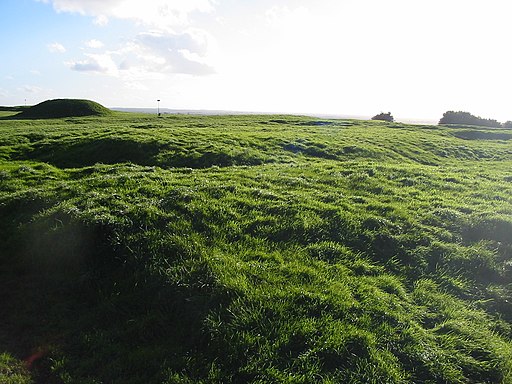
On a clear, summer day, climb to the top of the Hill of Tara. It is said that one quarter of all Ireland can be seen from this vantage point. A meandering line of silver marks the River Boyne in the valley below. To the east the Irish Sea catches the light. With the great sky opening overhead, and the rolling hills tumbling down from the top, the Hill of Tara seems an empty place. On the day I visited, few tourists wandered the hundred-acre site. Most of the ancient buildings are long gone, their timbers rotted and turned to dust over the millennia, their stone walls buried and forgotten for centuries.
And yet, their is a sense of awe about this place. Close your eyes a moment and feel the brisk wind whipping through the grasses, whispering of ancient power and wisdom and magic. It is this whispering that marks The Hill of Tara as sacred. Centuries of human monuments to this mystical feeling lie ruined or buried beneath the sod. From the huge standing stones to theRoman coins found there, the Hill of Tara is one of those places on earth where the aura of the past remains as a powerful force today.
The Hill of Tara, where archeology and mythology are inextricably entwined, has long been famous as an important historical and prehistoric site in Ireland. Even though most buildings remain unexcavated, archaeologists have found evidence of perhaps a hundred monuments in the Hill of Tara complex. The oldest monument known so far is the neolithic Hill of Hostages, a passage tomb dating to about 3000 BCE. A bonfire lit on this hill on the holy days (such as the solstices, equinoxes and quarter days) could be seen for miles in any direction. (Indeed, the name of Tara comes from the Gaelic Cnoc na Teamhrach (or Temair), usually translated as the hill of great prospect.)
Tara is considered the seat of the high king of Ireland. One famous upright stone at Tara is the Lia Fail, known as the Stone of Destiny. The stone is said to cry out when touched by the rightful high king of Ireland. In fact, the Hill of Tara has seen at least 142 kings crowned.
One such king is Cormac Mac Art, who supposedly built a great hall and a palace on the Hill of Tara. Though there are many legends surrounding him and blurring the truth, Cormac is generally considered to have been a real person, living around the 3rd century CE. It is said that his reign was a time of great peace, where even minor crimes were rare. Some legends claim Cormac is the author of the famous Brehon Laws, which comprise some of the fairest law codes of that or any era. These laws, though maintaining a patriarchal society, afforded some protection of women’s rights. Women were free to pursue any profession, and could divorce their husbands. Women also were considered partners, not property, in a marriage and maintained the rights to their own property. (Though Cormac gets credit for these laws, the earliest written forms date from the 8th century, several hundred years after Cormac’s reign.)
There are many legends regarding the settlement of Ireland. In one, the Tuatha de Danaan, a pre-Celtic people (Children of the Goddess, Dana) defeated the earlier settlers, and made Tara a sacred place to their own gods and goddesses. The Tuatha were in turn defeated by Celtic tribes (ie The Milesians) who took over the sacred places, and some of the old rites of the earlier people. The Tuatha were driven underground, becoming the ‘little people’ of Irish legends. The Hill of Tara remained sacred even into the advent of Christian times. St. Patrick is said to have come to the Hill of Tara in the 5th century CE to preach to King Laoghaire, and convert him and the island to Christianity.
Most of the facts concerning the Hill of Tara are so tangled with legend, we may never know the truth. But this sacred hill where stories live is well worth the visit. All you have to do is listen to the wind and let your imagination soar.
Cnoc na TeamhrachA moaning windEchoes the haunting bagpipes of oldEvoking a procession of long-dead kingsSwirling skirted warriorsRaise shining spears, piercing a cloud-studded sky beforeFading soundlessly beneath the waving grasses.
Sources:
Mark, Joshua J. “Hill of Tara.” Ancient History Encyclopedia. 26 August 2015.Web.
Murphy, Anthony. “Ancient Sites/ Hill of Tara- Teamhair.” Mythical Ireland. February 2019. Web
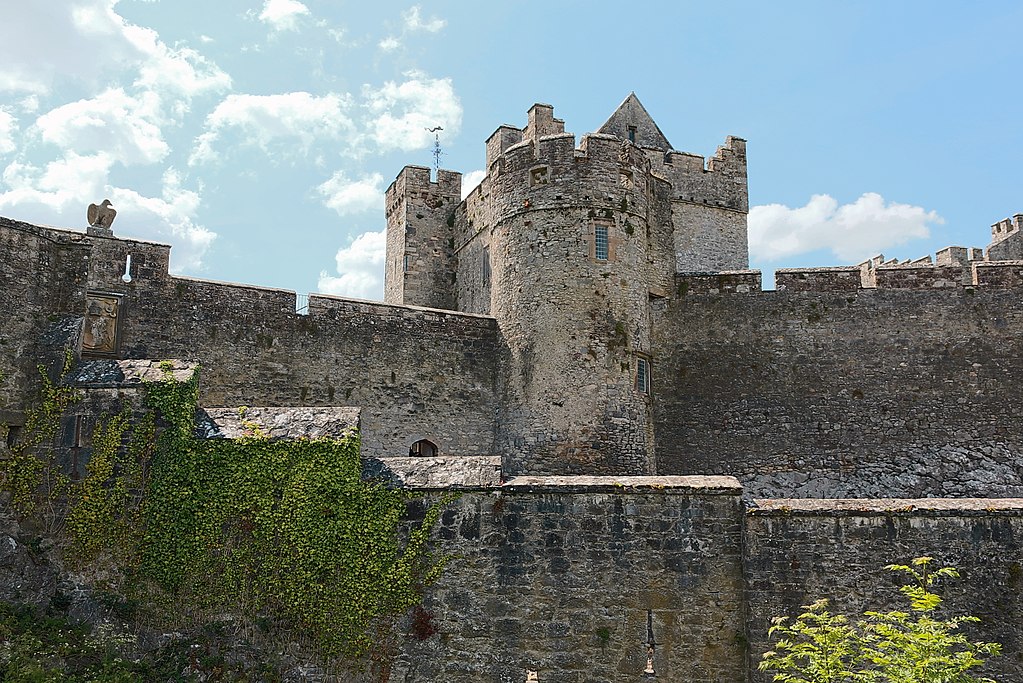
Cahir Castle: photo by Robert Linsdell from St. Andrews, Canada [CC BY 2.0 (https://creativecommons.org/licenses/by/2.0)]Since the dawn of humanity, people have been hard at work trying to keep their homes safe from interlopers. Today, we build fences, lock doors, and install security systems. For the most part, these measures work to keep out the majority of thieves, burglars, and home invaders. But in 12th century Ireland, with warring chiefs and marauding armies roaming freely, more drastic measures were needed. Their solution? Build a castle.
Safety was, after all, the main purpose of a castle. Cahir Castle, in County Tipperary, is a prime example of just such a defensive castle.
From the earliest times, roving bands of warriors knew that the high ground, with a commanding view of the region, offered the greatest safety because of its defensibility. The site of Cahir Castle on an elevated island in the River Suir offered such a location. Even better, the rocky formation prevented any possible undermining.
In fact, the Irish word ‘Cahir’ comes from the older word, ‘cathair’ which means ‘fortress.’ Even before a castle was built on the huge rock, there was a circular stone fort there. In 1142, Conor O’Brien, Prince of Thomod, built the first castle there atop the earlier fortifications. A medieval town grew up around the castle.
Over the next 200 years, the Norman Invasion changed the political landscape of Ireland. In 1375, James Butler was awarded the new title of Baron of Cahir, and given the castle as a reward for his loyalty to Edward III. Except for a few brief periods, the castle remained in the Butler family until 1961, when the last heir died and the castle became the property of the state.
James Butler and his descendants enlarged and updated the castle defenses for centuries. During all that time, the castle was lost to Butler family on only three separate occasions, only once by force. The first was in 1599 when most of the Butler family threw in their lot with the Irish against the Earl of Essex Army, sent by Queen Elizabeth. Essex took the castle after a three-day siege, The castle garrison tried to escape. Some did, but many more were slain. The English army took over the castle without further resistance. A year later, 60 Irish rebels took the castle back without gunfire, but they had to re-surrender shortly thereafter. Thomas Butler was charged with treason, but later he was acquitted and regained his family castle. The castle fell a second time in the Irish Confederate Wars to Oliver Cromwell. In this case, the family managed to regain favor with the crown and regain their castle once again. The third time the castle was lost was due to bankruptcy in the early 1800’s. The family was able to buy it back in the 1870’s.
Cahir Castle Portcullis: Photo by Robert Linsdell from St. Andrews, Canada [CC BY 2.0 (https://creativecommons.org/licenses/by/2.0)]Cahir Castle is a model of medieval strongholds. It is considered one of the largest, best preserved, and most impregnable castles in Ireland. It boasts all of the best medieval protective devices including:
Batter walls: stout outer walls that are thicker at the bottom than the top. These walls deflect rocks thrown from the battlements and help prevent tunnelling under the castle to gain entrance.
2nd layer of defense: an inner courtyard, also protected by strong, stone walls. This inner courtyard is only accessible by traversing a long, narrow passageway with a portcullis, making it possible to trap and shoot invaders.
Crenellations: Regular rectangular spaces in the stonework along the top of the outer walls, allowing archers to have some protection while shooting. A license from the king was required in order to build crenellations.
Loop windows: Long, narrow slits in the castle walls with splayed inner sides allow two defensive archers to shoot at different angles, thus protecting more of the castle wall.
Low doors, narrow passages, and stumble steps: all make it more difficult for strangers to navigate the castle.
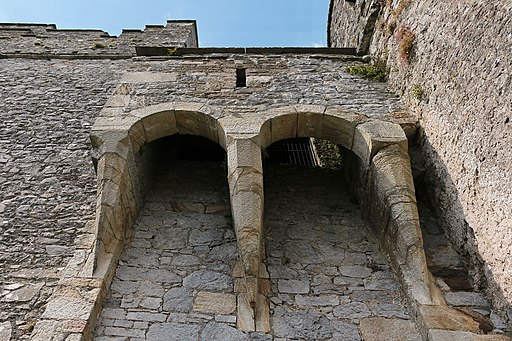
Machicolations: These openings in the floors above gates and doorways allow the castle defenders to thrown down rocks or hot liquids on potential intruders.
Portcullis: a heavy iron grate, often with spiked posts, that can be lowered in a stone gateway to prevent access. The portcullis at Cahir Castle is one of only three working portcullises in Ireland.
Spiral Stairs: These narrow stone stairways are built for a right handed-swordsman to defend against anyone mounting the stairs.
The development of cannons, gunpowder and other offensive technology, along with a decrease in general warfare, eventually made the defensive technology of castles obsolete. Rich families moved into more comfortable dwellings that were built more for beauty than for strength. Cahir Castle, built over 800 years ago to protect the O’ Brien and Butler familes, is, an impressive yet stark reminder of a dangerous past.





















 BRIC-A-BRAC