A Tribute to Notre Dame de Paris

Notre Dame 1975
Notre Dame in 1975

Earlier this week, thousands of people watched in horror as the famous Notre Dame Cathedral in Paris burned. In the aftermath, some have questioned why this building seems to matter more than other great losses around the world. I can’t say that this tragedy is worse than others, but this one strikes me more deeply. You see, I have a personal connection to the great cathedral.

I first saw Notre Dame in 1975. I was a wide-eyed, not quite starving student in Paris. Having come from California (where buildings were mostly short due to earthquakes), through rural Iowa (where there is not sufficient numbers of people to warrant tall buildings), I found Paris in general, and Notre Dame in particular, stunning–a place where history enveloped me and connected me to the people who lived there before.

SAM_2237
A view of gargoyles, 2017

Over the months I lived in Paris, I walked by Notre Dame almost daily since one of my classes was in a building alongside the cathedral. As I crossed the plaza and turned into the alley in bright sunshine, chilly sleet, or gloomy rain, the majesty and beauty of Notre Dame never ceased to amaze. The gargoyles, statues, and carvings all told stories with enough detail to keep me entranced. I felt transported to the middle ages, when the cathedral was built and presented the Bible in stone to all who passed.


The cathedral was built over a span of some 200 years, starting in 1163, during the reign of Louis VII. The first mass was celebrated at the newly consecrated high altar almost twenty years later. Over the reigns of several monarchs and many different builders, the cathedral was finally finished in 1345.
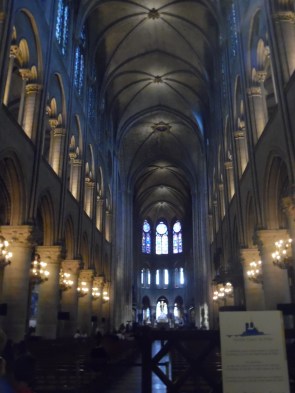
SAM_2228
Interior, 2017

Monday’s fire was not the first time Notre Dame faced destruction. In 1548, a group of French Huguenots  stormed the church and destroyed statues they felt were idolatrous. Almost 200 years later, more damage was done by over enthusiastic ‘renovations,’ in an effort to make the church building more classical, in line with the then current fashion.. Many of the stained glass windows from the middle ages were replaced with clear glass to let in more light. The spire was damaged by wind and removed near the end of the 18th century. Further damage was done during the French Revolution, when the cathedral was seen as a celebration of the French monarchy. Many statues were pulled down and beheaded in violent protest to the wealth and power of the nobles.

Some restoration of the great cathedral began in 1801, under Napoleon’s government. Further interest in restoring Notre Dame was sparked by Victor Hugo’s immensely popular novel, The Hunchback of Notre Dame. For twenty-five years, beginning in the middle of the 19th century, the cathedral underwent massive restoration, including a new spire.
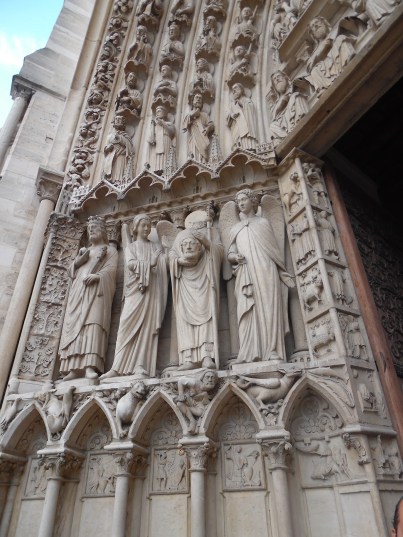
SAM_2234
Notre Dame–North Portico, West Façade. Emperor Constantine, an angel, St. Denis, and an angel

In the 20th century, stonework of the cathedral was cleaned, removing years of soot and grime caused by air pollution. Once again, people could see the stories in the stone. One such story that intrigued me was that of St. Denis. He was the first bishop of Paris. The local people and their Romans rulers objected to his preaching Christianity. He was beheaded in 258 on the hill of Mont Martre. The legend says that he picked up his head and carried it six miles to the place he would be buried (where the Basilica of St. Denis was later built.) Like the cathedral that sports his statue, St. Denis was truly resilient, beating the odds and leaving a lasting legacy.


Still, Monday’s fire is a reminder that nothing is permanent. Certain places become cultural symbols and we expect them to remain intact. But fires, earthquakes, tsunamis, and human folly have a way of destroying those hopes. The damage to Notre Dame is no greater, but also no less, than the loss of any great monument of human achievement. Whenever any such cultural icon is destroyed, all of us should weep. For within those cultural symbols lie the stories of all humanity.


Sources:

Fuentes, Jose Luís Corral. An 800-year history of Paris’s Notre Dame Cathedral. National Geographic History Magazine. May/June 2017, updated April 15, 2019

St. Denis.Encyclopedia Britanica. April 19, 2019. https://www.britannica.com/biography/Saint-Denis

Beyond the Blarney

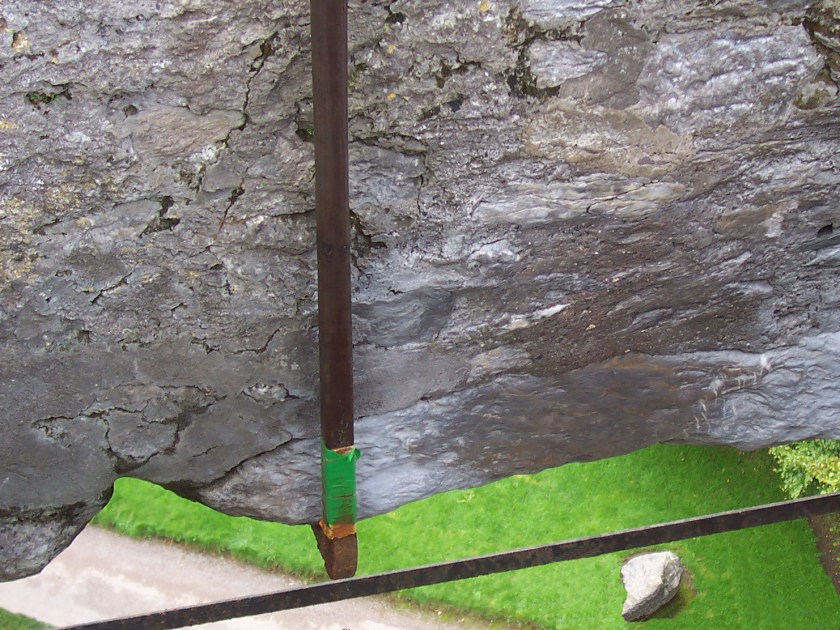
blarneyAs legends go, it’s a pretty weird one. The famous blarney stone is a large block of limestone set into the far wall of a machicolation high up in Blarney Castle. (A machicolation is a box-like, floorless opening in the battlements, used to pour hot oil or other nasty stuff on intruders.) They* say that if you climb to the top of the ruined keep of Blarney Castle, lay down and hang over the edge backwards far enough to kiss that block of limestone set into the battlements, you’ll be blessed with the gift of gab. You’ll be able to regale audiences with your silvered tongue and eloquence, with the fluency and perhaps even the loquacity to rival the best orators.

Having kissed the stone twice myself, I can tell you first hand that the legend is overstated. I’m no orator, and while I can tell a good story, I do better in print than in person.

But If it’s all just blarney, why do visitors flock to Blarney Castle every year? The history behind the blarney stone is as nebulous as its purported virtues. One story claims the Cliodhna /Kleena/, a major goddess in the Irish pantheon of the Tuatha de Danann, sometimes known as the Queen of the Banshees or the queen of the Sidheog (fairy women), was involved. Lord MacCarthy, the builder of Blarney castle in 1446 asked for Cliodha’s help to win a lawsuit. She advised him to kiss a stone on his way to court. He did and then won his case through his eloquent tongue. He then used the special stone in the building of his castle.

A hundred years later, Queen Elizabeth complained of the “blarney” because  she could not complete any negotiation with a later MacCarthy, the lord of Blarney Castle, because of his non-committal diplomacy, or the ability to promise little or nothing with a lot of eloquence. While it’s true that Cormac MacCarthy managed to sweet-talk Queen Elizabeth without signing over his lands, whether his eloquence and wit came from the stone is questionable.

Another early legend says the stone was actually Jacob’s pillow and was brought to Ireland by the Prophet Jeremiah. Some say it was part of the ‘speaking stone’, the throne where Irish kings were crowned at the hill of Tara. Still others claim it was the stone Moses struck in the desert on God’s command to bring water to his people. It’s even said the stone was the pillow on which St. Columba died.

Only slightly more plausible is the legend of the stone’s origin in Scotland. In 1314, before the current Blarney Castle was built, Cormac McCarthy supposedly sent several thousand men to aid Robert the Bruce, and in return Robert gave McCarthy half of the stone of scone or stone of destiny, where Scottish kings were crowned.

For the record, all of the legends claiming the stone came from somewhere else have been proved pure blarney by scientific evidence showing the stone to have originated in Ireland.

In fact, the Oxford English Dictionary’s first recorded use of the term ‘blarney’ is from 1803, well after Cliodhna  and all the early MacCarthys slid into oblivion. Perhaps the idea of blarney as lies, half-truths, and fabrications all wrapped up in charm came from Lady Blarney, a smooth-talking flatterer in Oliver Goldsmith’s Vicar of Wakefield, published in 1766.

Whatever the origins of the stone and the legends surrounding it, the history of Blarney Castle is well-known. The original Blarney castle was a wooden structure built about 1200 AD outside the village of Blarney. That first building has entirely disappeared. In 1210, a stone structure was built on the site. This lasted until 1446, when it was destroyed, and the current building was constructed by Cormac Laidir MacCarthy. The castle changed hands a number of times in the next several centuries, and eventually fell into disrepair, especially after Blarney House was built in 1874 as a more modern and convenient lodging for the family

Though it is now in ruins, Blarney Castle and the surrounding gardens are fascinating. It’s best to visit early, before the crowds come in. Narrow stone steps, worn smooth with age and use,  spiral upward in the dark tower and emerge at the top of the keep. The view over the battlements in the early morning as the mists are rising is as magical as any stone visitors come to kiss. Some of the rooms are still open. Passing through bare stone hallways and into empty rooms, it’s easy to imagine the footsteps of the people who lived here hundreds of years ago. In my mind’s eye, I could almost see the tapestries warming the walls, the tables laden with roasted game and rich pies, the servants hurrying to fill another goblet. It’s as if the stones are whispering their stories, if only we take the time to listen.

Equally enchanting and steeped in legends are the sixty acres of gardens and parklands surrounding the castle. In the Rock Close for instance, moss-covered rocks and twisted trees line the meandering paths. In the hush, we could hear the trickle of a waterfall, and when I closed my eyes, I imagined the brush of fairy wings on my cheek. The very air seems steeped with magic. Huge boulders loom over paths winding around an ancient dolmen, a druid’s cave, a sacrificial altar, a witch’s kitchen, and a stone circle. (To be sure, the druidic connections were ascribed by the romantic Victorians.)  

The stone circle called “The seven sisters,” has nine huge stones, seven standing and two toppled. In one legend the kind of Munster had seven daughters and two sons. When both sons were killed in a battle, the mournful king ordered his men to knock down two of the stones to commemorate his boys.

Another winding path leads to a set of rough stone steps called the wishing steps. According to the legend, anyone who climbs the steps to the stone archway, backwards and with eyes closed, thinking only of their wish, will be grant that wish within a year and a day by the Blarney witch.

From ancient Druids to magic stones, from wishing steps and witches to kings of old, Blarney is a place full of stories that stir the imagination. It’s a place to make us believe, if only for a moment, that all the legends are true.

stone-cropped
The stone is worn smooth and shiny from thousands of lips.  Iron bars now prevent the kisser from falling to the ground far below


*”They”  being the anonymous gossip mongers who spread rumors that turn into legends.


Trains 3: The Jacobite

engineIn past posts, I wrote of train wrecks and disasters, but in most cases, I  really do find train travel relaxing. Lest anyone think badly of Scottish trains after my New Year’s day experience years ago, I can share a much better train ride. A few years ago, I returned to Scotland and rode the Jacobite steam train from Glenfinnan to Mallaig.  Although Harry Potter and his friends faced the dementors on this train, I had no problems with the ride.
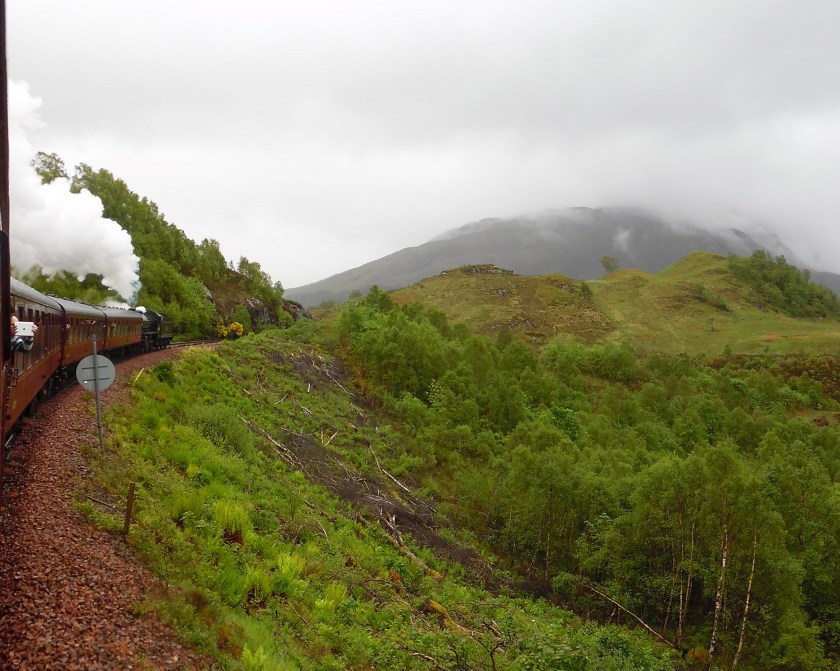
The Jacobite runs 41 miles from Fort William to Mallaig on the West Highland Railway line, using a steam locomotive. Originally known as the Mallaig  Extension, the service began in 1901 to transport fish, especially herring, from the Mallaig seaport. Steam service on the line ended in 1967, with the British Modernization Plan, replacing steam engines with diesel.

Then, in 1984 British rail lines returned steam power to the line, with the goal of improving tourism in the area. The train is called the Jacobite in reference to the last Scottish uprising (in the Eighteenth Century) when the Highland clans, tried (and failed) to restore the Stuart family to the Scottish throne (specifically, Bonnie Prince Charlie). Nowadays, the train is so popular with tourists, it’s best to book in advance as it usually sells out.

To fully experience this train, we wanted to see it cross the iconic Glenfinnan Viaduct, as seen in the Harry Potter movies, as well as ride the train. So the day before our booking, after a lovely hike in the rain through the Glenfinnan valley to a bothy, we stopped at the Glenfinnan Station, where we had tea. Above the station, there is a marvelous view of the famous viaduct.  

We were running a bit late, and expected the train to come into view at any moment. After hurrying along the steep, rocky path, with a raw wind in my face and rain spattering the ground, we arrived at the peak just as the train came into view, barreling along at a great rate and spewing huge clouds of steam in its wake. Like a dragon roaring through the valley, it filled the air, and then was gone. Breathtaking!

crossing the viaduct
The Glenfinnan Viaduct was completed in 1898, and the rail line opened in 1901. The viaduct is fifty feet long with 21 soaring arches. Built of mass concrete, it is the longest concrete viaduct in Scotland. The viaduct is about 18 feet wide, single track, and crosses the valley 100 feet above the River Finnan. One legend says a horse fell into one of the piers and perished during construction. However, later investigations have failed to find any evidence of such an accident.

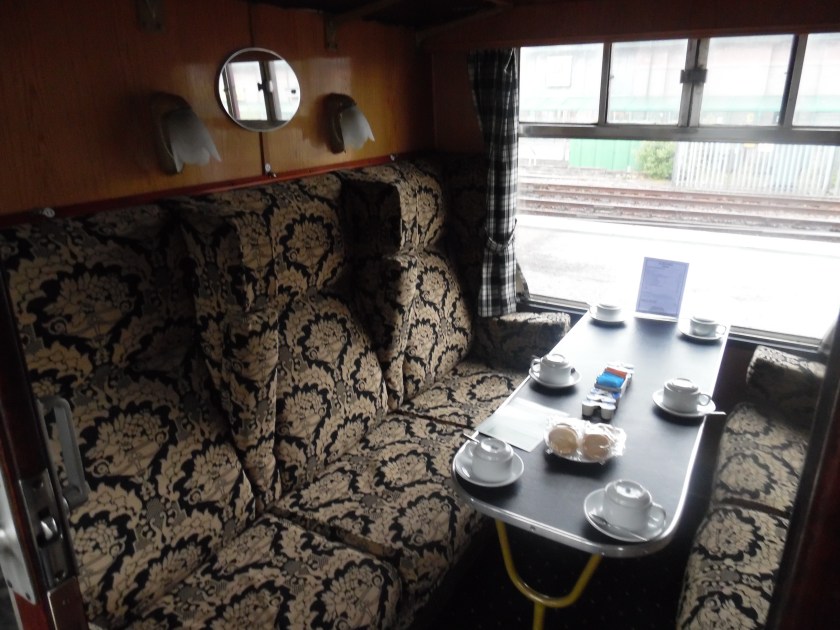
The next day we boarded the train in the morning and took our first class seats in the ‘Harry Potter’ car. The west coast of Scotland is still cold, even in June, but the train was a real delight. Stepping onto the Jacobite steam train is not only a step back into history, but immersion into fantasy world of Harry Potter. A narrow aisle runs along one side of the car, with compartments seating six each along the other side. Each compartment has a sliding door made of rich wood, polished to a brilliant shine. Tea was laid out for us in the compartment before we arrived, including a pot of tea and biscuits. We settled in and soon the train lurched forward, the wheels clacking on the rails. The engine chugged along, belching steam that rolled past the windows as the train rounded a bend or the wind shifted.

inside

Rain splattered the windows most of the trip, obscuring the views at times, but adding to the total sensation of being in another time and place. We passed through a landscape of munros and burns, lochs and forests, and caught brief glimpses of the Caledonian canal and Neptune’s Staircase (a series of locs). At times the train roared through a dark tunnel, then burst out into the cloudy gloom of the soft Scottish day.

After a bit, a trolly made its way down the aisle, and stopping at each compartment to offer sweets or souvenirs. Near Glenfinnan, there’s a lovely view of Loch Shiel, one of three lakes used for filming Hogwarts Lake. I almost expected to see the great castle of Hogwarts at the end of the line, instead of the thoroughly mundane fishing village of Mallaig.

Though quite part of the ordinary world, Mallaig offers a couple of choices for a simple, delicious lunch. We popped into Jaffy’s for Fish and Chips, then wandered about town to view the harbor. Since it was raining and cold (45 degrees) we spent more time in the shops than outside.

The train ride back was equally lovely, and I was sorry to disembark when we finally returned to Glenfinnan at the end of the day. Whether you are a history fan or a Harry Potter fan, the Jacobite steam train is an experience you won’t want to miss.

on the train


An Exploration of THE HOUSE OF SEVEN GABLES

1904 eidtion
1904 Edition

What makes an old house spooky? You know, the house that children run past, holding their breath in a sort of delightful dread?

The house my kids called the witch’s house was a dingy, slate blue, with small, dark windows. It stood tall and square right at the edge of the sidewalk, looming as if ready to grab the unwary child. We never knew who, if anyone, lived in this house, but something about its aspect frightened all the neighborhood children.

For many spooky houses, it is the mysterious or odd inhabitants who ‘haunt’ the house and make it frightening. Witness Boo Radley’s house in To Kill a Mockingbird, so scary it could only be passed at a dead run.

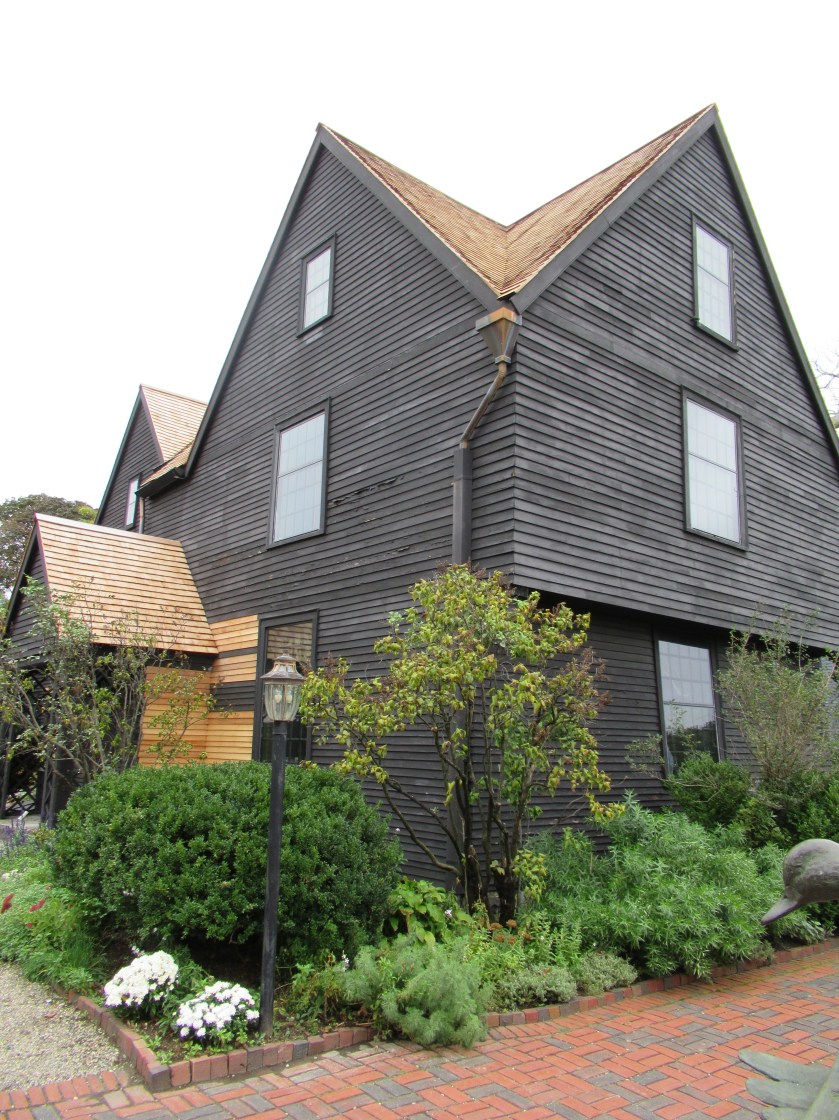
Nathaniel Hawthorne explores this idea of the haunted house (‘haunted’ by fear, sadness, and tragedy, not by ghosts) in his novel, The House of Seven Gables (1851). Hawthorne describes the house thus: “Halfway down a by-street of one of our New England towns stands a rusty wooden house, with seven acutely peaked gables, facing towards various points of the compass, and a huge clustered chimney in the midst” (1). He goes on to say the house seems like a “human contenance, bearing the traces not merely of outward storm and sunshine, but expressive also of the long lapse of mortal life, and accompanying vicissitudes that have passed within” (1). The exterior of the house is decorated with figures ”conceived in the grotesqueness of a Gothic fancy” (7). Hawthorne continues with more vivid description stressing the house’s mysterious and unusual character. He says, “the second story, projecting far over the base and itself retiring beneath the third, threw a shadowy and thoughtful gloom into the lower rooms”(7). img_1674

The House of Seven Gables takes on the role of a character in the novel, based partly on its odd architecture and gloomy aspect and partly on the miserable inhabitants of the house. The two principal characters in the novel are Hepzibah and Clifford Pyncheon, sister and brother, descendents of the original owner of the house. Hepzibah is a lonely, bitter, old woman, made ugly by her sorrow. Clifford is a sensitive, unstable man, broken by the injustice of his incarceration for a murder he did not commit.

In some ways, the house itself is the cause of Clifford and Hepzibah’s misery, since, as Hawthorne explains, it was built by their ancestor under a curse. The old Colonel Pyncheon claimed the land occupied by the humble Matthew Maule. When Maule was executed as a witch (during the famous Salem witch trials), he cursed the Colonel for his part in the condemnation. Though the Pyncheons continued to occupy the house, from that moment on, the family was beset with tragedies and sorrows. The curse of the house carried on through the generations until landing on poor Hepzibah and Clifford.

Nathaniel Hawthorne is quite wordy in his writing (sentences of 50-60 words are common.) Most of the novel is taken up with long explanations of the tragedies of the house–that is the backstory or history of the house and its inhabitants, leading up to the current situation where Hepzibah is penniless and Clifford returns home from prison unable to cope with life. In many ways The House of Seven Gables serves as a series of character sketches. Hepzibah’s loyalty to her brother, her bitterness to the cruel world, her discomfort with outsiders, and her indecision in times of crisis show her as a real, flawed, human being. She, along with her brother, Clifford, haunt the reader’s memory as much as they haunt the old house that seems to be their refuge as well as their prison. And the house itself is a character that sparks the imagination and haunts my dreams.

The strength of the novel is not in its plot, but in its character descriptions and its thoughtful exploration of the human condition. In the end, Hawthorne addresses the question: Can there be redemption for these people wracked by ancient sorrows and cursed by their ancestor’s greed? Can light be brought into the gloom of a ill-fated house so that justice be served and happiness return?

In the fall, I visited Salem and went to the House of Seven Gables on Sale

img_1659
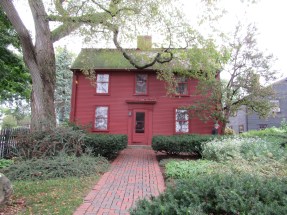
Nathaniel Hawthorne’s birthplace, built in 1750

m Harbor. In his introduction to his novel, Hawthorne claims that no single house in Salem was the model for the house in his book. Nevertheless, this house on Turner Street is most often considered the inspiration for Hawthorne’s story. The original house here was built in 1668 by John Turner, a prominent merchant and ship-builder in Salem. Today, several other historic buildings have been moved to the site, including the housewhere Nathaniel Hawthorne was born in 1804, the Hooper-Hathaway House built in 1682, and a counting house from 1830.

I visited on a grey day, with intermittent rain showers spitting across the harbor. The House of Seven Gables is impressive, but I did not find it spooky. Perhaps it was the cheerful voices of the tourists, or the lush green gardens surrounding the house, or the bright fresh wood of new roof and repaired siding.

Or perhaps, like poor Hepzibah and Clifford, the house truly has made peace with the past and is ready to face the world.img_1667

Hawthorne, Nathaniel. (1998 reprint) The House of Seven Gables. Rhode Island: North Books.

‘Tis the Season–for Chocolate

20181128_212345

  • A sweet treat after sledding or a hot  drink to warm up with on a chilly evening
  • Foil wrapped in balls or bells, a nearly ubiquitous stocking stuffer
  • Lauded as an aphrodisiac, a way to say “I love you,” or possibly cure smallpox
  • Historically, a form of currency and now 50 Billion dollar industry world-wide with some 50 million people employed globally

DSC00743


How does the humble cacao seed  (also called cocoa beans or nuts) from a tropical evergreen tree, native to the Americas, become all this and more? It turns out chocolate has a very long history.


People have been drinking chocolate beverages for at least 4000 years. There is evidence that the pre-Olmecs, of Central Mexico (predecessors of the Olmec, and later, the Maya and Aztec peoples) had a fermented chocolate drink. The tree was possibly first domesticated in Central America. ( Although now ⅔ of all cocoa beans are grown in Africa.) The Mayans and the Aztec both revered the cacao bean as a gift from the god. A hot spiced, (and very bitter) beverage was used in rituals and to seal agreements. They also used the bean, considered more valuable than gold, as a form of currency. One hundred beans might buy one turkey. (The practice of payment in chocolate was also used during the American Revolution.)

When the Spanish ran into (and over) the Aztec, they learned about chocolate. In 1565, explorer Girolamo Benzoni wrote about his experiences in the new world. He was one of the first describe the spicy beverage called cacahuatl. He was not a big fan, saying, “It seemed more a drink for pigs than a drink for humanity. I was in this country for more than a year and never wanted to taste it, and whenever I passed a settlement, some Indian would offer me a drink of it and would be amazed when I would not accept, going away laughing. But then, as there was a shortage of wine. . . .”(as quoted in Theobald)

He did eventually try it and described the taste as “somewhat bitter”  but conceded that “it satisfies and refreshes the body but does not inebriate.” (as quoted in Theobald).

In spite of the drink’s bitterness, the practice of drinking chocolate spread rapidly through the Spanish court. By 1585, Spain was importing chocolate. Chocolate beverages soon became popular throughout Europe. Europeans generally added some sugar to the drink. In order to melt the sugar, they generally served the chocolate hot. As Europeans spread out to colonize the Americas, they brought their newfound love of chocolate back with them.

By 1682 there were chocolate houses in Boston. In 1773, one ship alone brought in 320 tons of cocoa beans. (All of this cocoa was destined for beverages. Eating chocolate was not invented until 1847.) By the time of the Revolution, there were some 70 chocolate houses in the American Colonies.

This fall, I had the good fortune to discover Captain Jackson’s Historic Chocolate Shop, tucked away behind Old North Church in Boston. It’s named after a colonial merchant who owned a chocolate shop in the area in the 1740’s. Today, interpreters demonstrate the colonial process of turning cacao beans into a delicious and popular drink. The beans arrived in New England fermented and dried. The colonial chocolatiers roasted the beans in shallow pans. The brittle roasted beans were winnowed to separate the paper-thin shells from the chocolate nibs. (Some people, including Martha Washington, bought the shells and brewed a sort of tea from them (Theobald).)

The chocolate nibs (or broken up, roasted beans) are ground on a heated stone to a thick, dark, paste. Next, a variety of spices and flavorings are added. Each house had its own recipes, including combinations of vanilla, nutmeg, chili pepper, anise, annatto, salt, cinnamon, and orange or lemon peel. A bit of sugar might be added at this point also. The mixture is then allowed to dry in hard blocks.

To make the chocolate drink, the block of seasoned chocolate is grated and mixed with hot water. (By 1700, it might also be mixed with milk, brandy, port, or sherry.) The water and chocolate are whipped together to make a delicious, rich frothy drink.

Because of its melting point, chocolate was not produced during the summer, and hot chocolate became associated with colder weather. As an expensive treat, chocolate also became associated with the holiday season.

By the 18th century, chocolate was sometimes shaved or grated into puddings, or made into candies for the wealthy. However, chocolate was much more common as a drink than a food until J. S. Fry and Sons developed the first chocolate bar in the middle of the 19th century. By this time, chocolate prices had dropped and nearly everyone could afford chocolate, at least once in a while. Now it’s hard to imagine a Christmas stocking without a few chocolate bells.

One reason for chocolate’s traditional popularity is that it was believed to have medicinal value. It was thought to aid longevity and digestion, alleviate coughs and lung ailments, and cure hangovers. Both Ben Franklin and Dr. Benjamin Rush even proposed chocolate as a cure for smallpox. (Theobald.) However, chocolate was not without its detractors. As a stimulant for the libido, chocolate was considered dangerous for women and children. (The same was true of novels and romances.)

I’m not sure anyone still considers chocolate dangerous (except to the waistline), but it retains is reputation as the food of lovers. Think of that as you’re indulging in your sweet chocolate treats this year, and enjoy.

20181128_213232
Using research from Colonial Williamsburg, Mars Company has created a chocolate drink to reproduce the flavor of Colonial chocolate. Called American Heritage Chocolate, it is available from various museums and historic sites.


Sources:

Theobald, Mary Miley. A Cup of Hot Chocolate, S’good for What Ails Ya.
CW JOURNAL : WINTER 2012

Traverso, Amy. The History of Chocolate in New England. New England Travel Today. January 11, 2017


Sharing Ground: The Boston Common

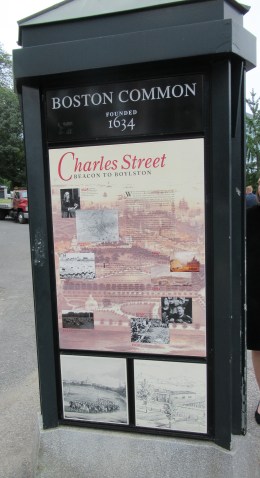
img_0923.jpgOn a crisp fall day in 2018, Boston Common plays host to all sorts of people. Though the sky is overcast, tourists stroll along the winding paths pst the Frog Pond, Children play . and old men park on benches to read the newspaper. Along the north side of the park a musician strums his guitar, the open case in front of him inviting donations. In another corner, several dozen people gather for an ecumenical outdoor church service led by a woman with a microphone. In short, the oldest public park in America is the heart of Boston, providing a free, open, space for the people to use as they will, just as it has done for the last 384 years.
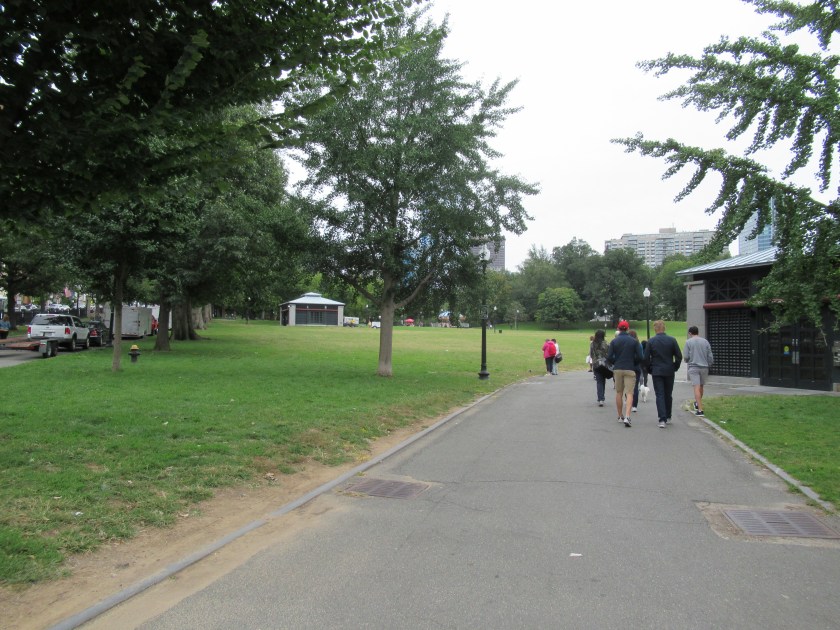
Amidst the modern bustle, it’s hard to believe all that has happened here in this space. The Common began as land held in common by the people of Boston, set aside for common usage, primarily for grazing the animals of the city inhabitants. This idea of common pasturage dates from at least the middle ages. The early inhabitants of Boston brought the practice with them from the old world. But such open land lent itself to other purposes, such as a place for the militia to gather and practice. In fact, The British used the Common for their military camp when they occupied the city in the years before the Revolution. On an even more gruesome note, a huge ancient elm located in the Common became the hanging tree, where miscreants were executed in public view. (In 1769 a gallows was erected, replacing the elm for public executions.)

Over the years, activities in the Common have evolved and the needs and character of the inhabitants has changed. In 1646, twelve years after the Common was established, public grazing was limited to 70 cows at a time. Richer families had acquired too many cows and the area was becoming overgrazed. Public grazing was banned altogether in 1830.

Just over a hundred years later, in 1756, the Central Burying Ground was established  in what is now a shady spot along Boyleston St. The other three burying grounds in the city were overcrowded and this fourth burying ground was meant to alleviate the problem. In 1749, the first corpse was interred here, seven years before the area officially became a burying ground.  From the start Central Burying Ground was not as popular, though some 5000 people are buried there. (There are only 487 tombstones.) Among the few famous people buried there lies Gilbert Stuart, the artist who painted the most famous pictures of George Washington. However, most of the people buried here lie in unmarked graves, mingled with the remains of countless other anonymous dead. The burying ground holds the remains of many French Catholic immigrants, British soldiers who died during the Revolution, and American Revolutionary soldiers from the Battle of Bunker Hill. Some of the victims of hanging (not everyone executed would be considered a criminal today; a law banning Quakers carried with it a death sentence for anyone violating the law.) were buried in here too.

The Common was used for other public gatherings besides hangings. In 1713, two hundred Boston citizens rioted here to protest a food shortage. The Boston Common has kept up the tradition as a place for public protest. In 1965 one hundred people protested the Vietman War and in 1969, one hundred thousand people took up the same cause.

Gatherings of a more peaceful nature have also taken place in the Common. Martin Luther King, Jr., Pope John Paul II, and Mikhail Gorbachev have all given speeches there, and many concerts, including one by Judy Garland, have brought thousands into the Common.

While it is true that many places on earth hold the memories of centuries of human activity, the Boston Common seems particularly steeped in history. You need only to sit quietly in the park, and close your eyes. In the mind’s eye, you can see  the ghosts of all those who have crossed this common ground.

IMG_0924


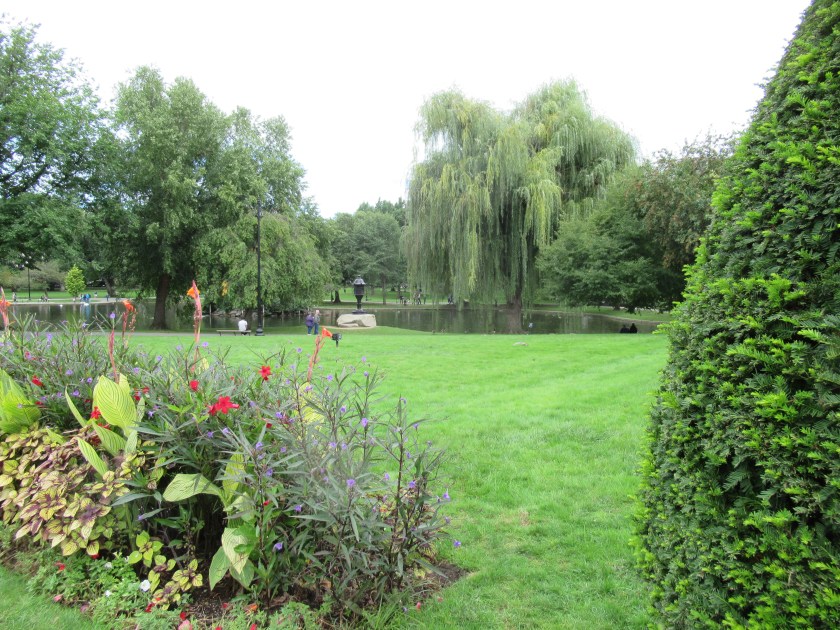
Ducks and Green Space: Boston Public Garden


Ducks
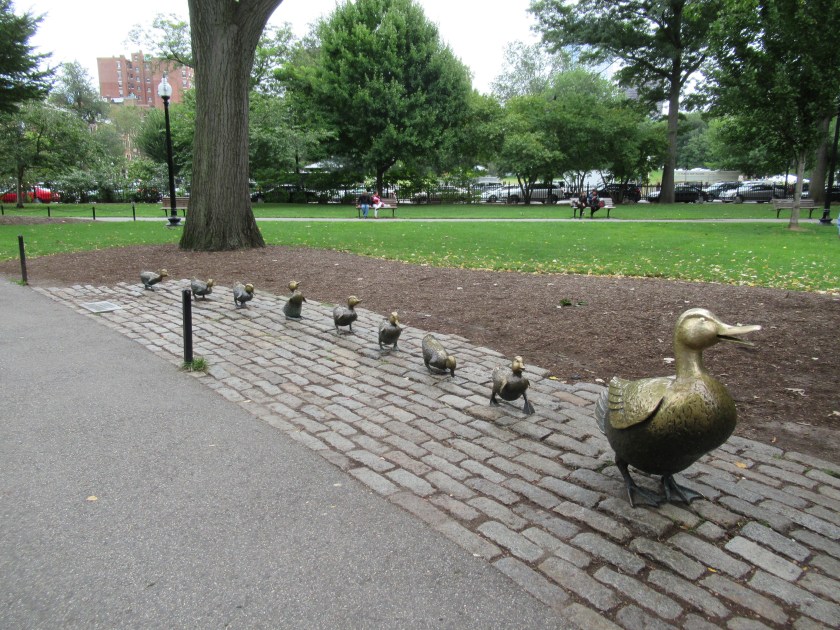
This statue of Mrs. Mallard and her eight ducklings was created by Nancy Schön in 1987. It is so popular I had to wait over 30 minutes for a 15 second gap in the parade of scrambling children to snap a picture.

Since its debut in 1941, Robert McCloskey’s Make Way for Ducklings has delighted millions of readers, both young and old. In the story, Mrs. Mallard must navigate the busy streets of Boston to guide her eight ducklings to their new home in the Boston Public Garden. McCloskey won the Caldecott in 1941 for this book, which remains popular today. While not exactly historical fiction, the story evokes an earlier era, nearly eighty years ago, when the world had time to stop for kindness. One of my favorite illustrations in the book is the one of the portly policeman blowing his whistle and holding up his hand to halt traffic.


It is fitting that the Mallard family finds their new home in Boston Public Garden, a place even more historic than the book. The garden was built on reclaimed land: salt marshes filled in with gravel and dirt taken from a hill in the Beacon Hill area of Boston. In 1837, the land was set aside to become the first public botanical garden in the United States, under the planning and vision of Horace Gray. For many years, the city of Boston, the state of Massachusetts, and private developers argued over what should be done with the land. There were several attempts to build housing there. Finally, in 1859, the 24 acre plot was permanently designated as parkland.


IMG_0903
 The garden is full of statues, the most famous of which is George Washington Equestrian statue, designed and cast by Thomas Ball in 1869. The statue is sixteen feet tall, and rests on a pedestal that is another sixteen feel tall.

The Public Garden features a Victorian landscape design with meandering paths, shady trees, and colorful and exotic plantings. The pond with the small island where the Mallard family finds a home was completed in 1859. Curiously, the island was originally a peninsula, but was detached from the mainland because too many lovers found the soft gas lights and alluring space too tempting. Now countless ducks inhabit the island as part of long-standing tradition.


And so, as part of this tradition, the Mallard family settles on the island in the pond within the very first Public Garden. It seems both Mrs. Mallard and the good people of Boston recognize the value of green spaces, even in big cities. Mr. McCloskey’s timeless story serves as a pleasant reminder of everyone’s need for peaceful shelter in an oft chaotic world.

IMG_0905
Designed by  William G. Preston and completed in 1869, this bridge crosses the lagoon. Originally it was the shortest functioning suspension bridge in the United States until it was converted to a girder bridge in 1921.


IMG_0910
The famous swan boats, featured in McCloskey’s book, have delighted visitors to the Public Garden since 1877. Though the boats had closed for the season when I visited, the swans (inaptly named Romeo and Juliet, thought both are femaie) floated gracefully atop the pond.

IMG_0904


A Place in Time: The Lewis R. French

IMG_1200
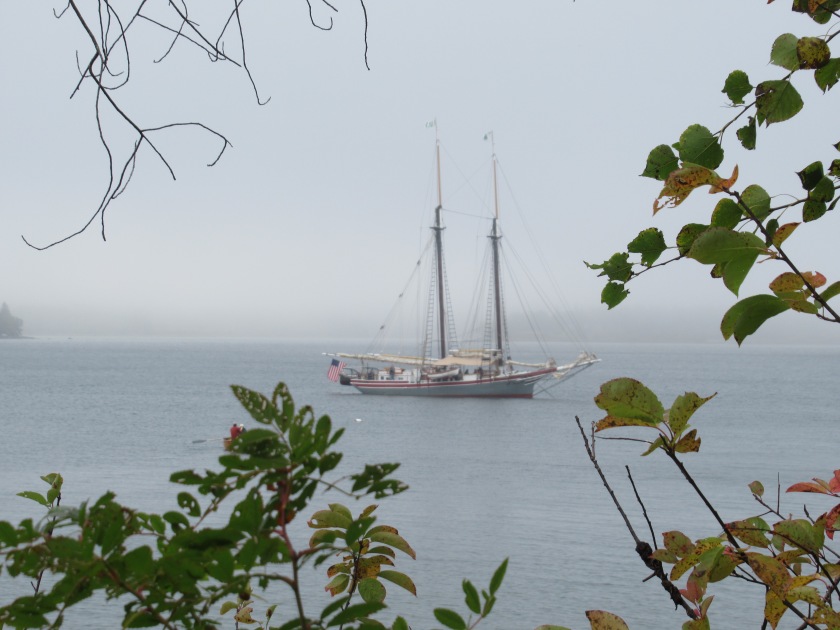
The Lewis R. French at anchor in Smith Cove.

Rain spattered the deck and canvas awning of the schooner. Kerosene lanterns hung fore and aft, their glowing circles of light spreading into the surrounding darkness. The wooden hull groaned and creaked, and the ship rocked gently on the tide, rubbing against the dock as if protesting the lines tethering her to shore. With such a lullaby, I fell asleep easily our first night on board the Lewis R. French, the oldest two masted schooner in the United States.

I woke to the smell of fresh baked muffins from the galley where the cook baked them from scratch on a wood stove. A heavy fog surrounded the ship as we hoisted the sails and eased out of Camden Harbor into Penobscot Bay. In spite of the fog, there was enough wind that we put a reef in the mainsail.


IMG_1161
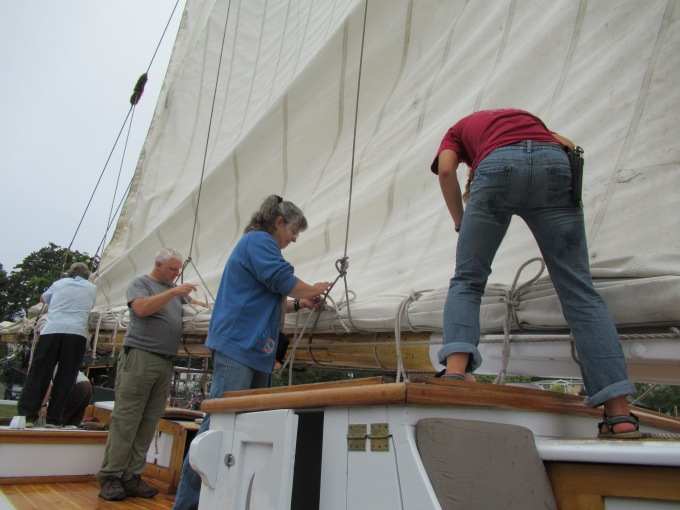
The Lewis R. French operates with a crew of four:  Captain GarthWells, First mate Darcy,  Jason the cook, and Mackenzie, the mess mate. These four can sail her fine by themselves, but often invite the passengers (21 of us) to help with setting and lowering the sails, reefing, or hauling up the anchor. Teamwork and helping out wherever needed makes for smooth sailing. 


Out in the bay, the fog was even thicker. First mate Darcy sat at the bow with a hand-cranked fog horn. She blew a long and two shorts every few minutes as a signal to other boats. We passed another schooner, emerging from the mist like a ghost off the starboard bow. Occasionally the vague shape of a rocky island slid by, and we heard the muffled clang of a buoy’s bell, warning of reefs. Captain Garth used GPS to navigate, but in the fog it was easy to imagine a time when such luxuries were unknown.

In many ways, sailing the French now is like reenacting the past. The ship looks and handles much the same as she did in 1871 when she was first launched. For a hundred years, she worked along the Maine coast hauling many different kinds of cargo from fish to Christmas trees. In 1971, she was rebuilt to carry passengers on pleasure cruises. Here we see the real differences between past and present. Though they are tiny (there is barely enough room for one person to stand beside the bunk with the door closed), each cabin is a model of design ingenuity, using every nook and cranny for storage, and providing far more space than any sailor would ever have.  Each cabin also boasts running water and electric lights, additional luxuries earlier sailors wouldn’t even dream of.

In 1992, the French was designated a National Historic Landmark. Though she is home-ported in one place, the French is unusual in that she is a moving landmark. In our four-day trip, we anchored in Smith Cove, off Burnt Island, and in Rockport Harbor before returning to Camden. As an historic landmark, the French is important not just because of where she is, but what she is: a 147-year-old schooner that still relies on human hands to raise and trim the sails. Even the anchor is raised manually with the aid of a windlass. She’s not just a place, but an experience. Sailing with only wind for power  in fog, rain, or bright sunshine evokes a time-gone-by when life was slower. (Slower, but not easier. A sailor’s life was hard, cramped and cold, alternating between periods of intense activity and boredom.) We saw porpoises, seals, cormorants and eagles, just as sailors have done in these same waters for more than a hundred years.

On the last day of our cruise, we sailed into Rockport Harbor. The wind had died, and we tacked back and forth across the bay to ease closer in, moving at one knot or less instead of the four to five knots we’d sailed the day before. As we lowered the anchor, a sliver of blue sky spread out under the clouds. Gradually the clouds blew off, until by late afternoon, the sun shone in a clear blue sky. Patches of bright red and brilliant orange dotted the hillsides as the trees began showing their fall colors.

That night, as the French swung slowly on her anchor, rocking with the tide, we sat up on deck and saw the Milky Way splashed across a clear sky. With the waves lapping at the hull, and the stars twinkling overhead, I could almost hear the voices whispering from the past, tying this place now to the same place long ago.

Learn more at Lewis R. French Schooner website

IMG_1260
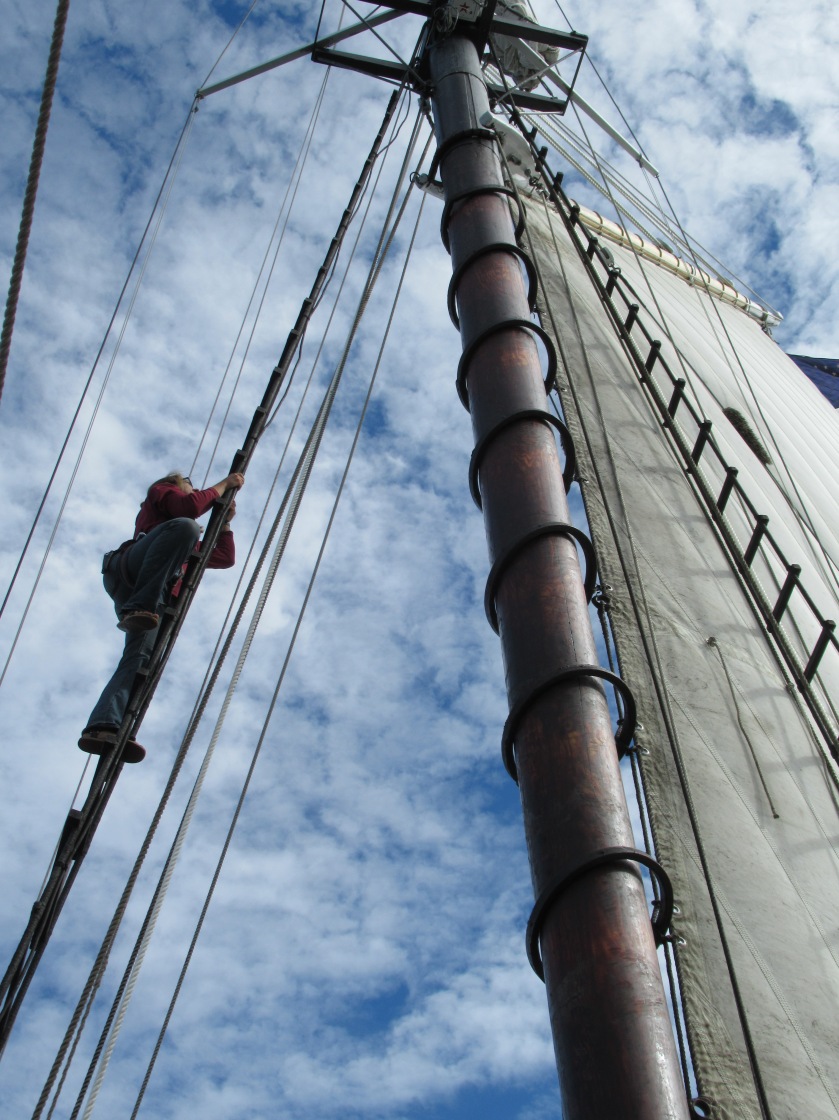
Silhouetted against a mackerel sky,  First mate Darcy climbs the rigging to set the main topsail.


Climbing Mt. Fuji with my son

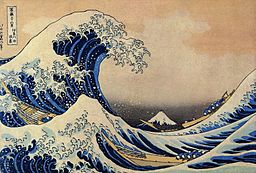
256px-Great_Wave_unrestored
“Behind the Great Wave at Konugawa”-The most famous image from Katsushika Hokusai’s 36 Views of Mount Fuji. (1823-1829)

When my youngest son, Rory, graduated from high school, he wanted to go to Japan. I wasn’t ready for an empty nest, so I decided to take him there myself.

Our biggest goal in Japan was to climb Mt. Fuji, the majestic peak of 12, 388 feet. Mt. Fuji has been a sacred mountain for hundreds of years, with the experience of watching the sunrise from the top of the volcano prized above all. But the mountain is climbable only in the height of summer. So one July evening at 8:00 p. m., we took a bus from Hakone part-way up the mountain to Fifth Station. The night was warm, but we had escaped the oppressive heat of Tokyo.

The route began as a wide, clear path, but within minutes it had deteriorated into little more than an animal track, overgrown with roots and branches and strewn with boulders. It was too dark to see anything clearly. Rory, who was increasingly far ahead of me, had the flashlight. As I stumbled over roots and clambered up the boulders, I knew I was in trouble. Altitude, plus the heat and humidity, had me breathing like I had run a mile at top speed.

After fifteen minutes I caught up to Rory, who was waiting for me at a turning in the path.

“Hey, Mom, you okay”’ he said, real concern in his voice.

“Sure,” I wheezed, immediately taking on my familiar role of Mom– the one never in trouble, never hurt. “I’m just a little slower than you.” I tried to catch my breath, but there didn’t seem to be enough air.

Reassured, Rory asked if I minded if he went on ahead.

“Just give me the flashlight,” I said.

“Great, Mom. I’ll see you at the top.”

So he left. It shouldn’t have surprised me. Kids always leave their parents behind.

I struggled on alone. My heart pounded and my ears throbbed. At first, I worried about Rory. What if he fell without the light? What if he got lost? But as the path grew steeper, I stopped worrying about him, to worry more about myself. By the time I reached the Sixth Station, I was pretty sure I wouldn’t make it to the top by sunrise. Still, Rory was expecting me. I struggled onward.

The flashlight burned out around midnight. Plenty of people had begun the hike at the same time as I had, but I had no idea where any of them were. I stumbled on, apparently alone on this great pile of rock in utter darkness. Somehow I missed the trail, and found myself on a slope of loose gravel scree. I took a step forward and slipped backward two feet. I fell to my knees and crawled, aiming upward, until I found a rope strung along the trail to mark the path.

At the Seventh Station I shared some raisins and chocolate with some other hikers. One of them gave me fresh batteries. It was colder by now, so that each time I stopped, my glasses steamed over. I was drenched in sweat, and the cold breeze cut into me. My legs felt like spaghetti, limp and slow to respond to my attempts to walk. I knew I wouldn’t reach the top. Rory would just have to manage without me. Still, I’m too stubborn to give up, so I kept putting one foot in front of the other.

By 2:00 a.m. the second set of batteries burned out. A pinkish half moon rose and illuminated a barren landscape of dark rock and stunted scrub, far above the treeline. A myriad of stars glittered the sky.

The trail zigzagged back and forth in steep switchbacks. Sometimes it wound between big stone steps, while other times I crunched through rocky gravel. Occasionally a thin rope marked the trail. Mostly, the way followed a narrow path worn smooth by thousands of passing feet.

I stumbled on, refusing to quit. Dizziness made me light-headed. Sometimes I could see the flickering flashlights of other hikers or hear jingling bells on hiking sticks. Sometimes people passed me. Once in a while I passed a group sitting alongside the path, resting. Each encounter brought a brief exchange of greetings, konbanwa, sumimasen, dozo. These conversations were always brief. We had no breath to waste.

I began counting my steps to keep going. Twenty steps I promised myself, twenty steps before resting. I shuffled forward. Always up with the great empty sky arching above me and the great empty mountain embracing me. I felt like a tiny, insignificant speck in the vast universe.

Soon, I couldn’t make twenty steps anymore. I tried ten steps. Ten steps before resting. Each step brought me a few inches closer to the top.

At the Eighth Station I met three Japanese teenagers. We shared water and chocolate cookies, and discussed the merits of Star Wars in a strange mixture of Japanese and English. I thought of Rory, my own teenager, somewhere on this huge mountain, out of reach, but not really too far away. Gradually my breathing eased.

After a brief rest I continued on trembling legs. Overhead, the Big Dipper turned on the axis of the North Star. The moon crossed the sky and set in the West. In the East there grew a pale, curved glow.

As I neared the Ninth Station, the faint light of pre-dawn slowly lifted the eastern edge of night. I could hardly move forward. I took five steps, then a rest. Five more. My steps grew shorter. Two inches forward. A tiny bit closer. I began to think I could make it.

Suddenly, the trail became very crowded. Hundreds of people converged from various paths and we merged to become a long, slow-motion line, a solid snake-like queue of people inching up the mountain. Above and ahead I could see the lights of Tenth Station, the last station. With new hope, I struggled forward, reaching the station with an overwhelming sense of relief.

But it wasn’t the top. The top was another hundred yards, a hiker told me, another hour. I sat on a boulder at the edge of the station, too discouraged to move, too tired to walk another ten yards, let alone a hundred. I could watch the sunrise from here just as well as the top, couldn’t I? Rory wouldn’t mind if I didn’t show up.

I knew I was fooling myself. I didn’t want to disappoint him. Or myself. Whatever the reason, I sighed and stood up. Maybe I couldn’t get to the top, but it wouldn’t be because I had stopped trying. I took a step. Then another. A hundred yards to go. Four hundred steps. A rest between each one.

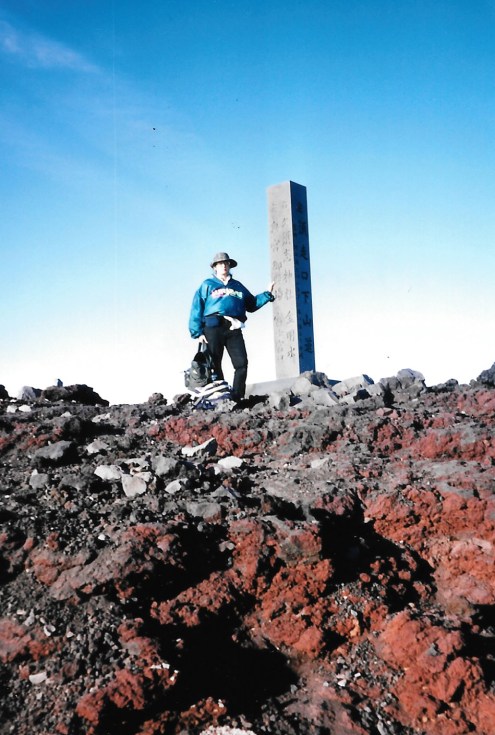
At last I could see the red torii gate. Two white lions guarded it, and the pillars were wreathed in bells. Tears of exhaustion, of joy, of relief streamed down my face as I stumbled through and rang the bells in the long-standing tradition.

There was Rory, waiting for me. He didn’t say much. He never doubted I would get there. Together we stood on the top of Mt. Fuji and watched the sun creep over the curve of the horizon and finally explode in a sudden burst of daylight.

And I knew it was enough. Rory would leave me behind many times as he went off to college and embarked on his adult life, but he would still be there, ready to share a new dawn, whenever I caught up to him

on top of Mt. Fuji
On top of Mt. Fuji

On visiting history–Surgeon’s Quarters

by Mark Meier, guest blogger

(Today we welcome Mark Meier, author of Ebony Sea: Origins.  Check out Mark’s blog at Meier-writers.com )

I’d like to thank Terri for the opportunity to blog for her. When I read her message the second time I noticed the word “historic.” Only a surprise that ANYONE asked me to write something that qualifies as “historic.”

Pondering that for a while revealed a couple of interesting points.

1 – I’ve written fantasy. Writing about low-tech people in fantasy novels really isn’t that much of a divergence from historic.

2 – Some of my favorite places to visit would qualify as historic.

The “historic” place I’ve visited most often is the Renaissance Festivalin Minnesota. It usually runs from late August through September and is an absolute blast. I highly recommend going if you have the opportunity.

Terri would be more qualified to comment about the authenticity. Because of that . . . questionable . . . accuracy, my post here isn’t about that festival.

There is also a heritage center near where I live called Norskedalen. I’ve been there more than once, and it’s fairly interesting. Not as much funas Ren Fest, but more historically accurate.

Another destination that fits about half-way between the fun of Ren Fest and the accuracy of Norskedalen is Medieval Times dinner theater. Jousting, swordplay, a torture museum, and a meal without forks and knives. Yep. Eat with your fingers.

The place I’ve visited most that actually qualifies as accurate history is Surgeon’s Quarters. While I’ve been to Ren Fest more often, Surgeon’s Quarters is far more compelling for someone interested in history.

There’s a location in Wisconsin where the watersheds to the Saint Lawrence and the Mississippi is close enough to portage from one to the other. Back in the colonial days people used that portage (which is how the City of Portage got its name) so much it became of strategic importance. Fort Winnebago was established to protect that important area.

The original use of Surgeon’s Quarters was a portage company and fur trading venture. It was sold to the Americans, and eventually became the home for the Fort Winnebago army surgeon. Hence the name, “Surgeon’s Quarters.”

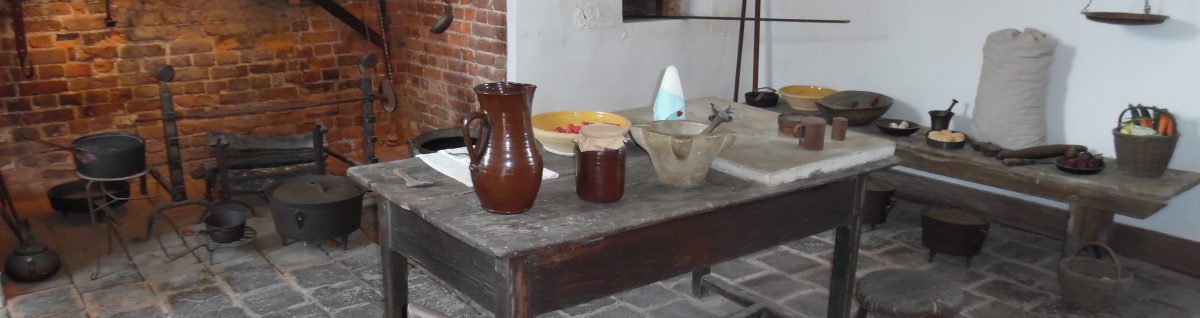
One of the reasons I want to write about this location is to point out how ingenious people were – and are. The simplest example I can give is the multiple uses early pioneers had for things. Take for instance a table at Surgeon’s Quarters. The top is hinged so tipping it up reveals it’s also a chair. With the wide, round back, people could pull it up close to a fireplace and hold in the heat. On the coldest of winter nights that seat would be a relatively warm place to pass the time.

At Surgeon’s Quarters I learned another tidbit of information. The phrase “sleep tight” came from the beds used in that period. Ropes were woven across the wooden frame of the bed, and a tick mattress was placed on top. Occasionally the ropes had to be tightened or a sleeper would sag to the floor. So telling someone to “sleep tight” wished them a good night’s sleep.

On the other side of interesting bits is how people can get history all wrong. There’s a trap door in one of the rooms at Surgeon’s Quarters leading to a dirt hole beneath the building. On one visit the tour guide told my wife and me that it was used to store pelts in a cool place so they wouldn’t “go bad.” On our next visit we were told it was probably used to hide runaway slaves from those hunting them down.

The point of that is what we think we know about history might change. Interpreting what hashappened through the lens of current understanding can lead to inaccurate perceptions. When someone tells you “this definitely happened,” take it with a grain of salt.

I wonder where that aphorism came from.

Terri?