This month I’m deviating a bit from my usual blog to celebrate Irish legend and Irish places. And celebrate two books I have coming out in the next few months.
First up, is Ireland: You Can’t Miss It. This collection of essays, photographs, and poems offers my impressions of Ireland. In it, it share stories of my own travels, along with the legends and myths of many memorable places. Part memoir, part travelogue, this celebration of Ireland is sure to delight anyone. (No Irish heritage required.)
Some of the places featured in this book are ones I wrote about in this blog previously. For instance:
The second book I’m celebrating is Finn McCool and the Giant’s Causeway. This story features one of my favorite Irish heroes (Finn McCool) and his clever wife (Oona) at one of my favorite place in Northern Ireland (The Giant’s Causeway).
Ireland: You Can’t Miss It will be available from my website http://www.terrikarsten.com or from Amazon on May 25.
Finn McCool and the Giant’s Causeway will be available from my website http://www.terrikarsten.com or from Amazon on August 10.
Take and look and enjoy celebrating Ireland with me.
I am a pharophilo. For as long as I can remember, lighthouses have fascinated me. I’m not sure why. Maybe it’s the romanticized drama of a secluded tower shining a light to aid travelers. Maybe it’s the association with wild storms and crashing seas. Maybe it’s the thrill of climbing round and round to the top and stepping out on the balcony to feel the wind. Whatever the reason, I make it a point to visit lighthouses whenever I have a chance. The summer of 2021, I spent a week with my siblings in Manistee, Michigan. With shoreline on four of the five Great Lakes (Superior, Michigan, Huron, and Erie), Michigan has at least 120 lighthouses, more than any other state. During my stay in Manistee, I managed to visit five of them.
Manistee North Pierhead Lighthouse
The north pierhead light in Manistee is cast iron, built in 1927. Shown here is the catwalk used to access the light in rough weather. It is one of only four such catwalks still existing in Michigan.
Point Betsie Light
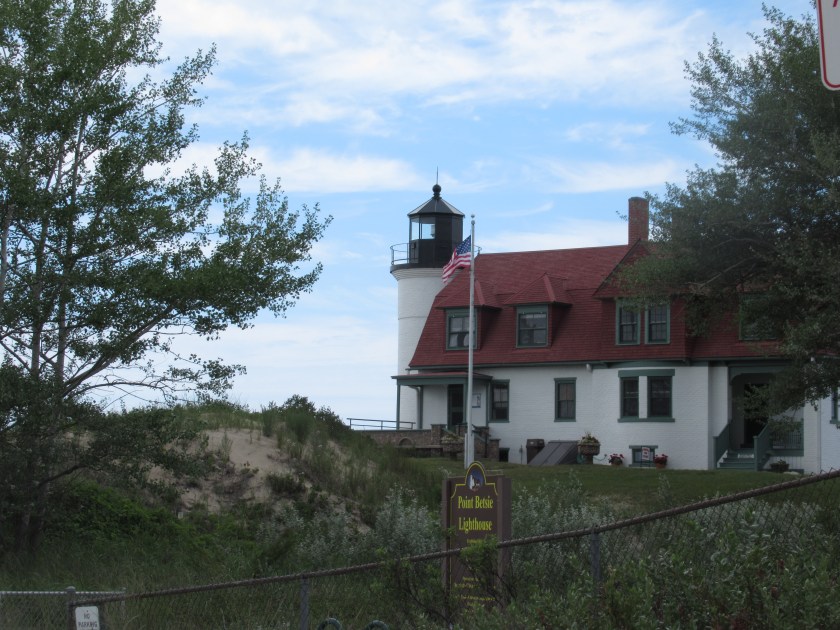
Point Betsie’s Lighthouse and keeper’s residence were built in 1858. The name comes from the French translation of the native name of a nearby river. In French, the name was Pointe Aux Becs Scies (meaning Sawbill Point). Later speakers modified the ‘Becs Scies’ to Betsie. Originally, the tower was a cream-colored brick, but it was painted white in 1900 to help make it visible by day.
Big Sable Point
Big Sable Point is at the end of a two mile walk through the shifting dune of Luddington State Park. Built in 1867, the tower is over 100 feet tall.
Petite pointe au sable
Petite Pointe au Sable (or Little Sable) Lighthouse was built in 1874 amid the towering sand dunes of the area south of Luddington. Like the Big Sable tower north of Luddington, this tower is also over 100 feet tall. It still has its original third order Fresnel lens.
Luddington North Breakwater Light
The Luddington North Breakwater light, built in 1924, features an unusual design of steel and reinforced concrete. It is 57 feet tall. The light can be accessed by a half-mile walk along the concrete pier. It was fully automated in 1972.
This fall my son’s mother-in-law gifted me with a bagful of apples, a tart, crisp variety ideal for eating fresh or cooking. Apples are an immensely versatile fruit with a myriad of recipes for enjoying them. While I never get tired of apple pie, apple crisp, apple pancakes, or even applesauce, this unexpected abundance of apples gave me the opportunity to try a couple of new recipes: apple puddings, from The American Frugal Housewife, from 1833. At this time, pudding does not always refer to the modern, creamy concoction we know in America, but refers to a variety of dishes both savory and sweet, not necessarily reserved for dessert. (See the link below for more about puddings).
Bird’s Nest Pudding
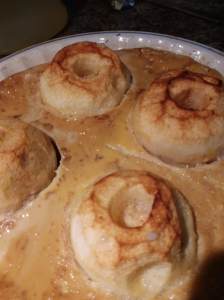
The first recipe I tried is a Bird’s Nest Pudding, which is also called Crow’s Nest Pudding. As with so many apple recipes, there are a great many variations of this popular 19th century dish. Laura Ingalls Wilder describes a dish of baked apples served with cream as ‘birds nest pudding’ in Farmer Boy published in 1933. The earliest recipe I have found so far is from 1833 (though I believe it was included in an earlier -1830- edition of the same book.) Mrs. Child seems confident that her readers will know what to expect from a bird’s nest pudding. Her recipe calls for cored and peeled apples to be baked in a custard. Depending on how sweet you make the custard, this pudding makes a lovely dessert or a delicious accompaniment to pork.
Mrs. Child’s recipe: “If you wish to make what is called ‘bird’s nest pudding’ prepare your custard, — take eight or ten pleasant apples, pare them, and dig out the cores, but leave them whole, set them in a pudding dish, pour your custard over them, and bake them about thirty minutes.”(63)
Mrs. Child tells us that puddings good enough for common use need only five eggs for a quart of milk. She suggests sweetening the pudding with brown sugar and seasoning it with cinnamon, nutmeg, or peach leaves (62). In my version I opted for cinnamon.
Modern Recipe
Pare and core four apples. Put these in a 10 inch pie pan or 8 inch square pan. Mix 3 eggs with 2 cups of milk. Add ¼ cup of brown sugar (more if you want it sweeter) and2 teaspoons of ground cinnamon. Stir well. Pour the mixture over the apples. Bake at 350 for 30 minutes. (Note baking time will vary depending on the variety of apples.)
The second pudding I made wasquie a bit more challenging, primarily because it is the first boiled pudding I’ve tried.
Mrs. Child calls this “a plain, inexpensive pudding” (63.) Her recipe calls for apples tied up in a common crust and boiled, like dumplings. Her variations include quartering the apples into one crust or wrapping a single cored and peeled apple in a crust and tying each one up separately (63). Her common crust calls for a quarter pound of butter for a half pound of flour, and she advises, “Always roll away from you. Pie crust should be made as cold as possible, and set in a cool place, but be careful it does not freeze. Do not use more flour than you can help in sprinkling and rolling. The paste should not be rolled out more than three times; if rolled too much it will not be flaky” (69). Using her method, I rubbed most of the butter into most of the flour, added water, then rolled it out. She tells us to dot the crust with butter, sprinkle with flour, and roll again, repeating until all the butter and flour is mixed in. I’ve never had much success with this method of making crust. The dough tends to crumble and is tough, not flaky. However, since this crust is meant to be boiled, not baked, a thicker, tougher crust works.
Modern Recipe
Set out ½ cup and 2 Cups os flour. Rub together ⅔ cup of the butter into 1 ½ cups of the flour. Mix until crumbly. Add 5 T. water and gather into a ball. Roll out thick (½ “). Dot with half of the remaining butter and sprinkle with half of the remaining flour. Gather and roll out again. Repeat until all the butter and flour have been used. Roll out the dough to about ⅛ inch thick. Peel and core 4 apples. Cut the crust into squares large enough to wrap each of the apples. Tie each wrapped apple in a section of cheesecloth. Bring a large pot of water to boil. Drop the wrapped apples in the water. Boil about 30 minutes.
The resulting apple dumpling is best served warm. Modern diners may prefer sprinkling the dumpling with cinnamon sugar.
Source: Child, Lydia Marie. The American Frugal Housewife. Dedicated to those who are not ashamed of economy. 12th Edition. Boston: Carter, Hendee, and Co. 1833. (First published 1828)
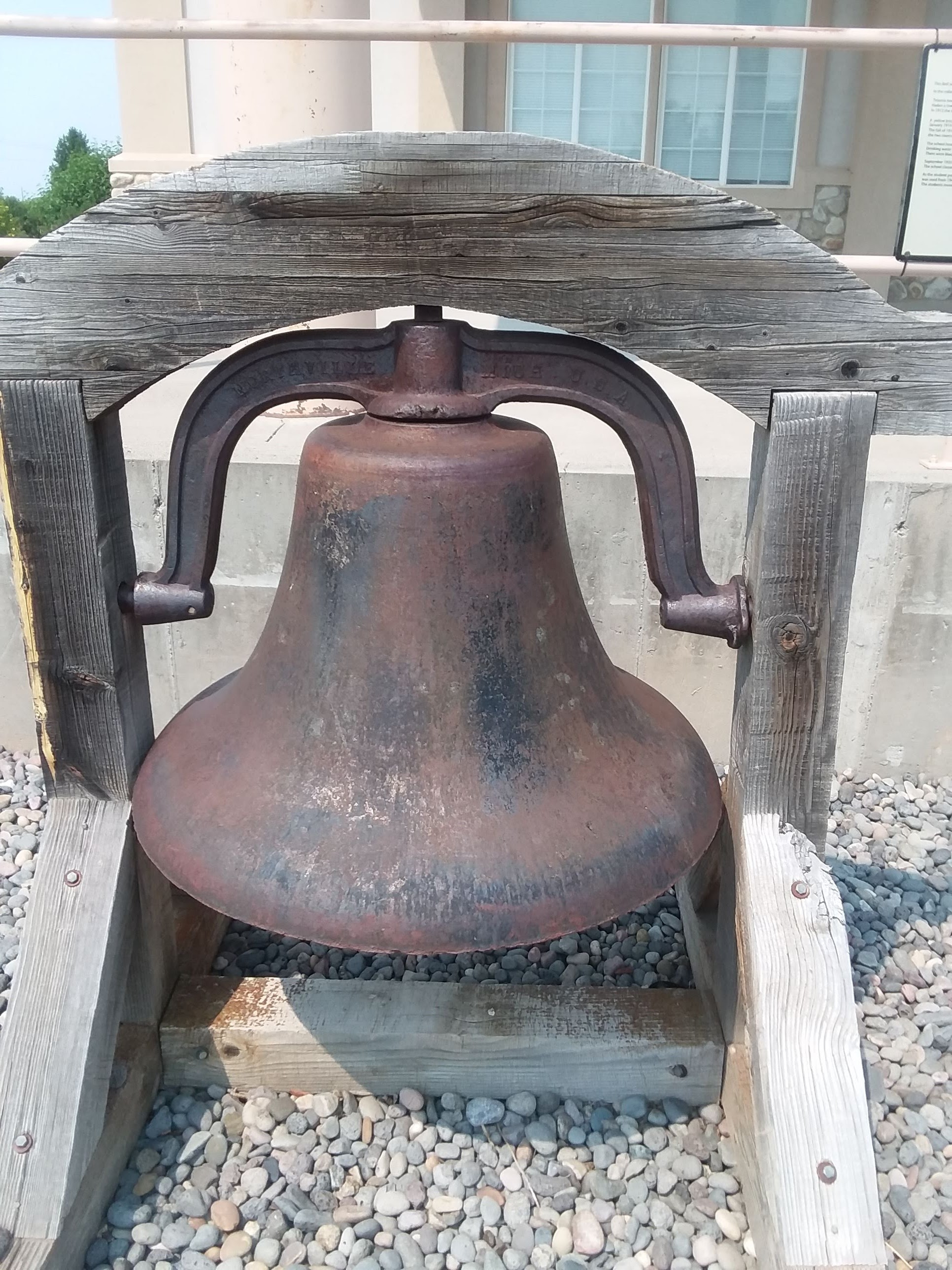
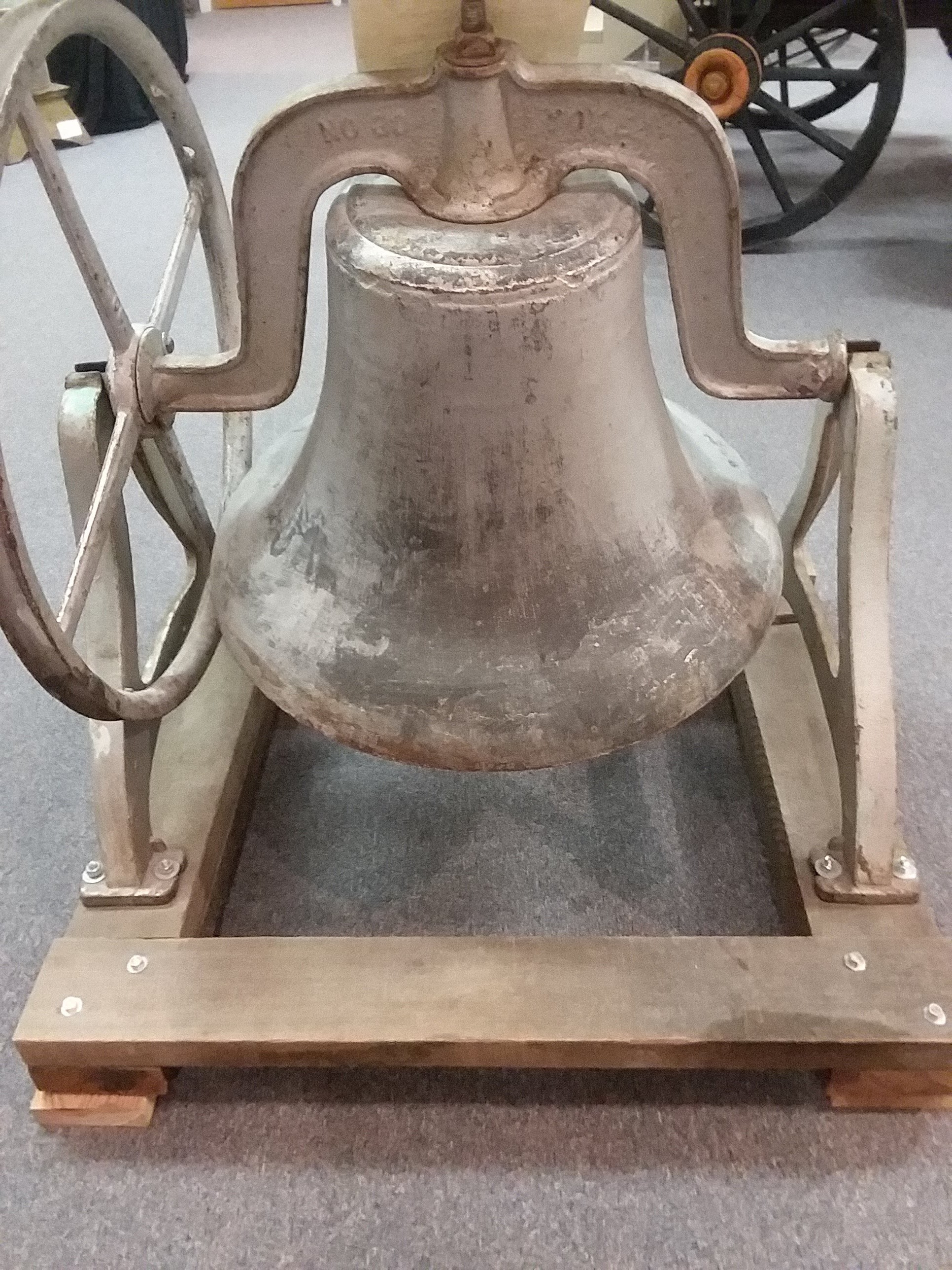
The Tetonia School Bell, currently housed at the Teton Valley Museum in Driggs, ID. The three room school house, operating from 1919 to 1953, was a consolidation of schools from Victor, Driggs, and Tetonia.
For almost my whole life, I think of the beginning of the year in September, not January. Not surprising, since from the time I was 5 years old, I’ve either been a student, a parent of young children, or a teacher, and so it seems natural to think in terms of the school year. Although many local schools start in August, September has always been the month I associate with the beginning of the academic year. But it hasn’t always been that way. In the late 1800’s, rural kids often only went to school for 5 months of the year. They had a short winter and a short summer session, and helped at home in spring and fall. In 1891 in Haden, ID, a school was required to be in session at least three months of the year. Urban students at this same time attended school much longer, in what was essentially year round school. However, event though the schools were open year round, attendance was not compulsory. During the hot summer months, many students did not attend because any family that could afford to do so left the city. Without air-conditioning, the school buildings were sweltering. Toward the end of the nineteenth century, rural and urban schools worked to make schooling more uniform. To that end, the typical 9-10 month school year, with time off in the summer gradually became the norm. (States also began passing laws that made elementary education compulsory.)
This year, 2021, the start of the school year is fraught with challenges. Covid-19 cases are on the rise again, and children under 12 are not yet eligible for a vaccine. School administrators are once again struggling with decisions about masks, social distancing, and virtual learning. I applaud all the teachers who survived the last year and a half, and are showing up again this year to face the challenges. As a former teacher, I can only imagine their struggles to work effectively in such a chaotic and ‘flexible’ environment.
Of course, teaching has never been an ‘easy’ job. It can be amusing to look at various ‘rules for teachers’ from the 19th century. (Although these ‘rules’ have not been verified as actually accurate or authentic.) One such ‘rule’ forbids teachers from loitering in ice cream shops. Another says women teachers could not ride in a carriage or motor car with any man except a father or brother. Whether or not these rules were really put in place, the challenges teachers have faced are very real. Consider trying to teach twenty or more people, ranging in age from five to twenty, all in one room.
The one-room school house was the norm in the decades before improved transportation made it possible for schools to consolidate. In the 1930’s, my mother attended a one room school house in Kansas. When she started, she was the only first grader in the school. With less work to do than the older kids, she had to go outside alone for longer recess breaks. Mom attended this one room schoolhouse through sixth grade, at which time she went to a consolidated school. This ‘big’ school had two rooms for first through eighth grades.
In September, the geese begin gathering to fly south, the leaves start to turn colors, and the school bells ring. (Although many school bells today are really buzzers that mark the beginning and end of each period.) For me, this is the beginning of a new year.
The Haden School Bell. The first permanent school in Haden, ID was opened Jan. 1892 and had 54 students by the spring of 1900. The town of Haden was formally dedicated three years later.
When I think of women of long ago, caring for their families during illness, I’m struck by both their ingenuity and their lack of medical resources. Some 46% of children born in 1800 would die before the age of five (O’Neill). Another 20% or so wouldn’t live to see sixteen (Raising …). I can only imagine the heartbreak these statistics reveal. When illness hit the family, most often mothers had to put their trust in one of the many well-known recipes for plague waters or medicinal syrups. Many recipe books from the medieval and colonial periods include directions for such potions, some of which actually help. But more often the potion or elixir was used not because of effectiveness, but because doing something is usually better than doing nothing.
Imagine the dilemma facing families in the 18th century: Dose your family with an herbal elixir said to be good for ague and fevers, and pray to God that none of you catch smallpox, with its 30% mortality rate (Smallpox) or risk variolation or inoculation by making a scrape or cut on the healthy person’s arm or leg, and spreading material from the scabs or pustules of the sick person. This usually resulted in a milder form of the disease with a mortality rate of only 2%. Much less risk obviously, but still a risk.
Not long after variolation became widely accepted in the New World, Edward Jenner developed a vaccine that further reduced the spread of smallpox. He expressed the hope it would eradicate the disease forever (History…) It took almost 200 years, but Jenner’s dream was realized in 1980 when the WHO declared the world free from naturally occurring smallpox.
Jenner’s vaccine did more than eradicate smallpox. It paved the way to develop other useful vaccines that are now common. I’ve lived long enough to be older than some of the vaccines now routinely given to children. I survived measles, mumps, and chicken pox, and made it to adulthood without contracting Rubella or German measles as it was called. But as soon as a vaccine became available, I got it. Of all the vaccines I’ve received, three stand out as truly significant.
One is the smallpox vaccine, described above. While I don’t have any memories of getting this, I do have a tiny scar on my arm as a visible reminder of my protection.
The earliest vaccine I do remember is the Sabin Polio vaccine. Polio was another one of those terrible diseases that was highly contagious and killed or crippled thousands. Some of you may remember the restrictions frightened parents made– pools, theaters, and playgrounds closed, birthday parties cancelled, children isolated from playmates. Polio was one of the most dreaded diseases of the 20th century. I was too young to remember the fear, but I do remember standing with my mother and various siblings in a long line in a huge, unfamiliar auditorium. I think it was 1961 or 1962 in San Bruno, California. Even then I understood the importance of what we were doing. At the end of the line I was handed a little paper cup with a sugar cube in it. As vaccines go, that was undoubtedly the most pleasant, like a candy treat, or sweet-tasting medicine. The massive worldwide vaccination efforts against polio have nearly wiped out this dreaded disease.
Fast forward to 2020 and 2021. Once again the world is facing a major pandemic: Covid-19.. We’ve learned to wear masks, close schools, and theaters, and practice ‘social distancing.’ With a speed never before achieved, scientists around the world have created vaccines to fight this new threat. Thus, my third memorable vaccine was this year when I got the first dose of the Pfizer Covid-19 shot. The little sting in my arm felt like a gift, a miracle even. I understand the pandemic is not over. Social distancing and masks are still important, especially in any public place. But like the smallpox and polio vaccines, this new vaccine lifts the weight of worry we’ve been carrying for the past year. It means that we can hug our loved ones without the fear that such an important gesture carries such a terrible risk.
Of course, vaccines can’t prevent everything. We’ll still catch colds and various bugs. For those we can use our modern elixirs: the myriad cough syrups, lozenges,and pills, available in any grocery store or pharmacy. Or we can try one of the concoctions our foremothers used. Unlike modern elixirs, those of bygone days were not subjected to rigorous study, but handed down from generation to generation. Some of them even formed the basis for modern remedies.
I’ve found that many of the recipes for medicinal syrups in early cookbooks use unfamiliar or unavailable herbs, some of which cause vomiting or purging, both thought at the time to be good ways to relieve a fever. Still some of the recipes are tasty enough to be made into a refreshing drink. As for their medicinal value, your guess is as good as mine.
For those of you who want to try an old-fashioned medicine, I’ve included a potion for rose syrup. I say potion because I personally find the scent too strong and flowery, so that the resulting syrup tastes like medicine, which of course, this syrup was used for. Rose water and rose spirits are said to be good for the heart and lungs, and helpful in reducing fevers. It is also said that rose water adds a pleasant flavor to all sorts of dishes. While I can’t vouch for any pleasant flavor, or even any real benefits, I can say that rose syrup is unlikely to be in any way harmful. Most of all, I can be grateful that I don’t have to rely on any such elixir to ease the colds or viruses that come my way.
Martha Washington’s Booke of Sweetmeats has five recipes for rose syrups, ranging from a simple rose water and sugar mixture boiled to the consistency of syrup, to a concoction requiring twelve days of steeping. The recipe below follows the simplest version. Hannah Glasse’s recipe calls for infusing rose petals in water for eight hours, then adding fresh petal and letting them steep another eight hours. Both these books call for using damask roses, cutting off the white parts of the petals, and making the rose infused-water first.
For my version, I used rose water that I purchased since I didn’t have fresh roses. Fresh damask roses would give the syrup a reddish tinge, so I added a few drops of red food coloring to the clear rose syrup.
Rose Syrup: Modern version
Mix 1 c. rose water and 1 ¼ cup sugar. Bring to a boil, and boil until the mixture reaches 200 degrees for a thin syrup. Add 3 drops red food coloring. Enjoy on pancakes or biscuits, or serve a spoonful to an invalid
Sources
—–. Martha Washington’s Booke of Cookery and Booke of Sweetmeats. (A Family Manuscript, Hand written circa 17th century. Transcribed and annotated by Karen Hess, New York: Columbia University Press, 1995).
Glasse, Hannah. The Art of Cookery Made Plain and Easy: Excelling any Thing of the Kind ever yet published. Alexandria: Cottom and Stewart. 1805. (First Edition publishing in London, 1747. This edition reprint of 1st American Edition, 1805, by Applewood Books, 1997).
Raising Children in the Early 17th Century: Demographics. A collaboration between Plimoth PlantationTM and the new england historic genealogical society® supported by the institute for museum and library services www.PlymouthAncestors.org Accessed 4/4/2021
Chocolate is good for you! While many people make that claim tongue-in-cheek, there are actually a good many ways chocolate actually is a healthy choice, in moderation. (Unfortunately, no one claims the sugar and cream often mixed with chocolate are healthy.) Our ancestors also appreciated the healthful benefits of chocolate.
A little research into chocolate consumption turned up some surprising things. Most surprising, perhaps, is that chocolate was much cheaper in colonial America than it was in Europe at the same time. Though not as cheap as coffee, chocolate was a great deal cheaper than tea. One reason for this is the issue of transportation. Chocolate comes from cocoa beans (sometimes called cocoa nuts) which are indigineous to the Americas. It was easier and less expensive to acquire cocoa in New England, than it was to get the beans to Europe. Besides the shorter distance, it was easier to circumvent taxes and restrictive shipping laws. It’s likely that smugglers transported chocolate made in the colonies to Europe. While the cost of chocolate was too much for the common laborer or slave to indulge, any of the ‘middling sort’ could afford to buy chocolate.
Throughout the 18th century, chocolate makers thrived in the northern colonies where the weather made it possible to grind chocolate without it melting. One reason for the success of this cottage industry was that there were far fewer barriers for colonial entrepreneurs than for those in Europe. There were no guilds or monopolies restricting millers. A chocolate mill could be a small, foot-powered operation or a much larger water-powered manufacturer, or something in between powered by one or more horses. Millers could diversify, milled oats, coffee, spices, mustard or even tobacco at the same time, so that they didn’t have to rely on the supply of just one product. Each manufacturer had a unique recipe, making spiced or unspiced chocolate bars. Colonial Americans bought their chocolate based on who made it and where the beans came from, with a strong preference for locally made chocolate. Local chocolate was less likely to be adulterated or to have soaked up the smells and tastes of products transported beside the chocolate.
The second surprising fact I learned is how important chocolate was to colonial men and women. While we’ve all heard stories of the importance of tea, less attention has been given to chocolate. Many religious groups approved of chocolate because it was stimulating without being alcoholic. It was thought of as wholesome, nourishing, and medicinal. At least one religious leader in 1707 doled out chocolate bars and sermons to the sick of his parish. Colonial Americans appreciated the energizing effects of chocolate, while much of Europe though chocolate was a sign of decadence.
From the time of the Aztecs to WWII, soldiers have carried chocolate as a lightweight and satisfying food. During the French and Indian War, both the French troops and the British troops, and even some of the various Indian allies, counted on chocolate provisions. Ben Franklin organized shipments of chocolate to General Braddock’s troops, and a few decades later, during the Revolution, chocolate was considered a ‘necessity’ for American prisoners, and was included in the provisions sent to the Continental Army.
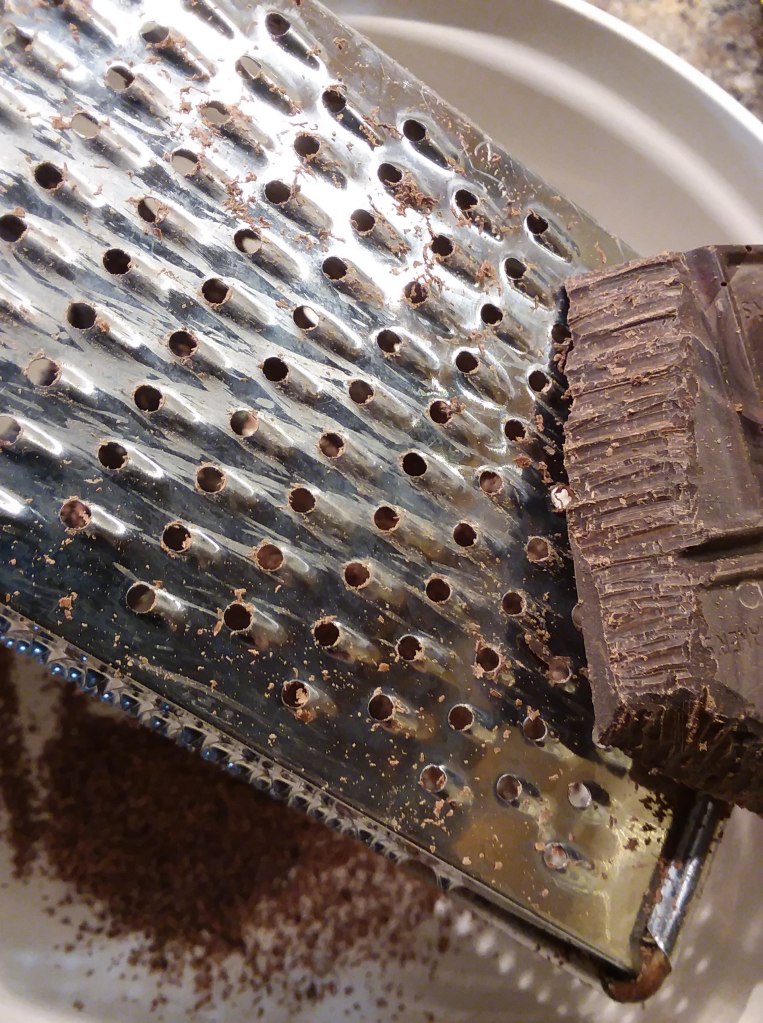
My third surprise was the many different ways chocolate was prepared during the 18th century. While it is uncertain exactly how the various groups of soldiers consumed their chocolate rations, recipes for common use abound. As we have seen before (see‘Tis the Season for more chocolate history) chocolate was frequently a beverage. As such it was most popular as a nutritious and stimulating breakfast drink. Chocolate shells, or the husk of the cocoa bean after it has been roasted, were also steeped to make a sort of ‘tea’ that tastes like chocolate. This was apparently a favorite drink of Martha Washington. Finally, chocolate was grated to make cakes, cookies, and candies. A recipe for chocolate almonds (chocolate candies shaped like almonds) dating from 1705 calls for scraped chocolate, sugar, gum tragacanth, and orange water. Other contemporary recipes include almonds or rose water.
The recipe included here is for chocolate biscuits. Don’t be put off by the name. In this context, biscuit (deriving from the French for ‘twice baked’) follows the British and Irish usage: a biscuit is a type of cookie.
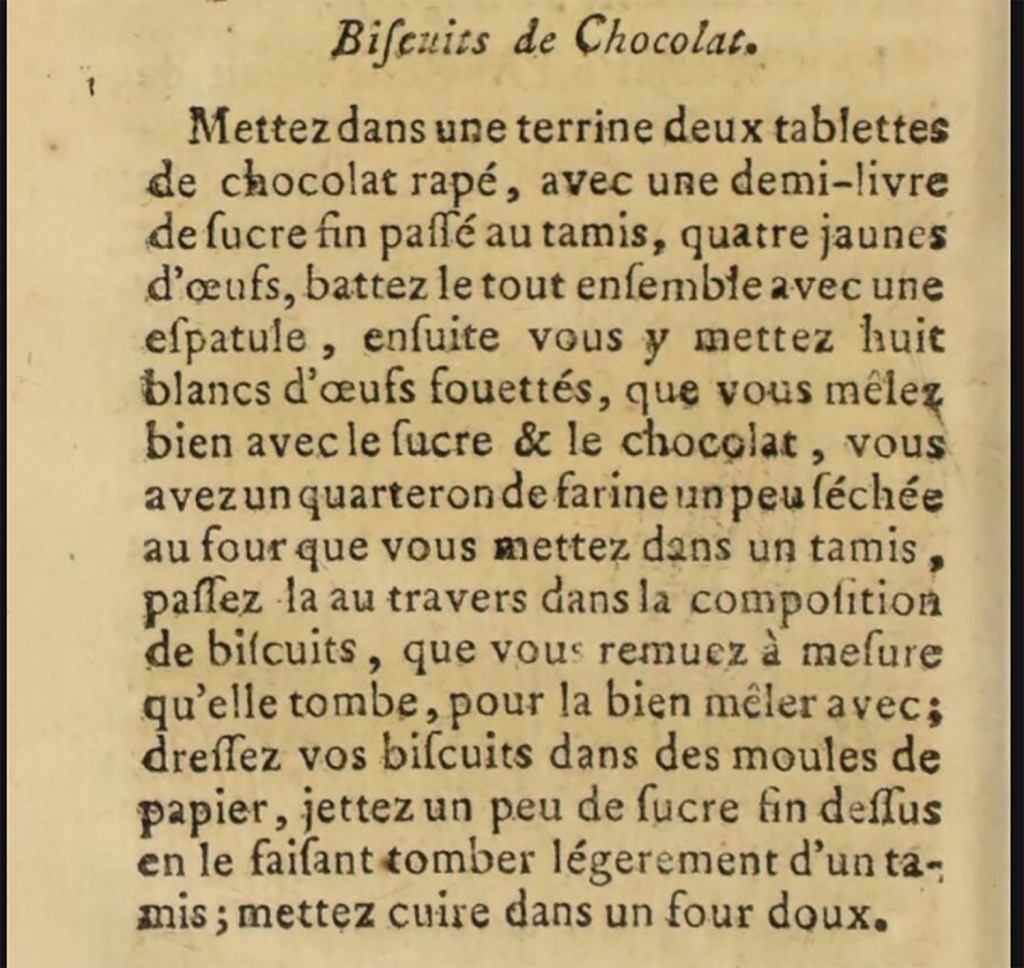
This recipe comes from the 1778 edition of La Science du maître d’hôtel, confiseur, but a similar chocolate biscuits recipe was also included in the 1750 edition.
My translation of the recipe is as follows: (Note, I have added periods for clarity. The French author connected all of the sentences with commas only.)
BISCUITS OF CHOCOLATE. Put two tablets of grated chocolate in a bowl, with a half pound of sifted sugar, four egg yolks. Beat it all together with a spatula. Then put in eight egg whites beaten stiff and mix them well with the chocolate and sugar. Take a handful* of flour that has been dried in the oven, and sift it over the biscuit batter, stirring as it falls in order to mix it in well. Put your biscuits in paper molds. Sift a little fine sugar on top. Cook in a soft oven.
There are few difficulties with this recipe. The recipe writer kindly specifies the amount of eggs and sugar, but is less clear on the quantities of chocolate and flour. However, in pages preceding the recipe, the writer explains how to process chocolate into tablets that are one ounce each, so I can assume two tablets means two ounces. So the only problem with quantities is the amount of flour. A quateron can mean a quarter (of something, perhaps a quarter of a pound) or a handful. A quarter of a pound of flour is nearly 1 cup, which is much more than a handful. I opted for just enough flour to help the biscuits keep their shape. I made half of the original recipe for about 2 dozen cookies.
Finally since chocolate was sold both spiced and unspiced in the 18th century, I added cinnamon and pepper to the mix to replicate a simple spiced chocolate. The result was a delicious cookie with good chocolate flavor. For a crisp cookie, similar to a meringue, let the cookies cool, and keep in a very dry place. For a softer cookie, more like a sponge cake, bake for a shorter time and store in a sealed container to keep the moisture in.
Chocolate Biscuit Recipe

2 ounces chocolate (unsweetened baking chocolate)
1/2 c. sugar
1 t. Cinnamon
¼ t. Black pepper
2 eggs yolks
4 egg whites
1/3 c. flour

Grate the chocolate. Mix with sugar, cinnamon and pepper. Add the egg yolks and stir well. In a separate bowl, beat the egg whites until stiff. Fold into the chocolate mixture. Gently add the flour. Drop by spoonfuls onto parchment paper (for a flat drop cookie) or fill paper muffin cups ¼ to ⅓ full. Bake at 325 for about 20- 25 minutes. (The time will vary based on how thick your cookies are and how crisp you like them.)

The cinnamon and pepper add a nice, subtle ‘bite’ to the cookie. For a stronger, darker chocolate flavor, double the amount of grated chocolate.
Though chocolate has a reputation for decadence, this recipe offers more pleasure than guilt. After all, chocolate IS good for you.
Sources
Farmer, Dennis and Carol. The King’s Bread, 2d Rising: Cooking at Niagara 1726-1815. Old Fort Niagara Association, 1989. p.30.
La science du maître d’hôtel, confiseur, à l’usage des officiers, avec des observations sur la connoissance & les propriétés des fruits. Suite du Maître d’hôtel cuisinier. (Anonymous). Paris. Par la compagnie de Libraires Associeés, 1778
If there is anything that can drive away the chills and ills of a dark January day, it is a posset. Why is that, you may ask, or even, what is that? Shakespeare wrote of possets most famously in the scene where Lady Macbeth gave the king’s guards drugged possets to make sure they were asleep for Macbeth to kill the king. Samuel Pepys mentioned eating or drinking a sack-posset at least ten times between 1660 and 1668 in his diary. Often his posset was part of a late night supper or a remedy for an illness or a hangover.
So what exactly is a posset? At its simplest, it is a warm drink/dessert traditionally made of cream, eggs, and alcohol, often flavored with nutmeg. Think warm egg-nog. Twenty-first century possets are often flavored with anything from lemon to chocolate, but we’ll stick to the possets of the 18th century and before. To be sure there are many drinks made with milk or cream and eggs, so what makes a posset different from a syllabub or a cawdel or even gruel (see earlier post). Actually not a lot. All are variations of custards, with a few differences in thickness, richness, and temperature.
My own interest in possets stems from its similarity to eggnog. I have always loved homemade eggnog (much more than the thick, overly sweet kind you find in the store.) My fondness for eggnog might have started when I was a baby, and the doctor told Mom to put egg yolks in my milk since I didn’t much like eating. In any case, I grew up on homemade eggnog, made with milk, raw eggs, a bit of sugar, nutmeg, and rum flavoring. (Never any real alcohol.) I also gave my kids eggnog. Then health officials began talking about how bad it was to eat (or in my case, drink) raw eggs, and my beloved eggnog was purged from my diet.
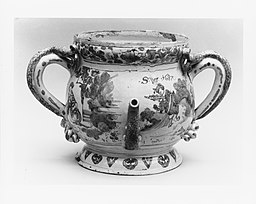
A posset pot circa 1687, tin enamled earthen ware, Metropolitan Museum of Art. Picture in public domain, retrieved 1/9/2021 Wikimedia commons
But possets, using more or less the same ingredients, are cooked, so the problem of raw eggs is eliminated. The alcohol curdles the dish, while the egg or egg yolks thicken it. Taken warm, a posset is thin enough to drink. It thickens as it cools, which is why several sources refer to ‘eating’ the posset rather than drinking it. Posset pots were specially made with a spout so the liquid settling to the bottom could be drunk, while the more solid, custardy part could be eaten with a spoon.
I used a recipe from Martha Washington’s Booke of Cookery that called for a quart of cream, a half pound of sugar, a half pint of sack (similar to sherry), 7 whole eggs and 7 additional yolks, nutmeg and musk (from the scent glands of a male deer, many species of which are endangered) or ambergreece (produced in the digestive system of sperm whales and illegal in the United States). Since not all posset recipes called for the musk and ambergreece (ambergris), and since obtaining such ingredients would be not only illegal but quite difficult, I decided to leave them out of my own version. The recipe calls for warming the sack, then stirring in the eggs, sugar, and nutmeg. Finally the cream is poured into the mixture and cooked on low until it is thickened. Some recipes suggest strewing cinnamon on top before serving.
Fourteen eggs to make myself a drink or dessert seemed excessive, so I reduced the recipe, and used the following.
Posset #1
1 c. cream
 ¼ c. sherry
 ¼ c. sugar
 3 whole eggs
 ½ t. Nutmeg
 A sprinkle of cinnamon.

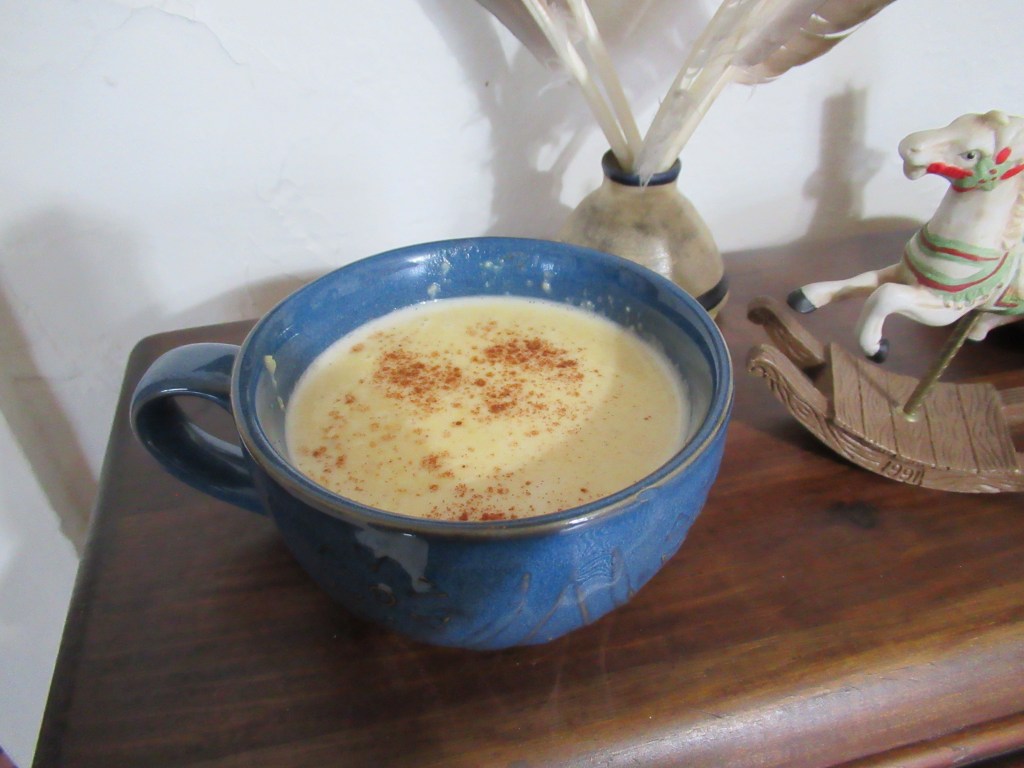
Mix the sherry, sugar, eggs and nutmeg. Beat well until the mixture is smooth and frothy. Heat slowly until it thickens. Add the cream and continue heating, stirring constantly. When the mixture is thick enough coat a spoon, pour into a cup. Sprinkle with cinnamon and serve.
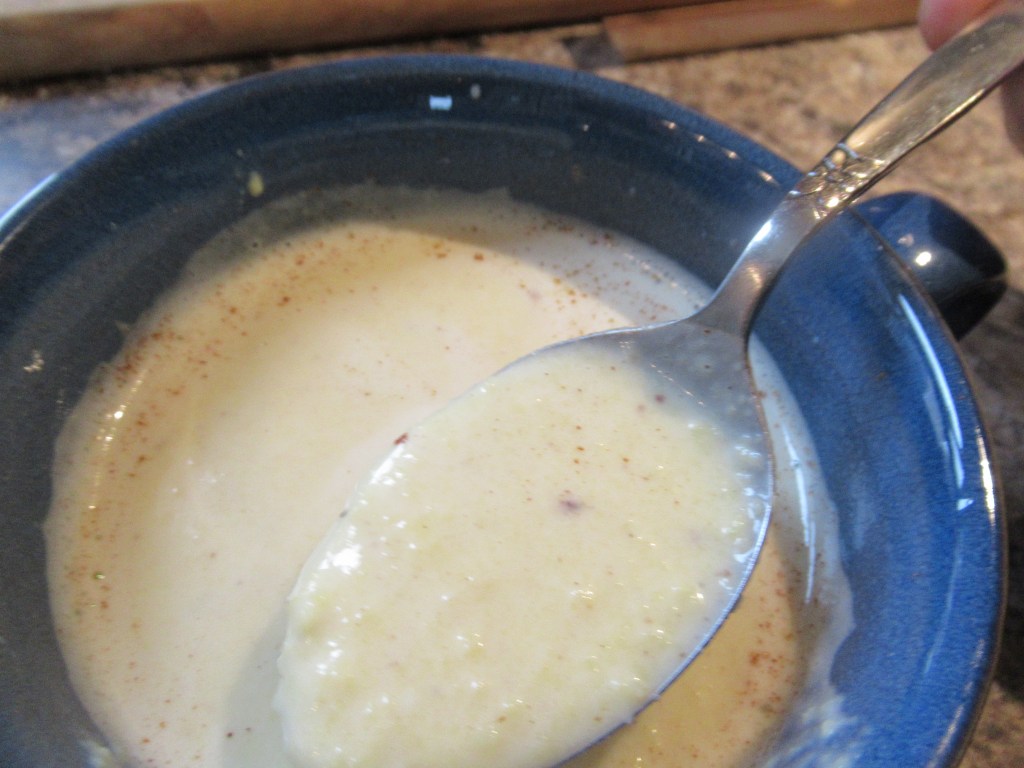
Note the slightly curdled consistency.
At this point the mixture is still liquid. The result is very sweet and very rich. This recipe makes at least two servings. I put half of the mixture in the refrigerator. By the next day, it had thickened to a very rich, sweet custard that I ate with a spoon. Both the warm drink and the cooled custard had a slightly curdled texture. It was delicious either warm or cold, but so rich, I couldn’t imagine having it often.
So how to enjoy a more modern (moderate) posset today? I decided to use my own eggnog recipe, but cook it like a custard to solve the stricture against raw eggs.
Posset #2
Posset #2
 1 c. milk (I used skim)
 2 T. sugar
 1 whole egg
 ½ t. Nutmeg
 2 T. sherry.

 Mix all ingredients in a small saucepan. Whip until smooth and frothy. Cook on low heat until the mixture thickens. Sprinkle with cinnamon. Drink warm or cooled. Like the possets of previous centuries, the result has a slightly curdled texture and a delicious flavor.
As a mid-winter treat, this really hits the spot. Enjoy.
Sources: —–. Martha Washington’s Booke of Cookery and Booke of Sweetmeats. (A Family Manuscript, Hand written circa 17th century. Transcribed and annotated by Karen Hess, New York: Columbia University Press, 1995)
This year I decided to celebrate the holiday season with a good, old-fashioned Bûche de Noël. To my surprise this delightful chocolate cake shaped like a log is not really all that old-fashioned. Although the methods and ingredients for sponge cakes, the base cake of the Bûche, were known at least by 1615 (see The English Huswife, by Gervaise Markham), the earliest mention of a Yule log meant to be eaten is from over two hundred years later. (see Alfred Suzanne’s La Cuisine Anglaise et la Pâtisserie, 1894). The earliest recipe recorded for such a confection is from 1898, in Pierre Lacam’s Le Mémorial Historique et Géographique de la Pâtisserie. It wasn’t until 1905 that the earliest recipe resembling the cake we love today was recorded, in Joseph Favre’s Dictionnaire Universel de Cuisine Pratique. From the cake’s name and the first places a recipe was published, it’s easy to see that French bakers popularized this treat in the 19th century. No one seems to know exactly how the tradition got started, but it probably has to do with the ancient tradition of the Yule Log.
Buche de Noel is often translated at Yule Log, but there is an important difference. Noel is FRench for Christmas, stemming from the Latin ‘natalis’ or ‘birth’, and can also be connected to the French phrase ‘bonnes nouvelles’ or ‘good news’, specifically the good news of Christ’s birth. It is a decidedly Christian sentiment. Yule, on the other hand, comes from much earlier times, before the spread of Christianity, even though now Yule means Christmas in many places. Jol (yul) from old Norse refers to a pagan feast or time of feasting in December and January, a mid-winter celebration.
In many pre-Christian cultures, especially Germanic and Celtic, the tradition of a Yule log was important. Not a log-like cake, but an actual log, or in some cases a whole tree, to be burned, not eaten. The log was brought in and kept burning throughout the darkest time of the year, the Winter Solstice, and the days following. Winter Solstice, around December 22, is the shortest day of the year. Following the solstice, the days gradually grow longer and thus lighter. The burning log was thought to cleanse the air and welcome the coming of Spring, or at least the time of year when the earth turns toward Spring, rather than away from it.
The carefully chosen log was imbued with certain powers to protect and predict. Oak, a magical tree in Celtic tradition, was often used. Other special trees included beech, elm, or fruit trees. In some places the ‘log’ was actually a huge tree, including the roots.
Various rites and traditions accompanied the burning log. Often it was sprinkled with wine, salt, or oil (and later, after Christianity spread, with holy water.) The log might be decorated with holly, pinecones, or ivy, all plants which have importance in both Germanic and Celtic mythology.
The importance of the tree did not end with the burning. The ashes were said to have medicinal value, guard the house against evil, and even protect from lightning. Ashes buried in the garden helped insure a good harvest and prevent crop diseases. These ashes could also deter pests–foxes away from the chicken coop, and rats and weevils out of the barn loft.
In some places it was also thought that the burning log could predict the future. Striking the log to produce a shower of sparks gave insight to the coming year’s harvest. The sparks represented the grain. A lot of sparks promised more abundance. On the other hand, if the flames of the burning log cast shadows on the walls, someone in the family would suffer death in the coming year.
It’s unlikely the Buche gracing my table will predict anything, good or bad, though I do hope it brings a 2021 better than this year has been. Whatever the next year brings, however, this yule log will be thoroughly enjoyed!
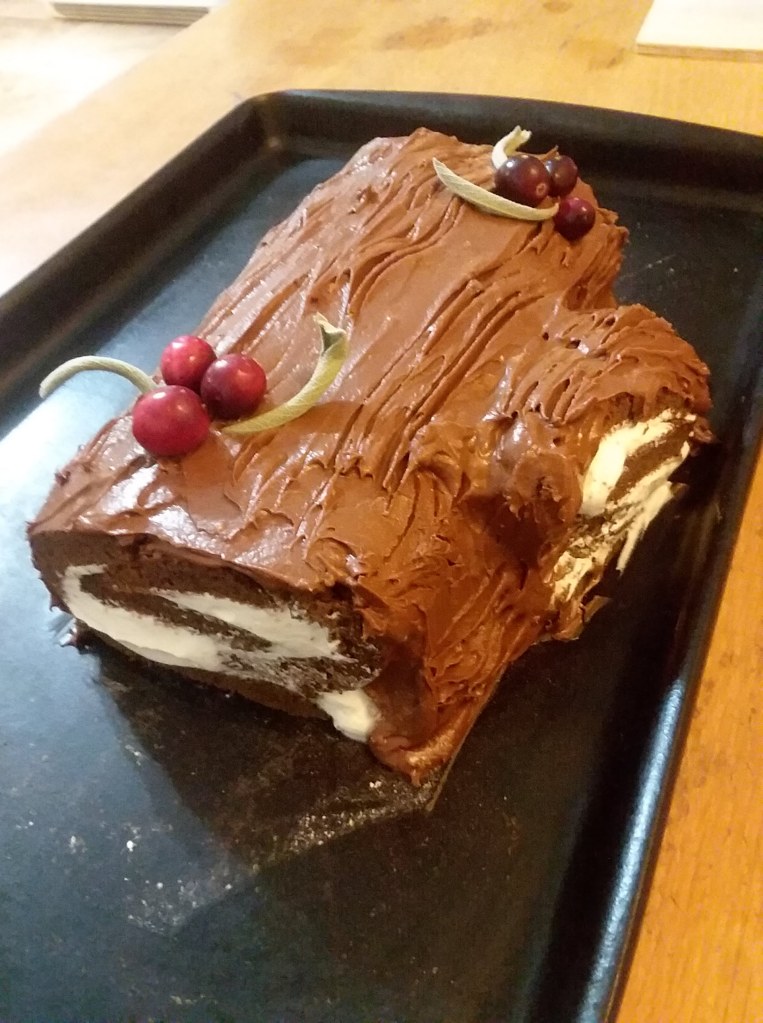
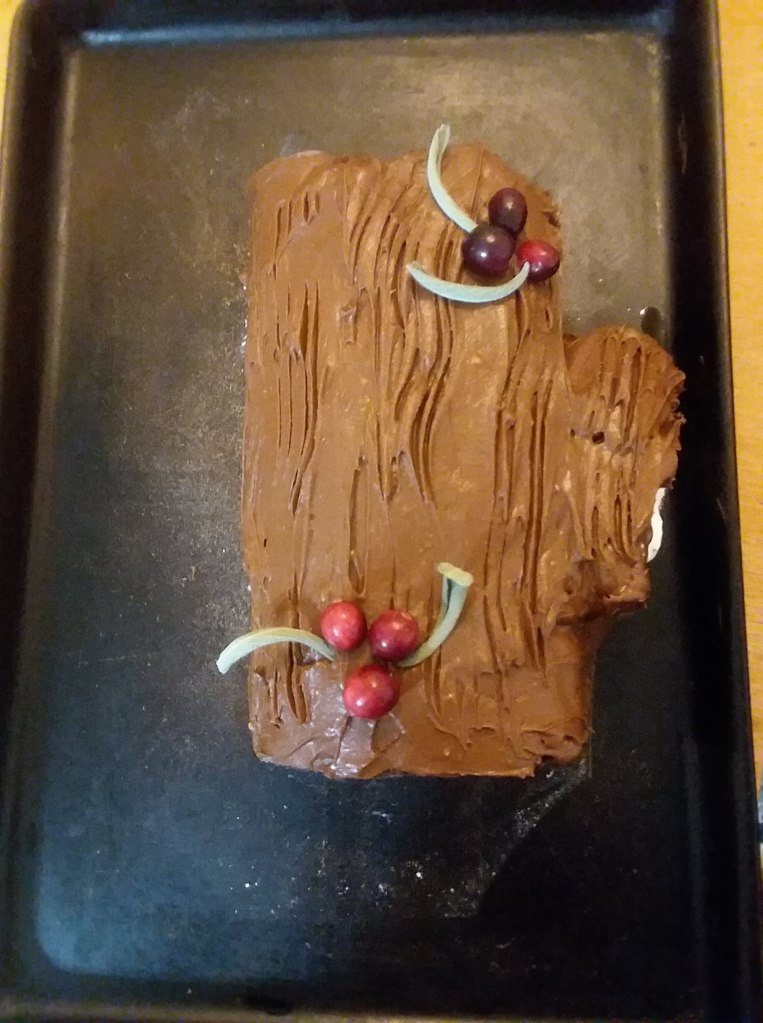
I added ¼ cup. cocoa to the cake for more chocolate, and one additional egg to make the batter moist enough. I filled the log roll with whipped cream, and used chocolate buttercream frosting to decorate the log. For garnish, I used cranberries and dried sage leaves.
My Recipe:
5 eggs, separated
½ c. plus 1 T. powdered sugar
2 T. water
1 c. flour
½ c. cocoa
2 t. Baking powder
½ t. salt
Filling:
1 c. whipping cream
1 t. Vanilla
2 T. sugar
Frosting:
1 c. butter
¼ c. cocoa
2 c. powdered sugar
2 T. milk
For the cake: beat the eggs with the water and egg yolks. Mix the baking powder, cocoa, and salt to the flour, and add this to the egg mixture a little at a time. The dough will be stiff.
Beat the egg whites to stiff peaks. Gently fold the egg whites into the batter. Spread gently into a parchment-lined jelly roll pan so the batter is about ¼ to ½ inch thick. Bake at 350 degrees for 15 to 20 minutes. Check for doneness by inserting a toothpick. Cake is done if the toothpick comes out clean.
While the cake is still warm, sprinkle powdered sugar on a kitchen towel. Turn the cake out onto the towel. Remove the parchment paper, and roll the cake up in the towel, starting at the short end. Let the rolled cake cool completely.
Prepare the filling: Whip the cream to stiff peaks. Mix in sugar and vanilla.
Prepare the frosting: Mix all the ingredients until smooth. Add either more powdered sugar or more milk, a little at a time, to achieve a spreadable consistency.
To assemble the cake: Gently unroll the cake. Remove the towel. Spread the whipped cream on the cake and reroll it. Cut a 1 -2” slice off of one end of the cake. Set the slice along one side of the cake. Frost the cake, leaving the ends (and cut end of slice) unfrosted. Use a fork to mark lines in the “bark.” Decorate as desired.
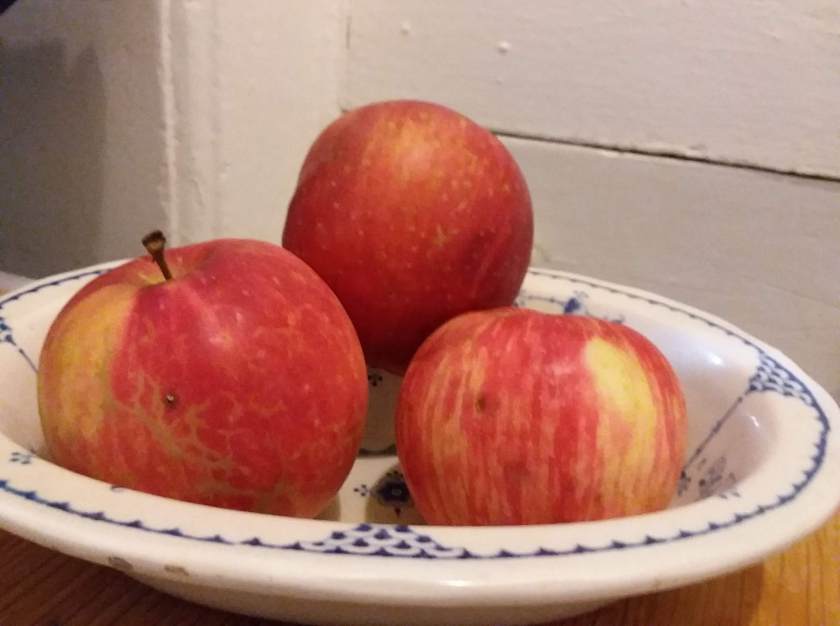
We all know what an apple is, right? Sweet, crunchy fruit, ripening each fall. But it turns out a lot of things called apples actually aren’t apples at all. There are love apples (tomatoes), earth apples (potatoes), golden apples (oranges), and of course, pommes dorées (golden apples in French.)
Click on the picture to see the 2019 post with a history of the word ‘apple’.
Let’s take a closer look at golden apples. There are a number of myths from various cultural traditions that feature golden apples. The well-known Greek myth concerns Paris of Troy and the golden apple of discord. Angry at not being invited to the wedding of Thetis and Peleus, Eris, the goddess of discord, tossed a golden apple with the inscription, “for the fairest.” into the celebration. The three goddesses present, Hera, Athena, and Aphrodite, all wanted the golden apple. Paris of Troy was called upon to judge which was fairest. Each goddess bribed him to pick her. Paris chose Aphrodite, and she awarded him the most beautiful woman in the world, Helen. Unfortunately, Helen was already married to King Menelaus. When Paris and Helen met, they fell in love and ran away back to Paris’s home in Troy. Furious, Menelaus gathered up a Greek army to attack Tro, and get his wife back. Thus began the epic Trojan War.
In Norse Mythology, golden apples also were highly desired but not without trouble. Idunn, goddess of youth had charge of the golden apples, which insured the gods eternal youth. One day Loki tricked Idunn into coming with him to Jotunheim, land of the giants, in order to save himself from the giants. But Idunn’s apples were crucial for keeping the Norse gods immortal. When the other gods learned what Loki had done, they forced him to bring her back. He did s, by turning Idunn into a nut and himself into a hawk. Loki flew back to Midgard carrying Idunn, but pursued by Thjazi, in the form of an eagle. Loki made it back to Asgard, barely escaping Thjazi and the gods once again had access to Idunn’s golden apples.
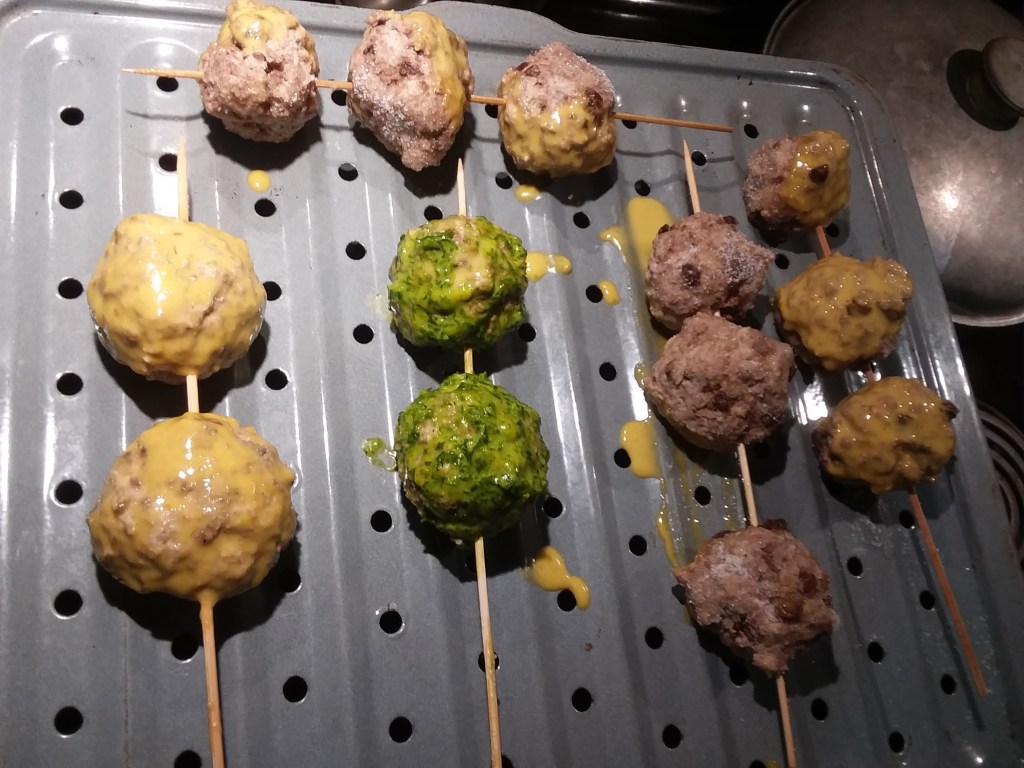
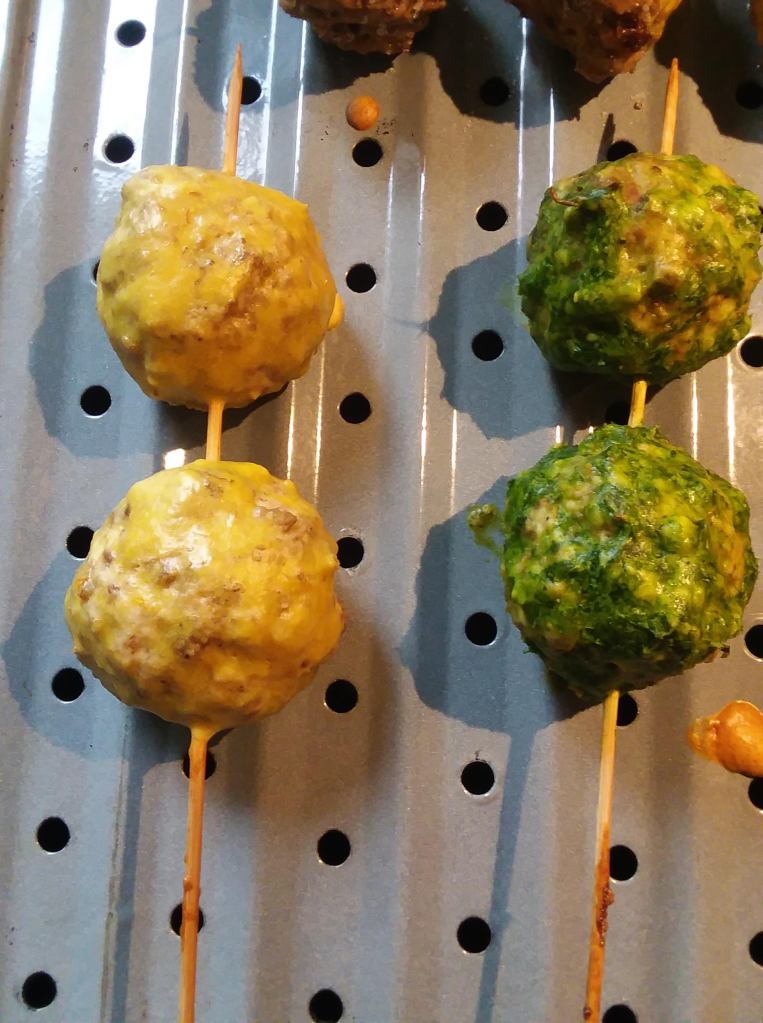
The most surprising of all these golden apples are the pommes dorées, the gilded apples of French. Many versions of recipes for Pommes Dorées can be found in medieval English cookbooks. This was a period when the language of the English court was often still French, and most English nobility spoke French, so it’s not surprising to find French words in English books. What is surprising is that all these golden apple recipes aren’t apples at all, but meatballs. (Other recipes, like mashed apples, also use the French word, pomme).
So when is an apple not an apple?
When it’s a meatball.
Here are two recipes for gilded apples, in the original, translated to more modern English,and then adapted as a recipe for modern use.
59. For to make poum dorroge, tak pertrichis wit longe filettis of pork al raw & hak hem wel smale, and after bray hem in a mortar, & when they be wel brayd do thereto god plente of poudere & yolkys of eyryn, & after mak thereof a farsure formed of the greteness of an onyoun, & after do it boyle in god breth of buf other of pork. After lat yt kele, & after do it on a broche of hasel & do hem to the fere to roste, & mak god bature of floure & egges, on bature wyt and an othere yelow & do thereto god plente of sugur & tak a fethere or a styk & tak of the bature & peynte theron aobue the applyn so that on be wyt & that othere yelow wel colourd. (Curye on Inglysch II. Diuersa servicia)
Rough translation from Middle English to modern English:
To make gilded apples, take fillets of raw partridges and pork. Chop it up and grind it in a mortar. When it is well ground, add plenty of powder (spices) and egg yolks. Then make it into stuffing (balls) the size of onions and after that, boil them in beef or pork broth. Then let them cool and put them on a branch of hazel and put them on the fire to roast. Make a good batter of flour and eggs, one batter white and the other yellow. Add plenty of sugar. Take a feather or a stick and paint the top of the apples so they are white and the other (part of the apple) is yellow, well colored.
42 For to make pommedorry, tak buff & hewe yt smal all raw, & cast yt in a mortar & grynd yt noyt to smal. Tak safroun and grynd therewyth. Wan yt is grounde, take the wyte of the eyren, yf yt be noyt styf; cast into the buf pouder of pepyr, olde reysyns & reysyns of coronse. Set ouer a panne wyth fayr water, & mak pelotys of the buf; & wan the water & and the pelotes ys wel yboylyd, set yt adoun & kele it. Put yt on a broche & rost yt & endorre yt wyth yolkys of eyren & serue yt forth. (Curye on Inglysch II. Diuersa servicia)
Rough translation from Middle English to modern English:
To make gilded apples, take raw beef and chop it small, put it in a mortar and grind it not too small. Take saffron and grind it with (the beef). When it is ground, take the whites of eggs if it is not too stiff, and put them in the beef along with powder of pepper, old raisins and dried currants. Set over a pan with fair water, and make pellets (balls) of the beef, and when the water and the pellets are well boiled, set them down and cool them. Put them on a spit and roast them and gild them with the yolks of eggs and serve them.
Modern version of the Recipe
(Note this version draws on both of the recipes above, as well as a few other medieval recipes for pomme dorées)
1 lb. ground beef
1 lb. ground chicken (if you have no partridges available)
2 egg whites (save the yolks for gilding the meatballs)
1 t. Salt (optional)
1 T. ground black pepper
1 T. ground ginger
1 T. ground cinnamon
½ c. raisins (optional)
Mix all these together. Form into balls the size of small onions. Boil the balls for 10 minutes in beef broth. (Save the beef broth, and add sliced onions to make a nice onion soup to serve with your pommes dorés.) Remove the meatballs from the broth and put them on skewers.
To gild the meatballs:
1 T. Safflower (an inexpensive substitute for saffron- not the     same taste, but serves as a good coloring agent.)
2T. Beef broth
2 egg yolks
¼ c. flour
Put the safflower in the warm beef broth and let it steep for 5 minutes. Strain out the safflower. Mix the colored beef broth, the egg yolk and the flour to make a nice batter. If it is too thick to spread on the meatball, thin it with a little more broth. If it is too thin, add a little more flour.
Options:
Version 1: Spread the gilding over the meatballs.
Version 2: Chop parsley fine and add to the gilding mixture. Some of the recipes called for gilding to be green.
Version 3: Roll the meatball in sugar, then paint half of it with the egg gilding.
For all versions: Roast at 350 degrees for 15 minutes, and serve.
If 2020 had gone as planned, I’d be coming back from Scotland right about now, with new stories and pictures. But in the words of Robert Burns, “The best-laid schemes o’ mice an’ men / Gang aft agley.” So I offer instead these memories of great castles in Scotland, 2015.
Edinburgh Castle: On a rare, clear moment
The rock that Edinburgh Castle sits atop has been fortified since before Roman times.
A view of Edinburgh Castle ramparts and the city below.
The oldest parts of the castle were built by King David I in 1103.
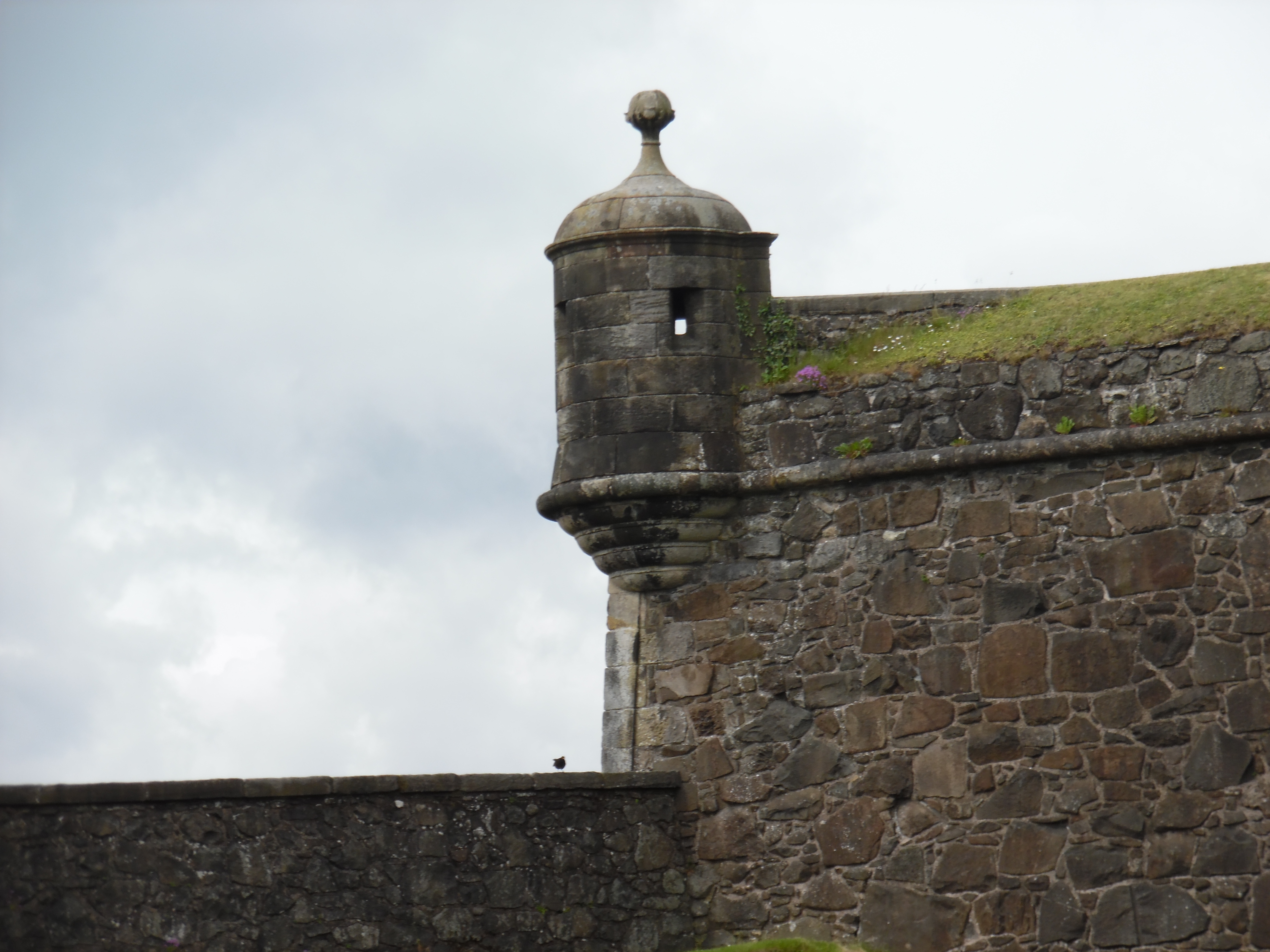
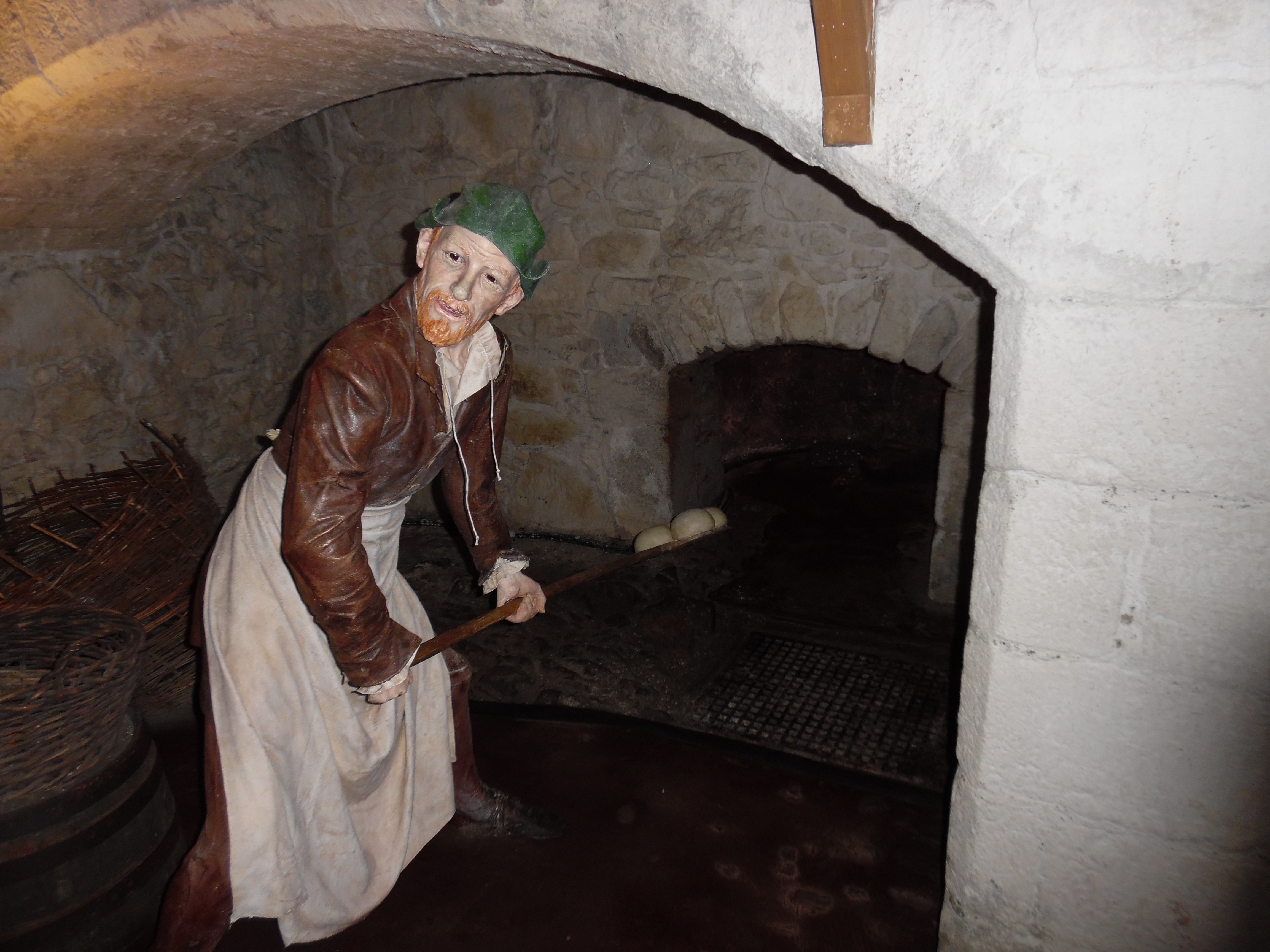
Like Edinburgh Castle, Stirling Castle, is not a single building, but a complex. Here we see the ramparts, a passage way between buildings, and life-sized model of a medieval baker in the lower kitchens. Many of the present buildings at Stirling Castle were built between 1490 and 1600.
Inverlochy Castle, Fort William
Though it is in ruins, Inverlochy Castle is unusual in that it had no additions or changes to the basic design since it was built in the 13th century by John “the Black” Comyn. It sits at the entrance to the Great Glen, a strategic passage into the Scottish Highlands.
Mansfield Castle
Mansfield Castle was built much later than the others, during Victorian times. It became a hotel after World War II. It is said to be haunted by the ghost of Mrs. Fowler, who with her husband, refurbished the place in the early 20th century. We didn’t see or hear the ghost during our lovely stay here.
Cawdor Castle
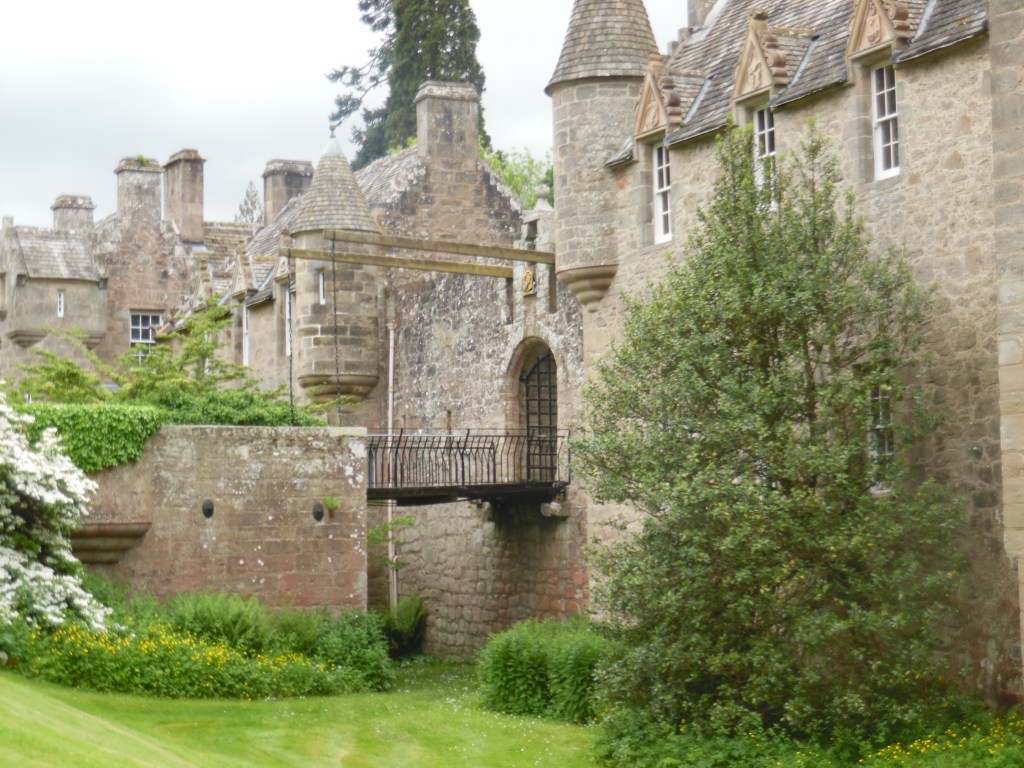
Cawdor Castle was built in the 14th century for the thanes of Cawdor. Though it is open to the public, the castle remains the home of members of the Cawdor family. For me, the castle is significant because Macbeth was awarded the title of Thane of Cawdor after the previous thane was executed for treason. The witches announce this to Macbeth as the first part of the prophecy that ultimately leads to his downfall. Visiting this castle made Macbeth’s story seem all the more real. (The real King Macbeth fought the Thane of Cawdor, but did not receive the title himself.)



















 BRIC-A-BRAC