On Corning Beef

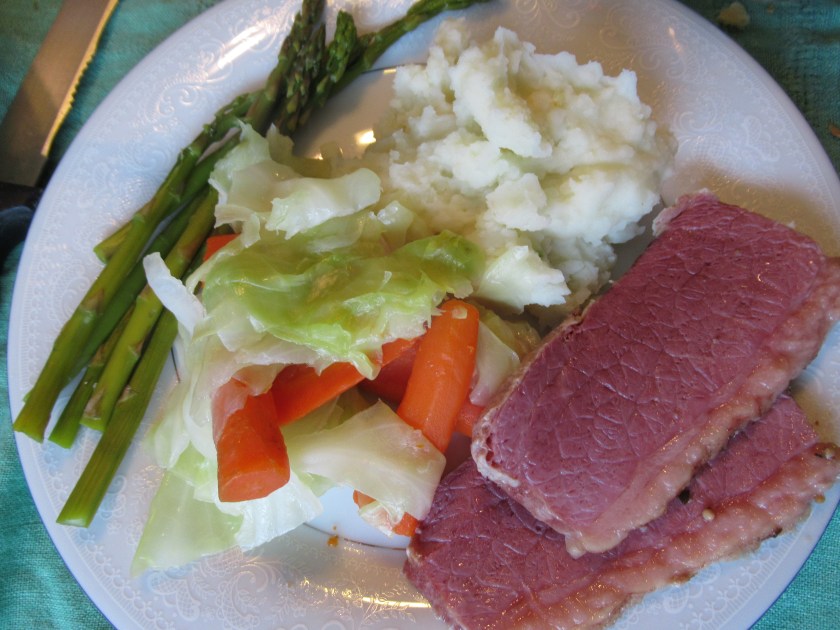
IMG_0552As March draws toward its closing, we have just finished celebrating St. Patrick’s Day, the biggest Irish-American holiday of the year, with one of my favorite meals–traditional corned beef and cabbage.

Except that it’s not.

Not traditional Irish that is. In Ireland, corned beef is not particularly special or common. So how did this iconic dish gain first class status for Irish-Americans? The story is complicated.

First of all, what is corned beef and how did it get its name? Corned beef is beef preserved with a salt brine,various spices, and saltpetre.The saltpetre gives the meat its pinkish color. (Modern corned beef uses sodium nitrite.) ‘Corn’ related to kernel, means grain and refers to the large grains of salt used in the process.

The Irish did not invent corned beef. Many cultures around the world salted beef or other foods as a way of preserving them even before the Greeks and Romans. Corned beef appears in Irish cookery as early as the 12th century. The dish is mentioned in a satiric poem, Aislinge Meic Conglinne, about a king trying to defeat gluttony. It’s interesting, because in ancient and medieval Ireland, only kings were wealthy enough to eat beef. Cattle were a mark of wealth and status. Though used for dairy products, cows were not often eaten. Most of the Irish people ate pork, salted or fresh.  

Then things changed in the 12th century, when England invaded Ireland. By the 16th century, England ruled all of Ireland. The English brought their love of beef (inherited from the Romans during that invasion centuries earlier). Ireland had wonderful pasture lands for raising beef cattle. In fact, the English overlords did such a good job of expanding beef production that in the 1660’s, the English parliament passed the Cattle Acts which prohibited exporting Irish beef since the Irish beef was hurting English farmers.

At the same time that Ireland was increasing beef production, the English navy was expanding, and English merchants (including slavers) began increased trade with the new world. Salted beef was very important for long sea voyages because it keeps well. Another factor in the rise of Irish corned beef was the tax on salt. Ireland had a much lower tax on salt imported from Spain or Portugal.

This plentiful combination of good salt and good beef meant that the Irish became known for great exported corned beef. They even sold it to both sides (French and English) during the Seven Years War. However, since corned beef was now an important trade commodity, it was too expensive for the average Irish to eat.

In another twist to the story, the demand of corned beef indirectly contributed to the Great Potato Famine in the middle of the 19th century. So much acreage was used for pasture land for beef production for export that ⅖ of the total population of Ireland relied completely on potatoes. When the blight hit the potato crop, they had nothing else to eat.

Thousands of starving Irish came to America, where they found corned beef regarded as poor food, fit mostly for slaves. For the first time, corned beef was affordable and the Irish immigrants embraced it. And so began the association of corned beef and and cabbage (another cheap food) with the celebration of all things Irish.

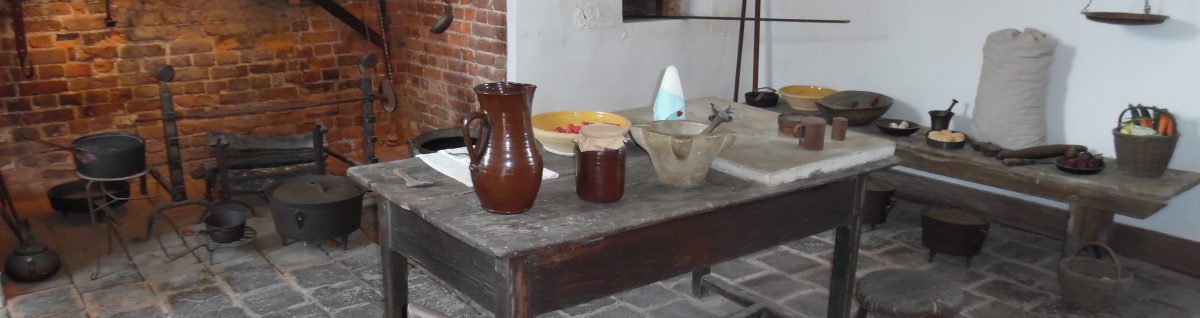
Most people buy packaged corned beef from the supermarket, but I found a couple of recipes from colonial times for salting your own beef.

The one I tried comes from The American Frugal Housewife, by Mrs. Child, (12th Edition) published in 1832.

It is good economy to salt your beef as well as pork. Six pound of coarse salt, eight ounce of brown sugar, a pint of molasses, and eight ounces of salt-petre are enough to boil in four gallons of water. Skim it clean while boiling. Put it to the beef cold; have enough to cover it’ and be careful your beef never floats on the top. It it does not smell perfectly sweet, thurw in more slat. If a scum rises upon it, scald and skim it again, and pour it on the beef when cold. …A six pound piece of corned beef should boil full three hours. (41-42)

Mrs. Child does not say how long to leave it in the brine, before boiling, but she does say that in summer the beef won’t keep well more than a day and a half, but will be good for a fortnight in winter. She also recommends leaving out the saltpetre in summer since it inhibits the absorption of other salts, and so the meat won’t keep as long.

For my recipe, I left out the saltpetre (because I didn’t have any) and adjusted for a much smaller piece of beef.
IMG_0550

Corned /Salted Beef
1 c. coarse salt
¼ c. brown sugar
¼ c. molasses
2 qts. water
2 lb. piece of beef (rump roast is all right, but a fattier cut works better)

First, make the brine. Pu all ingredients except the beef in a large pot. Bring it to a boil and boil until the salt and sugar dissolves. Skim it if necessary, then cool it thoroughly. Put the beef and brine in a non-reactive container. Make sure the brine can cover the beef. The beef will float, so put a weight (like a plate or inverted bowl) on the beef to hold it down in the brine. Refrigerate for 3 days, 
turning the beef daily.

To cook the beef, drain the brine, rinse the meat, and put it in 
fresh water. Boil it for about 2 hours.

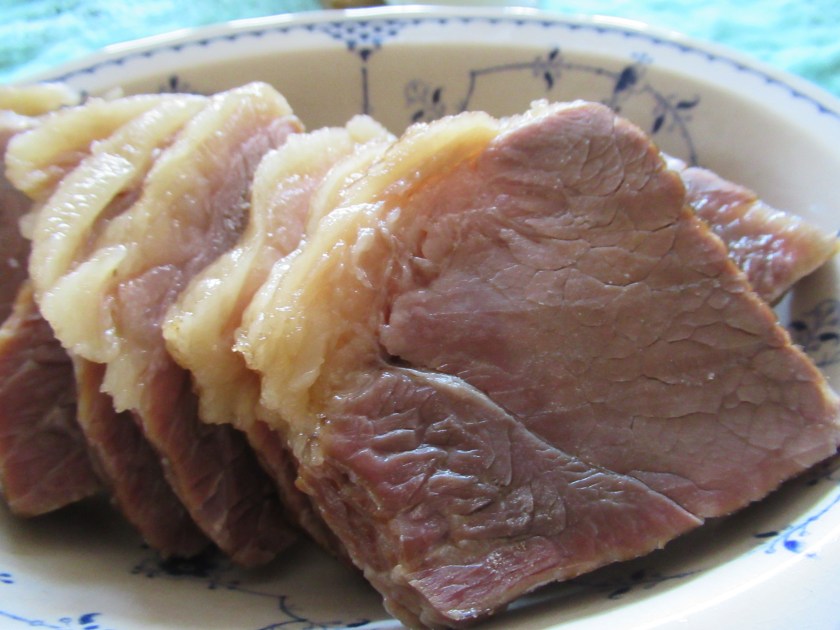
Since this recipe does not include the spices of the more common corned beef, the result tastes like nicely salted roast beef- quite delicious. Other colonial recipes suggest adding various spices when boiling the beef, but I didn’t have a chance to try those. Perhaps next year.

In the meantime, I’ll keep my Irish (American) tradition. Erin go bragh (Éirinn go Brách)!

 

Irish Mysteries: The Proleek Dolman

A  Megalithic Portal Tomb

cr. at Proleek Dolman

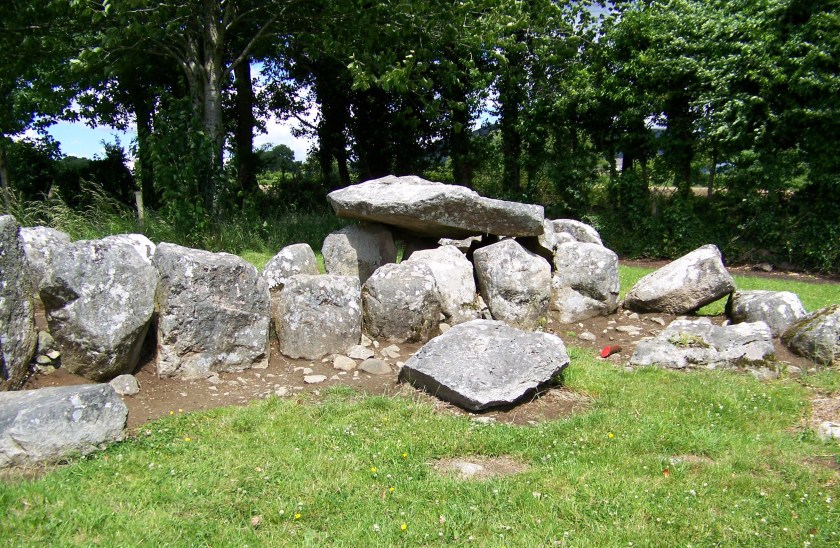
With the coming of St. Patrick’s Day, March is the perfect month to celebrate all things Irish. Though perhaps most famous for the saint that drove away the snakes, Ireland has far more ancient mysteries, including nearly 200 portal tombs, often called dolmens or stone tables. Dolmens usually have three or more standing stones with a (more or less) flat capstone resting on top. Usually two of the standing stones form a portal to the inner chamber. Some evidence suggests that the standing stones and table stone were originally covered with a cairn of smaller rocks, so what we see today is only the skeleton of the neolithic structure.

These neolithic monuments are found in Europe, Africa, and Asia. Like the more famous Stonehenge, the massive stone pillars inspire awe and wonder in the millennia since they were built. Why were they built? How were they built? Who built them? For the most part, these  questions remain unanswered. No one knows for sure why the dolmens were built. Many archaeologists consider these monuments to be single-chamber, megalithic tombs, but there is insufficient evidence to be sure. A more intriguing, those less scientific explanation can be found in many legends that have been told explaining the dolmens, including stories of giants buried there, sleeping on top, or using the table stone as a griddle.

One delightful example is the Proleek Dolmen found on the grounds of Ballymascanlon House Hotel in County Louth. This dolmen was built around 3000 BCE. Its portal stones are about 3 meters high, and the capstone weighs over 35 tons. The portal faces westward, toward Slieve Gullion, so that at the summer solstice it is facing the sunset behind the mountain.100_6095

Why it’s called the Proleek Dolmen is another mystery. References to this monument in 1895 call it the Puleek Cromleach or Puleek Dolmen. The Irish name is Dolmain Phrollig. One nickname is the Giant’s Load. According to legend, a Scottish giant called Parrah Boug MacShagean carried the stone here. Para challenged the famous Irish hero, Fionn mac Cumhaill. Always more ready to trick his opponents than fight them, Fionn poisoned the Flurry River which runs nearby. Para drank from it and died, leaving Fionn the victor. The legend claims that the Scottish giant was buried in the wedge tomb found about 80 meters from the Dolmen.

100_6089.jpg
Wedge tombs were generally built 500 to 1000 years after the portal tombs and are unique to Ireland. The wedge tomb here runs west to east. The tomb is formed by two rows of large stones, decreasing in width and height to form a wedge.  A single roof stone remains, capping the east end of the tomb. Though not as impressive as the portal tombs, the wedge tombs are still a marvel of neolithic engineering. They are the last of the great megalithic tombs built in Ireland.

Finding the Proleek Dolmen can be an adventure. With little fanfare and few signs to guide the visitors, this 5000 year old monument to human ingenuity sits in a small clearing on the estate grounds. I’ve been to see the Proleek Dolmen a couple of times on my visits to Ireland, since it is in the same county where my Dad lived. The most recent was a visit with my three sisters. We arrived on a rainy afternoon after a stressful encounter with Irish roads and ditches.  


Golf ball warning

We arranged for both tires on the rental car to be replaced, indulged in a restorative cup of tea in the hotel dining room, then ambled out through the rose courtyard, through a cattle gate, and alongside the fairway of the hotel golf course (where the intrepid tourist must beware of stray golf balls.).

The rain let up by the time we reached the dolmen in a little clearing in the Irish countryside. Legend says that whoever throws a pebble on top of table stone and gets it to stay there, will either (depending on the version) marry within a year or have good luck. Since my sisters and I are already married we hoped for the luck. All of us managed to get the rock to stay on top, though it took me three tries. Perhaps that’s enough to guarantee continued good luck.

7.1.10 Proleek Dolmen.23

Lucky or not, the dolmen is worth the visit. Touching stones lifted into place by nameless hands centuries ago gives a profound sense of awe. Did they mourn for their loved ones? Did they believe the dead would live on, perhaps in a better place? There are no answers. Those who were buried beneath the stones, those who built the tomb, those who loved and cared for the dead are all gone now, unknown and perhaps unknowable. Yet the tomb remains, a mystery and an inspiration.


Thoughts on Remembering

Children’s Crusades and the Impact of Historical Fiction

My enchantment with historical fiction goes way back. The first real chapter book I remember reading was called A Boy of the Lost Crusade by Agnes Danforth Hewes. It was a long book, very long for a second grader–279 pages. It had a reddish brown hard-cover and a picture of a boy in a ragged tunic with a red crusader’s cross on it. Inside were just words, no pictures. In fact, my teacher told me it was too hard for me, which made me want to read it all the more.  And read it I did, starting a lifelong interest in the genre.

There is a lot I don’t remember about the book. The main character’s name is gone. The details of where in France (or was it Germany?) he started, exactly when the crusade occurred, and how the story ended have all slipped my mind in the 50+ plus years since I first read it. Actually, I even mis-remembered the title, thinking for years it was called Children of the Lost Crusade. (Perhaps because in my mind, I always became the main character in the book I was reading, and so I subconsciously remembered it as the story of a girl.)

What is more amazing is how much I do remember from this very first real book.  I remember being fascinated with the idea of children going on a crusade, and realizing it had really happened. I remember wondering why it was so important to ‘take back’ the Holy Land. I remember seeing slavery in a new light, understanding for the first time that many different people had been enslaved in many different places. In the parts of plot I do remember, the main character was headed toward the holy land toward a port in Italy with hundreds of children from all over Europe.They were cheated by a ruthless ship captain who sold them into slavery. The leaky ship wrecked somewhere in the Mediterranean, maybe Northern Africa or the shores of Jordan perhaps. At age 7, I had no idea these places even existed before  reading this book. Most of all I remember being carried away on that ship, agonizing over the boy’s fate, and feeling totally immersed in another time and place.

I’m not sure I would still like the story. The style of writing from 1923 is slower and less culturally sensitive than styles today. But in second grade, the story fascinated me–so much so that I remember the the book (or at least parts of it) decades later.  I began a quest to find out more about the past and the people who lived in it. My first novel (A Mistake of Consequence) explores the idea of forced indenture in the American colonies. A different time period, to be sure, but still another look at how people throughout history have forced others to work for them. I am still intrigued by how people lived and what they thought. I see so many connections between what happened ‘back then’ and what happens now. People of long ago fought over religious issues (some of the same ones) and struggled for power both in their personal lives in the political world. Mothers and fathers worried about caring for their children. Children got into mischief. Everyone needed to find food and shelter and avoid the bad guys, whoever they were. The solutions to the problems of long ago differ from today, but the problems are much the same. Both the solutions and failures of our forebears can help us learn to navigate the complexities of life today.

This all goes to say, historical fiction is valuable. For me, it opened new ways of looking at the world. With historical fiction, I do indeed live in interesting times…a lot of interesting times.

On Hedgehogs and Subtleties

Whether you call them hérisson (Fr.) or igel (German), sündiznó (Hungarian) ,or yrchouns (Middle English), hedgehogs are terribly cute. Of course, they haven’t always been regarded as such. Like guinea pigs and rabbits, this enchanting little creature has been considered a delicacy for the table. In fact, some evidence points to 8000 years ago, when roast hedgehog was served to the rich. In medieval times, the cook was advised to put a reluctant hedgehog in hot water to make it unroll so it could be properly cut open, cleaned and roasted.

That has changed. Perhaps it was because hedgehogs are so prickly, or perhaps it was that the medieval cooks loved subtleties (foods cooked to look like something else, serving also as table decorations). In any case, roasting actual hedgehogs became less popular among the elite, and hedgehog-themed foods took the animal’s place on the table.

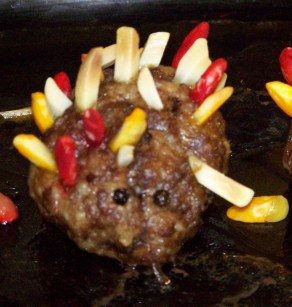
My first encounter with a hedgehog subtlety was years ago, cooking for a medieval feast in the Society for Creative Anachronisms.  The recipe, called hedgehogs or yrchouns was a sort of glorified meatloaf/meatball stuck all over with almonds.

The original recipe:  Yrchouns. Take Piggis mawys, and skalde hem wel; take groundyn Porke, and knede it with Spicerye, with pouder Gyngere, and Salt and Sugre; do it on the mawe, but fille it nowt to fulle; then sewe hem with a fayre threde, and putte hem in a Spete as men don piggys; take blaunchid Almaundys, and kerf hem long, smal, and scharpe, and frye hem in grece and sugre; take a litel prycke, and prykke the yrchons, An putte in the holes the Almaundys, every hole half, and eche fro other; ley hem then to the fyre; when they ben rostid, dore hem sum wyth Whete Flowre, and mylke of Almaundys, sum grene, sum blake with Blode, and lat hem nowt browne to moche, and serue forth                 (Harleian Manuscript 279, c. 1430)

This recipe seems to be a variation from the French cookbook, Le Viandier de Taillevent. In that recipe, no almond spikes are included. Rather the rounded, stuffed sausage looks like a hedgehog without spines.  (Yrchoun is an anglicization of the French hérisson.)

hedgehop crop

My version:

2 lb. ground meat 
2 t. Ginger
1 t. mace
1 t. Salt
½ c. breadcrumbs
1 egg
Slivered almonds, raisins, food coloring

Mix the first 6 ingredients  and 
form into oval shaped balls. 
Color some of the almonds red and 
yellow with food coloring.Stick the almonds into the balls to resemble spines. Add 2 raisins for eyes. 
Bake 350 degrees about 30 minutes. 

Notes: Other recipes for hedgehogs suggest other meats,(ie mutton) which is why I use a mixture of pork and beef. I add breadcrumbs and egg to hold the mixture together more like a meatball, though neither is suggested in the original. (The French recipe calls for soft cheese for binding.) Spicerye just means spices, so which spices are added is up to the cook. I use mace as fairly common medieval spice added to ginger in meats. I leave out the sugar since it really isn’t necessary. Raisin eyes are not documented as period correct, but the French recipe does include raisins in the mixture.

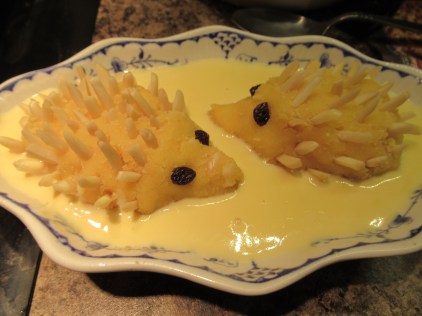
Having enjoyed medieval meatball hedgehogs for years,  was recently astounded to see a completely different sort of hedgehog recipe in colonial and early American cookery. In the 1805 version of The Art of Cookery Made Plain and Easy, by Hannah Glass, there is a recipe for an almond paste hedgehog (a dish which in my mind is neither plain nor easy if the ‘marzipan’ is done by hand.)

Take two pounds of blanched almonds, beat them well in a mortar, with a little canary and orange-flower water, to keep them from oiling. Make them into stiff paste, then beat in the yolks of twelve eggs, leave out five of the whites, put to it a pint of cream sweetened with sugar, put in a half pound of sweet butter melted, set it on a furnace or slow fire, and keep it constantly stirring, till it is stiff enough to be made in the form of a hedgehog, then stick it full of blanched almonds, slit and stuck up like the bristles of a hedgehog, then put it into a dish; take a pint of cream, and the yolks of four eggs beat up, sweetened with sugar to your palate. Stir them together over a slow fire till it is quite hot; then pour it round the hedgehog in a dish, and let it stand till it is cold, and serve it up. Or a rich calf’s-foot jelly made clear and good, poured into the dish round the hedgehog; when it is cold, it looks pretty, and makes a neat dish; or it looks pretty in the middle of a table for supper .     (Glass, 185)

For modern cooks, a half recipe should suffice and still allow you to serve an impressive, delicious and decorative dish to the table.I kept the full amount of custard since it is such a delicious addition to the hedgehog. My adaptation for modern cooks is as follows

hedgehogs in custard
‘Marzipan’ Base:
1 lb almonds
1/2 c. Sherry
1 T orange extract
¼ c. sugar (more if you like a sweeter confection)
3 whole eggs
3 egg  yolks
¼ lb butter
½  pint cream
Decorations:
Slivered almonds
Raisins 
Custard sauce:
1 pt. Cream
4 egg yolks
¼ c. brown sugar

Blanch the almonds (Put raw, whole almonds in boiling water. Boil for 2 minutes. Drain and cool.  Squeeze or rub the almonds to pop them 
out of their skins.) and crush them to paste, adding the sherry and 
orange extract gradually. Put the almond mixture and remaining base 
ingredients in a saucepan. Cook over medium heat until it is stiff 
enough to mold.
Make into small oval shapes resembling hedgehogs- approximately ½ c. mixture for each one.
Set each in a custard dish or plate with a lip. Add raisins for eyes, and slivered almonds for spines.

To make the custard,
Mix the cream, egg yolks, and brown sugar. Cook over medium heat, 
stirring constantly, until thickened. Do not boil.

Pour the warm custard into each dish with the hedgehogs. Serve warm 
or chill and serve cold.

Notes:

Hannah Glass’s recipe is obviously designed for a wealthy home, with a large kitchen staff. Pounding the almonds in a mortar is difficult and time consuming. Whole blanched almonds are as slippery as real hedgehogs, and are as likely to pop out of the mortar and go flying as they are to be crushed.  I found chopping them first made it much easier. But crushing them is still time consuming. The modern cook can use a food processor to get the same effect. I ended up with a sort of crunchy paste, similar to crunchy peanut butter, but drier and finer. More pounding or processing may have made a smoother paste, but I was running out of time. For a smoother dish, the modern cook could purchase marzipan paste.

It is possible to get or make orange flower water (distilled from orange petals) but I substituted orange extract.

Canary is a sweet wine from the Canary Islands. I used sherry as a reasonable alternative.

Not surprisingly, hedgehogs continue to inspire. Pinterest boards abound with ideas for hedgehog crafts, cards, and cakes.  In fact, I made a hedgehog cake for my daughter-in-law’s baby shower.

hedgehog-cake.jpg

Though thoroughly modern in taste and ingredients, this hedgehog unwittingly carries on the medieval tradition of the subtlety. Food for show? Absolutely. We’re not so far from those lords and ladies of old trying to impress their guests. And who doesn’t like hedgehogs?

SNOW FALLING ON CEDARS: A Review

20180125_160746On a bleak winter’s day in January, nothing beats curling up with a cup of hot tea and a good book. Snow Falling on Cedars, by David Guterson, is a perfect choice for metaphorically shivering in your cozy chair.

The story takes place in the ironically named town Amity, on an island in Puget Sound off the coast of Washington in 1954, nine years after the end of World War II. It soon becomes apparent that the war and its consequences still haunt the islanders. Kabuo Miyamoto, an American of Japanese ancestry, is on trial for the murder of his fellow veteran and neighbor, Carl Heine. The trial, held during a December blizzard, reveals deep prejudice between the islanders of European/ German descent and those of Japanese descent. Their scars barely hide the festering wounds and smoldering resentments from war-time activities.

Through flashbacks skillfully woven into the trial narrative, Guterson takes readers back to the war years when the Japanese American citizens were rounded up and sent to Manzanar. Gradually we learn how Kabuo’s and Carl’s lives intertwined around seven acres of disputed strawberry fields. And we watch with sympathy as their high school classmate, Ishmael, an embittered, one-armed war hero-turned-journalist, struggles with his demons from the past, including his never-forgotten love for Kabuo’s wife, Hatsue. Suspenseful, poetic and well-plotted, Snow Falling on Cedars, is at its heart, also a love story, where love and hate  are two sides of the same coin.

With superb, evocative writing, Guterson takes us on a roller coaster ride, making us question our own convictions and prejudices as we consider Kabuo’s guilt or innocence. Guterson’s vividly portrayed characters reveal a community deeply divided by cultural rifts and mutual suspicions. Like To Kill A Mockingbird, another famous novel revolving around a trial, Snow Falling on Cedars examines  themes of prejudice, justice and personal integrity, with a deep understanding of the human heart and its weaknesses. It “portrays the psychology of a community, the ambiguities of justice, the racism that persists even between neighbors, and the necessity of individual moral action despite the indifference of nature and circumstance”(from dust jacket blurb), and makes us realize that love, chance, and accident all play a part in the universe of humanity.

This is historical fiction at its best, with solid research backing the story and nuanced characters so real they could be our own neighbors. Even though 1954 and WWII were before I was born, even though I’ve never gone gill-netting in the Pacific Northwest, or dug goeducks on a beach, or sheltered in a cedar tree in the rain, Guterson’s writing transported me to another time and place. This is a book is bound to be a classic, well worth reading and re-reading.

On Silver Linings

IMG_3832Part 2: Train wrecks

Remember Pollyanna? The girl who saw the good in every bad situation? I have been accused of being too much like her. I see adventure even in adverse situations more than I see the trouble. Take for instance, my luck with train travel. I’ve had three journeys that while memorable, were not ones I would ever want to repeat.

My first bad experience with a train was in Scotland. My at-that -time fiance and I were stranded in Loch Ness on New Year’s Day, 1976. (Why we were stranded is a story for another day). The train station was closed most of the day, and we had no place to stay except the sitting room of a B & B where we had spent part of the night. (We had to check out by 10 am and there were no other rooms available.)  When the train station finally opened in the late afternoon, we took the first train to Edinburgh. The train was not crowded and the compartments would have been comfortable, except there was no heat on the train. January in Scotland is cold. Very cold. Ice on the inside of the windows cold. Luckily, we traveled with a sleeping bag, under which we shivered all the way to Edinburgh.

Worse than a frigid ride are the wrecks. I’ve been in two, whIch I think far more than my lifetime allotment. (If bad things come in threes, than I’m safe, right?)

The most recent took place in 2014 in Tiffany Bottoms Wildlife Area, along the Chippewa River near Durand.  This stretch of track was built in 1882 to haul lumber to the Mississippi  River. For 14 miles, the rails run through a lush green corridor of marsh, wetlands, meadow, and bottomland forest. A winter derailment in 1977 caused the Chicago, Milwaukee, St. Paul and Pacific Railroad to abandoned the line. In June of 1979, NSP (now X-cel Energy) bought the track for possible future use, but didn’t actually use it. The tracks fell into disrepair, and some bridge sections collapsed. In 1995, a local group of rail enthusiasts founded the Chippewa Valley Motor Car Association to maintain and use the tracks for private interests. In an ingenuous use of resources, cars that had been used by maintenance workers were put to work hauling tourists, bird-watchers and nature lovers on 20 mile (out and back) trip through the Tiffany Bottoms, which is part of the Chippewa River Delta, the largest river delta in the Midwest.

The day Mike and I took the trip was a crisp, fall day with the sumac turning. Puffy clouds drifted across a deep blue sky. The train itself had a little gas-powered engine at each end, and open cars with back to back benches in between. We chugged along slowly on the way out, stopping frequently to take pictures and listen to the naturalist explain the history of the area. The excitement came on our return when the train hit a tree that had fallen on the tracks after our passing. Seated near the front of the second car, I saw the tree about the same time the engineer did. I also saw that we weren’t going to stop. Hand brakes, metal wheels on metal tracks, and stopping distance all combined to mean the crash was inevitable. At first I thought the train would break the fallen tree. Instead, when the engine hit, the tree bent. In a flash, I knew it would snap back with tremendous force. Instinctively I ducked. Half a second later a four inch log hit my head, skittered across Mike’s back and slammed into the people in the next car. At least two people tumbled off the train into the brush. Amid the screams of the passengers, the train screeched to a halt. Shaking, we disembarked to help the injured and assess the damage.

The conclusion? It could have been far, far worse. No one was seriously injured, though one man probably needed a few stitches in his cut lip. I had a mild headache, but no concussion, just a new story to tell.

Far worse than this mild catastrophe, was the wreck of the California Zephyr in 1982. My family (husband, and two toddlers) boarded the train in Iowa, heading toward California for my brother’s wedding. We had a sleeper berth on the upper floor and bedded down right after boarding with my husband and our 3 year old son on the top bunk, and me and our 1 year old daughter on the bottom.

Several hours later I was wakened by a tremendous crashing, a terrible lurching, and the thump of something hitting my back. As the train tilted over, I was desperately afraid I would crush my daughter.  Fortunately for all of us, that didn’t happen.

We soon determined that our car was half submerged and all exits blocked, but everyone on the floor below was safely brought upstairs. For three hours we sat in semi-darkness, waiting for dawn and rescue, which eventually came in the form of a boat. We learned there had been a flash flood that washed out the bridge, causing the the derailment. As dawn broke, we saw the water swirling below our window on the tilting train car and a helicopter with a net hovering downstream, presumably to rescue anyone swept away in the flood.  

So what’s good in all this? Well, I believe that any experience a writer survives is good in the long run because it provides new dimensions and new perspectives. I can write more realistically about a train crash in a flood because I’ve been in one. Less specifically, but just as important I can write about the confusion of waiting for rescue, the fear of not knowing what is going on, and the heart-warming gratitude toward strangers who remembered to bring diapers to the Red Cross shelter.

Pollyanna? Maybe, but I prefer to think of it as using the lemons to make lemonade.

Riding the rails

cropped sepia tracks      The Holiday Train

One of my earliest memories is riding the upper deck of a passenger train from San Bruno, California to San Francisco. I must have been about 6 or 7. Mom put me on train in San Bruno and my Aunt Betty picked me up at the end of the line in San Francisco. I don’t remember for sure, but I think one or two of my little sisters came along. I mostly remember how grown up I felt sitting in the fancy seat, and watching the hills fly by.

I still like train travel. It’s more  comfortable than flying, more elegant than a bus, and more relaxing than driving. Over the years since that first experience with trains I’ve had a many memorable train trips. I have taken the bullet train in Japan, and the Train de Gran Vitesse in France, a Jacobite steam train in Scotland, and Amtrak in the United States.

It’s a good thing I like trains, because the tracks in Winona run through my backyard.  When my kids were little, we made a game of watching the trains (from a safe distance). To this day, freight trains clank and screech as they park just beyond bedroom window. They shake the house and rattle the windows as they rumble past.

Trains are a part of life in Winona, a town divided by train tracks. Getting from one place to another almost always involves crossing the tracks. That makes for a good excuse for being late, but a lot of people (myself included) get annoyed when they have to wait for a train.

The one train no one minds waiting for is the Canadian-Pacific Holiday Train. For the past nineteen years, this fabulous train has criss-crossed the US and Canada bringing holiday cheer as they raise support for local food banks. Over the years, they have raised C$13 million and four million pounds of food for food banks across North America.  It’s a tradition in Winona I’ve grown to love.

This year, the train was due at 4:00 on December 8. Since the weather was so nice, I decided to walk to the station, only about a mile from my house. Families lined the tracks watching for the train. Children craned their necks and (mostly) minded their parents to stay off the tracks.

At last the train, ablaze with holiday lights, roared into the station, where hundreds of Winonans had gathered, munching cookies and sipping hot chocolate.  The doors of the freight car rolled open and the band began to play. The audience clapped mittened hands and stomped boots on frozen ground as we sang along to Jingle Bells, Up on a House Top and other Christmas favorites. Fog rolled from the train car-turned stage and red and green laser lights flashed.  Some years the fog comes from the singers’ breath and the musicians have had to play with frozen fingers, but this year we enjoyed a balmy 34 degrees. For 15 minutes we rocked-and-rolled Minnesota style. Then the band waved goodbye, the freight doors shut and the train chugged out of town.  

Volunteers gathered up the food and money donations and cleared away the hot chocolate and cookies. Slowly the crowd dispersed, the streets emptied and the dark, quiet of a December night returned.

Until the next train rolls through!

Downtown

20171207_142604.jpg

The concept of downtown started in New York and spread across North America in the 19th century. It designated the historical core and main business area of the city, (which was called city centre in Britain and Ireland). Throughout the 19th and early 20th centuries, downtown was indeed the place to find all the people, as the song claimed,, along with the best department stores, theatres and clubs. Downtown was where all important business took place. Skyscrapers grew. and shoppers thronged the streets. Transportation in the form of street cars, buses and trains converged near downtown, where most people lived, worked and played.

However, downtown today isn’t what it used to be. By the early decades of the 20th century, decentralization began changing the downtown areas of most cities. People began moving out to the suburbs. Department stores and other shopping venues moved out to malls. Businesses moved to the outskirts where land was cheaper. And museums and other cultural institutions moved away from the historic enter for room to spread out. Many modern downtowns, especially in bigger cities, are now filled with offices for white collar workers.

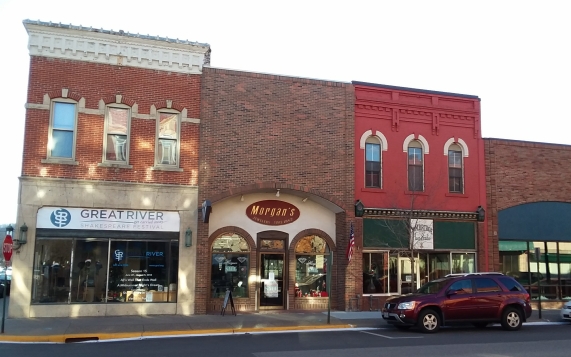
In spite of all these changes, some of the glory of those vibrant downtowns of long ago remain, especially in the architecture.  Winona, Minnesota is a case in point. Like most small towns in the midwest, Winona has a downtown area of several blocks which are considered the city center. In the century and a half since its founding, the area has undergone many changes, but it is still possible to find the beauty and craftsmanship of the older city. At least seventeen buildings on 2nd and 3rd streets have been listed on the National Register of Historic places.

It may be cold, but December is a great time to appreciate the downtowns of yesteryear. In Winona the holidays encourage the old-fashioned habit of window shopping. Like stores from the 19th century, many Winona store fronts decorate for Christmas, with displays ranging from the cute and whimsical to to nostalgic.

While many of the 19th and 20th century buildings have been altered at street level, the upper stories retain much of their original characteristics. Year-round, Winona’s downtown can best be appreciated by looking up.  Many buildings have the date of construction and the original owner’s name written in ornate lettering.

Upper-story windows often have intricate and ornate brickwork designs. Rooflines design and decoration is another example of quality 19th century workmanship. Though fewer in number, Winona’s rooflines and decorations rival those of bigger cities in the US and Europe.

The Choate building opened in 1888 as a grand department store.

I’m no singer, but like Petula Clark, I urge you to head downtown, wherever you live. Take the time to stroll along the sidewalk, put away the phone and the to-do list, and look up. Who knows what delightful surprises await?


On Pumpkins

pumpkin-raw.jpgEven more than apple pie, the pumpkin is symbolic of early America. Before Europeans landed, Native Americans used pumpkins for both food and medicine. Indeed, early colonists from England found pumpkins so important that one of the earliest folk songs from the colonies satirizes the ubiquitous pumpkin in the oft-quoted pilgrim verse from c. 1630.
…Instead of pottage and puddings and custards and pies, Our pumpkins and parsnips are common supplies; We have pumpkin at morning and pumpkin at noon; If it was not for pumpkins we should be undone. If barley be wanting to make into malt We must be contented and think it no fault For we can make liquor, to sweeten our lips, Of pumpkins and parsnips and walnut-tree chips…” (1).

Of course, the neither the Native Americans nor the first settlers had wheat flour or sugar for making the familiar pumpkin pie. Pumpkins were baked, boiled, or roasted sometimes stuffed. These earliest pumpkins were not always the round, orange pumpkin we see today, but a variety of shapes and colors, much like other squash varieties.

By the 18th century, many of the traditional food stuffs from Europe were readily available and so were incorporated into pumpkin usage. Samuel Peters, writing in 1781, talks about marigold-colored pumpkins as large as 60 pounds. He writes,

The pumpkin or pompion is one of the greatest blessings… Each pumpkin contains 500 seeds which, being boiled to a jelly are the Indian infallible cure for the strangury. Of its meat are made beer, bread, custards, sauce, molasses, vinegar, and on thanksgiving days, pies, as a substitute for what the Blue Laws brand as antichristian minced pies” (2).

Peters also claimed the pumpkin shell was good for making a cap by which to cut hair and also good for making lanterns. (3)

In spite of Peters’s glowing praise for the pumpkin, by the eighteenth and early nineteenth century it seems to have settled into the role of pie more than anything else. Cookbooks from the period often contain receipts for pumpkin pie, but rarely other ways of preparing pumpkin. The standard puimpkin pie, a custard made with mashed pumpkin, eggs., milk and seasoning, is much like the pie we know it today. Receipts for pumpkin pie or pudding from the late colonial and early revolutionary period differ primarily in proportion and the exact variety of spices recommended.

For instance, Hannah Glasse uses  1 pint of stewed pumpkin to 1 pint of milk, 1 glass of malaga wine, 1 glass of rose-water,  7 eggs, ½ pound of butter, one small nutmeg, and salt and sugar to taste (4).

Amelia Simmons has receipts for two versions of a pumpkin pie. The first uses 1 quart mashed pumpkin, 3 pints cream, 9 eggs, sugar, mace, nutmeg and ginger in a crust, with bits of pastry on top. Her second recipe calls for 1 quart of milk, 1 pint of pumpkin mash, 4 eggs, molasses, ginger and allspice (5).

Simmons does have a variation using both apples and pumpkin for a pudding thickened with breadcrumbs and a bit of flour and seasoned with rose-water, wine, sugar, nutmeg and salt. She says to use 1 large squash and 6 apples to ½ pint cream  and 5 or 6 eggs. (5)

Mary Randolph’s pumpkin pudding adds 6 eggs to ½ pint of milk, with nutmeg, ginger wine for seasoning, sugar to taste and baked in a crust with bits of crust on top (6).

Am anonymous lady of Phildadelphia only offers one pumpkin recipe in her seventy five receipts. She directs cooks to use 1 quarter pound of stewed pumpkin with 3 eggs, a quarter pound of butter or cream, a quarter pound of sugar, a half glass of wine and brandy mixed, a half glass of rose water, and a teaspoon of mixed cinnamon, nutmeg and mace, poured in a pastry lined dish and sprinkled with sugar before baking (7).

Mrs. Child’s recipe assures cooks that 3 eggs to 1 quart of milk works very well for a common family pie, though even one egg will do. She says to remove the seeds but not scrape the pumpkin before stewing. The pie can be sweetened with molasses or sugar, and seasoned with salt, cinnamon, and ginger, and perhaps a bit of lemon peel. Ginger alone will suffice if there is enough of it.  She does say the more eggs used, the better the pie (8).

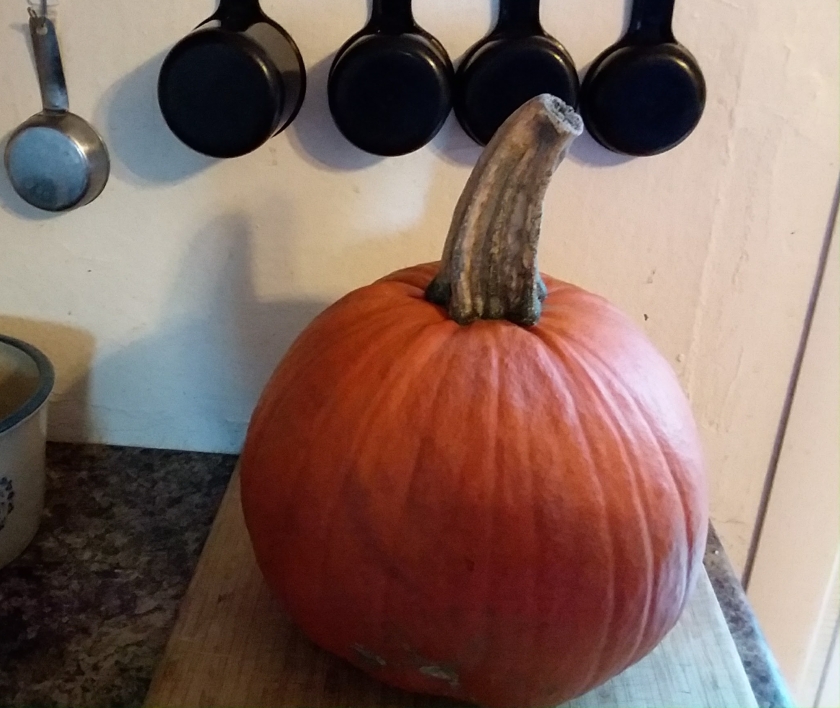
Surpisingly, only Mrs. Randolph offered a recipe for fixing pumpkin in a different way.Her recipe for ‘Potato pumpkin’ makes a striking dish to bring to any fall table. (I have no idea why she calls it potato pumpkin. The recipe has no potatoes whatsoever.)

Potato Pumpkin

Get one of a good colour, and seven or eight inches in diameter; cut a piece off the top, take out all the seeds, wash and wipe the cavity, pare the rind off, and fill the hollow with good forcemeat–put the top on, and set it in a deep pan, to protect the sides; bake in a moderate oven, put it carefully in the dish without breaking, and it will look like a handsome mould… (6).

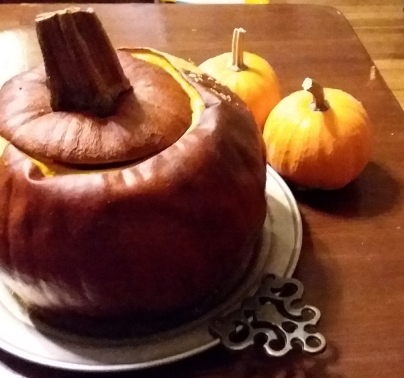
To modernize this recipe, I first had to research forcemeat. I found several receipts using veal, pork, or even fish, all bound with suet. Because veal and suet are hard to get in my town (make that impossible), I used a combination of ground pork and ground beef, seasoned with the spices suggested by Mary Randolph. Since paring a pumpkin is quite difficult, I pared only half the pumpkin before cooking to see if that step was necessary. The pared side developed a thicker outer surface that I found too dry. The unpared side was easier to scoop and held its shape better. The end result was quite tasty and made a great dinner center-piece.

Here is the modernized version of Potato Pumpkin.

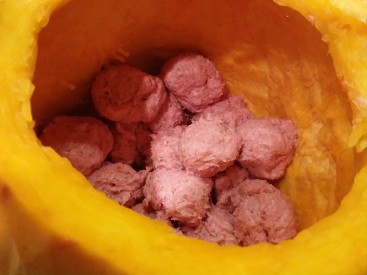
pumpkin hollow with raw meat
Before cooking
  • 1/2lb. ground pork
  • ½ lb. ground beef
  • ⅓ c. shortning
  • 1/1 t. nutmeg
  • 1 t. salt
  • ¼ t. mace
  • ½ t. pepper
  • 2 t. lemon rind, grated
  • 1 T. parsley
  • 1 t. dried basil, crushed
  • 1 egg.
  • 1 small to medium pumpkin

Put all ingredients except the pumpkin in a food processor and grind to a smooth paste. (This can be done in a mortar, but that takes a  long time.)

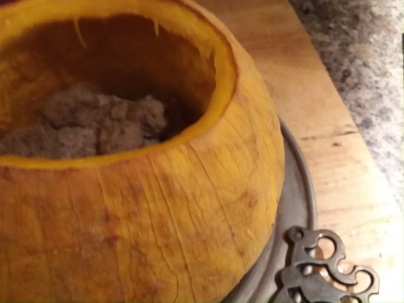
Cut off the top of the pumpkin. Remove seeds, scrape out the hollow, and rinse it. Form the forcemeat into small balls the size of walnuts, and place inthe cavity. Put the top back on the pumpkin and bake at 350 degrees. When it is done, a fork will easily puncture the pumpkin, and a meat thermometer placed in the center of a meatball will register 170 degrees. This took two hours for an eight inch pumpkin. 

best cooked picture

To serve, scoop out a portion of the pumpkin along with the meatballs. This makes a great conversation piece, as well as a very tasty meal for four.whole-pumpin-to-serve-e1512158763701.jpg

Notes: 

  1. Forefather’s Songs: New England’s Annoyances…Source: The Annuals of America: 1493-1754, Discovering a New World. Vol. I. Mortimer Adler, Ed. London: Encyclopedia Britannica, Inc., 1976. Print Retrieved from  Masterpieces of American Literature
  2.  Peters, Samuel. A General History of Connecticutt by Samuel Peters, 1781 republished new Haven, D. Clark  and Co. ,1829  Retrieved from google books
  3. Strangury is a painful blockage of the bladder
  4. Glasse, Hannah. The Art of Cookery. First published in England in 1747, 1st American edition Alexandria: Cottom and Stewart, 1805. 138.
  5. Simmons, Amelia. American Cookery. 1796. 27-28.
  6. Randolph, Mary. The Virginia Housewife Or, Methodical Cook. Washington, 1824. 127, 109, 91.
  7. A Lady of Philadelphia. Seventy-five receipts. Boston: Munroe and Francis: 1828. 21-22.
  8. Mrs. Child. The American Frugal Housewife. Boston: Carter, Hendee and Co., 1833 (12th edition, first published 1828) 66-67.

Crocodile on the Sandbank: A Discussion

UnknownOne of the best gifts  is a good book. The trouble is, picking a book for a fellow reader can be tough. It’s hard enough to keep track of what I’ve read, let alone remembering what my sisters, my children and my friends have on their shelves.  One option is to buy new, just-published works. That’s a great idea, but if I take time to read the new book to make sure it is what the recipient would like, it’s not new any more.

So another option is to share great books from the past. One such book, well worth re-reading is Elizabeth Peters’ Crocodile on the Sandbank, first published in 1975.

This delightful historical mystery is the first in Peters’ Egyptian series. Set in the Victorian Era, the novels follow the adventures of the formidable Amelia Peabody, a woman firmly  grounded in the expectations of her day, but so full of self-confidence that she blithely disregards any convention not suited to her own ideas.

Readers first meet Amelia Peabody in Crocodile on the Sandbank. Having inherited  a surprising fortune when her father died, Amelia decides it is high time she travels to all the places her father had studied.  In Rome, she meets, and rescues a young woman, Evelyn.

Together the two women travel to Egypt and eventually arrive at an archeological site where the Radcliffe brothers, Emerson and Walter are working.  While Walter and Evelyn begin falling in love, Amelia and Emerson seem determined to out-shout each other. Meanwhile, several accidents and a wandering mummy threaten Evelyn’s safety.

Told in the witty, sardonic voice of Amelia, who is never wrong and unfailingly ready to act, the story is not only a great mystery, but also a romantic romp into the straight-laced Victorian world. Peters pokes fun at the stereotypes of Victorian England at the same time she present fully rounded, memorable characters.Amelia considers herself the very model of a perfect gentlewoman, the equal, or rather the superior to any man. With her sturdy umbrella and her unfailingly self confidence, Amelia is equally at home  serving tea or fighting villains. And Emerson, blustering, full of life, a character to rival Indiana Jones, is equally lovable.

One thing I really appreciate in historical fiction is accuracy. Peters is a master at showing the British empire in the late 19th century and is a respected Egyptologist in her own right. She weaves details of real people into the narrative and accurately presents the state of museums, artifacts and archeology in Egypt at the turn of the last century. Although her writing never feels like a textbook, I always come away with the satisfaction of having learned a great deal.

There are twenty books about Amelia Peabody, with the most recent and unfortunately last in the series, A Painted Lady, just published. Though the characters age throughout the series, each one works as a stand-alone mystery. So whether your friends and family go in for old books or new, Elizabeth Peter’s Amelia Peabody series makes a great gift.