Wind Power

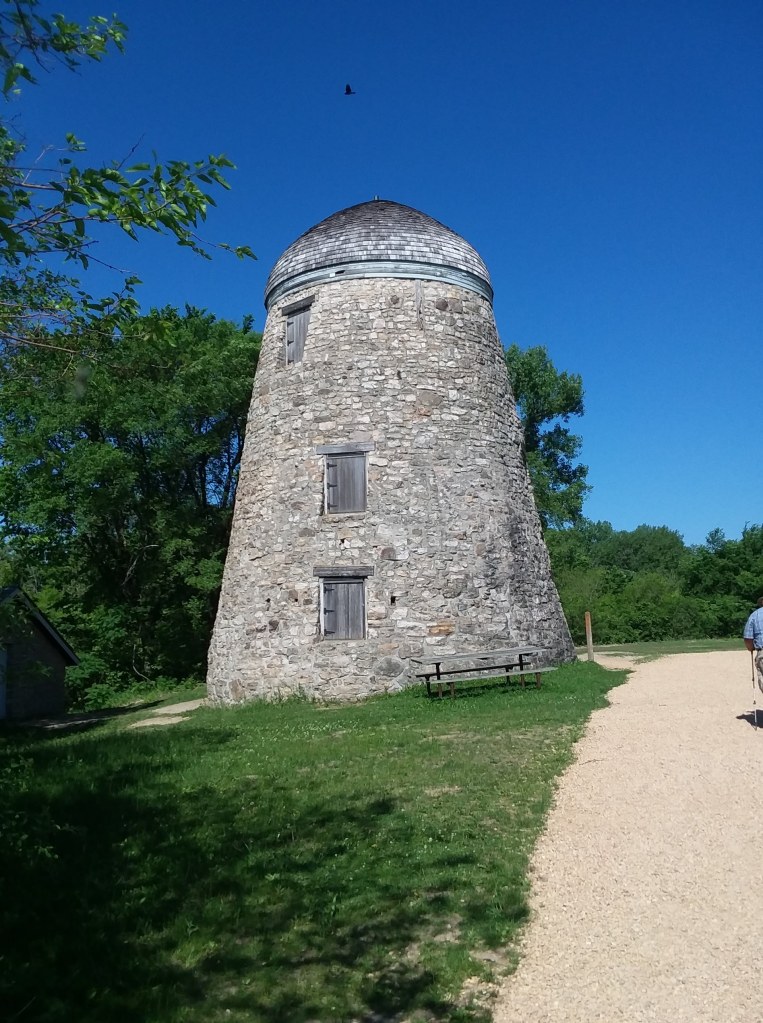
Seppman Mill, Minneopa State Park, MN

“Who has seen the wind?” Christina Rossetti asks in her famous poem. “Neither you nor I,” she answers. It’s true we can’t see the wind itself, but we can certainly feel it.  Whether it is a gentle breeze bringing cool relief, or a violent tornado ripping through town, that unseen wind has power. Not surprisingly, people learned to harness wind power for their own purposes many centuries ago. 

 My own fascination with windmills began when I was a child, watching Chitty Chitty Bang Bang. How exciting to actually live in a windmill! I could only dream about such an opportunity. Later I read about Don Quixote in his hopeless quest, tilting at the great giants. The windmill seems to be a romantic symbol, recalling bygone days as well as the relentless march toward the future.

Persians made the first known windmills around 500 CE, for milling grain and pumping water. Even before that, circa 2000 BC, Hammurabi is said to have planned a windmill, but there is no evidence if it was completed. Windmills spread throughout Europe and Asia in the 12th and 13th centuries. The first windmills in the United States were built in the middle of the 19th century. 

As pioneers moved westward, spreading out to farm the rich land, they needed a means to grind the grain into flour. One such wind-powered grist mill is the Seppmann Mill in Minneopa State Park. The mill was built of stone in 1864 by Albert Seppmann. He modeled it after the windmills from his birthplace, Germany.  On a good, windy day, the mill could grind 150 bushels of wheat into flour. 

This massive stone building still remains, though it ceased working in 1890 after a tornado ruined the windmill’s arms. (How ironic to be destroyed by the very wind the mill was designed to harness!) It was too expensive and unprofitable to replace the arms.

Windmills have changed in the century after this windmill was last used. Solid stone buildings like this are now rare, replaced by cheaper, metal frames. Today great wind farms sport sleek silver posts that are 212 feet high with steel blades of 116 feet or more. Instead of a single windmill for an entire town, some of these wind farms have hundreds of wind turbines. Instead of turning grain into flour, modern windmills mostly use the power of wind to create electricity. 

What hasn’t changed is the wind. Who has seen the wind? Not us perhaps, but we need only watch the slowing churning blades of a windmill to see its force.

The Season for Sparrow Grass

20190605_173744Of all the lovely vegetables that pop up in the spring, my favorite is sparrow grass, more commonly known now as asparagus. This delightful vegetable has been popular since ancient times, appearing in the first known cookbook  (Apicus’s De Re Coquinaria Book III, 3rd Century BCE). It was undoubtedly cultivated even earlier, perhaps even as early as 2000 BCE in Egypt, where asparagus seeds have been found in tombs.

Asparagus was popular  in the Ancient Mediterranean world. Both Greek and Arab writers claimed it was an aphrodisiac, possibly due to the shape. Romans dried it, froze it, cooked it, and ate it fresh, claiming the shoots were good for the digestion. For a time in the late middle ages, asparagus was considered a delicacy, eaten primarily by royalty. However, common people enjoyed it too. In 1677, Samuel Pepys wrote that he had purchased a bundle of sparrow grass from the market in Fenchurch Street, London, for 1s 6d*. (Brunning). Nearly all of my period cookbook (reprints and facsimiles from the 18th and 19th centuries) offer recipes for asparagus.

In addition to the delicious taste, asparagus is also known as a diuretic. Less appealing is the effect asparagus has on the urine of many, but not all eaters. Ben Franklin wrote about the ‘disagreeable odor’ of urine after consumption.

Prior to the Norman Invasion in 1066 CE (Old English) what we know as asparagus, was called eorthnafela (earth navel). The name ‘asparagus’ is Latin, coming from Greek ‘aspharagos’, possibly deriving from the Persian word, ‘asparag’, meaning ‘shoot’. By the14th century (Middle English) it was called asperages. Sometimes, people assumed that ‘asperages’ was plural, and left off the ‘s’ for the singular form, calling a single green spear  ‘aspergy’. By the 16th century (Early Modern English) the word had morphed into ‘sperach’ or ‘sperage’. Around this same time, educated writers went back to the Latin form, asparagus.’ but common folk began pronouncing it ‘sparrow grass’, since that is what it sounds like, and the tall, slender shoots are somewhat grass-like. Though the edible shoots of asparagus do indeed look like some grasess, it turns out that this plant is actually a distant cousin of leeks and onions. Surprisingly, the Latin name won out in the end, so that now ‘asparagus’ is the most common word for this vegetable.

The following recipe is one of many similar examples for cooking asparagus in the 18th and 19th centuries.

Asparagus

Set a stew-pan with plenty of water on the fire, sprinkle a handful of salt in it, let it boil, and skim it, then put in the asparagus prepared thus: scrape all the stalks till they are perfectly clean; throw them into a pan of cold water as you scrape them; when they are all done, tie them in little bundles, of a quarter of a hundred each, with bass,* if you can get it, or tape*; cut off the stalks at the bottom, that they may be all of a length; when they are tender at the stalk, which will be in from twenty to thirty minutes, they are done enough. Great care must be taken to watch the exact time of their becoming tender; take them just at that instant, and they will have their true flavour and colour; a minute or two more boiling destroys both. While the asparagus is boiling, toast a slice of a loaf of bread, about a half an inch thick; brown it delicately on both sides; dip it lightly in the liquor the asparagus was boiled in, and lay it in the middle of a dish; pour some melted butter on the toast, and lay the asparagus upon it; let it project beyond the asparagus that the company may see there is a toast. Do not pour butter over them, but send some in a boat. (Randolph, 100-101)

This recipe seems unnecessarily complicated for the modern cook. Scraping the asparagus may be more useful with garden fresh asparagus, when the little leaves on the stalks are more likely to harbor dirt. Hannah Glasse suggests scraping the stalks so that they look white (35), though she is undoubtedly talking about the white variety of asparagus. In any case, I see no need to scrape well-washed stalks, as scraping makes no real difference in taste, color, or texture.

Likewise, tying the stalks in a bundle seems unnecessary. Perhaps the purpose is to make a neater, nicer-looking vegetable for serving. I boiled the asparagus as suggested, but normally I prefer steaming it in the microwave, a method obviously unknown to Colonial cooks. Again, the taste is the same, but it is easier to make sure the asparagus is crisp-tender, not over-cooked.  Hannah Glasse reiterates the idea that all ‘garden things’ should be cooked delicately:

Directions concerning Garden Things.                                                                                             Most people spoil garden things by over-boiling them. All things that are green should have a little crispness, for it they are over-boiled, they neither have any sweetness or beauty. (Glasse, 35)

Finally, modern consumers are not likely to enjoy slightly soggy toast as a base for the asparagus. Although I found the combination surprisingly tasty, I think toasted bread crumbs as a garnish will prove more palatable to people today.  Here then is a modernized version of asparagus which our forebears would recognize and enjoy as much as we do.

Wash 1 bunch of asparagus thoroughly. Trim the ends so the spears are all the same length. Place in a microwavable dish with a little water and a ¼ t. salt. Cover and microwave on high for 5 minutes. (Microwaves vary so you might check for tenderness after 3 minutes, adding more time as necessary.) Toast some whole wheat bread. Butter it and crumble it.  Lay the asparagus on a dish. Strew the bread crumbs over it, and serve.

___________

Notes:

* 1s 6d (One schilling, six pence) was about a day’s wages for a skilled tradesman in 1670 or almost $11.00 in today’s money.) See National Archives Currency Converter for  more information. http://www.nationalarchives.gov.uk/currency-converter/#currency-result

** ‘bass’ is a type of straw of fiber used for tying, and tape is atrip of cloth for the same purpose. Surgical tape, the first adhesive-backed fabric strip, was invented in 1845)

____________

Brunning, Pam. “Asparagus: Liliaceae-Asparagacease.” Food and Wine. June 2010.page 6-7.

Glasse, Hannah. The Art of Cookery Made Plain and Easy: Excelling any Thing of the Kind ever yet published. Alexandria: Cottom and Stewart. 1805. (First Edition publishing in London, 1747. This edition reprint of 1st American Edition, 1805, by Applewood Books, 1997).

Randolph, Mary. The Virginia Housewife Or, Methodical Cook. Philadelphia: E. H. Butler & Co., 1860. (Facsimile by Dover Publications, 1993, with introduction by Janice Bluestein Longone.)
 

The Hill of Tara

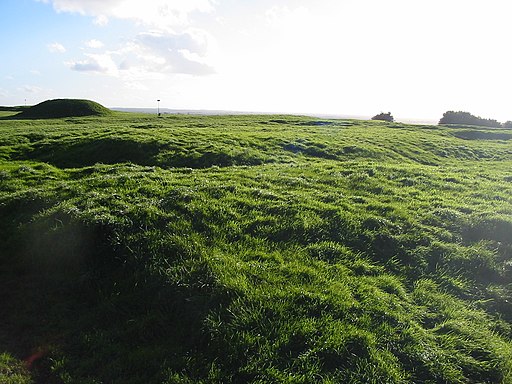
Tara5-1
Photo by Nemoi, used according to Creative Commons License

On a clear, summer day, climb to the top of the Hill of Tara. It is said that one quarter of all Ireland can be seen from this vantage point. A meandering line of silver marks the River Boyne in the valley below. To the east the Irish Sea catches the light. With the great sky opening overhead, and the rolling hills tumbling down from the top, the Hill of Tara seems an empty place. On the day I visited, few tourists wandered the hundred-acre site. Most of the ancient buildings are long gone, their timbers rotted and turned to dust over the millennia, their stone walls buried and forgotten for centuries.

And yet, their is a sense of awe about this place. Close your eyes a moment and feel the brisk wind whipping through the grasses, whispering of ancient power and wisdom and magic. It is this whispering that marks The Hill of Tara as sacred. Centuries of human monuments to this mystical feeling lie ruined or buried beneath the sod. From the huge standing stones to theRoman coins found there, the Hill of Tara is one of those places on earth where the aura of the past remains as a powerful force today.

The Hill of Tara, where archeology and mythology are inextricably entwined, has long been famous as an important historical and prehistoric  site in Ireland. Even though most buildings remain unexcavated, archaeologists have found evidence of perhaps a hundred monuments in the Hill of Tara complex. The oldest monument known so far is the neolithic Hill of Hostages, a passage tomb dating to about 3000 BCE.  A bonfire lit on this hill on the holy days (such as the solstices, equinoxes and quarter days) could be seen for miles in any direction. (Indeed, the name of Tara comes from the Gaelic Cnoc na Teamhrach (or Temair), usually translated as the hill of great prospect.)

Tara is considered the seat of the high king of Ireland. One famous upright stone at Tara is the Lia Fail, known as the Stone of Destiny.  The stone is said to cry out when touched by the rightful high king of Ireland. In fact, the Hill of Tara has seen at least 142 kings crowned.

One such king is Cormac Mac Art, who supposedly built a great hall and a palace on the Hill of Tara. Though there are many legends surrounding him and blurring the truth, Cormac is generally considered to have been a real person, living around the 3rd century CE. It is said that his reign was a time of great peace, where even minor crimes were rare. Some legends claim Cormac is the author of the famous Brehon Laws, which comprise some of the fairest law codes of that or any era. These laws, though maintaining a patriarchal society, afforded some protection of women’s rights. Women were free to pursue any profession, and could divorce their husbands. Women also were considered partners, not property, in a marriage and maintained the rights to their own property. (Though Cormac gets credit for these laws, the earliest written forms date from the 8th century, several hundred years after Cormac’s reign.)

There are many legends regarding the settlement of Ireland. In one, the Tuatha de Danaan,  a pre-Celtic people (Children of the Goddess, Dana) defeated the earlier settlers, and made Tara a sacred place to their own gods and goddesses. The Tuatha were in turn defeated by Celtic tribes (ie The Milesians) who took over the sacred places, and some of the old rites of the earlier people. The Tuatha were driven underground, becoming the ‘little people’ of Irish legends. The Hill of Tara remained sacred even into the advent of Christian times. St. Patrick is said to have come to the Hill of Tara in the 5th century CE to preach to King Laoghaire, and convert him and the island to Christianity.

Most of the facts concerning the Hill of Tara are so tangled with legend, we may never know the truth. But this sacred hill where stories live is well worth the visit. All you have to do is listen to the wind and let your imagination soar.

Cnoc na Teamhrach

A moaning wind
Echoes the haunting bagpipes of old
Evoking a procession of long-dead kings

Swirling skirted warriors
Raise shining spears, piercing a cloud-studded sky before
Fading soundlessly beneath the waving grasses.

Sources:

Mark, Joshua J. “Hill of Tara.” Ancient History Encyclopedia. 26 August 2015.Web.

Murphy, Anthony. “Ancient Sites/ Hill of Tara- Teamhair.” Mythical Ireland. February 2019. Web

Want to be safe? Build a castle!

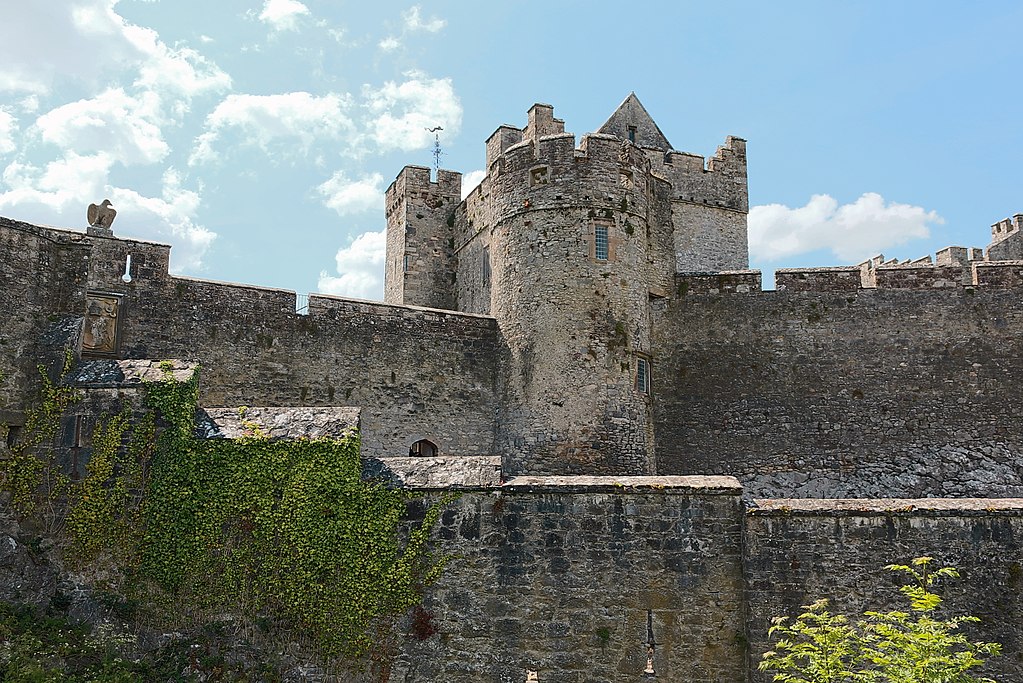
Cahir Castle, Co. Tipperary, Ireland

1024px-Cahir_Castle,_Castle_St,_Cahir_(506764)_(27959296834)
Cahir Castle: photo by Robert Linsdell from St. Andrews, Canada [CC BY 2.0 (https://creativecommons.org/licenses/by/2.0)]
Since the dawn of humanity, people have been hard at work trying to keep their homes safe from interlopers. Today, we build fences, lock doors, and install security systems. For the most part, these measures work to keep out the majority of thieves, burglars, and home invaders. But in 12th century Ireland, with warring chiefs and marauding armies roaming freely, more drastic measures were needed. Their solution? Build a castle.

Safety was, after all, the main purpose of a castle. Cahir Castle, in County Tipperary, is a prime example of just such a defensive castle.

From the earliest times, roving bands of warriors knew that the high ground, with a commanding view of the region, offered the greatest safety because of its defensibility. The site of Cahir Castle on an elevated island in the River Suir offered such a location. Even better, the rocky formation prevented any possible undermining.  

In fact, the Irish word ‘Cahir’ comes from the older word, ‘cathair’ which means ‘fortress.’ Even before a castle was built on the huge rock, there was a circular stone fort there. In 1142, Conor O’Brien, Prince of Thomod, built the first castle there atop the earlier fortifications. A medieval town grew up around the castle.

Over the next 200 years, the Norman Invasion changed the political landscape of Ireland. In 1375, James Butler was awarded the new title of Baron of Cahir, and given the castle as a reward for his loyalty to Edward III. Except for a few brief periods, the castle remained in the Butler family until 1961, when the last heir died and the castle became the property of the state.

James Butler and his descendants enlarged and updated the castle defenses for centuries. During all that time, the castle was lost to Butler family on only three separate occasions, only once by force. The first was in 1599 when most of the Butler family threw in their lot with the Irish against the Earl of Essex Army, sent by Queen Elizabeth. Essex took the castle after a three-day siege, The castle garrison tried to escape. Some did, but many more were slain. The English army took over the castle without further resistance. A year later, 60 Irish rebels took the castle back without gunfire, but they had to re-surrender shortly thereafter. Thomas Butler was charged with treason, but later he was acquitted and regained his family castle. The castle fell a second time in the Irish Confederate Wars to Oliver Cromwell. In this case, the family managed to regain favor with the crown and regain their castle once again. The third time the castle was lost was due to bankruptcy in the early 1800’s. The family was able to buy it back in the 1870’s.

512px-Cahir_Castle,_Castle_St,_Cahir_(506812)_(28655638356)
Cahir Castle Portcullis: Photo by Robert Linsdell from St. Andrews, Canada [CC BY 2.0 (https://creativecommons.org/licenses/by/2.0)]
Cahir Castle is a model of medieval strongholds. It is considered one of the largest, best preserved, and most impregnable castles in Ireland. It boasts all of the best medieval protective devices including:

  • Batter walls: stout outer walls that are thicker at the bottom than the top. These walls deflect rocks thrown from the battlements and help prevent tunnelling under the castle to gain entrance.
  • 2nd layer of defense: an inner courtyard, also protected by strong, stone walls. This inner courtyard is only accessible by traversing a long, narrow passageway with a portcullis, making it possible to trap and shoot invaders.
  • Crenellations: Regular rectangular spaces in the stonework along the top of the outer walls, allowing archers to have some protection while shooting. A license from the king was required in order to build crenellations.
  • Loop windows: Long, narrow slits in the castle walls with splayed inner sides allow two defensive archers to shoot at different angles, thus protecting more of the castle wall.
  • Low doors, narrow passages, and stumble steps: all make it more difficult for strangers to navigate the castle.
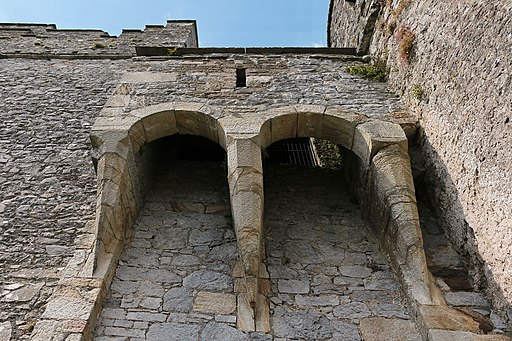
  • Machicolations: These openings in the floors above gates and doorways allow the castle defenders to thrown down rocks or hot liquids on potential intruders.
  • Portcullis: a heavy iron grate, often with spiked posts, that can be lowered in a stone gateway to prevent access. The portcullis at Cahir Castle is one of only three working portcullises in Ireland.
  • Spiral Stairs: These narrow stone stairways are built for a right handed-swordsman to defend against anyone mounting the stairs.

The development of  cannons, gunpowder and other offensive technology, along with a decrease in general warfare, eventually made the defensive technology of castles obsolete. Rich families moved into more comfortable dwellings that were built more for beauty than for strength. Cahir Castle, built over 800 years ago to protect the O’ Brien and Butler familes, is, an impressive yet stark reminder of a dangerous past.

Cahir Castle, Castle St, Cahir, Co. Tipperary, Ireland
Cahir Castle Machicolations: Photo by Robert Linsdell from St. Andrews, Canada [CC BY 2.0 (https://creativecommons.org/licenses/by/2.0)]
_________________________

Sources

DoChara: Insiders Guide to Ireland. Irish Place Names:C. 5/14/2019. https://www.dochara.com/the-irish/place-names/irish-placenames-c/

Irish Tourism. Cahir Castle.  5/14/2019. https://www.irishtourism.com/historic-sites-buildings-in-ireland/cahir-castle/1459

Sweeney, Colm and Susanna. Enjoy Irish Culture. 5/14/2019. https://www.enjoy-irish-culture.com/castles-in-ireland-cahir.html

Photo attribution:

Robert Linsdell from St. Andrews, Canada [CC BY 2.0 (https://creativecommons.org/licenses/by/2.0)]


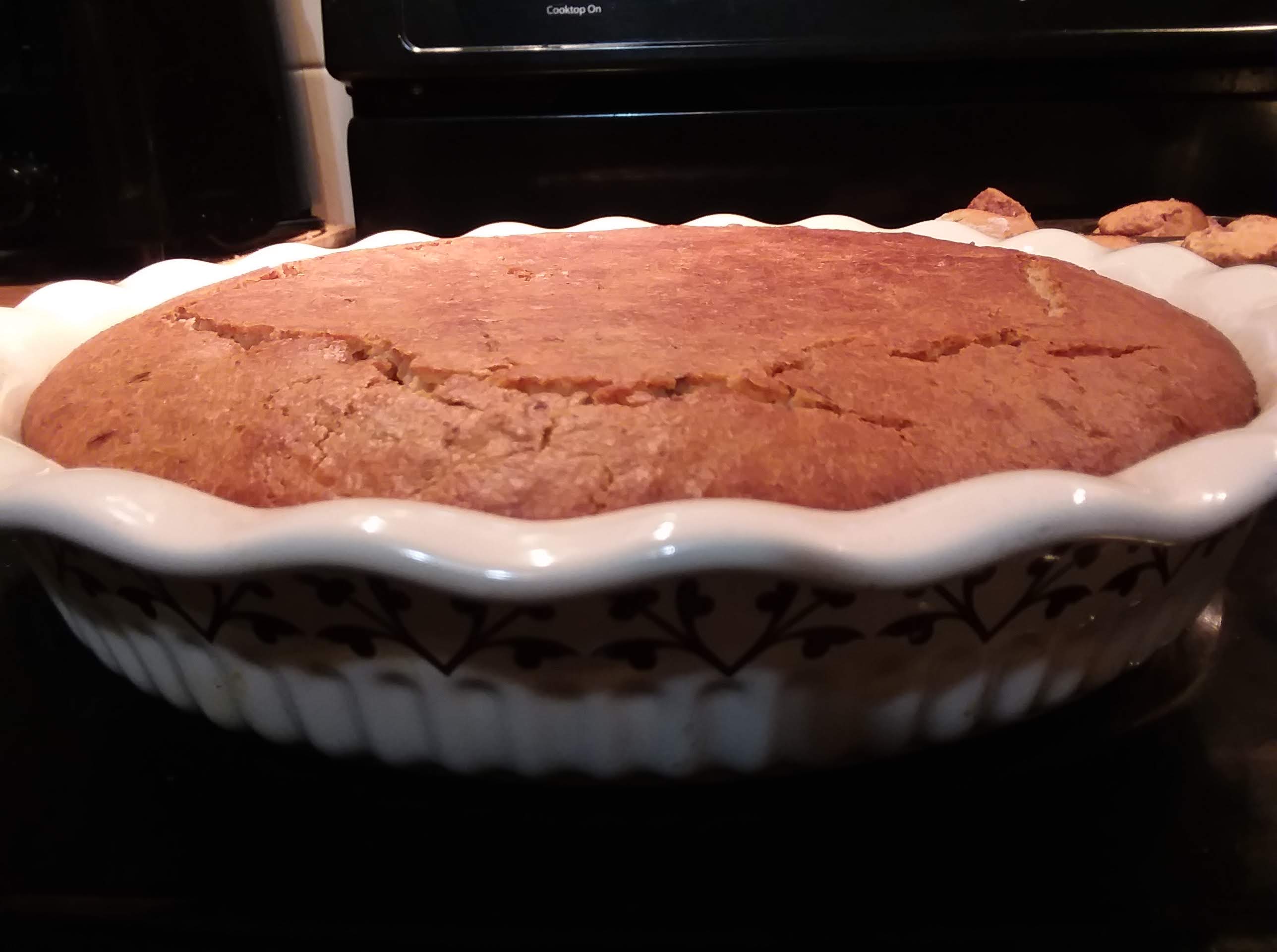
A Penny-worth of Cinnamon in a Saffron Cake

20190415_202527Today, anyone who can read can follow a recipe and produce a delicious cake or casserole. Directions are mostly clear, and measurements are standardized. It hasn’t always been that way. One of the great challenges of recreating period recipes is figuring out how much to use of each ingredient. Measurements, when they are given, are often listed in terms we no longer use. While pints, quarts, pounds, and ounces are familiar, other terms are puzzling. Consider:
A half drachm of cardamom seeds
Three blades of mace
A good piece of butter
Half a gill of sack
A pennyworth of cinnamon *

To follow a recipe using these terms, the cook needs a dictionary, a good understanding of the desired result, and a bit of lucky guesswork.

Today’s example is an experiment from The Art of Cookery Made Plain and Easy, by Hannah Glasse.

To make a fine Seed or Saffron Cake

You must take a quarter of a peck of fine flour, a pound and a half of butter, three ounces of caraway-seeds, six eggs beat well, a quarter of an ounce of cloves and mace beat together very fine, a penny-worth of cinnamon beat, a pound of sugar a penny-worth of rose water, a penny-worth of saffron, a pint and a half of yeast, and a quart of milk; mix it all together, lightly with your hands thus: first boil your milk and butter, then skim off the butter, and mix with your flour and a little of the milk, stir the yeast into the rest and strain it, mix it with the flour, put in your seed and spice, rose-water, tincture of saffron, sugar, and eggs, beat it all up well with your hands lightly, and bake it in a hoop or pan, but be sure to butter the pan well. It will take an hour and a half in a quick oven. You may leave out the seeds if you choose it,  and I think it rather better without it, but that you may do as you like. (164)

There are a number of difficulties with this recipe, including the odd order to the directions. First we are told to mix everything together. Then the author seems to back up and give us more specific directions on which ingredients to add and in what order. Then there’s the matter of the tincture of saffron, which the author assumes you know how to make. The advice at the end, that the cake is better without the caraway seeds, is particularly charming as Mrs. Glasse leaves that decision up to you.

To recreate this recipe for a modern cook, several things need to be explained. First a peck of flour is about 37 cups of flour. That is enough for a very large cake. I decided to make a third of a recipe, mostly because it is easy to divide 6 eggs into thirds. The recipe calls for ¼ peck of flour, or about 9 ⅓ cups. A cake using only 3 cups of flour seemed much more manageable.

The cloves, mace and cinnamon must be beaten in a mortar because they were purchased whole, not ground. Yeast is measured in pints because the yeast of this time period is most likely a moist starter, like sourdough starter, rather than cake of powdered yeast. And a tincture of saffron at this time meant the saffron should be soaked in the milk.

Finally we come to the penny-worth of cinnamon, rose-water, and saffron.  A penny-worth is a variable term, meaning a small amount or as much as a penny can buy. Saffron, then as now, is one of the most expensive spices available, and costs much less than cinnamon, so a penny-worth of cinnamon is likely much more than a penny-worth of saffron. For this recipe, I decided to estimate the actual small amount for each ingredient based on my own personal tastes and experiences. Ultimately, each cook must do the same here. We don’t know exactly what tastes were fashionable and expected in Colonial America. Cooks today, like those of yesterday, must create dishes that taste good according to their own likes and dislikes.

A Modern Seed or Saffron Cake 

1 c. milk ½ lb. butter
¼ t. saffron 1 T. dry yeast
3 c. Flour ⅔ c. sugar
¼ t. Ground cinnamon ½ t. each ground mace and cloves
1 t. Rose water 2 eggs
2 T. caraway seed (optional)

Warm the milk and butter until the butter melts. Add the saffron to the warm milk and let sit for 5 minutes. When the milk has cooled to lukewarm, add the yeast. Let sit 5 more minutes.

Mix the flour with all the dry ingredients (sugar, seeds, and spices). Then add the milk mixture, eggs, and rose water. Mix well. This should be a sticky batter, wetter than bread dough but thicker than cake batter. Grease a 10 inch dish or cake pan. Pour in the batter, cover with a damp cloth, and let rise for 15 to 20 minutes. Bake 35-40 minutes (or until a wooden pick inserted comes out clean) in a ‘quick’ oven (375-400 degrees).

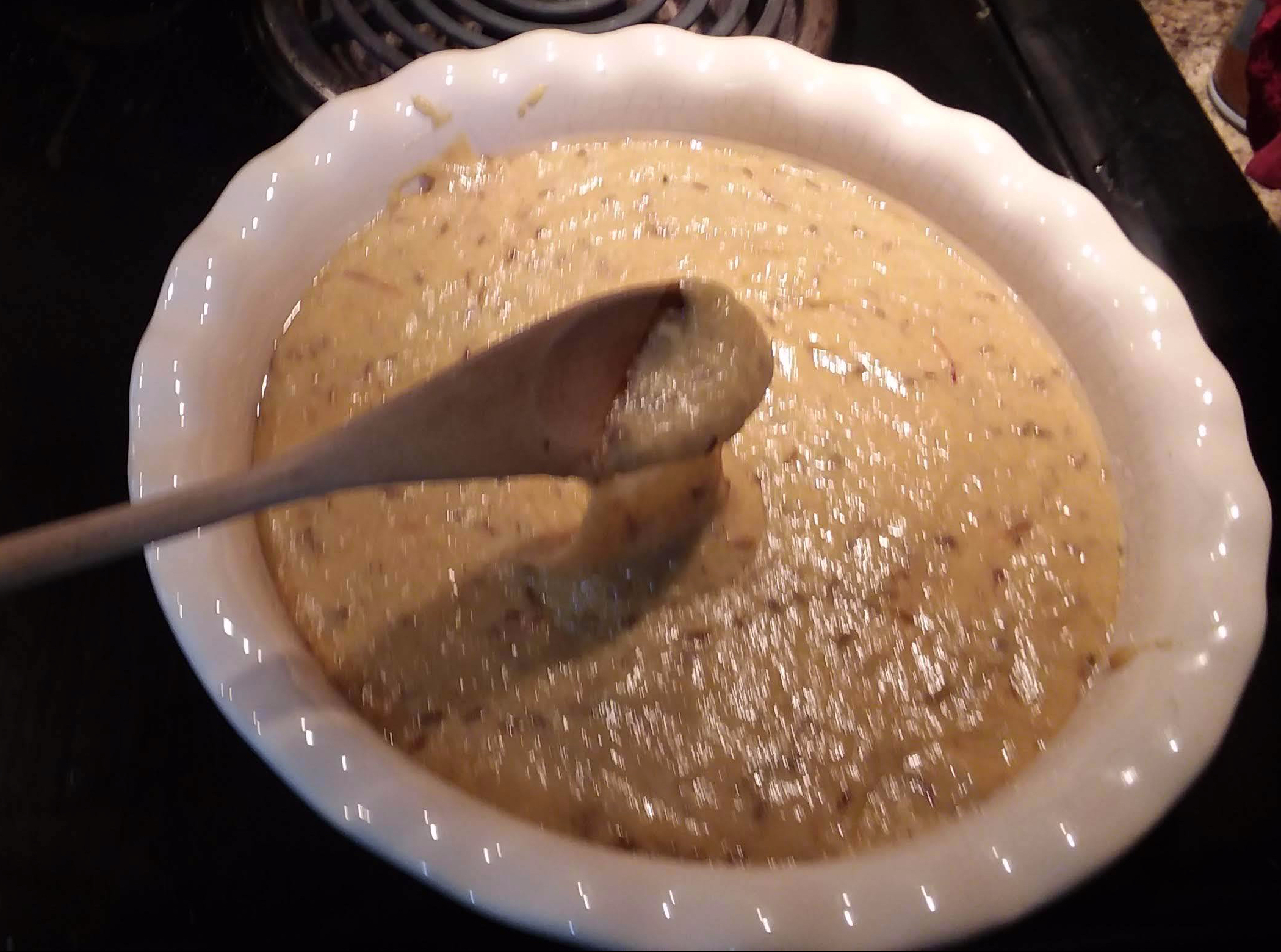
20190415_151132Feel free to adjust the spices in here to suit your own tastes. After all, even Hannah Glasse insists “you may do as you like.” The result is a delicious ‘quick’ bread, suitable for breakfast, tea, or dessert.
___________________________________________________

*A few definitions:

A half drachm of cardamom seeds: a drachm (pronounced /dram/) is 60 grains or ⅛ ounce or ¾ teaspoon

Three blades of mace: mace is the outer, petal-like covering of the nutmeg. These reddish pieces are dried and called blades. Crumbled or ground, each blade makes about an ⅛ teaspoon

A good piece of butter: your guess is as good as mine. I usually figure a ‘good piece’ to mean about a quarter of a cup

Half a gill of sack:  Sack is an alcoholic beverage, similar to sherry. A gill (pronounced like the name, Jill) is also called a teacup. It is equivalent to ¼ pint or ½ cup, equivalent to 4 ounces (or 5 imperial ounces). An interesting side note is that ½ gill is sometimes called a jack, and in Scotland a nip is ¼ imperial gill, half a jack, or about 1 ½ ounces.


A Tribute to Notre Dame de Paris

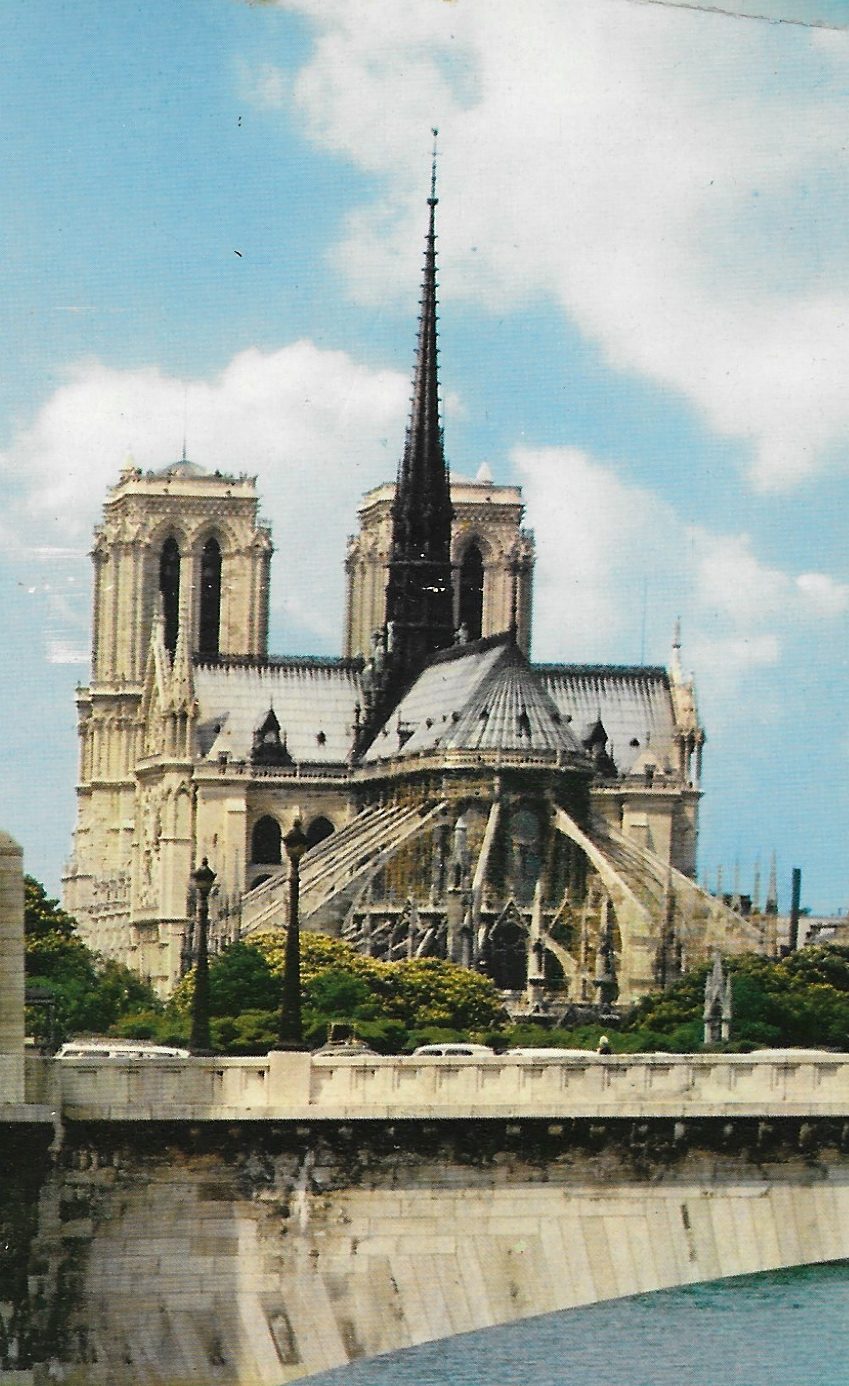
Notre Dame 1975
Notre Dame in 1975

Earlier this week, thousands of people watched in horror as the famous Notre Dame Cathedral in Paris burned. In the aftermath, some have questioned why this building seems to matter more than other great losses around the world. I can’t say that this tragedy is worse than others, but this one strikes me more deeply. You see, I have a personal connection to the great cathedral.

I first saw Notre Dame in 1975. I was a wide-eyed, not quite starving student in Paris. Having come from California (where buildings were mostly short due to earthquakes), through rural Iowa (where there is not sufficient numbers of people to warrant tall buildings), I found Paris in general, and Notre Dame in particular, stunning–a place where history enveloped me and connected me to the people who lived there before.

SAM_2237
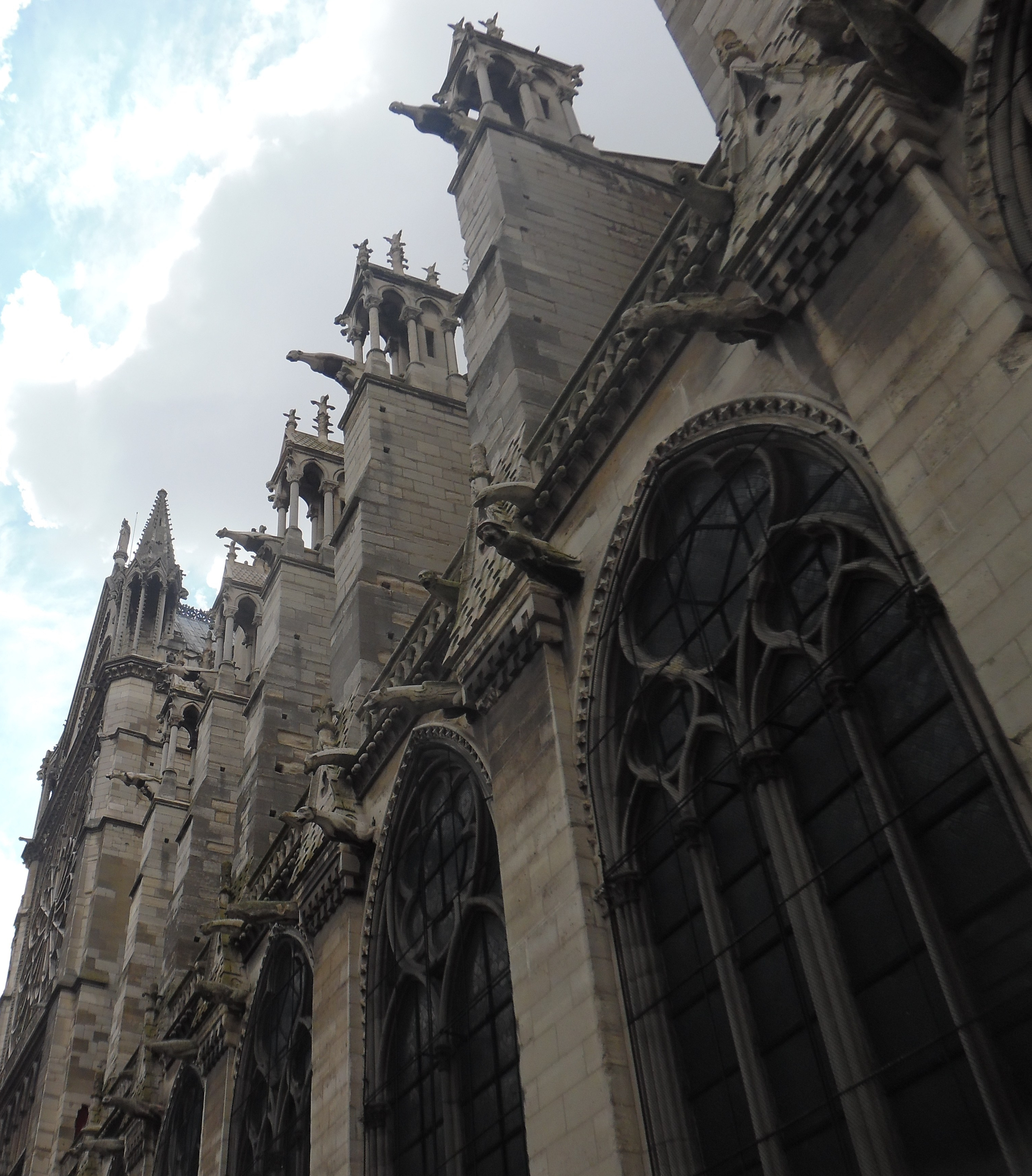
A view of gargoyles, 2017

Over the months I lived in Paris, I walked by Notre Dame almost daily since one of my classes was in a building alongside the cathedral. As I crossed the plaza and turned into the alley in bright sunshine, chilly sleet, or gloomy rain, the majesty and beauty of Notre Dame never ceased to amaze. The gargoyles, statues, and carvings all told stories with enough detail to keep me entranced. I felt transported to the middle ages, when the cathedral was built and presented the Bible in stone to all who passed.


The cathedral was built over a span of some 200 years, starting in 1163, during the reign of Louis VII. The first mass was celebrated at the newly consecrated high altar almost twenty years later. Over the reigns of several monarchs and many different builders, the cathedral was finally finished in 1345.

SAM_2228
Interior, 2017

Monday’s fire was not the first time Notre Dame faced destruction. In 1548, a group of French Huguenots  stormed the church and destroyed statues they felt were idolatrous. Almost 200 years later, more damage was done by over enthusiastic ‘renovations,’ in an effort to make the church building more classical, in line with the then current fashion.. Many of the stained glass windows from the middle ages were replaced with clear glass to let in more light. The spire was damaged by wind and removed near the end of the 18th century. Further damage was done during the French Revolution, when the cathedral was seen as a celebration of the French monarchy. Many statues were pulled down and beheaded in violent protest to the wealth and power of the nobles.

Some restoration of the great cathedral began in 1801, under Napoleon’s government. Further interest in restoring Notre Dame was sparked by Victor Hugo’s immensely popular novel, The Hunchback of Notre Dame. For twenty-five years, beginning in the middle of the 19th century, the cathedral underwent massive restoration, including a new spire.

SAM_2234
Notre Dame–North Portico, West Façade. Emperor Constantine, an angel, St. Denis, and an angel

In the 20th century, stonework of the cathedral was cleaned, removing years of soot and grime caused by air pollution. Once again, people could see the stories in the stone. One such story that intrigued me was that of St. Denis. He was the first bishop of Paris. The local people and their Romans rulers objected to his preaching Christianity. He was beheaded in 258 on the hill of Mont Martre. The legend says that he picked up his head and carried it six miles to the place he would be buried (where the Basilica of St. Denis was later built.) Like the cathedral that sports his statue, St. Denis was truly resilient, beating the odds and leaving a lasting legacy.


Still, Monday’s fire is a reminder that nothing is permanent. Certain places become cultural symbols and we expect them to remain intact. But fires, earthquakes, tsunamis, and human folly have a way of destroying those hopes. The damage to Notre Dame is no greater, but also no less, than the loss of any great monument of human achievement. Whenever any such cultural icon is destroyed, all of us should weep. For within those cultural symbols lie the stories of all humanity.


Sources:

Fuentes, Jose Luís Corral. An 800-year history of Paris’s Notre Dame Cathedral. National Geographic History Magazine. May/June 2017, updated April 15, 2019

St. Denis.Encyclopedia Britanica. April 19, 2019. https://www.britannica.com/biography/Saint-Denis

Of Parsnips and Skirrets

parsnip pieSeafood two thousand miles from the ocean? No problem. Fresh strawberries in the middle of a February snowstorm? Why not? In the modern world of well-stocked grocery stores, world-wide distribution, and a multiplicity of preservation options, we can generally eat whatever we want whenever we want. This hasn’t always been true. For centuries our ancestors relied on highly nutritious root vegetables to get through the winter. Stored in cool, dark cellars, root vegetables keep well for many months. While we still enjoy many root vegetables, like carrots and potatoes,  others have become less popular. This week’s recipe focuses on two such vegetables: the parsnip and the skirret.

CDC_parsnipThe parsnip has an unusual history. Even the name is a bit odd. The word comes from the Latin ‘pastinum’ (fork) through Old French ‘pasnaie’.  Parsnips are native to Eurasia, but have spread world-wide. In fact, parsnip’s wild cousin is a dangerous invasive posing problems for hikers. The stems and leaves contain a toxic sap that can cause a bad rash when damp skin that has come in contact with the plant is exposed to sunlight. Cultivated parsnips are harvested the first year of growth, so they are not allowed to develop the tall stems and leaves that cause the problem.
Parsnips were cultivated by the Romans, who sometimes confused them with carrots. (Parsnips are indeed related to carrots, as well as parsley. In Roman times, carrots were purple or white, hence the confusion.) The Romans held that parsnips were an aphrodisiac. Emperor Tiberius even accepted parsnips as payment for part of the tribute due from German tribes.

Parsnips can be left in the ground for storage (except in areas where the ground freezes solid) and are sweeter after winter frosts. They were used as a sweetener in Europe before cane or beet sugar was discovered. Both French and British colonists introduced parsnips to the Americas, where the root was popular in cookery for decades. (Potatoes eventually replaced the parsnip as the most popular root vegetable.)

Valued as a staple in Europe and the Americas, lauded as a sweetener for many centuries, and prized for medicinal purposes in China, the parsnip is now fed to the pigs as often as it is eaten by humans.

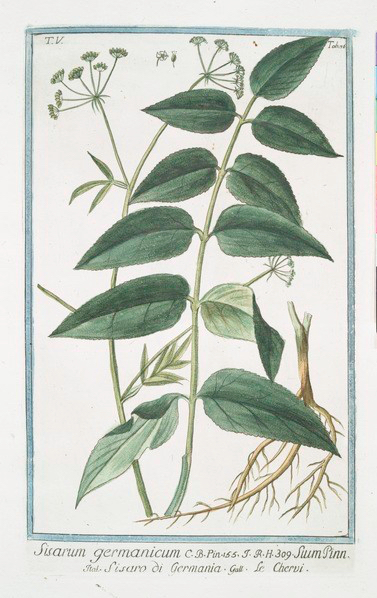
Sisarum_Germanicum_-_Sium_Pinn._-_Sisaro_di_Germania_-_Le_Chervi_(Skirret,_Sugar_root,_Skiwort)_(NYPL_b14444147-1130639).tiff
Skirret

Parsnip’s cousin, the skirret is another misunderstood root vegetable that has lost popularity. In fact, it is difficult to even find skirrets today. Also know as a crummock, or water parsnip, the skirret is fairly low yield, so it is rarely grown commerically. Later cooks have sometimes confused the skirret with carrots, though they are not the same. In German, the skirret is called zuckerwürzel (sugar root). By medieval times, the name had morphed into ‘skyrwates’, with the folk etymology of ‘pure whites’. Like the parsnip, skirrets came out of Asia, and were used in Europe by Roman times.

In medieval times, skirrets were considered mostly beneficial. The Benedictine Abbess/ Herbalist Hildegard von Bingen recommended they be used in moderation, as too much could cause a fever or intestinal troubles. She also suggested mashed skirrets mixed with oil made a good poultice for weak skin on the face. In Maud Grieve’s 16th century book, a Modern Herbal, skirrets are recommended for chest complaints. Skirrets remained popular at least until the 17th century, when Nicholas Culpeper recognized them as nourishing, but cautioned they could cause ‘wind’ and provoke venery and urine.

Despite my earlier claim that it is now mostly possible to what we want when we want, I could not find skirrets in any local grocery store. So the following recipe relies only on parsnips for a delicious side dish to any meal.

Parsnip Pie

To make a tart of parsneps & skirrits

Seethe yr roots in water & wine, then pill them & beat them in a morter with raw eggs and grated bread. Bedew them often with rose water & wine, then streyne them & put suger to them & some juice of leamons, & put it into yr crust; & when yr tart is baked, cut it up & butter it hot, or you may put some butter into it when you set it in yr oven & and eat it cold. (Martha Washington’s Booke of Cookery, 97)

My version:

Pie crust dough for 1 pie, top and bottom
4 c. mashed parsnips 
4 eggs
1 c. wine sweet white wine
Juice of 1 lemon (¼ c.)
¼ c. sugar
¼ c. bread crumbs
2 T. rose water
¼ c. butter (melted)

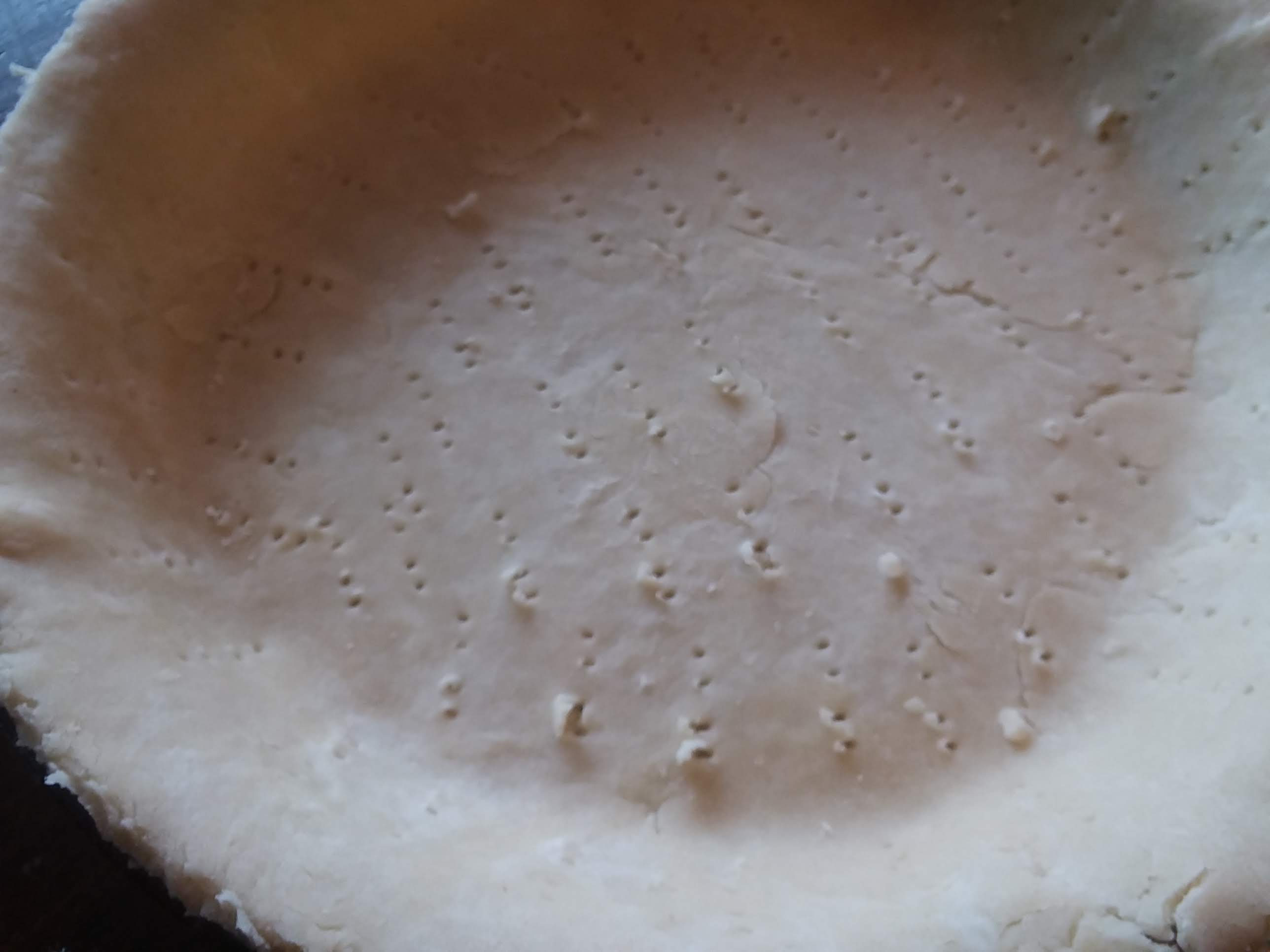
Roll out half of the pie crust dough and pricked pie crustplace in a deep 10” pie pan. Prick all over 
(bottom and sides) with a fork. 
Bake for 10 minutes, 425 degrees.
Meanwhile, peel the parsnips and 
cut them into chunks. Boil until 
tender. Cool slightly and mash. Mix mashed parsnips with the remainder of the ingredients. Fill the pie. Roll out the top crust and cover 
the pie. Pinch it closed. (Brush the edge of the bottom crust with 
water to help seal the edge.) Cut vents in the top crust.

Bake at 350 degrees until top crust is golden (about 1 hour).
Serve warm or cold
This pie is very good, barely sweet, making a good side dish for a 
meal. For a dessert or breakfast pie, add up to ½ c. additional sugar.

References:

Culpeper, Nicholas. Culpeper’s Complete Herbal and English Physician. 1653. (Applewood Books reprint)

Grieve, Maud. A Modern Herbal. botanical.com (retrieved 4/3/2019)

Martha Washington’s Booke of Cookery. Edited by Karen Hess

Martinko, Katherine. Meet the Skirret, the long-forgotten Tudor vegetable. Treehugger.com. 3/11/2016

The Parsnip. Towne’s Harvest Garden. Montana State. University. (pdf, retrieved 4/3/2019)


A review of J. D. Smith’s TRISTAN AND ISEULT (B.R.A.G. Medallion Honoree)

16fd96deba85a06311383433f152ed24_MWhen it comes to legends of Irish princesses, don’t expect a happy ending. Their stories are decidedly tragic.
The ancient legend of Tristan and Iseult, known from at least the 12th century, is a case in point. There are many versions of the story, which is basically a love triangle. Iseult, daughter of an Irish king, is a pawn in the game of political marriages. She is wed to King Mark of Cornwall  in order to cement an alliance between an Irish kingdom and Cornwell. Mark’s younger nephew and heir to the throne of Cornwall, Tristan, falls in love with Iseult, and she with him. Because of their tangled loyalties and overwhelming passion, the lives of all three end tragically.

This tale of wronged lovers, duty, and sorrow has greatly influenced many retellings, including many versions of the story of King Arthur, Lancelot, and Guinevere. In the story of Camelot, as in Tristan and Iseult’s story, the three people involved love and respect each other. They have no intention of betrayal, but their love is so strong it cannot be denied. Such love is powerful enough to incite jealousies. Even if the lovers never actually do any wrong, their downfall is inevitable because such power is dangerous.

As a whole, legends tend to focus on plot rather than character. Modern novelizations of legends go beyond the retelling of events to develop the characters. That is exactly what J. D. Smith’s version of the legend, Tristan and Iseult, does. Smith uses the alternating voices of Tristan and Iseult to bring the story to life. He shows how Iseult knows that her fate as the daughter of a king is not her own choice, and that her marriage will be a tool used by men to gain power. When she is saved from her impending marriage to the brutish King Morholt, she finds herself grateful to King Mark and impressed with his ideas of alliance and peace. In fact, she wouldn’t mind marrying him, in spite of his age, if it weren’t for Tristan.

Tristan, a warrior fighting to stem the tide of the Saxon invasion, honors and respects his uncle, King Mark. He mourns the death of his cousin, Mark’s son, and is surprised when Mark names him his heir.

Iseult and Tristan do not mean to fall in love, but they do. Smith’s version of the story shows us how such a forbidden passion can grow. He reveals the character’s inner thoughts, desires, fears and hopes, making us understand and sympathize with their dilemma, where every choice seems destined to lead only to lifelong sorrow.

Rather than the flat, archetypal character of the legend, Smith’s characters seem very real, very human. Faced with their impossible choice, can they do what is right?  Will such honor bring them happiness? With simple, direct prose, Smith makes us care about these doomed lovers and the fate of their world.

Legends like this one reveal human frailty and the power of human impulses. We care for these people who, in spite of vast difference in time and culture, could be us.  Even though we know their end will be tragic, we hope for the best. We hope, perhaps this time, honor will be rewarded and love will win.

Perhaps, that is why legends endure. In spite of tragic fate, that hope remains.


Beyond the Blarney

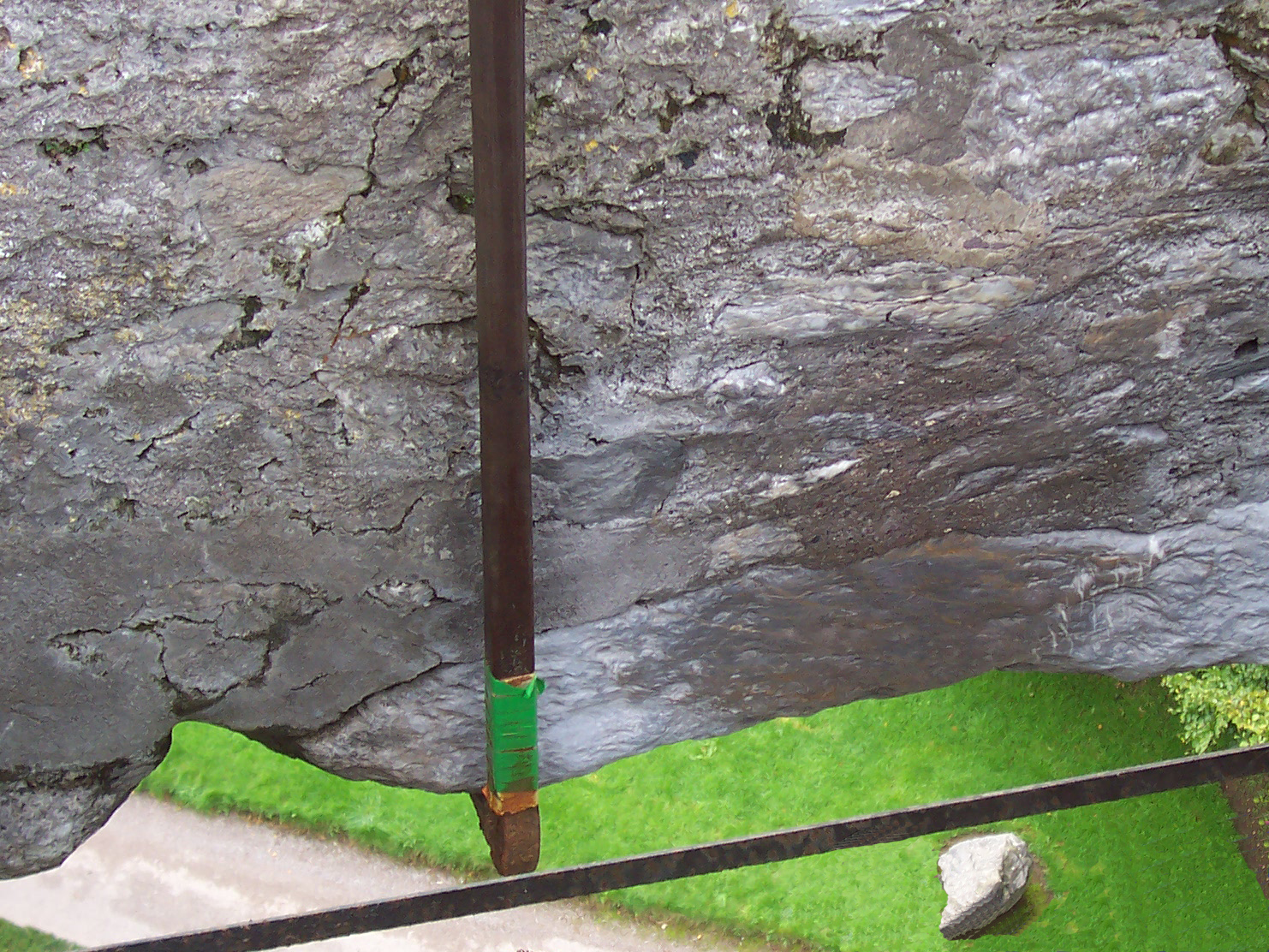
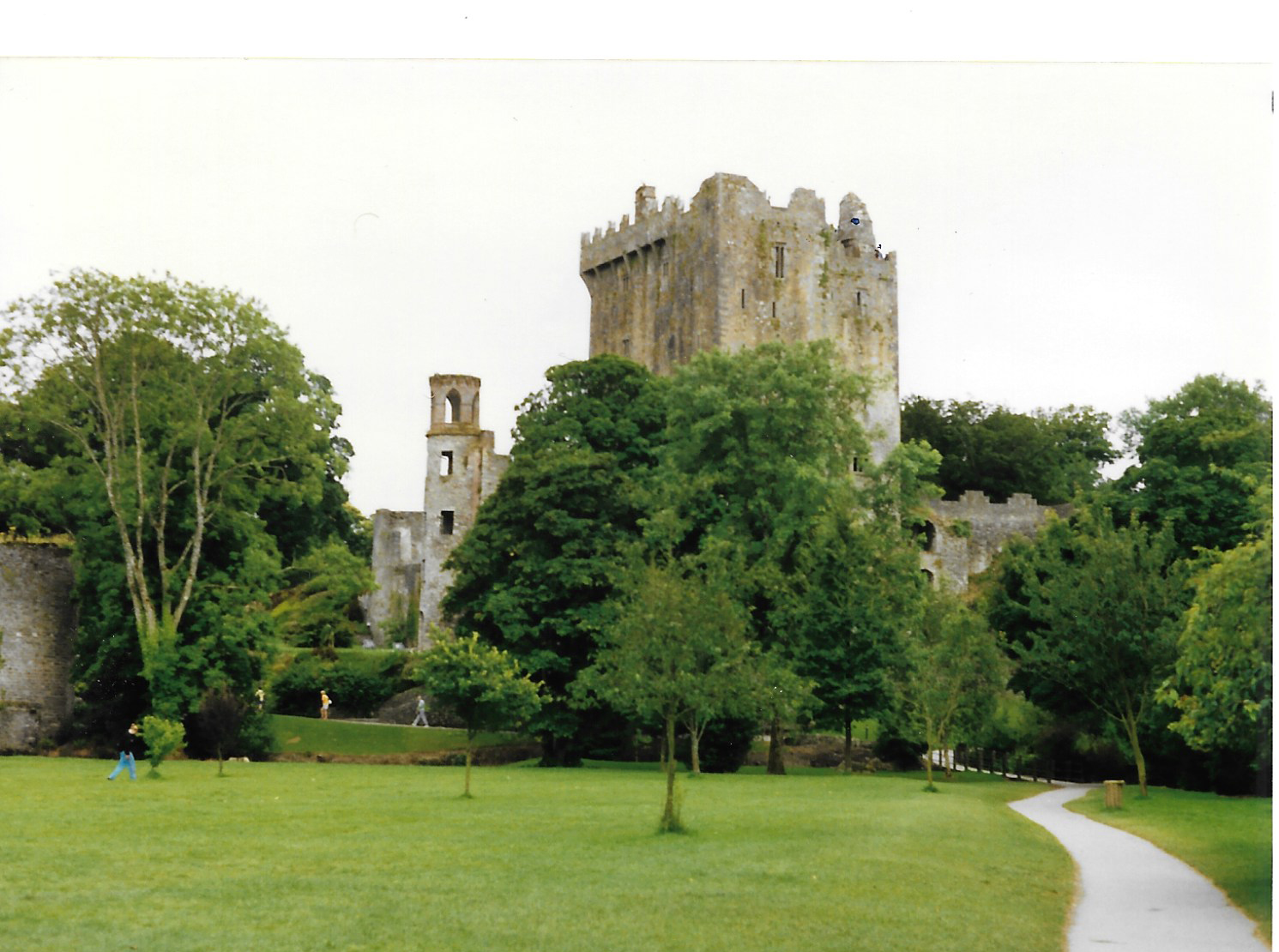
blarneyAs legends go, it’s a pretty weird one. The famous blarney stone is a large block of limestone set into the far wall of a machicolation high up in Blarney Castle. (A machicolation is a box-like, floorless opening in the battlements, used to pour hot oil or other nasty stuff on intruders.) They* say that if you climb to the top of the ruined keep of Blarney Castle, lay down and hang over the edge backwards far enough to kiss that block of limestone set into the battlements, you’ll be blessed with the gift of gab. You’ll be able to regale audiences with your silvered tongue and eloquence, with the fluency and perhaps even the loquacity to rival the best orators.

Having kissed the stone twice myself, I can tell you first hand that the legend is overstated. I’m no orator, and while I can tell a good story, I do better in print than in person.

But If it’s all just blarney, why do visitors flock to Blarney Castle every year? The history behind the blarney stone is as nebulous as its purported virtues. One story claims the Cliodhna /Kleena/, a major goddess in the Irish pantheon of the Tuatha de Danann, sometimes known as the Queen of the Banshees or the queen of the Sidheog (fairy women), was involved. Lord MacCarthy, the builder of Blarney castle in 1446 asked for Cliodha’s help to win a lawsuit. She advised him to kiss a stone on his way to court. He did and then won his case through his eloquent tongue. He then used the special stone in the building of his castle.

A hundred years later, Queen Elizabeth complained of the “blarney” because  she could not complete any negotiation with a later MacCarthy, the lord of Blarney Castle, because of his non-committal diplomacy, or the ability to promise little or nothing with a lot of eloquence. While it’s true that Cormac MacCarthy managed to sweet-talk Queen Elizabeth without signing over his lands, whether his eloquence and wit came from the stone is questionable.

Another early legend says the stone was actually Jacob’s pillow and was brought to Ireland by the Prophet Jeremiah. Some say it was part of the ‘speaking stone’, the throne where Irish kings were crowned at the hill of Tara. Still others claim it was the stone Moses struck in the desert on God’s command to bring water to his people. It’s even said the stone was the pillow on which St. Columba died.

Only slightly more plausible is the legend of the stone’s origin in Scotland. In 1314, before the current Blarney Castle was built, Cormac McCarthy supposedly sent several thousand men to aid Robert the Bruce, and in return Robert gave McCarthy half of the stone of scone or stone of destiny, where Scottish kings were crowned.

For the record, all of the legends claiming the stone came from somewhere else have been proved pure blarney by scientific evidence showing the stone to have originated in Ireland.

In fact, the Oxford English Dictionary’s first recorded use of the term ‘blarney’ is from 1803, well after Cliodhna  and all the early MacCarthys slid into oblivion. Perhaps the idea of blarney as lies, half-truths, and fabrications all wrapped up in charm came from Lady Blarney, a smooth-talking flatterer in Oliver Goldsmith’s Vicar of Wakefield, published in 1766.

Whatever the origins of the stone and the legends surrounding it, the history of Blarney Castle is well-known. The original Blarney castle was a wooden structure built about 1200 AD outside the village of Blarney. That first building has entirely disappeared. In 1210, a stone structure was built on the site. This lasted until 1446, when it was destroyed, and the current building was constructed by Cormac Laidir MacCarthy. The castle changed hands a number of times in the next several centuries, and eventually fell into disrepair, especially after Blarney House was built in 1874 as a more modern and convenient lodging for the family

Though it is now in ruins, Blarney Castle and the surrounding gardens are fascinating. It’s best to visit early, before the crowds come in. Narrow stone steps, worn smooth with age and use,  spiral upward in the dark tower and emerge at the top of the keep. The view over the battlements in the early morning as the mists are rising is as magical as any stone visitors come to kiss. Some of the rooms are still open. Passing through bare stone hallways and into empty rooms, it’s easy to imagine the footsteps of the people who lived here hundreds of years ago. In my mind’s eye, I could almost see the tapestries warming the walls, the tables laden with roasted game and rich pies, the servants hurrying to fill another goblet. It’s as if the stones are whispering their stories, if only we take the time to listen.

Equally enchanting and steeped in legends are the sixty acres of gardens and parklands surrounding the castle. In the Rock Close for instance, moss-covered rocks and twisted trees line the meandering paths. In the hush, we could hear the trickle of a waterfall, and when I closed my eyes, I imagined the brush of fairy wings on my cheek. The very air seems steeped with magic. Huge boulders loom over paths winding around an ancient dolmen, a druid’s cave, a sacrificial altar, a witch’s kitchen, and a stone circle. (To be sure, the druidic connections were ascribed by the romantic Victorians.)  

The stone circle called “The seven sisters,” has nine huge stones, seven standing and two toppled. In one legend the kind of Munster had seven daughters and two sons. When both sons were killed in a battle, the mournful king ordered his men to knock down two of the stones to commemorate his boys.

Another winding path leads to a set of rough stone steps called the wishing steps. According to the legend, anyone who climbs the steps to the stone archway, backwards and with eyes closed, thinking only of their wish, will be grant that wish within a year and a day by the Blarney witch.

From ancient Druids to magic stones, from wishing steps and witches to kings of old, Blarney is a place full of stories that stir the imagination. It’s a place to make us believe, if only for a moment, that all the legends are true.

stone-cropped
The stone is worn smooth and shiny from thousands of lips.  Iron bars now prevent the kisser from falling to the ground far below


*”They”  being the anonymous gossip mongers who spread rumors that turn into legends.


Trains 3: The Jacobite

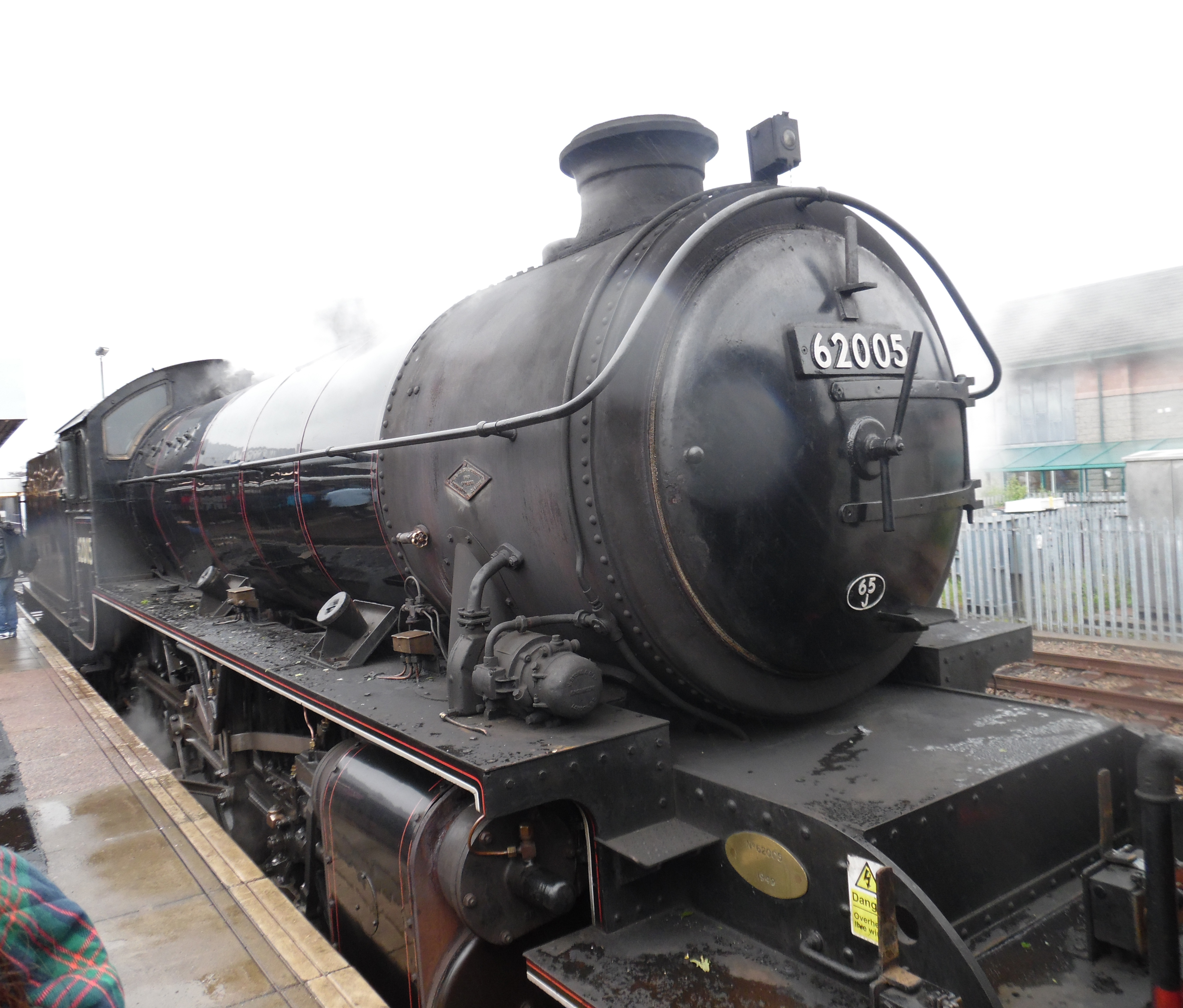
engineIn past posts, I wrote of train wrecks and disasters, but in most cases, I  really do find train travel relaxing. Lest anyone think badly of Scottish trains after my New Year’s day experience years ago, I can share a much better train ride. A few years ago, I returned to Scotland and rode the Jacobite steam train from Glenfinnan to Mallaig.  Although Harry Potter and his friends faced the dementors on this train, I had no problems with the ride.

The Jacobite runs 41 miles from Fort William to Mallaig on the West Highland Railway line, using a steam locomotive. Originally known as the Mallaig  Extension, the service began in 1901 to transport fish, especially herring, from the Mallaig seaport. Steam service on the line ended in 1967, with the British Modernization Plan, replacing steam engines with diesel.

Then, in 1984 British rail lines returned steam power to the line, with the goal of improving tourism in the area. The train is called the Jacobite in reference to the last Scottish uprising (in the Eighteenth Century) when the Highland clans, tried (and failed) to restore the Stuart family to the Scottish throne (specifically, Bonnie Prince Charlie). Nowadays, the train is so popular with tourists, it’s best to book in advance as it usually sells out.

To fully experience this train, we wanted to see it cross the iconic Glenfinnan Viaduct, as seen in the Harry Potter movies, as well as ride the train. So the day before our booking, after a lovely hike in the rain through the Glenfinnan valley to a bothy, we stopped at the Glenfinnan Station, where we had tea. Above the station, there is a marvelous view of the famous viaduct.  

We were running a bit late, and expected the train to come into view at any moment. After hurrying along the steep, rocky path, with a raw wind in my face and rain spattering the ground, we arrived at the peak just as the train came into view, barreling along at a great rate and spewing huge clouds of steam in its wake. Like a dragon roaring through the valley, it filled the air, and then was gone. Breathtaking!

crossing the viaduct
The Glenfinnan Viaduct was completed in 1898, and the rail line opened in 1901. The viaduct is fifty feet long with 21 soaring arches. Built of mass concrete, it is the longest concrete viaduct in Scotland. The viaduct is about 18 feet wide, single track, and crosses the valley 100 feet above the River Finnan. One legend says a horse fell into one of the piers and perished during construction. However, later investigations have failed to find any evidence of such an accident.

The next day we boarded the train in the morning and took our first class seats in the ‘Harry Potter’ car. The west coast of Scotland is still cold, even in June, but the train was a real delight. Stepping onto the Jacobite steam train is not only a step back into history, but immersion into fantasy world of Harry Potter. A narrow aisle runs along one side of the car, with compartments seating six each along the other side. Each compartment has a sliding door made of rich wood, polished to a brilliant shine. Tea was laid out for us in the compartment before we arrived, including a pot of tea and biscuits. We settled in and soon the train lurched forward, the wheels clacking on the rails. The engine chugged along, belching steam that rolled past the windows as the train rounded a bend or the wind shifted.

inside

Rain splattered the windows most of the trip, obscuring the views at times, but adding to the total sensation of being in another time and place. We passed through a landscape of munros and burns, lochs and forests, and caught brief glimpses of the Caledonian canal and Neptune’s Staircase (a series of locs). At times the train roared through a dark tunnel, then burst out into the cloudy gloom of the soft Scottish day.

After a bit, a trolly made its way down the aisle, and stopping at each compartment to offer sweets or souvenirs. Near Glenfinnan, there’s a lovely view of Loch Shiel, one of three lakes used for filming Hogwarts Lake. I almost expected to see the great castle of Hogwarts at the end of the line, instead of the thoroughly mundane fishing village of Mallaig.

Though quite part of the ordinary world, Mallaig offers a couple of choices for a simple, delicious lunch. We popped into Jaffy’s for Fish and Chips, then wandered about town to view the harbor. Since it was raining and cold (45 degrees) we spent more time in the shops than outside.

The train ride back was equally lovely, and I was sorry to disembark when we finally returned to Glenfinnan at the end of the day. Whether you are a history fan or a Harry Potter fan, the Jacobite steam train is an experience you won’t want to miss.

on the train