A mistake that led to Independence
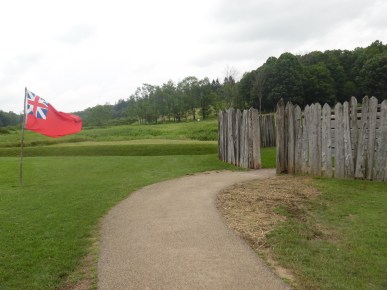
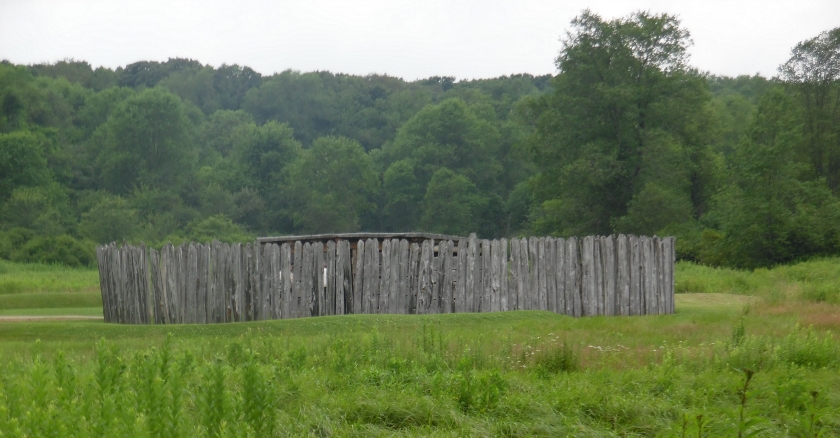 On our way from Minnesota to Virginia, we stopped for a late lunch at Fort Necessity National Battlefield in the southwest corner of Pennsylvania. The rain of the morning had mostly stopped, but there weren’t many people visiting. The place has a very well designed visitor center and a pleasant walk to the reconstructed fort that commemorates the battle between George Washington’s Virginia Militia and the French Canadians and Indian.
The fort is small, unassuming and apparently insignificant. But the wilderness battle fought there on July 3, 1754 shook the world, changing the course of history. It started what could be called the first world war and ultimately lead to the Revolutionary War and the establishment of the United States of America as an independent nation
It seems incredible that such a peaceful place could have been so important. In 1754, there were no roads leading to this meadow. There were no villages or businesses to protect. There weren’t even very many settlers in the region.
So why build a fort in this wilderness?
 The answer is LAND–untamed, and to European eyes, unclaimed, land, rich for the taking.
The British wanted it. The French wanted it. Not to mention the various groups of Native American, including the Shawnee, the Mingo, the Iroquois, the Monangahela and the Delaware.
All of them claimed it. Rival British colonies even squabbled among themselves over who had the right to settle here and exploit its resources.
In all this vast territory, the question remains, why is Fort Necessity important?
Fort Necessity’s significance is really built on two mistakes, both made by George Washington.
When we think of the first president of the United States of America, we usually see a serious, white haired gentleman of with strong morals and a clear sense of duty. We remember the courageous general who led the Continental Army to victory. We rarely consider George as a somewhat rash young man, upright and eager to earn a good reputation.
George was 22 when he led a the Virginia militia to what is now southwestern Pennsylvania. He was acting on orders from Virginia’s Governor Dinwiddie to secure the territory for Virginia and make the French leave, with force if required.
Washington’s first mistake was leading an ambush against the French. This didn’t seem like a mistake at the time. He thoroughly defeated the troops led by Joseph Coulon de Villiers de Jumonville. In the short skirmish or its aftermath, Jumonville was killed. The French claimed he was an ambassador, delivering to the British that same message Washington had been ordered to give the French: leave this area. Therefore, killing him was in fact an assassination. Washington claimed ambassadors don’t travel with troops, justifying his act of aggression.
After this encounter, Washington expected to be attacked, and so he choose Great Meadow to set up his defenses. This was his second mistake. He had his men build a circular stockade, 53 feet in diameter, with earthworks surrounding it and a small shed in the middle of it. This storehouse was intended to shelter supplies, not men. In fact, the purpose of the storehouse was to protect those supplies from his own men. Washington choose the meadow because they would be able to see the enemy approach. But the meadow was too small, and the trees were too close. The attackers could use the cover of the trees to fire on the fort’s defenders.
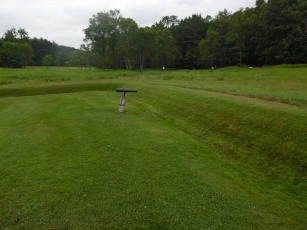
Walking across the quiet meadow in July of 2017, it was hard to imagine what took place here 263 years early. In 1754, it rained heavily, turning the trenches Washington had built into stream. The two forces exchanged fire all day, but in the end, Washington surrendered. His men had found the supplies and gotten drunk. Their powder was wet. The French and Indians attackers had a better position and outnumbered the his troops. This was the first and only time George Washington surrendered.
When news of the battle reached Europe, both sides escalated military presence in the new world, eventually declaring war in 1756. The Seven Years War was fought world-wide, involving all the powers in Europe. The conflict raged across five continents, including Europe, North and South America, Africa, India and the Philippines.
One result of this war was increased British control of North America and opened up the Ohio Territory to colonial settlers. The war had been very expensive for the British, and they naturally expected the colonists to help pay. This led to a number of tax initiatives, and we all know the result of ‘taxation without representation.’
What strikes me as particularly ironic about the battle of Fort Necessity is Washington’s role in it. In this battle, Washington fought alongside British troops against the French and their Indian allies. Twenty-one years later, an older, wiser Washington took charge of the Continental Army. In the following years, Washington led that army to victory, fighting alongside French troops against the British. It just goes to show the two sides of the conflict were not so different after all.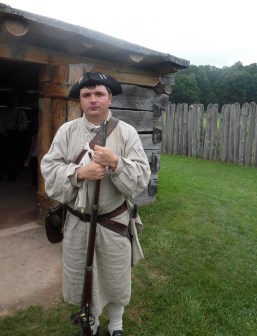
A lesson we might still need to learn.
 BRIC-A-BRAC