I know it sounds ungrateful, but really, I don’t much like being rescued. It’s not that I like having trouble or getting stuck, I’d just rather ‘do it myself’.
Of course,I am just as happy as anyone else to accept help with chores or share the work of driving or divide tasks at a campout. But there is a difference between sharing the work and being rescued. There’s a sense of failure when help is absolutely needed.
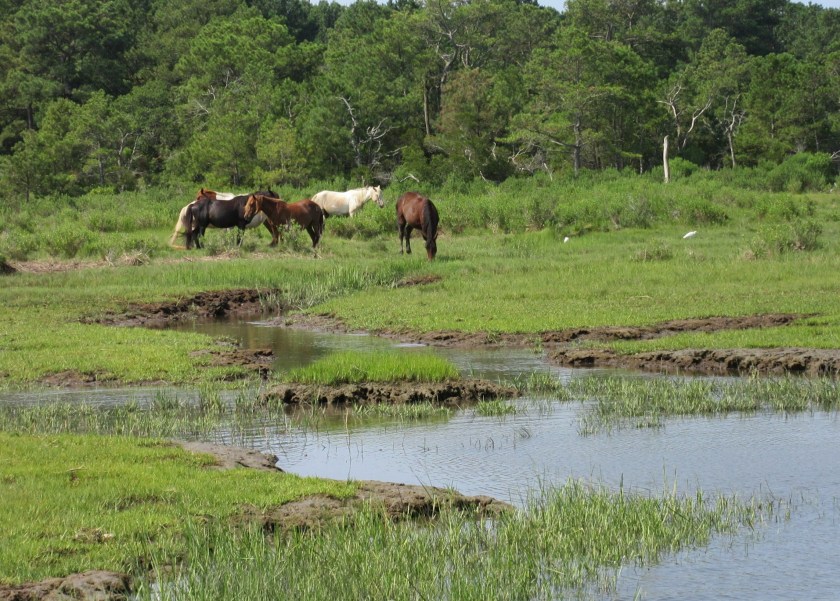
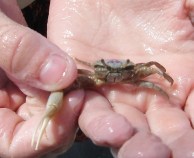
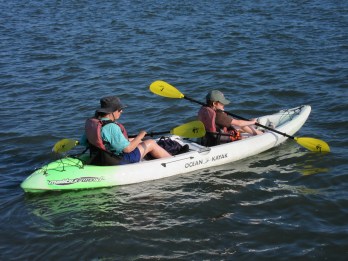 Take for instance my kayaking trip with my great-nephew to Assateague Island from Chincoteague. At eleven years old, Ian was the youngest in the group, and I was clearly the oldest. He and I shared a double kayak. Everyone else, including our guide, was twenty-something. We crossed the bay from Chincoteague to Assateague. Once there, we beached on the mud flats, then walked across the mud and sand to the edge of the salt marsh. We saw the ponies way on the other side of the tall grass, but the real drama was on the mud. At our approach a ‘herd’ of fiddler crabs scuttled sideways to scramble under the driftwood. (The collective term for crabs is ‘cast’, but these creatures resembled a galloping herd or flowing wave more than anything else.)
After returning to the kayaks, we paddled up one of the drains to get a better view of the ponies. The drain was like nothing else I’ve kayaked through. It was low tide, so we glided through the twisting canal, below the salt grass. On either side, cliff-like banks, crusted with clams and mussels, rose above us. Exposed, tangled roots of the salt grass capped the banks. Herons stalked the marshes and gulls wheeled overhead. There was an eerie remoteness to the place, an otherworldly feeling separating our silent kayaks from the bustle of civilization.
Civilization intruded, however, when our guide’s boss called and said a storm was approaching. It was time to head back.
As we emerged from the drain, we could see the dark sky looming to the west. Now, I like storms. I like the energy in them, the sense of something immense building, the moment when the rains pounds down and the wind howls. I like all of that, but I like it best from some sort of shelter. On the Assateague side of the bay, we had no shelter.
Instead, we had a bay to cross before the storm hit. The black wall of storm with its ‘comb-over’ white top filled the sky. The kayak suddenly felt quite small as the puffs of wind churned up the water Young Ian and I couldn’t keep up with others as we fought the waves. We paddled hard toward shore while the storm barreled toward us.
About 300 yards from the Chincoteague shore, the wind running ahead of the storm hit us. We stopped, dead in the water. The first splatters of rain hit the kayak and I knew at that moment, we would lose the race. No matter how hard I paddled, we wouldn’t reach land before the full force of the storm hit us.
The others had all reached the shore. Our guide saw our trouble and came back out to help us in. He hooked his kayak to ours, and with all of us paddling hard, we made it to shore just as the sky broke open and the rain poured down.
This is where it gets complicated. I really did appreciate the guide’s help, but I was embarrassed at being ‘hauled’ in. I hadn’t been afraid as the storm rolled inexorably toward us , though I admit to a surge of adrenaline. But I was keenly aware I wasn’t going to be able to get us in before we were drenched. The thought we might not get in at all didn’t occur to me. Looking back, I realize the force of the wind and rain might have capsized us, and it was a long way to swim.
So the guide’s decision to tow us was the right choice. He did what he needed to do as a responsible guide. The thing is, I’ll always wonder if I could have made it in. I’m left with a sense I wasn’t strong enough or good enough, a sense that I lost the race.
I didn’t rail or fuss at his help or tantrum like I might have done when I was two. I took what was offered, and I am grateful for his help.
But I’d still rather do it myself.


 BRIC-A-BRAC