
Everyone knows lettuce–that mundane, leafy green vegetable. It’s indispensable in fresh salad. It’s center of a BLT. It adds crunch to a tuna sandwich. It’s grown world wide and even in space on the International Space Station. For nearly 5000 years, lettuce has been a part of the human diet.
Egyptians were the first to grow lettuce, originally for the oil from the seeds. Over time, they bred lettuces for tastier leaves. Because of the milky sap and thick, upright stems of these early plants, the Egyptians associated lettuce with sexuality.
The Greeks continued breeding lettuces for more flavorful leaves, but they told various stories of Adonis being killed in a bed of lettuce. For the Greeks, lettuce signified impotence rather than prowess.
The Romans continued the lettuce-growing tradition, siding with the Egyptians on the question of how lettuce affects male stamina. Lettuce was also served before meals and after meals to improve digestion in the first case and sleep in the second. By 77 AD, at least eight different types of lettuce are recorded in Pliny the Elder’s Natural History.
Lettuce cultivation spread into Asia and Western Europe, with many more varieties developing along the way. Early lettuces were all leafy and upright, like romaine. By the 15th century, loose head lettuces were developed. By Elizabethan times, lettuce was popular throughout Europe. Gerard, a notable medieval cook, claims lettuce helps with heartburn, thirst, and sleep problems. He also says that it “maketh plenty of milk in nurses.” (as quoted by Hess, 99).
Europeans settling in America brought along their love of lettuce. Thomas Jefferson, well-known for his interest in gardens and plant varieties, recorded seventeen kinds of lettuce in his garden. This year I grew two heritage varieties of lettuce. Grandma Hadley’s is soft, slightly sweet lettuce with a bit of purple on the leaves. It comes from Emma Hadley of Illinois, stemming from 1915. The second lettuce I grew is called Tennis Ball lettuce. According to the seed saver’s packet, this type of lettuce was “often pickled in a salt brine during the 17th and 18th centuries.” (Weaver)


By this point you may be asking what does all this have to do with pie? Currently in America, we usually eat lettuce raw. Indeed, from ancient times, lettuce was often eaten as a raw salad, perhaps drizzled with oil and vinegar. One such salad is described in The Virginia Housewife or, Methodical Cook. Mary Randolph suggests mixing lettuce with chervil, pepper grass, cress and other greens and tells how to make a dressing of hard boiled egg yolks, salt, sugar, mustard, oil, and vinegar.
This all sounds familiar, but in looking at the history of lettuce, I came across a very unusual recipe for a lettuce pie, in Martha Washington’s Booke of Cookery.
The recipe (from Martha Washington’s Booke of Cookery, 98) is a follows:
To make a lettis tart

     When you have raised the crust, lay in all over the bottom some butter, & strow in sugar, cinnamon & a little ginger; then boyle yourcabbage lettis in a little water and salt,& when the water is draynedfrom it, lay it in your coffin with some damask pruens stoned;  then lay on the top some marrow& such seasoning as you layd on the bottom.Then close it up and bake it.
 There are a number of challenges in following this recipe. First I had to figure out what it means to raise the crust. A raised crust is not, as I first thought, made from a yeast dough. Rather, a raised crust is a thicker crust made without a mold. So raising the crust means pushing the sides up to make a free-standing, pie-shaped bowl, often in a rectangular shape.
Another challenge for this crust was what recipe to use. The author calls it a tart, but tart crusts were generally rolled thinner and baked uncovered. A tart crust is too thin to be raised. Later in the recipe, the cook calls for a coffin. A coffin is generally a heavier pie crust, rolled thicker, allowing it to be raised. With this distinction in mind, I used a heavier, thicker paste based on suggestions from Hannah Glasse and Karen Hess.
Alas, it turned out to be beyond my skill to raise a crust. I could roll the crust and form the bow shapel, but it collapsed on itself when baked. I ended up making the crust using a springform pan to hold the sides in place.
The next challenge with this recipe is the term ‘cabbage lettis.’ This is head lettuce. I used iceberg lettuce, though it was not developed until the 20th century. There were head lettuces available in Colonial America, mostly softer, looser and more flavorful than modern iceberg lettuce.
The only challenges remaining were figuring out how much of each ingredient and how long to bake it. My answers to those questions came through trial and error. In the end, I came up with a flavorful, pie unlike anything else I’ve tasted, though the cinnamon makes it slightly reminiscent of apple pie.
Here’s my modern version of Lettuce Pie:
Crust:

Melt 6 Tablespoons of shortening in ½ cup water.
Mix 1 c. rye flour, 1 c. white flour and ½ teaspoon salt in a food
processor.
Add the melted shortening and water and pulse until well mixed. (Use a spatula if necessary to scrape the sides)
Knead the warm dough a few minutes.  Divide into two balls, one slightly bigger than the other.  Roll the large ball into a circle between ⅛ and ¼ inch thick.
Place it in a 8” springform pan, and push the edges up the sides. You may have to repair cracks as you do so.
Reserve the smaller ball to form the top crust.

Filling:

Spread 2 T. soft butter over the bottom pie crust.
Mix 4 Tablespoons of sugar, 1 teaspoon cinnamon, ½ teaspoon ginger.
Sprinkle half of this on the buttered crust in the pan.
Roughly chop one head of lettuce. Boil it in salted water for about 3 minutes, or until limp. Drain thoroughly and place it in the pie
shell.

Chop ⅓ cup pitted prunes. Strew those over the lettuce. Sprinkle the remaining sugar mixture over the lettuce and prunes.
Dot with 2 Tablespoons butter (shaved or cut in bits).

Roll out the remaining pie crust to cover the pie. Crimp the edges.

Bake 45- 50  minutes at 400 degrees. Enjoy warm or cold.
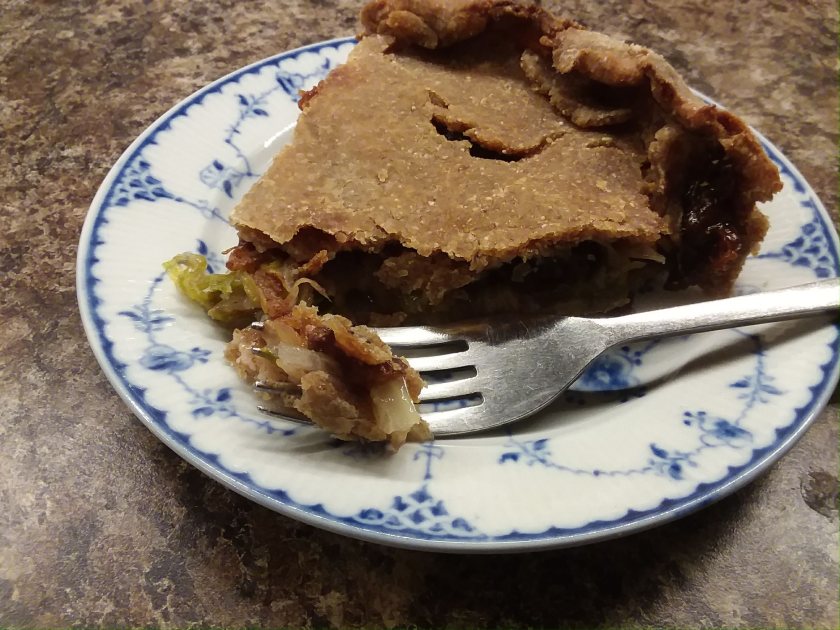 P.S. Whoever invented the phrase ‘easy as pie,’ probably never made a scratch pie.
Sources:
Fischer, Nan. The History of Lettuce: From Ancient Egypt to outer space, lettuce is a well-traveled little plant. Heirloom Gardener, Spring, 2018. www.heirloomgardener
Glasse, Hannah. The Art of Cookery Made Plain and Easy. Cotton and Stewart, 1805. (Facsimile Reprint, Applewood Books, 1997.)
Hess, Karen, transcriber. Martha Washington’s Booke of Cookery. Columbia University Press, 1995.
Randolph, Mary. The Virginia Housewife Or, Methodical Cook. (Fascsimile reprint) Dover Publications,1993.
 BRIC-A-BRAC