Imagine a scribe 4000 years ago, perhaps someone much like myself, interested in what foods go together and how they might taste. This person, who must have really existed, had a clay tablet and a stylus to write down the most important combinations, leaving for posterity a record of what was eaten in Ancient Mesopotamia.
My interest in this food tradition started when my six year old granddaughter was reading about ancient civilizations in her first grade class. Mesopotamia really caught her interest. She wanted to know how they lived and what they ate. So my son decided to make a Mesopotamian meal. Since he is an archeologist he did some research to find out what foods were available. That’s when I learned of several clay tablets written in cuneiform nearly 4000 years ago, around 1750 BC. That is around the time of the Old Babylonian empire and the reign of Hammurabi. The tablets are now part of the Yale Babylonian Collections. Translations reveal they are the earliest known ‘cookbooks’, listing ingredients and offering some directions for preparation. Ancient cookbooks? Of course I’m intrigued.
Very few people in Ancient Babylon could read or write, so these tablets must have been for the scrubs and the royalty. There are recipes for stews and breads and grain products, but what intrigued me the most was the reference to a special cook who prepared pastries (mersu) for the king– a professional pastry chef, if you will. Something very like mersu is still consumed in the Middle East. In Turkish, it’s called cevizli.
The ancient tablets don’t tell quantities or methods for mersu. I’ve only seen the recipes in modernized form. One variety is very simple with only two ingredients: dates and pistachios.
Dates have been cultivated in this region for millenia–at least as long ago as 3000 BC. Pistachios, originating in what is now Syria, are even older, with evidence of their consumption from 9000 BC. So while I’m not sure this is exactly what is meant by mersu in the ancient cookbooks, I am confident the ingredients were available, and the ancient Mesoptamians used them together.
Recipe:
¾ c. dates
1/2 c. pistachios
Mash the dates. Chop and mash the pistachios separately. Mix the date mash with half of the pistachios. Make into small balls, (Wet your fingers to make them easier to roll) Roll the balls in the remaining pistachios.
Back when my kids were little, we often made peanut butter balls, in much the same way: using a mixture of nuts, honey, and wheat germ. I can imagine a royal Mesopotamian mother offering her child a snack of mersu, and popping one in her own mouth at the same time. Plus ça change…
Historic food – A Mesopotamian sweet from 1750 BC. despite the snow. January 17, 2019. Retrieved Dec. 21, 2024. https://despitethesnow.wordpress.com/2019/01/17/a-mesopotamian-sweet-from-1750bc/
Oats and Beans* and Barley Grow
Oats and Beans* and Barley Grow
But you nor I nor anyone know
How Oats and Beans and Barley Grow
(Children’s rhyme and circle game first mentioned in Joshua Cushing’s The Fifer’s Companion (1790)
*In some versions peas or wheat is substituted for beans.
We don’t hear a lot about barley these days, but it is, in fact, one of the oldest grains, first cultivated around 9000 BC in the Fertile Crescent. From there, barley diverged and spread through Asia, Europe and Africa with different varieties thriving in different places. I came across one such variety on a recent visit to Orkney.
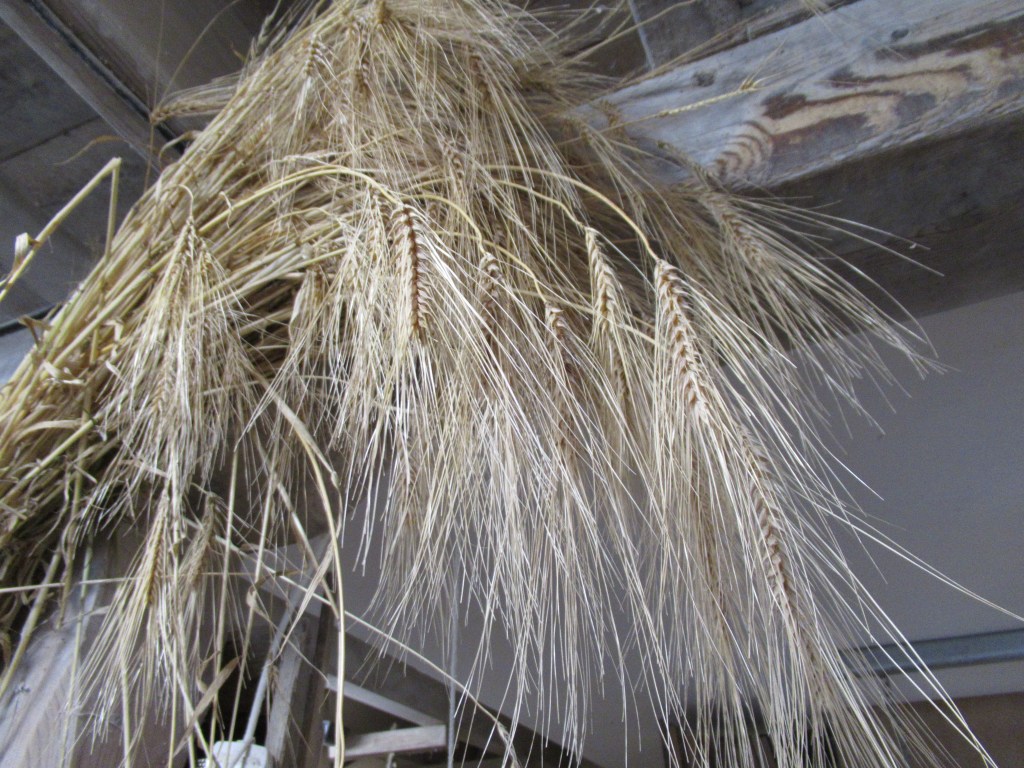
Bere (pronounced close to bear or bare) is a six row barley variety that has been grown in the Orkney Islands of Scotland, for around 5000 years. It is a fast growing barley, sometimes called 90 day barely, well suited to the long summer days and longer winters in Northern climates. Besides growing well in the Orkneys, bere is very nutritious, having more protein than modern two row barleys.
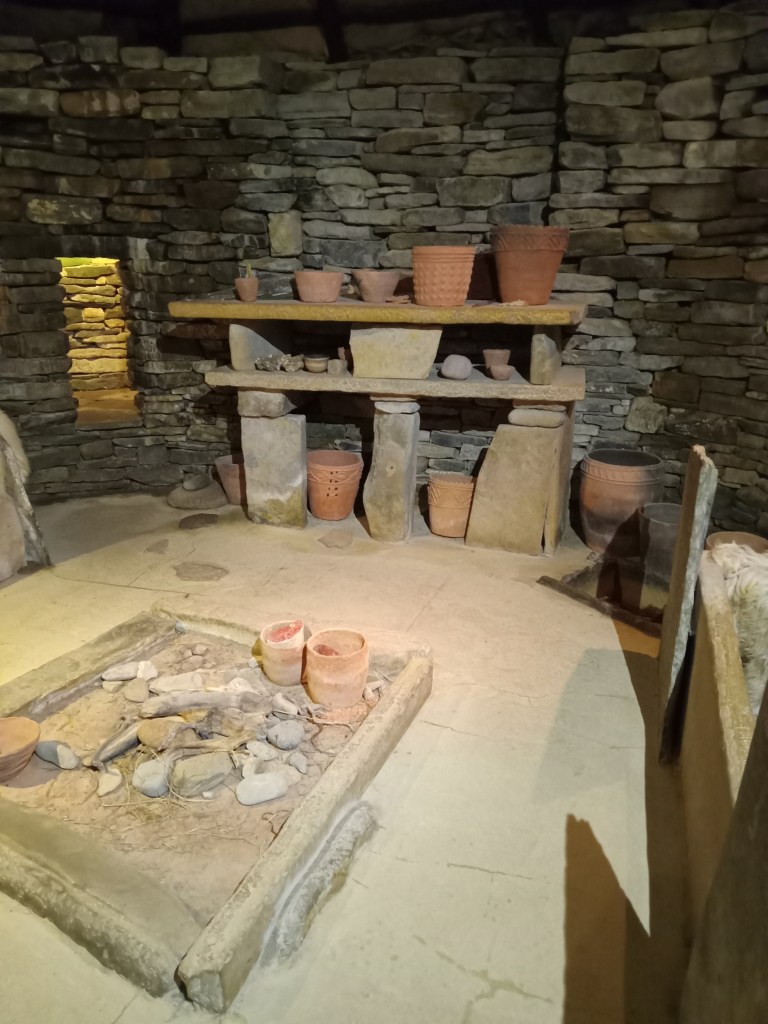
Reconstructed neolithic house in Skara Brae
Early neolithic sites in Orkney include evidence of bere cultivation and processing. Centuries later, Pictish farmers grew bere. When the Nore came, the discovered bere was very similar to their barely variety which they called bygg.
A conversation with my son, an archeologist, leads me to hypothesize that the neolithic farmers did not bake bread or bannocks with bere, but made a grain porridge, either boiling bere meal and water in a clay pot on the hearth fire, or adding hot stones to the water and meal in the clay pot. It is likely they added other things to this porridge also, probably berries, seaweed, small rodents, fish, or anything else they planned to cook and eat. My son also reminded me that a pot of grain porridge left unrefrigerated ferments. These fermented porridges were mildly alcoholic and led to some of the first beers produced. I find it interesting to note that beer, potion, and poison probably all come from the same proto-indoEuropean root *po(i) to drink.
Neolithic people used a saddle quern to grind the grain. The grinder, probably a woman, would kneel, and rub a stone back and forth over the grain in the bowl of a larger stone. The oldest saddle quern found in the Orkeneys was dated to 3,600 BC and found at Knap of Howar on Papa Westray.
By the iron age, the saddle quern was replaced by a pair of flat mills stones, in which the upper one rotates. And then by the viking era, some mills were converted or built to use water power .
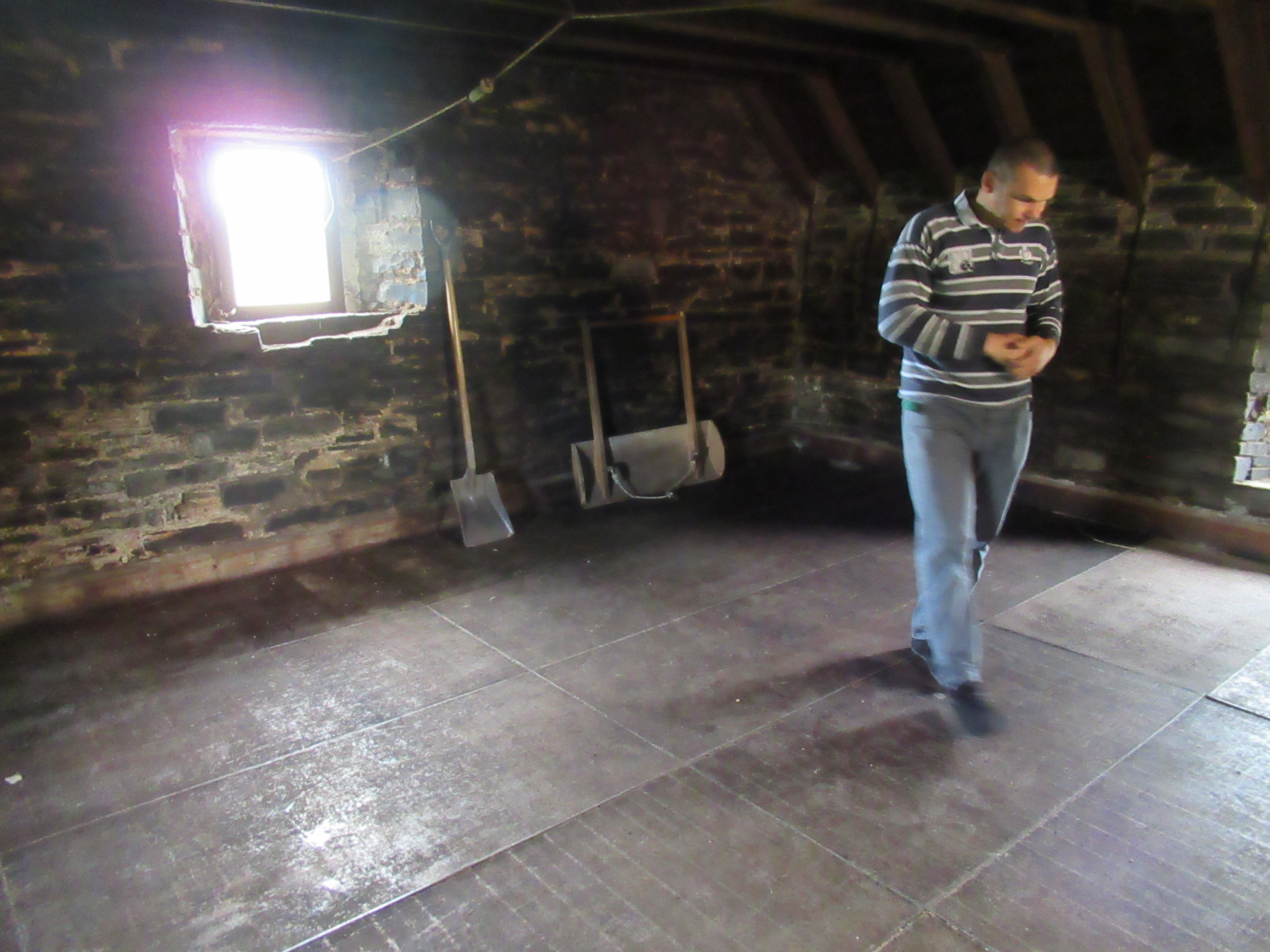
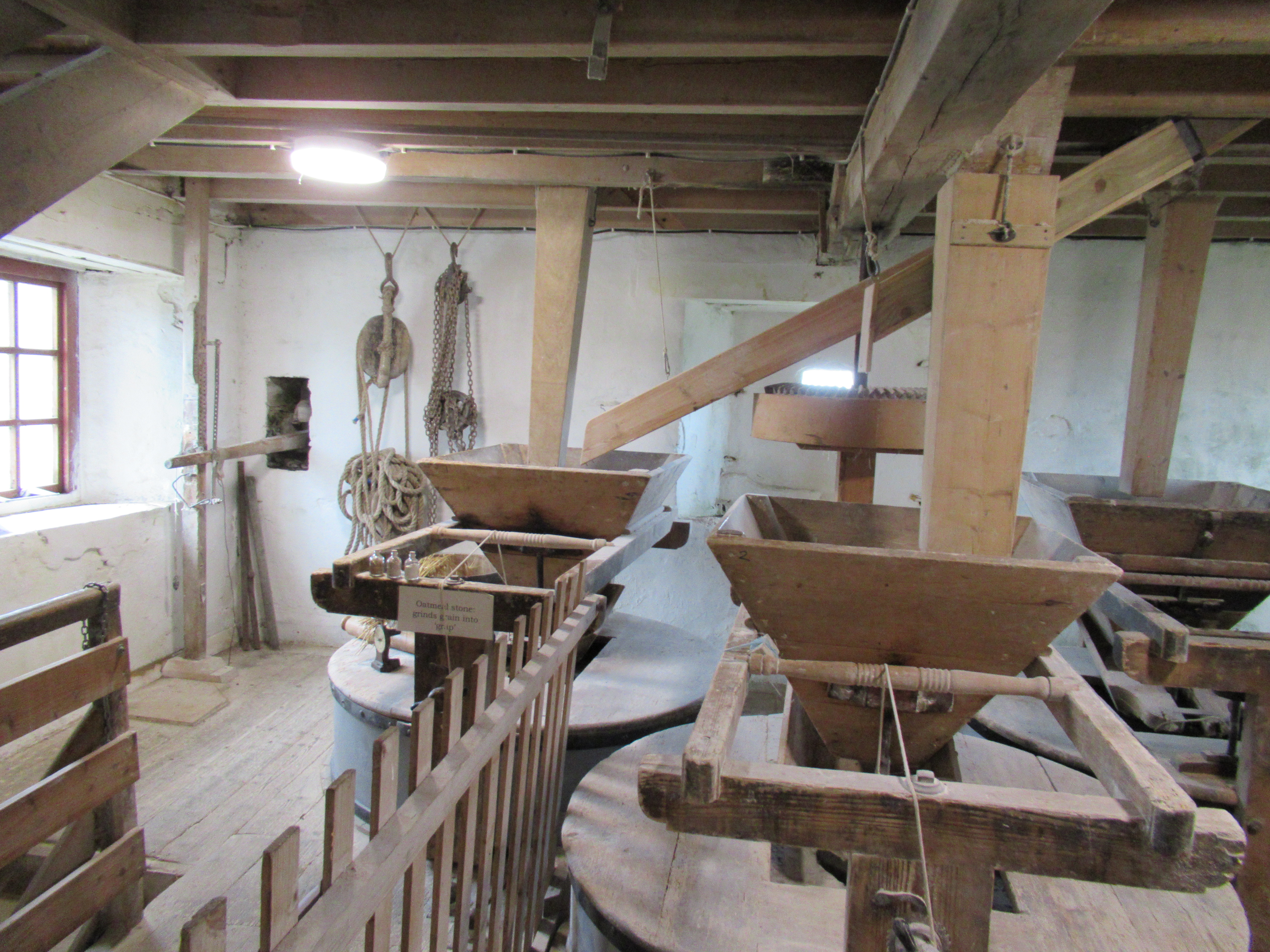
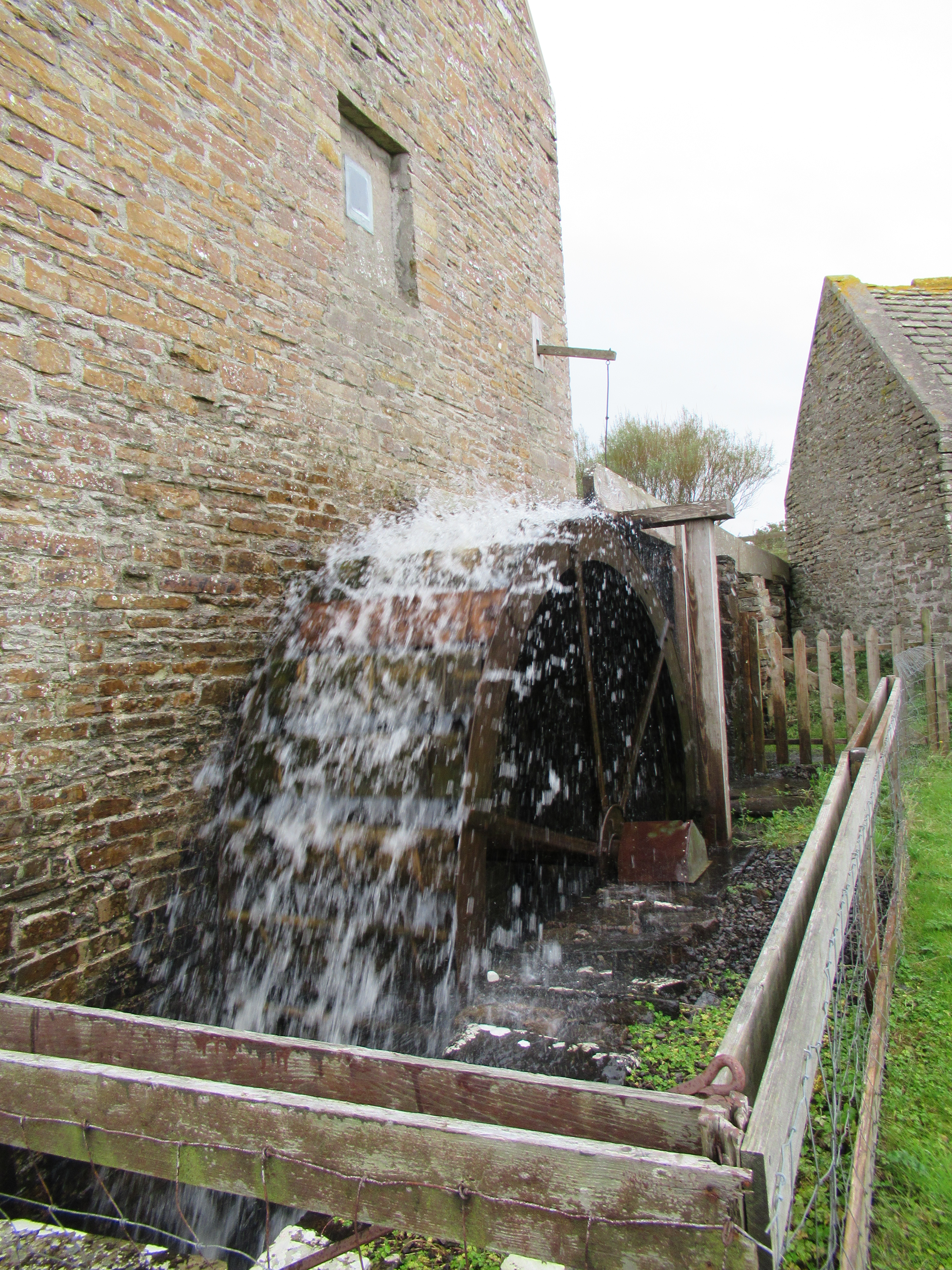
Nowadays, the Barony Mill, run by the Scottish Heritage Trust in Birsay, Orkney is the only mill still processing bere. The mill here has been in operation for over 300 years using an overshot waterwheel. I learned it takes two and a half days to process a load of bere. It must be dried, then ground through 3 wheels to remove the husk, crush the grain, and finally grind it into flour.
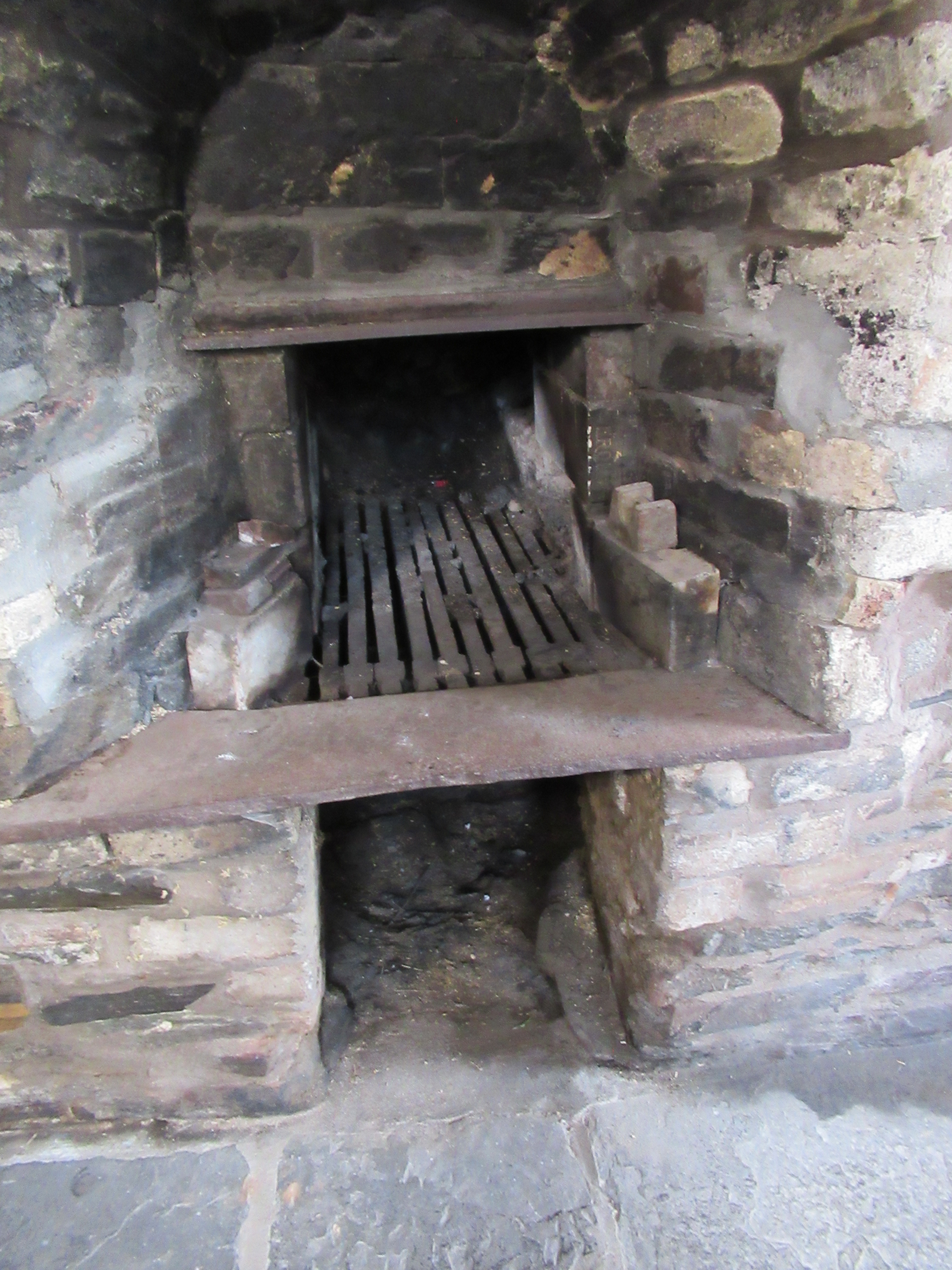
Views of Barony Mill: Drying oven, drying floor, grinding wheels, water wheel
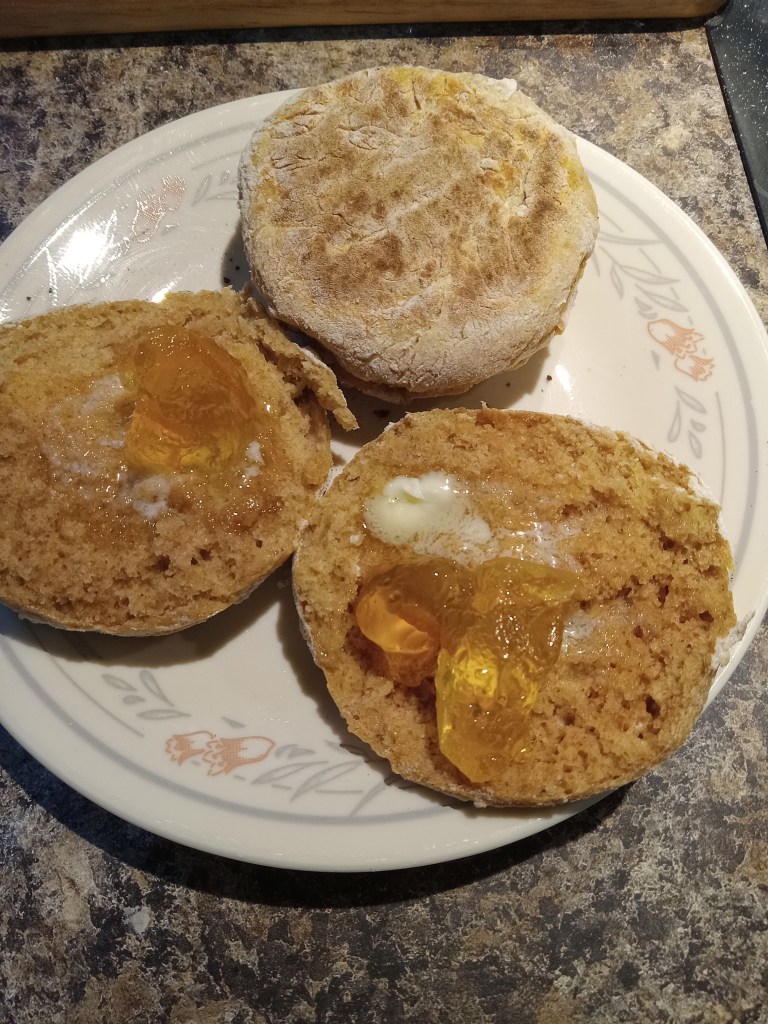
Of course, I had to buy some bere flour, and bring it home to try out. So far I’ve made an apple cake and several types of bannocks. Bannocks, originally unleavened, flat cakes of barley or oat baked like pancakes on a flat stone, that had been heated in the fire.(later a griddle was used)
Early 1800’s unleavened bannocks:
300 ml (½ pt.) milk
25 gr. (1 scant oz) butter
230 gr. 8 oz. bere meal
1/4t. Salt.
Heat the milk and butter, add salt and meal to make a soft dough. Knead lightly, roll out about ¼” thick. Fry in a lightly oiled pan or griddle. Flip to finish. Makes 2 small bannocks
After baking soda and cream of tartar came into common use in the middle of the19th century, bannocks, along with all other quick breads, underwent a major revolution. Bere Bannocks made today are light and airy like a scone. There are several recipes available for bere bannocks, One of the best sources is Barony Mills: https://baronymill.com/orkney-bere-bannocks/
Unfortunately, as far as I know, bere meal is unavailable in the United States as it is only sold in the UK. Perhaps that’s one more good reason for a trip to Scotland.
Sources: Ashworth, Liz. Book of Bere. Berlin LTD, Edinburgh, 2017.
You know how some words just mean what they sound like they should mean? I’m not talking about onomatopoeia, where the word imitates a sound. I’m talking about a certain mouthfeel where the sound and the meaning align perfectly. Maybe its just me, but I think steeple sounds pointy and blubber sounds bouncy.
Flummery is such a word. I think it sounds delicious, like a fluffy, sweet treat. But the problem with my whole theory is that such sound and meaning correlations are entirely subjective.
I discovered this with flummery. When I first proposed making it, my friend, without knowing anything about what it is, was decidedly uninterested. She thought it sounded horrible.
So I conducted a very informal survey, asking a little over a dozen people what they thought flummery means.
Answers varied from scam artist and buffoon to a fluffy dessert and a dish with barberries to everything in between. Turns out, most of them were at least partly right. Flummery is one of those words that has acquired a great many diverse meanings. Etymonline says flummerymeant a sour oatmeal jelly (from the Weslh ‘llymru’) in the 1600’s, then a sweet dessert in the 1700’s and flattery or empty talk, also in the 1700’s. Dictionary.com gives several meanings including boiled oatmeal, fruit custard, or foolish humbug.
There are as many variations in flummery recipes as there are in flummery definitions. The main thing all the flummery recipes have in common is that the dish is usually some sort of custardy gelatin, with more emphasis on either the custard or the gelatin, depending on the recipe. Even boiled oats have a custardy, gelatinous or even gooey texture. Flummery may or may not include any of the following ingredients: oatmeal, harsthorn, cream, almonds, jelly, calves feet, isinglass, eggs (yolks and/ or whites), wine, rose water, orange flower water, or sugar.
The first flummery I made was a sort of overnight (or over three days) oatmeal, using a recipe from John Towhnshend (p. 202). It involved soaking oatmeal in water for three days, straining off and replacing the water every day. After this soaking, the oatmeal is boiled until thick, put in molds, and served cold with wine and sugar. (The recipe also suggests beer and sugar or milk.) Even though I never would have associated oatmeal with wine, this dish was surprisingly good. Not great, but good enough to enjoy.
Another simple recipe for flummery is in Mary Randolph’s The Virginia Housewife Or, Methodical Cook (p.119) This is more pudding than jelly, and involves mixing equal measures of cream and jelly with half a measure of wine. This produces a very soft custardy dish that is very rich. I think it is best used as a sauce.
Since I didn’t have hartshorn or calves feet, I decided to try one of the isinglass recipes, such as French Flummery.
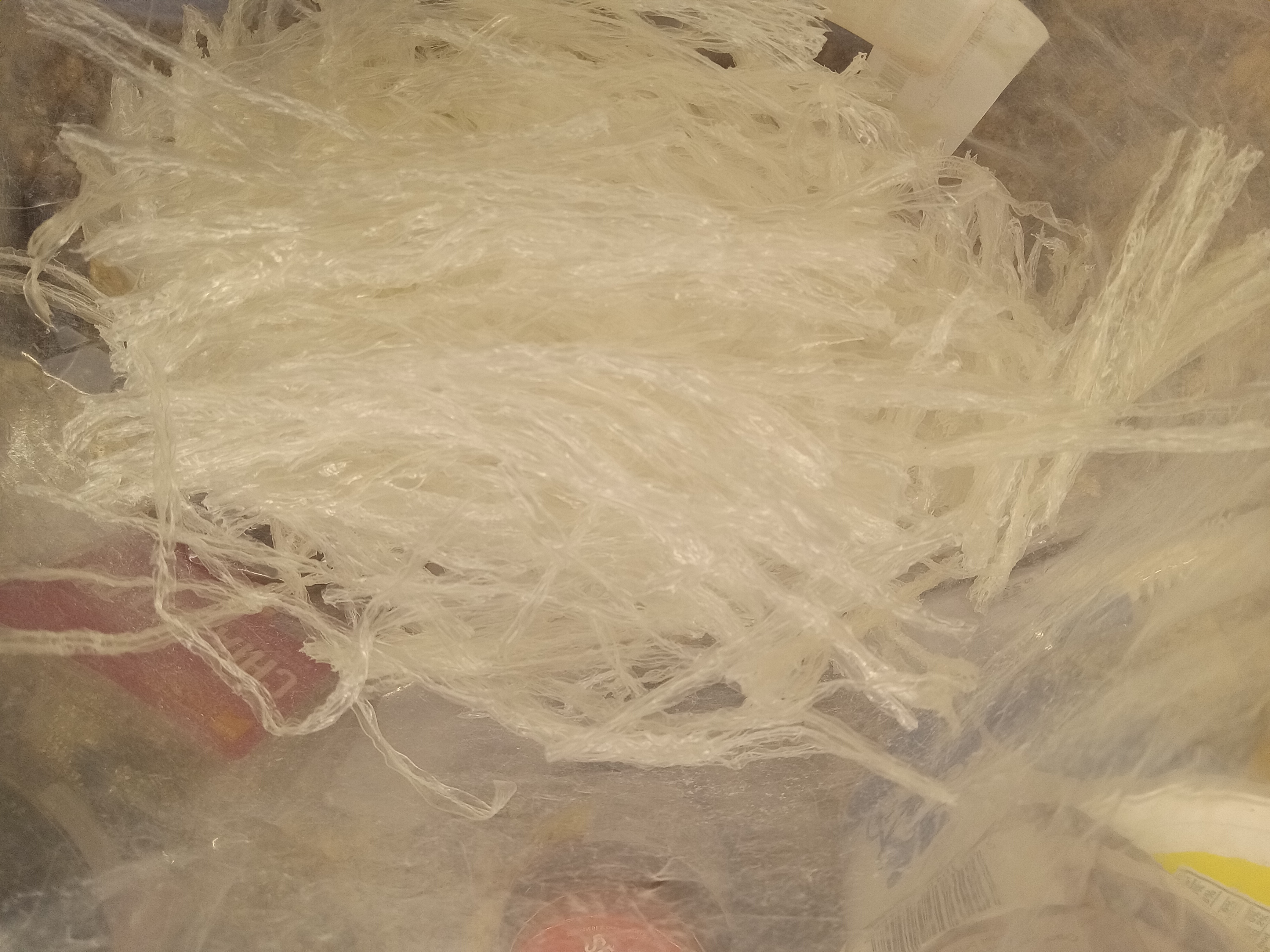
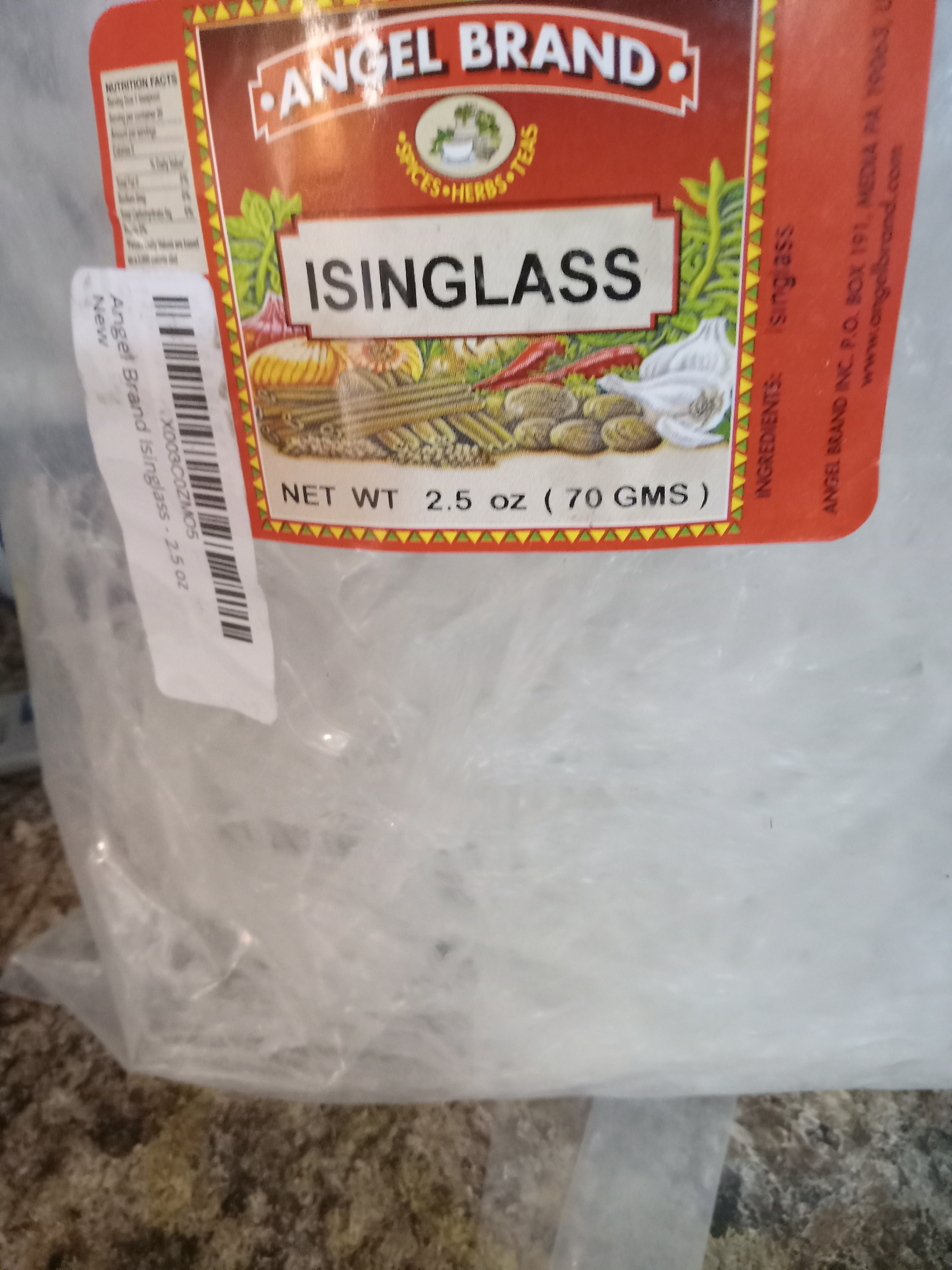
Identical recipes for French flummery appear in both John Townshend’s and Hannah Glasse’s books. (Many cookbooks following Glasse copied her recipes, often word for word, as does Townshend’s recipe) French Flummery is made with isinglass. I had no idea what that was. A little research taught me that isinglass is the dried swim bladders of fish, especially sturgeon. It has been used for centuries in making jellies (and coincidentally, glue). Today isinglass is available from the Amazon marketplace.
To Make French Flummery
Take a pint of cream and half an ounce of isinglass, beat it fine, and stir it into the cream. Let it boil softly over a slow fire a quarter of an hour, stirring all the time; then take it off, sweeten it to your palate and put in a spoonful of rosewater, and a spoonful orange-flower water; strain it and pour it into a glass or basin, or what you please, and when it is cold, turn it out. It makes a fine side dish. You may eat it with cream, wine, or what you please. Lay round it baked pears. It both looks very pretty, and eats fine. (Glasse, 186, Townshend,203)
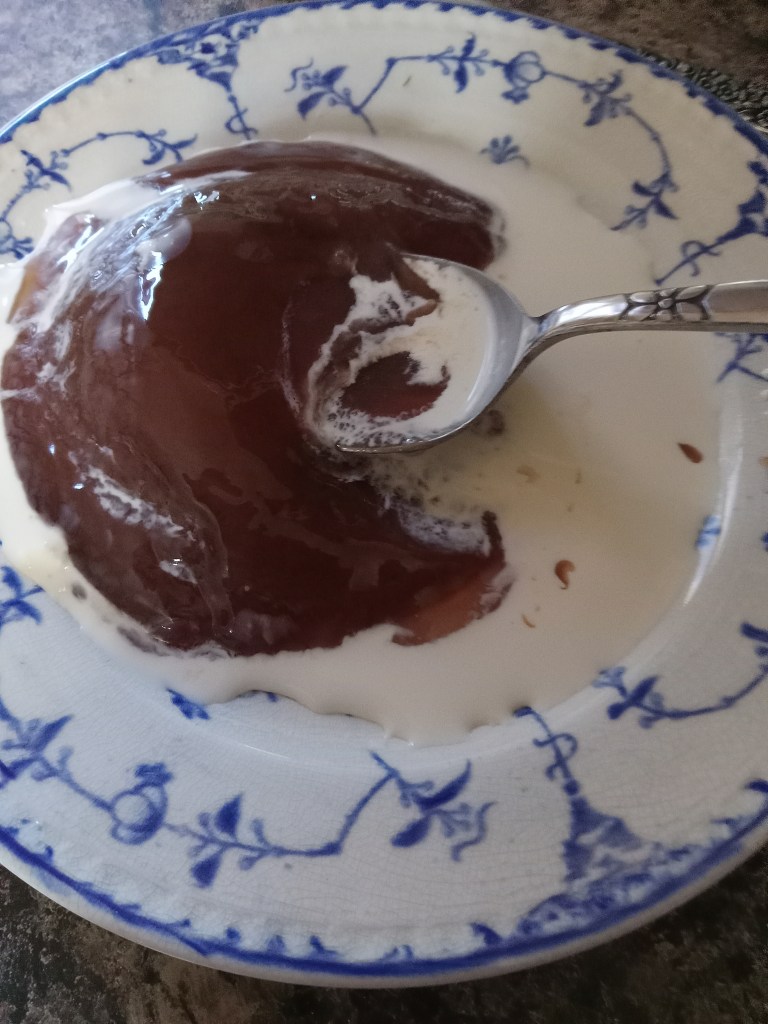
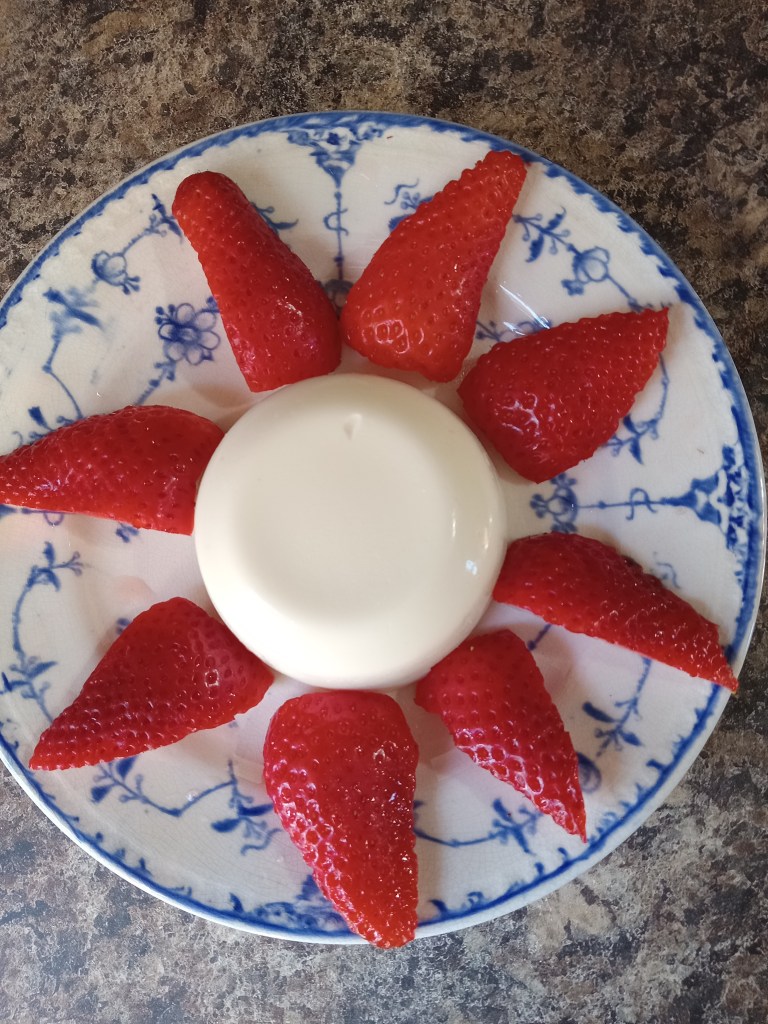
I used 2 cups of cream, ¼ cup of sugar, 1 teaspoon each of rosewater and orange flower water, and ¼ ounce of isinglass. The first step was to powder the isinglass. It comes in 3 -4 inch long translucent ribbons. They are slightly rubbery, which meant that trying to powder them in a mortar was an exercise in frustration. I resorted to using a blender. My ¼ ounce of isinglass made 2 Tablespoons in powdered form. I cooked the cream and isinglass mixture long enough that the powdered isinglass had been absorbed. (about twenty minutes.) Then I added the sugar and waters, and cooked it until the sugar was melted. I put the mixture in custard cups and cooled them. As it cooled, the pudding separated into two layers, making an interesting appearance.
I made this in spring, when strawberries were in their prime, so I used them instead of baked pears. I expect Hannah would approve.
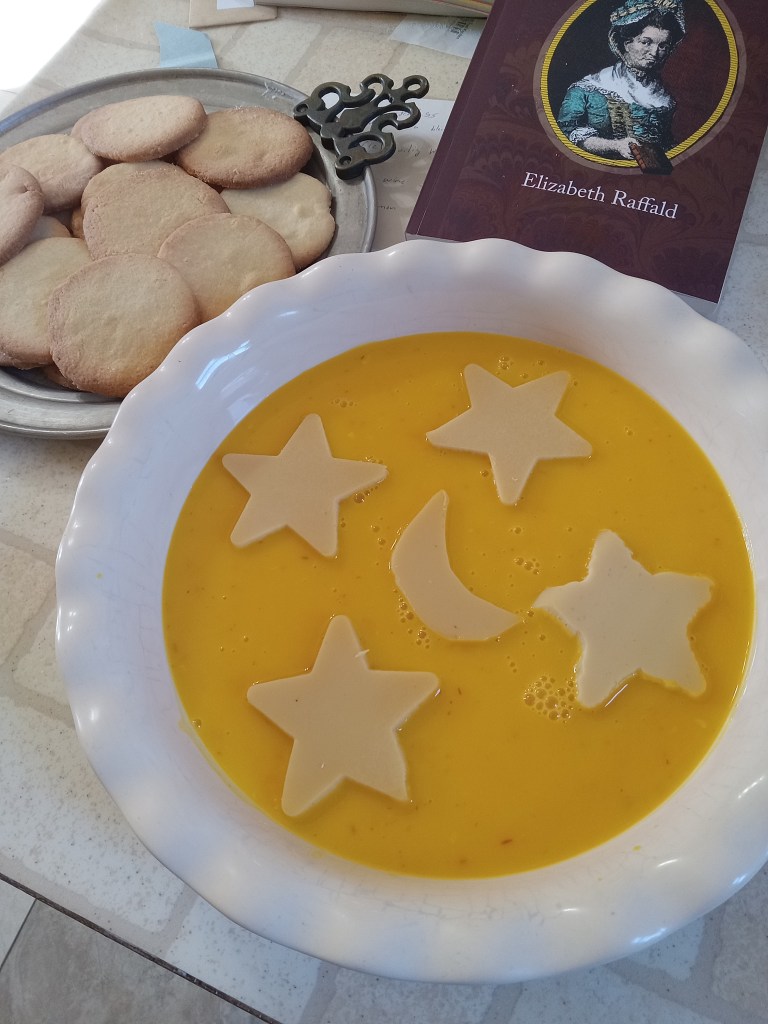
Flummery in many forms graced some fancier tables. Elizabeth Raffald, an English housekeeper who worked in Lady Warburton’s home for many years, gives several recipes for coloring flummery so that it could be used in many decorative dishes. In addition to the Moonshine described below, she has recipes for Eggs and Bacon Flummery, Solomon’s Temple in flummery, and Cribbage Cards in Flummery, among others. In medieval times, this use of food to create an edible centerpiece was called a subtlety.
I decided to make the Moonshine, as the name conjures up a more potent drink rather than a sweet dessert.
Moonshine Note Hannah Glasse has a moonshine recipe that is similar to, but not the same as, the one I made.
To Make Moonshine
Take the shapes of a Half-moon, and five or seven stars, wet them and fill them with Flummery, let them stand ‘till they are cold, then turn them into deep China Dish, and pour Lemon cream round them, made thus: Take a pint of Spring Water, put to it the juice of three Lemons and the yellow Rind of one Lemon, the Whites of five Eggs, well beaten, and four Ounces of Loaf Sugar, then set it over a slow Fire and stir it one Way till it looks White and thick; If you let it boil it will curdle, then strain it through a Hair Sieve, and let it stand ‘till it is cold, beat the Yolks of five Eggs, mix them with your Whites, set them over the Fire, and keep stirring it ‘till it is almost ready to boil, then pour it into a Bason; when it is cold pour it among your Moon and Stars: Garnish with Flowers.
It is a proper Dish for a second Course, either for Dinner or Supper. (p. 178)
For the Flummery, I used Raffald’s recipe for Yellow Flummery.
Take two Ounces of Isinglass, beat it and open it, put it into a Bowl, and pour a pint of boiling water upon it, cover it up ‘till almost cold, than add a Pint of White Wine, the Juice of two Lemons with the Rind of one, the Yoiks of eight eggs beat well, sweeten it to your Taste, put it in a Tossing Pot and keep stirring it, when it boils strain it thro’ a fine Sieve, when almost cold put it into Cups or Moulds. )p. 172)
Both of these recipes use a lot of eggs, so I cut them down.
First I made the Flummery:
1 ounce isinglass (powdered in a blender)
1 cup boiling water
1 cup white wine (choose a sweet rather than dry white)
Juice of 1 lemon and the yellow rind of half of it
4 egg yolks
½ c. brown sugar
Pour boiling water on the isinglass, and stir until the isinglass dissolves. Add the remaining ingredients and bring it slowly to a soft boil. (Don’t let it boil hard.) Strain it through a fine strainer. Pour it into a flat dish, either 8 by 8 or 9 x 13”. Let it cool, then cut it into the shapes of stars and moons. ) Cookie cutters or a drinking glass works well.
While it is cooling, make the lemon cream.
2 cups water
½ cup lemon juice
2 Tablespoons grated lemon peel
2 eggs, separated
1 cup sugar
½ teaspoon saffron (optional)
Mix the water, lemon juice, lemon peel, sugar and egg whites in a saucepan. Cook slowly, stirring constantly until thick. Do not let it boil. Mix a little of the hot mixture into the egg yolks, (to prevent curdling) then add the egg yolks to the saucepan. Cook, stirring constantly, until it is almost ready to boil. Note: in order to make a greater contrast between the flummery moon and stars and the lemon cream, I added a half teaspoon of saffron to the lemon cream along with the egg yolks. Saffron was not included int the original recipe, but it was known and used as a coloring agent in Raffald’s time, so I feel she would approve..
Put your flummery cut-outs in a flat dish or pie plate, and pour the lemon cream around them. Let cool and serve.
This was the tastiest of the flummery dishes, but the flummery shapes were quite rubbery. I think the same recipe with less isinglass would work as well, or better.
In spite of its versatility, I don’t see a resurgence of flummery is likely. All of the flummery dishes I made tasted interesting, and some were even pretty good. However, we have easier methods of making jellied desserts. Still, flummery is such an intriguing word, perhaps its meaning will evolve again. Can you imagine marshmallow flummery?
Sources:
Glasse, Hannah. The Art of Cookery Made Plain and Easy: Excelling any Thing of the Kind ever yet published. Alexandria: Cottom and Stewart. 1805. (First Edition published in London, 1747. This edition reprint of 1st American Edition, 1805, by Applewood Books, 1997).
Raffald, Elizabeth.The Experienced English Housekeeper. Originally published 1769, Manchester, England. This reprint published 2024, Townsends.
Randolph, Mary. The Virginia Housewife Or, Methodical Cook. Philadelphia: E. H. Butler & Co., 1860. (Facsimile by Dover Publications, 1993, with introduction by Janice Bluestein Longone).
Townshend, John. The Universal Cook or Lady’s Complete Assistant. S. Bladon: London, 1773 (facsimile).
Norfolk Dumplings with a lump of butter (top dumplings are with a thicker batter.)
Noodles have been eaten for millennia, probably originating in the Middle East and spreading both east and west into Asia and Europe; however, the word ‘noodle’ is first attested in English as late as 1779. Various noodle-like dishes were called by many different names, from “thin foyles [leaves] of past” in (Curye on Inglysch) in 1390 for what is basically a lasagna recipe, to “macaroni” from an Italian dialect in the 1590’s. (In the well-known Revolutionary War song about Yankee Doodle and his hat, “macaroni” refers to dandies, or overly fashionable young men, rather than any type of pasta.) Thomas Jefferson is credited with bringing the first ‘macaroni’ machine to the young United States in 1789.
In modern parlance, a dumpling seems far removed from a noodle. One is thick and doughy, the other thin and slimy. However, though their preparation is different, (noodle dough is kneaded, rolled thin, and cut in strips, while dumpling dough is dropped by lumps into boiling liquid) they share nearly the same ingredients (flour, eggs, and salt) and both are boiled in hot liquid. Besides this culinary connection, there is a linguistic overlap between the two words. The word dumpling comes from the 1600’s from a Norfolk dialect of uncertain origin. Knödel: German for dumpling, and perhaps the origin of the word noodle (first attested from 1779). It seems to me some cook mixed up the German word for dumpling with the flat, thin, pasta that came to be known as a noodle.
I could not find recipes for noodles, macaroni, or pasta in my earliest American cookbooks. Although by the 1830’s there were recipes for making and using macaroni, the first pasta company in the United States didn’t open until 1848. However I did find many different dumpling recipes, specifically Norfolk-dumplings.
Norfolk dumplings are surprisingly simple and tasty, with a texture somewhere between a slippery noodle and a biscuity dumpling. The following recipe comes from Hannah Glasse’s The Art of Cookery, page 111. book, though the exact same recipe is also found in Townshend’s The Universal Cook, p. 158.
“Mix a good thick batter, as for pancakes; take a half pint of milk, two eggs, a little salt, and make it into a batter with flour. Have ready a clean saucepan of water boiling, into which drop this batter. Be sure the water boils fast, and two or three minutes will boil them; then throw them in a sieve to drain the water away; then turn them into a dish, and stir a lump of fresh butter into them: Eat them hot and they are very good.”
I used ½ c. milk, 1 egg, ½ teaspoon salt, and 1 cup of whole wheat flour to make a batter the consistency of pancake batter and dribbled the batter into the water by spoonfuls. The result was like a thick, rather lumpy noodle. Adding more flour to make a thicker dough, resulted in a more biscuit dumpling.
So if you want something similar to a homemade noodle, but are pressed for time, the Norfolk dumpling is a reasonable alternative.
References:
Curye on Inglysch: English Culinary Manuscripts of the Fourteenth Century (Including the “Forme of Cury”) Constance B. Heiatt (Editor), and Sharon Butler (Editor). Oxford University Press; 1st Edition edition, 1985.
Glasse, Hannah. The Art of Cookery Made Plain and Easy: Excelling any Thing of the Kind ever yet published. Alexandria: Cottom and Stewart. 1805. (First Edition publishing in London, 1747. This edition reprint of 1st American Edition, 1805, by Applewood Books, 1997).
Townshend, John. The Universal Cook or Lady’s Complete Assistant. S. Bladon: London, 1773 (facsimile).





 BRIC-A-BRAC