 Because it’s there.
That, of course, is the standard answer to the age old question: Why cross the unknown sea? Why brave the harsh desert? Or in this case, why climb the mountain?
The real question is why do people, myself included, challenge personal limits and seek out adventure?
There is no doubt thousands of people do just that. Witness the number of tourists to Peru each year, most of whom come to Machu Picchu.
Rest assured, any visit to Machu Picchu involves challenges on a variety of levels. Even at its easiest– taking a train to Aguas Calientes, a bus up the narrow, steep, winding one-lane road without guardrails, and walking/climbing hundreds of steps to rock-strewn terraces- getting there is daunting. The hardest way to get to Machu Picchu is walking in on the Inca Trail–four days of grueling hiking at high altitude.
I opted for the middle level challenge–the one day hike from Kilometer 104. It’s about six miles long, with 2,600 feet rise in elevation. That hike ranks as one of the hardest and most rewarding hikes I’ve ever done.


So, why go?
I first heard of this mysterious Inca city in grade school. The city had been swallowed by the jungle, abandoned and forgotten in the centuries following the Spanish Conquest of Peru. Sure, local farmers still knew of the ruins in the shadow of the mountain they called Machu Picchu, but the rest of the world did not. Most importantly, the Spanish conquistadors had not plundered or defaced the place. In 1911, Hiram Bingham–one of those intrepid adventurers seeking challenge– found the city in his quest for Vitcos, the last capital of the Inca state. His pictures of this mysterious city emerging from the thick vegetation intrigued me.
To get to Machu Picchu (which means old mountain) I took the train from Ollantaytambo to Kilometer 104. There isn’t really a station there, just a place where the train stops. Amid the cheers and calls for good luck from my fellow travellers who had not opted to walk in, my guide, Marcelino, and I left the train and crossed the Urubamba River.
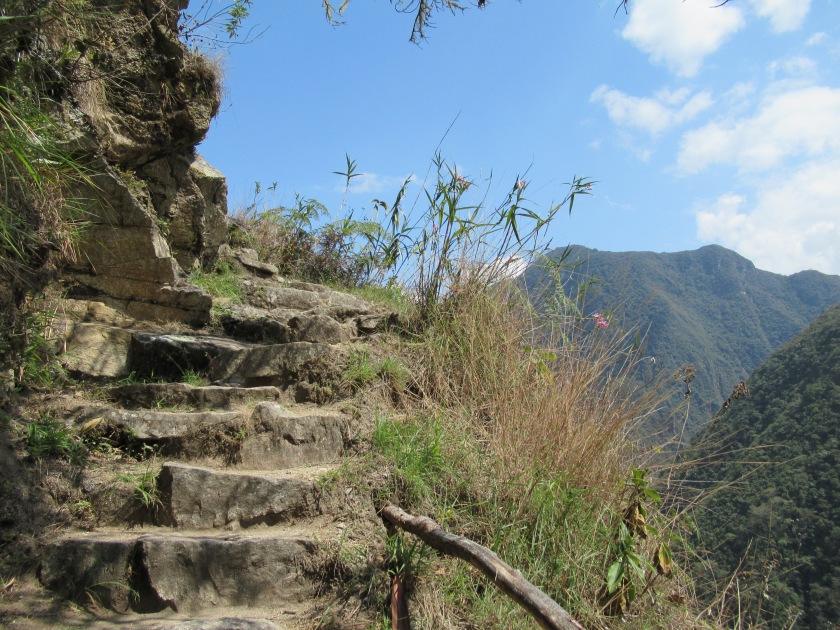
We set off, slow and steady, walking up…and up…and up some more. The trail was rocky, narrow in places, and fairly steep. I had to stop and suck air often.
We walked on the windy side of the mountain, across the river from the train. We soon lost sight of the tracks, though we could hear its echo across the valley from time to time, and occasionally we saw another train.
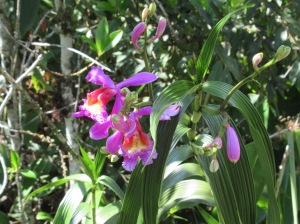
The sky was clear, and so it was very hot as we walked. The tall grasses on the mountain side were dry-season brown, but it is still a tropical cloud forest. Besides the overwhelming majesty of the mountains surrounding us were smaller glories. Nestled among the craggy rocks are many beautiful orchids
For about 2 ½ or 3 hours we walked mostly uphill on a rocky, narrow path. Sometimes there were uneven steps, carved centuries ago by the Inca. Sometimes the trail was just steep. My legs burned, my breath was ragged, and we stopped often. A few minutes to slow my pounding heart and catch my breath, then on again. I thought about the drop-off edge to my right, wondering what would happen if my legs, wobbly with exhaustion, gave out, and I were to stumble.
Such thoughts made me walk closer to the cliff side of the trail.
At 11:30 I had to stop for a snack. Marcellino assured me we were close to the spot we would stop for lunch. And we were, but first we had to ascend and cross Wiñay Wayna (which means forever young- named after a local orchid.)
Looking up at this Inca agricultural marvel, I was awed by the symmetry of the terraces, by the beauty of the stone work, and by the sheer height of the ruins. Imagine looking up from the bottom of three stadiums stacked, one on top of the other. Tired as I was, I wasn’t sure I could do it.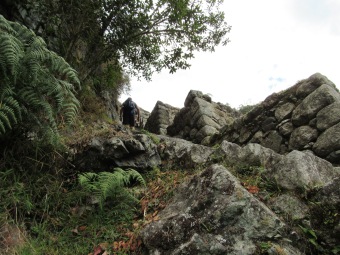
Marcelino had no such doubts and urged me onward. We stopped at each terrace to breathe and rest my ‘spaghetti’ legs. My thighs burned as I clambered up the rugged steps.
Finally we reached the top. Cheering quietly, I sank to rest on a nearby boulder (no shortage of boulders). Looking back across Wiñay Wayna, I felt a dizzying sense of satisfaction, amazed I had made it.
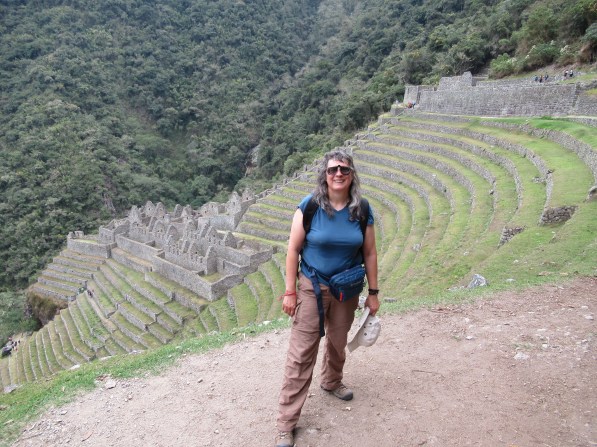
We stopped for lunch shortly after that at the spot where our section of the Inca Trail meets the campsite for the third day of the 4-day trail. Here a bit of rain fell, more like mist from a low cloud, just enough to cool us off.
Refreshed by the rain, the rest, and some chicken and vegetables, Marcelino and I tackled the next bit of the trail, the flat part as Marcelino claimed. Turns out the ‘flat part’ is Inca flat, which really means rolling bumps– up ten steps, down ten steps and so on. We walked this way for another couple of hours, enjoying the parakeets whistling in the trees, bright hummingbirds flitting through the leaves, and dozens of butterflies hovering in patches of sunshine. We paused at a waterfall splashing over the rocks. The misty rain sprinkled off and on, never hard enough to really wet us. The trail here was delightful and much easier- at least on my breath, if not on my knees, one of which started twinging with each downhill step.
The final stretch of the trail was uphill again, steep and rocky, uneven steps for about 45 minutes.
And at the top: the sun gate, (Inti Punku in Quechua) where centuries ago, Inca guards controlled the main entrance to the citadel. I rounded the corner and took in my first view of the marvel of the city below. The sun came out and shone on the citadel as I looked upon Machu Picchu unfolding beneath me.
Tears filled my eyes and a smile stretched across my face. I had done it.
The ache in my legs, the pain in my knees, the exhaustion all disappeared in the satisfaction of mastering the challenge, that moment of sublime joy at reaching a difficult goal. It’s a little bit like giving birth–all the pain and difficulty forgotten in the exhilaration of the reward.
No one knows for sure why Machu Picchu was built and ultimately abandoned, but I can tell you why it’s worth the effort of visiting.
Because it’s there. 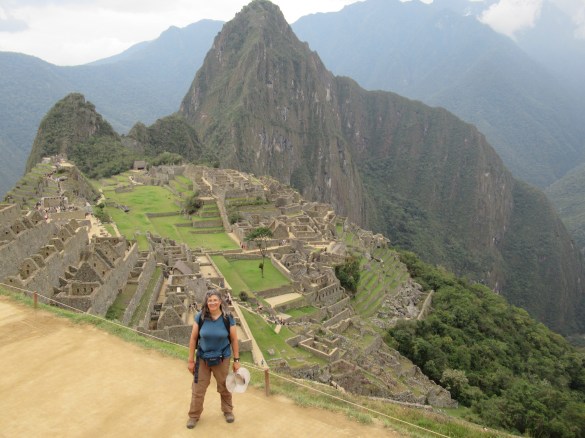
In all its sun-drenched, mist-shrouded, magical glory. It’s there.
 BRIC-A-BRAC
Super-fun read! Keep up the great work:)
LikeLike
The whole thing! But Cloud Forest Orchids …. lovely!
LikeLike
The whole walk was breath-taking (pun intended.)
LikeLike