A Megalithic Portal Tomb

With the coming of St. Patrick’s Day, March is the perfect month to celebrate all things Irish. Though perhaps most famous for the saint that drove away the snakes, Ireland has far more ancient mysteries, including nearly 200 portal tombs, often called dolmens or stone tables. Dolmens usually have three or more standing stones with a (more or less) flat capstone resting on top. Usually two of the standing stones form a portal to the inner chamber. Some evidence suggests that the standing stones and table stone were originally covered with a cairn of smaller rocks, so what we see today is only the skeleton of the neolithic structure.
These neolithic monuments are found in Europe, Africa, and Asia. Like the more famous Stonehenge, the massive stone pillars inspire awe and wonder in the millennia since they were built. Why were they built? How were they built? Who built them? For the most part, these questions remain unanswered. No one knows for sure why the dolmens were built. Many archaeologists consider these monuments to be single-chamber, megalithic tombs, but there is insufficient evidence to be sure. A more intriguing, those less scientific explanation can be found in many legends that have been told explaining the dolmens, including stories of giants buried there, sleeping on top, or using the table stone as a griddle.
One delightful example is the Proleek Dolmen found on the grounds of Ballymascanlon House Hotel in County Louth. This dolmen was built around 3000 BCE. Its portal stones are about 3 meters high, and the capstone weighs over 35 tons. The portal faces westward, toward Slieve Gullion, so that at the summer solstice it is facing the sunset behind the mountain.
Why it’s called the Proleek Dolmen is another mystery. References to this monument in 1895 call it the Puleek Cromleach or Puleek Dolmen. The Irish name is Dolmain Phrollig. One nickname is the Giant’s Load. According to legend, a Scottish giant called Parrah Boug MacShagean carried the stone here. Para challenged the famous Irish hero, Fionn mac Cumhaill. Always more ready to trick his opponents than fight them, Fionn poisoned the Flurry River which runs nearby. Para drank from it and died, leaving Fionn the victor. The legend claims that the Scottish giant was buried in the wedge tomb found about 80 meters from the Dolmen.
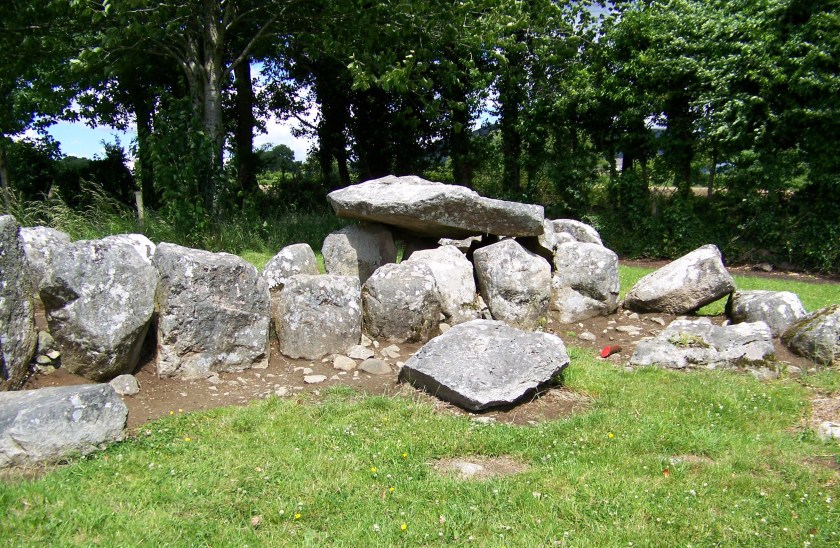
Finding the Proleek Dolmen can be an adventure. With little fanfare and few signs to guide the visitors, this 5000 year old monument to human ingenuity sits in a small clearing on the estate grounds. I’ve been to see the Proleek Dolmen a couple of times on my visits to Ireland, since it is in the same county where my Dad lived. The most recent was a visit with my three sisters. We arrived on a rainy afternoon after a stressful encounter with Irish roads and ditches.



We arranged for both tires on the rental car to be replaced, indulged in a restorative cup of tea in the hotel dining room, then ambled out through the rose courtyard, through a cattle gate, and alongside the fairway of the hotel golf course (where the intrepid tourist must beware of stray golf balls.).
The rain let up by the time we reached the dolmen in a little clearing in the Irish countryside. Legend says that whoever throws a pebble on top of table stone and gets it to stay there, will either (depending on the version) marry within a year or have good luck. Since my sisters and I are already married we hoped for the luck. All of us managed to get the rock to stay on top, though it took me three tries. Perhaps that’s enough to guarantee continued good luck.

Lucky or not, the dolmen is worth the visit. Touching stones lifted into place by nameless hands centuries ago gives a profound sense of awe. Did they mourn for their loved ones? Did they believe the dead would live on, perhaps in a better place? There are no answers. Those who were buried beneath the stones, those who built the tomb, those who loved and cared for the dead are all gone now, unknown and perhaps unknowable. Yet the tomb remains, a mystery and an inspiration.


 BRIC-A-BRAC
What a fun article. Quite a few miles to the north, we visited the Kilclooney Dolmen (that’s the one on the cover of my Circle of Nine book #3). It seems every trip to these mystical and mysterious places ends up with a good story to tell. Happy St. Patrick’s Day to you!
LikeLike
And to you as well! Scotland has a number of standing stones also.
LikeLike
Another tradition says that if your pebble stays atop the stone, you will return one day to Ireland. Since my pebble did stay up, I’m hoping that belief is true! (Thanks for not pointing a finger about WHY we had to replace TWO tires on the car!)
LikeLiked by 1 person
I like that one! I hope I’ll be back someday too. ( And Nno finger pointing, just a lot of good memories; even the troubles make good stories.)
LikeLike