
I’m a big fan of museums, especially historical museums. Best of all are quirky historical museums. Recently my husband and I found ourselves in Houston, Texas with a day of leisure. Houston has many wonderful museums to choose from, but the one we found the most intriguing was the National Museum of Funeral History (NMFH).
What? A museum of funerals? Absolutely.
It may be a bit macabre, but it’s not too surprising that we were drawn to this museum. After all, my husband sells monuments (doublespeak for tombstones), and I have several stories about a guy (Roscoe Gordon) (13 Haunting Tales) who talks to ghosts. The museum has several different exhibits including celebrity funerals, a money casket, casket making, funerals of popes and presidents and Japanese funeral customs, to name just a few.
One of my favorite exhibits is Victorian mourning customs. We learned the length of time a widow matte black in full mourning (a year and a day) and how she could add a bit of black satin to her mourning costume for the next nine months. A widow’s full mourning lasted two years, after which she might go into half-mourning, wherein she wore muted, dull colors. Men did not have such strict customs when it came to grieving, and the length of time of full mourning varied considerably for the death of parents, siblings, grandparents or children
In the 19th century, it wasn’t always easy to tell exactly when someone died. I heard before about coffin bells, which were bells placed on the coffin with a string leading inside so that if the deceased turned out to have been buried alive, he or she could ring the bell, thus calling or help. In the same vein, 19th century wake lasted three days, during which time, mourners kept a close watch on the deceased, just in case he or she woke up. In fact, this practice may be the origin of the word, “wake.”
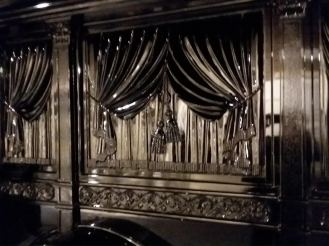
The largest permanent exhibit is of historical hearses. From horse-drawn carriages of the 19th century to the sleek Packard Funeral Bus of 1916, this is probably one of the best collections of rare funeral vehicles. A hearse is much more than a car or wagon. Remember the gruesome kid’s song, “Whenever I see a hearse go by…” A hearse leading a funeral procession makes everyone stop and think about death. It’s like the bell in John Donne’s Meditation 17, when he says, “…never send to know for whom the bell tolls; it tolls for thee.”


But lest our reflections become too somber, think about the hearse as a sometimes opulent and always powerful statement honoring the dead. When I was in Ireland several years ago for my father’s funeral, everyone we saw along the streets and lanes, stopped and removed their caps as the hearse carrying Dad passed by. I was very touched by this sign of respect, as if all these others, strangers though they were, shared in my own mourning.
In spite of its focus on death, the museum has its share of whimsy, especially in the elaborate fantasy coffins of Ghana. In Ghana, death is seen as a transition to a spiritual realm. The coffins are designed to reflect the character of the departed. They include fancy cars, animals such as a crab or chicken, a shallot, and even an outboard motor.
 My favorite kind of history is the exploration of how people in the past dealt with the problems of living. In their fascinating displays about how other people have dealt with the problems of dying, National Museum of Funeral History earns my recommendation. And who knows…another Roscoe Gordon story could come out of our visit there.
 BRIC-A-BRAC
Fascinating!
I would enjoy visiting museums with you.
LikeLiked by 1 person