 Ask a dozen people about mincemeat and you’ll like get one of two answers. Some will fondly remember how their mother or grandmother made mincemeat pies. Most of the rest will say, “Huh? What’s in that anyway? Does it really have meat in it?”
The answer is … complicated. Modern mincemeat is a spicy mixture of mostly apples and raisins. But if you go back a ways, mincemeat was indeed a pie made with chopped meat.
Some of the earliest recipes for mincemeat I have found date from the 14th century. These heavy, elegant pies were inspired by the Crusaders, bringing home ideas of new, exciting spices like cinnamon and nutmeg from the Middle East. It was common in the Middle East at that time to serve meat sweetened with fruits and spices. It became popular in England to recreate these exotic dishes, especially for elegant feasts meant to impress the neighbors in the holiday season.
These medieval mincemeat pies could be made from any type of meat, including mutton, veal, pork or venison. Some recipes even call for fish in a mince pie to serve on fish days when the church forbade eating meat. The mixture usually called for prunes, currants, raisins, and/or dates.
These pies were baked in a coffin, which is a thick, heavy crust, often rectangular shape. (Note: coffin comes from the French word for chest–like the modern word–coffer. The word ‘coffin’ was used to mean a pie crust from as early as the 14th century. The meaning of a box for burying a dead person came later, from 1520.) Meat pies in the Middle Ages were meant to be kept for months, with the thick crust helping to preserve the pie.
One more confusing note in the history of mincemeat is the word ‘meat.’ Although the earliest mincemeat pies did have chopped veal, pork, or other meat in them, the word ‘meat’ didn’t mean what it means today. Originally, in Old English, ‘meat’ meant food, any type of food. It wasn’t until the 13th century that the sense of the word narrowed to mean flesh meant for eating. Even as late at the 15th century, vegetables might be called ‘grene-meat.’ So the name mincemeat, could easily refer to all the chopped ingredients in a mincemeat pie.
Like meatloaf today, mincemeat over the years has had many variations, in the spices used, the type of fruit, and the crust. By the 18th century, crusts were flakier and apples and raisins were usually included in the recipe. It wasn’t until the late 19th and early 20th century that mincemeat lost the meat. As late as 1941, some mincemeat recipes still cared for meat (usually beef).
The real change came in 1898 when dried or canned mincemeat (such as Nonesuch) was developed. This mixture of apples, raisins and spices was one of America’s first convenience foods. As with many pre-packaged, prepared foods, people lost track of what exactly was in that jar or box of mincemeat.
Unfortunately, as popular tastes changed, pies were more commonly relegated to the dessert course. Homemade pies have given way to more store-bought desserts. Gradually, the taste for mincemeat has declined. Most people I talk to are leery of a sweet meat and fruit mixture.
But old-fashioned mincemeat is definitely worth trying. The recipe I’ve included here is from 1833. (Mrs. Child, The American Frugal Housewife. Dedicated to those who are not ashamed of economy). The modern version I developed makes 4-5 pies, but can be easily cut in half.
And if you still don’t want meat in your pie? That’s okay. You can omit the meat and make a spicy, apple and raisin pie –perfect for the Holiday season.


1833 Recipes: Mince Pies.
Boil a tender, nice piece of beef–any piece that is clear from sinews and gristle; boil it until it is perfectly tender. When it is cold, chop it very fine, and be very careful to get out every particle of bone and gristle. The suet is sweeter and better to boil half an hour or more in the liquor the beef has been boiled in; but few people do this. Pare, core, and chop the apples fine. If you use raisins, stone them. If you use currants, wash and dry them at the fire. Two pounds of beef, after it is chopped; three quarters of a pound of suet; one pound and a quarter of sugar, three pounds of apples; two pounds of currants, or raisins. Put in a gill of brandy; lemon-brandy is better, if you have any prepared. Make it quite moist with new cider. I should not think a quart would be too much; the more moist the better, if it does not spill out into the oven. A very little pepper. If you use corn meat, or tongue, for pies, it should be well soaked, and boiled very tender. If you use fresh beef, salt is necessary in the seasoning. One ounce of cinnamon, one ounce of cloves. Two nutmegs add to the pleasantness of the flavor; and a bit of sweet butter put upon the top of each pie, makes them rich; but these are not necessary. Baked three quarters of an hour. If your apples are rather sweet, grate in a whole lemon. (66)
Pie Crust.
To make pie crust for common use, a quarter of a pound of butter is enough for a half a pound of flour. Take out about a quarter part of the flour you intend to use, and lay it aside. Into the remainder of the flour rub butter thoroughly with your hands, until it is so short that a handful of it, clasped tight, will remain in a ball, without any tendency to fall in pieces. Then wet it with cold water, roll it out on a board, rub over the surface with flour, stick little lumps of butter all over it, sprinkle some flour over the butter, and roll the dough all up; flour the paste and flour the rolling pin; roll it lightly and quickly; flour it again; stick in bits of butter; do it up; flour the rolling pin, and roll it quickly and lightly; and so on, till you have used up your butter. Always roll away from you. Pie crust should be made as cold as possible, and set in a cool place; but be careful it does not freeze. Do not use more flour than you can help in sprinkling and rolling. The paste should not be rolled out more than three times; if rolled too much it will not be flaky. (69)
Child, Lydia Marie.The American Frugal Housewife. Dedicated to those who are not ashamed of economy. Boston, Carder, Hendee and Co. 1833.
Paste for Tarts
One pound of flour, three quarters of a pound of butter, mix up together and beat well with a rolling pin.
Glasse, Hannah. The Art of Cookery made Plain and Easy. Alexandria: Cottom and Stewart, 1805. 121.
Modern Recipes: Mincemeat for 4-5 pies
1 ¼ c. shortening (or suet)
21/2-3 lb beef roast (chuck roast is fine)
3 lbs apples (about 9 medium apples)
2 lbs. Raisins ( about 5 cups)
1 ¼ lbs. Sugar (about 2 ¾ c.)
½ c. brandy
¼ c. lemon juice
2 T. cinnamon
4 t. Cloves
1 T. nutmeg
1/4 t. Pepper
1 qt. Apple cider
Freeze the shortening, and dice while still frozen. Keep cold.
Cover beef with water, bring to a boil, then reduce heat and simmer for 30 minutes or until the meat tests 170 degrees. (The amount of cooking time will vary with the thickness of the beef. Let cool, then dice small. Be careful to remove all gristle, but leave in any hard fat (which is like suet.)
Peel, core and dice the apples.
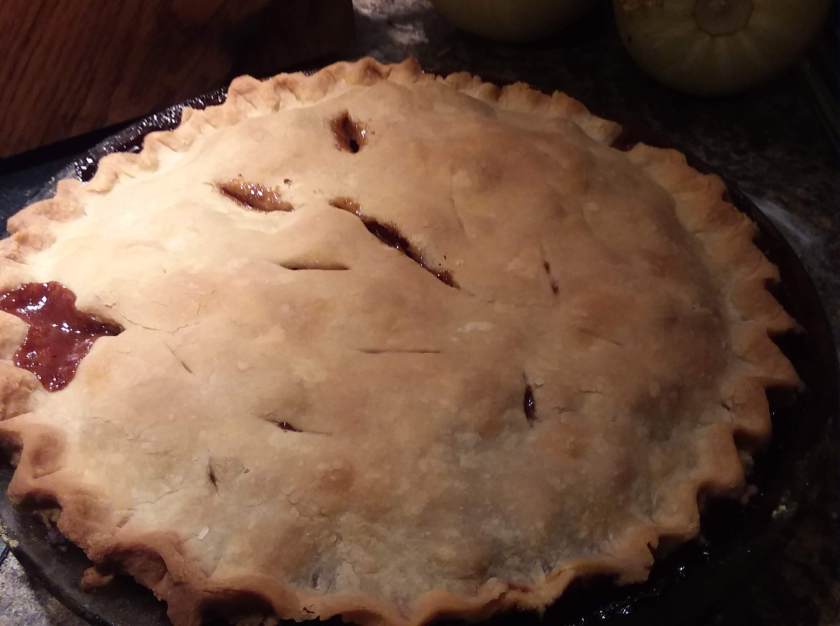
Mix beef, apples, and shortening with the remaining ingredients. Fill unbaked pie shells (3-4 cups of filling per pie.) Cover with pie crust. Cut vent slits. Bake at 375 degrees for 45 to 55 minutes. Serve warm or cold.
Pie Crust: for 2 pies
4 c. flour (approx. ½ lb.)
1⅓ c. shortening (or butter)
1 t. salt
10 T. cold water
Mix the flour and salt. Rub or cut the shortening into the flour until it resembles coarse meal. Add water. Mix lightly. Gather the mixture into a ball and press solid. Cut into 4 pieces (two for the bottom crusts two for the top crusts.). Roll each out to a circle. The circles for the bottom crusts should be about an inch larger than your pie plate. Carefully place one circle in each pan. Add the filling, and cover with the top crust. It helps to wet the edge of the bottom crust before placing the top crust on the pie. Pince the edge all around to seal the pie.
 BRIC-A-BRAC
I love modern mincemeat pie! I’d like to make the original sometime. I think I have had your mincemeat!
LikeLiked by 1 person
I love any kind too. I think you had mine at a medieval feast sometime.
LikeLike