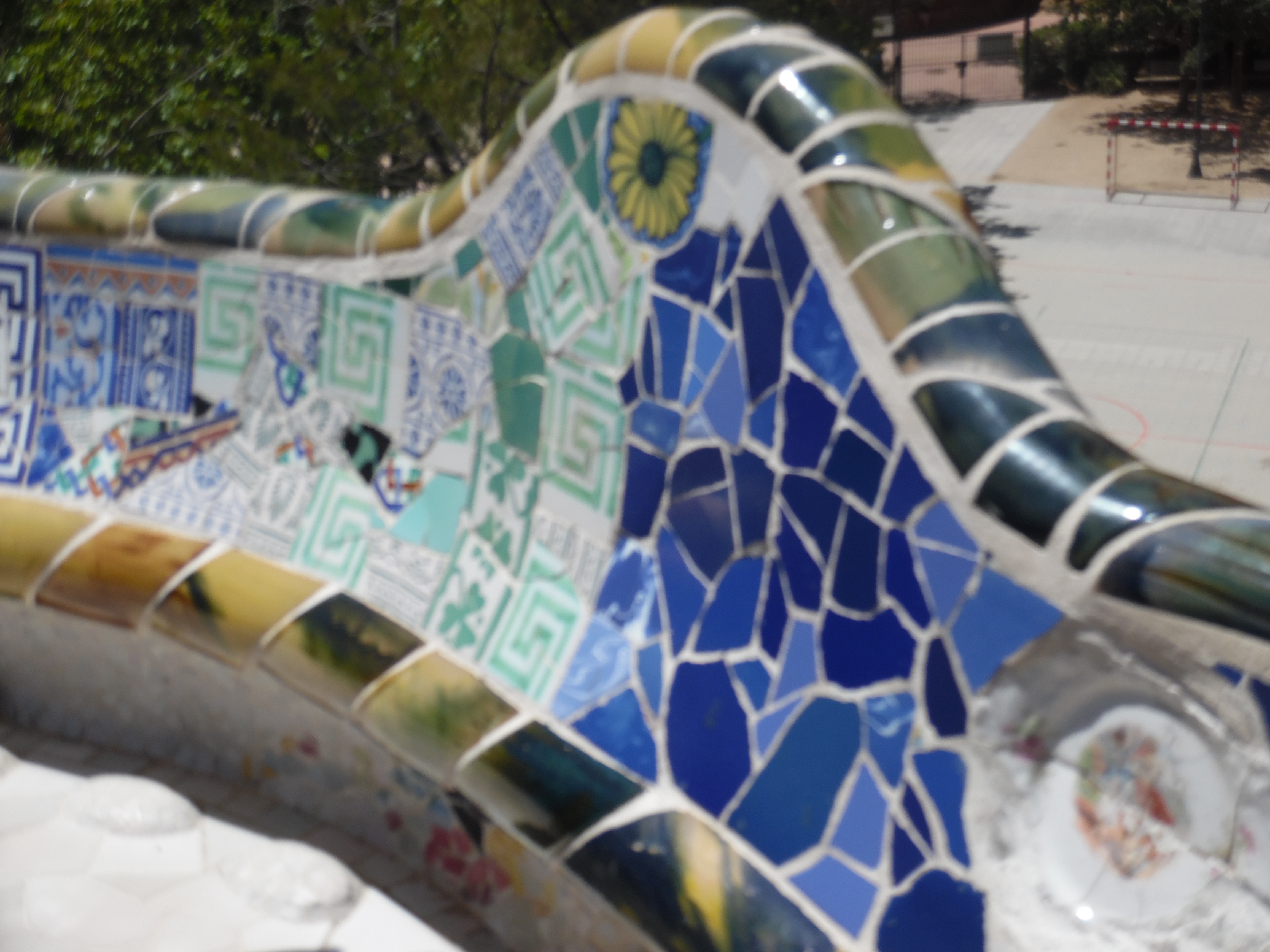
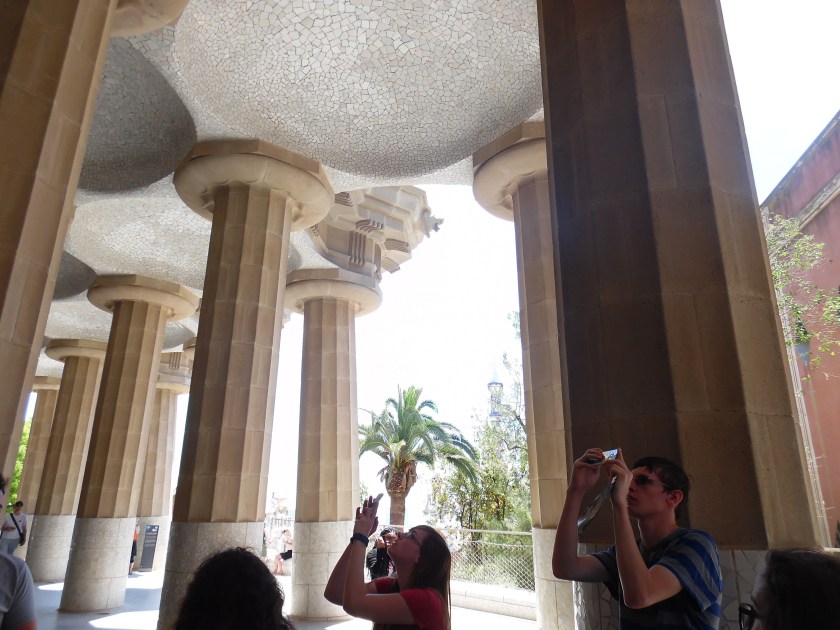
Park Güell in Barcelona is amazing–sort of like Dr. Seuss meets classical Greece. Majestic Doric columns support the roof of the terrace, which features the famous curving mosaic bench, so serpentine it seems almost to writhe and flow. Built to be ergonomically sound and quite comfortable, the loops and curls of the bench invite relaxed conversation. The park startles visitors with irregular shapes, slanted arches, and unusual creatures, such as the huge multi-colored mosaic lizard (known as Drac, the Dragon), descending the stairs near the park entrance. A mixture of the practical and the whimsical, this park is deservedly famous in Barcelona.

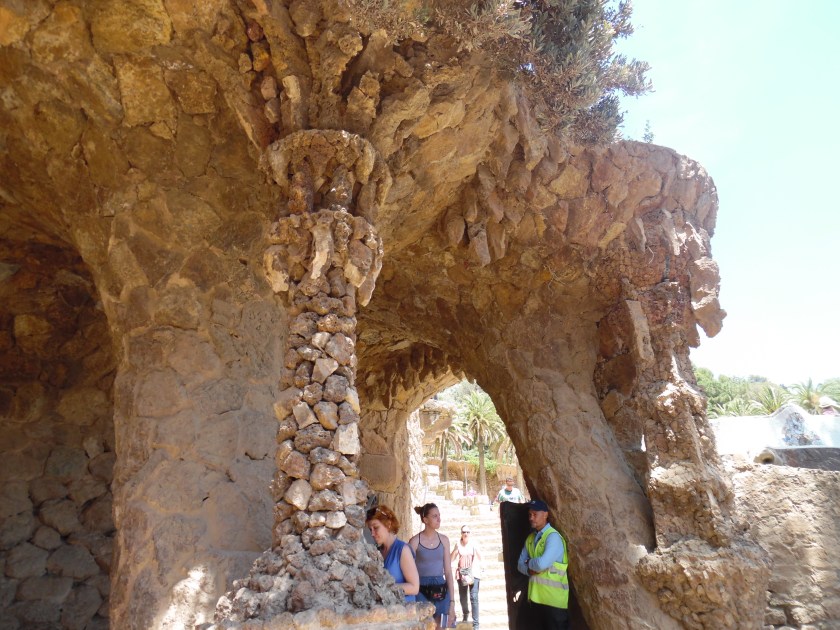
Yet fanciful and modern as it seems, the park was built over a hundred years ago. Starting in 1900, Gaudi built this park for M. Güell who was a speculator planning to sell houses in the park. Unfortunately for him, no one bought the houses, thinking the park was too far from the city. Eventually, as partial payment from Güell, Gaudi ended up living in the model house that he had designed there. This park exemplifies many of Gaudi’s important ideas. First, Gaudi’s deep religious convictions are apparent throughout the park. For instance, round balls lining an avenue represent rosary beads. Gaudi was also very innovative, planning for all the rainwater to be collected in great underground cisterns that could water the park for three months. Finally, as a early conservationist, Gaudi created his mosaics from recycled material, like broken wine bottles.
The day we visited Park Güell, firework stands lined the nearby streets in preparation for St. John’s Day, a holiday derived from the ancient pagan summer solstice celebration. Today festival goers unwittingly mingle ancient traditions with newer ones as they strum the guitar and sing, start a fire on the beach, drink warm rum, then jump over the fire and set off fireworks. This seems a perfect magical celebration of this surrealistic park.

Perhaps Gaudi’s work takes us far beyond the borders of this galaxy to the windswept landscapes of Tatooine. Casa Mila, also known as the Stone Quarry, is the last family home designed by Gaudi before he turned to larger projects. It was built between 1906 and 1912. The roof features a maze of bizarre shapes.
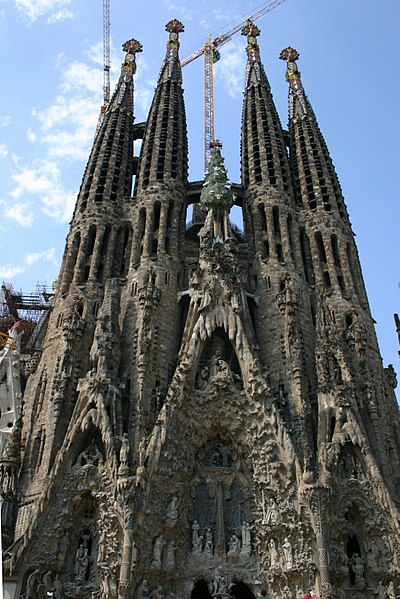
Another great monument to Gaudi’s work is La Sagrada Familia, a huge cathedral which dominates the city skyline and is able to seat over 1000 people. Building this church began in 1882. Gaudi took over the work in 1883, but it is still not finished. (Gaudi planned the entire project, which is due to be finished in 2026). It has been built from donations and more recently, entrance fees. This remarkable cathedral seems to have been built of liquid stone, like living stone formed into symbolic shapes. When it is finished, there will be 18 spires. The main tower will be 565 feet, the tallest bell tower in the world when it is done. Gaudi’s symbolism covers every inch of the building. For instance, there are 12 pillars for the 12 apostles, each with a fruit at the top, one for each month of the year, and according to the seasons (so figs and oranges in winter). The next higher set of pillars is alternating grapes and wheat for the bread and wine of the last supper.
A great many details make this church one of the most unusual combination of Gothic and inspired surrealism. For instance, there are no completely right angles in the building. The columns inside the church double in size as they go up. They are made to look like tree trunks with branches supporting the ceiling, snd the stonework looks like pale, melting chocolate.

Every detail is symbolic. For instance, the colors of the stained glass windows inside are incredibly brilliant, so translucent they glow. The glass shows sunrise on the east and sunset on the west, so the east starts with oranges and reds and moves toward blue green light of day, and vice versa on the west.
All three places, La Sagrada Familia, Casa Mila, and Park Güell, have been designated UNESCO World Heritage Sites. Perhaps that’s not surprising since it is not often a place can be securely grounded in the past at the same time it transports the visitor to such other-worldly, mystical experiences more like dreams than reality. All of Gaudi’s works in Barcelona, with their roots in the neo-Gothic and early modernism of the late 19-th century, and their forward-thinking incorporation of nature into architectural forms take visitors beyond the conventional into unearthly regions of the imagination.
 BRIC-A-BRAC
I first heard of Park Guell many years ago, from Dr. Christenson. What an amazing site!
LikeLike
It certainly is. And how neat to recognize it from a long-ago conversation.
LikeLike