This post starts with a fair warning: I don’t like beans. With the notable exception of various kinds of green beans (that is, beans with minimal seeds and edible pods), I dislike all types of the actual bean seeds. Dislike is perhaps too mild a word. My mother’s famous bean soup, relished by all other members of my family, always made me gag. I know that beans are nutritious, a valuable source of vegetable protein, and fairly easy to grow. They are eaten with gusto in many parts of the world. The fact remains, however, that in spite of years of trying to learn to like them, I still don’t like beans.
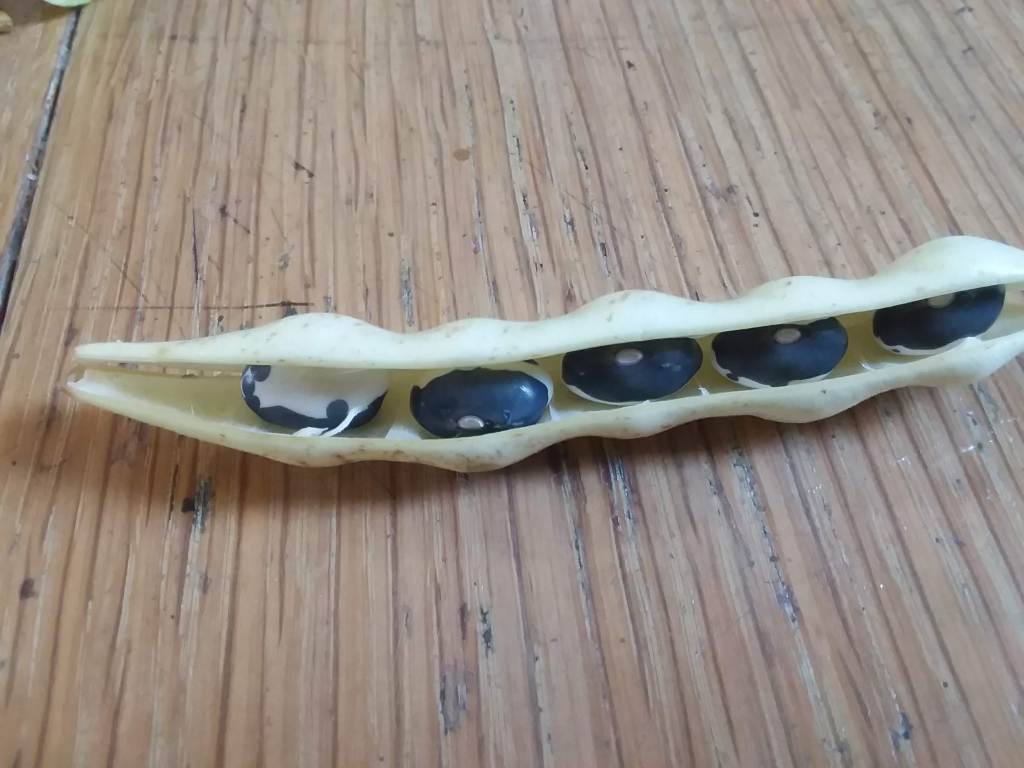
So, you might reasonably ask, why write a blog post about beans? The answer is a bit complicated. Due to vacation travels, benign neglect of the garden, and a misunderstanding, (I thought the beans we planted were green beans) I ended up with a good quantity of beautiful Heritage Calypso Beans. It turns out I hate wasting food even more than I hate beans. So I decided to find a way to cook these beans and enjoy eating them.

Easier said than done. I started by reading up on beans. Beans have been cultivated for thousands of years in both the Old and New Worlds. Broad beans, also called fava beans, were known in Asia, the Middle East, and Europe. The common bean originated in the Americas. Suffice it to say, beans have enjoyed world-wide popularity since ancient times.
With this information in mind, I searched my older cookbooks for bean recipes. Most of the Colonial-era cookbooks suggested cooking beans with pork or bacon. Older, medieval-era books had more variety in method and seasoning.
I settled on three methods of cooking the beans:
1.To Dress Beans and Bacon (18th century)
Mary Randolph suggests using tender, fresh beans (the seed portion), picked in the morning. These are to be boiled with a flitch of bacon, and served with butter. (Randolph p.106-107)
Child recommends cooking beans with pork, but calls for soaking the beans overnight, and seasoning the pork and beans with pepper. (Child p.51)
Glasse also pairs beans with pork, but insists the two be boiled separately, then served together with butter and parsley, and topped with toasted bread crumbs. (Glasse, p.35-36)
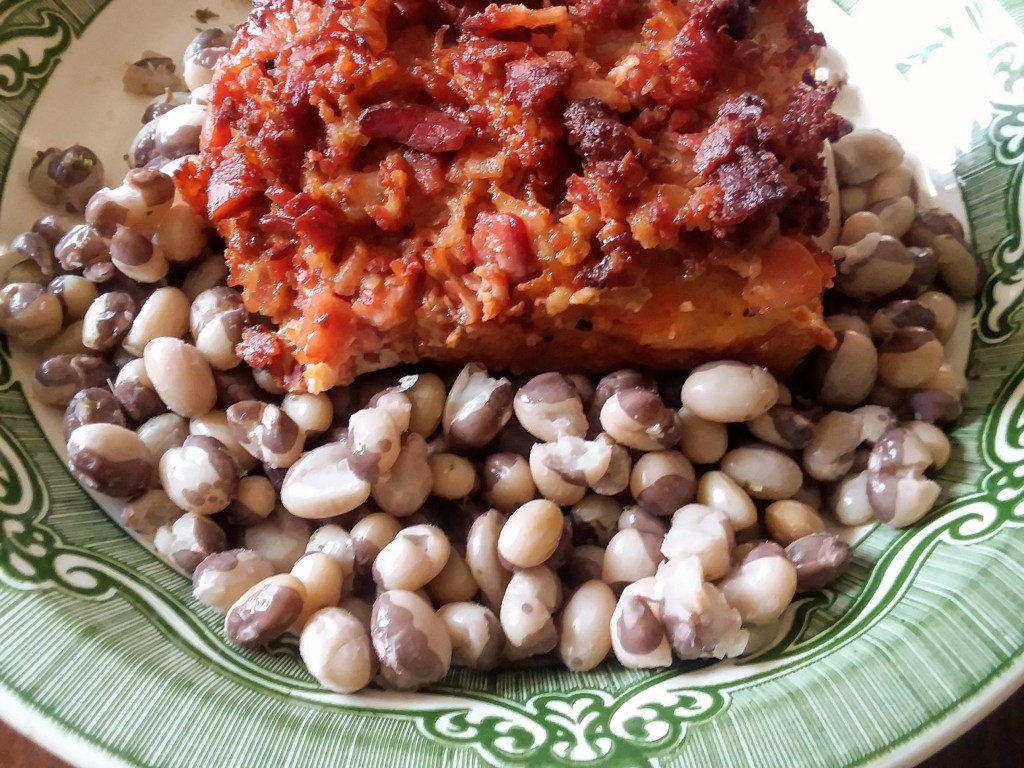
My version: Colonial Pork and Beans
Soak 2 cups fresh Calypso beans overnight. (This step is probably not necessary with fresh beans.)
Boil the beans for 45 minutes, until they are soft.
Meanwhile, roast a pork tenderloin or pork tenderloin crusted with bacon for 1-1½ hours (depending on size)(Note- all the colonial recipes called for boiling the chunk of bacon or pork, but I felt that roasting the meat would produce a better flavor.)
Drain the beans. Add butter and salt to taste. Serve them in a dish with the pork.
The result: This dish was very nice to look at, but the beans still tasted like beans to me. I could eat them if the flavor was disguised with enough of the pork. My daughter, who likes beans, thought the beans were fairly bland this way, and suggested they would be better if the beans and pork or bacon were cooked together.
2. For to make drawen benes (14th century)
“Take benes and seethe hem, and grynde hem in a morter, and drawe hem vp with gode broth; & do oynouns in the broth grete mynced, & do therto; and colour it with saffroun, and serue it forth.” (Curye on Inglysch, p. 98)
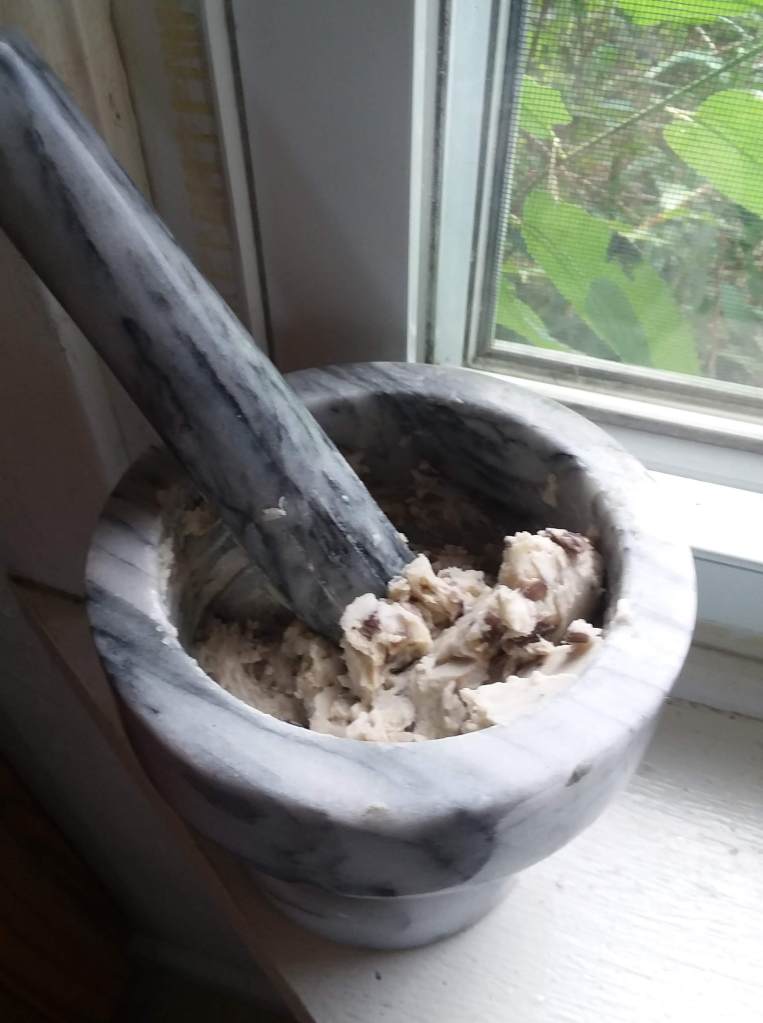

My version: Medieval Bean Dip
This is very much like a modern bean dip.
Take 1//2 c. Calypso beans, boiled until they are soft. Mash them well. Simmer ¼ c. chopped onion and a pinch of saffron in 3 T. beef broth. Add the broth mixture to the bean mixture. Season to taste.
The result: This is also a very bland dish with a strong bean flavor.
3. For to make a potage (14th century)
“Tak wite benes & seth hem in water, & bray the benys in a morter al to nought; & lat them sethe in almande mylk & do therein wyn & hony, & seth reysouns in wyn & do therto & after dresse yt forth.” (Curye on Inglysch, p. 77-78)
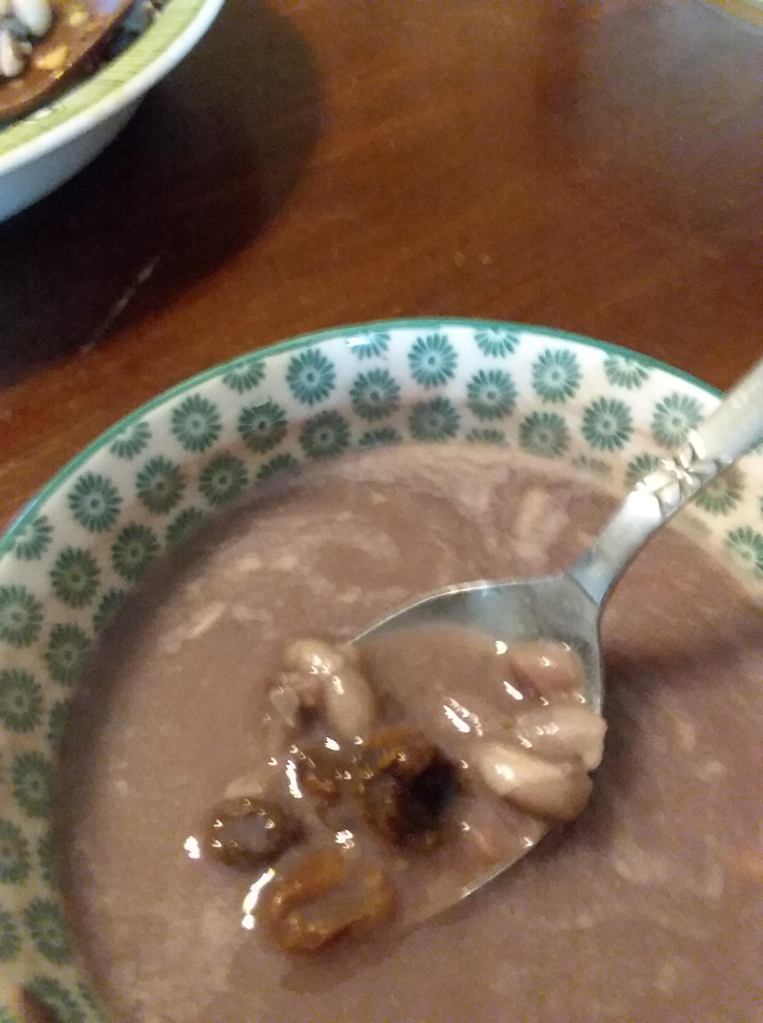
My version: A Sweet Bean Soup
A potage is a soup, so I had serious doubts about this recipe, remembering my experience with my mother’s bean soup. However, this recipe is quite different from any other bean recipe, so I was willing to try it.
Boil ½ c. Calypso beans until they are soft. Mash them. Stir in 1/2 c. almond milk. Soak ½ c. raisins in ½ c. red wine for 10 minutes. Mix the wine and raisins into the bean and milk mixture. Add !/4 c. honey. Heat and serve.
The result: In this recipe, the sweetness of the honey and raisins completely masked the bean flavor, and I actually liked the dish. Unfortunately, no one else did.
In the end, my experiment with Calypso beans was only partially successful. Although at least one person liked each of the three dishes, no one begged for seconds. I’m happy to say, none of the beans were wasted.
But next year, I think I’ll plant green beans.
Sources:
Child, Lydia Marie. The American Frugal Housewife. Dedicated to those who are not ashamed of economy. 12th Edition. Boston: Carter, Hendee, and Co. 1833. (First published 1828)

Curye on Inglysch: English Culinary Manuscripts of the Fourteenth Century (Including the "Forme of Cury") Constance B. Heiatt (Editor), and Sharon Butler (Editor). Oxford University Press; 1st Edition edition, 1985.

Glasse, Hannah. The Art of Cookery Made Plain and Easy: Excelling any Thing of the Kind ever yet published. Alexandria: Cottom and Stewart. 1805. (First Edition publishing in London, 1747. This edition reprint of 1st American Edition, 1805, by Applewood Books, 1997).

Randolph, Mary. The Virginia Housewife Or, Methodical Cook. Philadelphia: E. H. Butler & Co., 1860. (Facsimile by Dover Publications, 1993, with introduction by Janice Bluestein Longone).
 BRIC-A-BRAC
Your ‘dislike’of Mom’s bean soup is legendary! I therefore commend your willingness to try all these recipes. I think I might like these, especially the wine and raisin one. As an aside, you do know calypso beans can be used decoratively?
LikeLike
They are beautiful. I’m not sure how to use them. Any ideas?
LikeLike