This week, on November 5th, parts of the British empire celebrated a curious holiday: Guy Fawkes Day. The day is marked with parades, bonfires, the burning of an effigy, and children begging for “a penny for the guy.” Though I’ve paired Guy Fawkes with Shrewsbury Cakes, in reality the two have nothing to do with each other beyond the fact that both existed in the early 17th century. Let’s start with Guy Fawkes, the unfortunate man for whom the day is oddly dedicated.
Guy Fawkes was Catholic in Prostestant England. As such, he joined with a group of dissenters who wanted to get rid of the Protestants and restore a Catholic monarch to the throne. In 1605, these misguided men decided the best way to accomplish this was to blow up Parliament on a day when King James and his son would be there. This was not Guy Fawkes’ idea, nor was he any kind of leader in the plan. He was a flunky whose task was to guard and then set alight the gunpowder which had been secreted in the cellars under Parliament. Fortunately for Parliament and the king, the plot was discovered and thwarted. Unfortunately for Guy, he was the conspirator who was caught. He was tortured until he revealed the names of the co-conspirators. Then he was executed (hung, drawn, and quartered.) Most of the others were then rounded up and executed as well.
Today we would call this Gunpowder Plot the act of a terrorist group. In their defense, Guy and his associates did not consider themselves either traitors or terrorists. They were only trying to see justice done and fight for religious freedom.
That is to say, their own religious freedom, not anyone else’s. They were as willing to jail, torture and execute Protestants as the Protestants were willing to suppress Catholicism (or ‘popery.’) In the United States today, where interfaith councils are common, and Christians often share a meal with non-Christians, it is hard to imagine the hostility between Catholics and Protestants 300 years ago. During Guy Fawkes’ life, the monarch was Protestant and the persecution of Catholics was severe. It was illegal to attend Mass, and refusing to go to Protestant services resulted in heavy fines and other punishments. During the reign of Elizabeth I, many Catholic priests were executed. Because James I’s mother (and possibly wife) had been Catholic, the beleaguered Catholics of England hoped for a change when James ascended to the throne in 1603 after Elizabeth I died. But James ordered all priests to leave England, said Catholicism was mere superstition, and continued the persecution of Catholics. The famous Gunpowder Plot was one of many unsuccessful attempts to oust James and get a Catholic monarch.
After the foiled plot was discovered, the kingdom celebrate James escape with bonfires. Some communities burned effigies of the Pope. Later, effigies of Guy Fawkes were burned.
This lack of religious tolerance continued well into the 19th century, by which time the 5th of November was securely established as a National Holiday, celebrated with fireworks and bonfires.
Now, you might ask, what does tall his have to do with Shrewsbury cakes?
Not much really, but in my mind the two always go together. For many years I taught Macbeth in my high school English classes. Macbeth was a play Shakespeare wrote to please James (complete with a warning of the chaos engendered by regicide.) In order to develop more interest in Shakespeare’s works, I talked about James, and Guy Fawkes, and I brought cookies or ‘byskettes’ for the class. (see blog post for Applemoyse https://bricabrac164.wordpress.com/2019/10/11/applemoyse/)
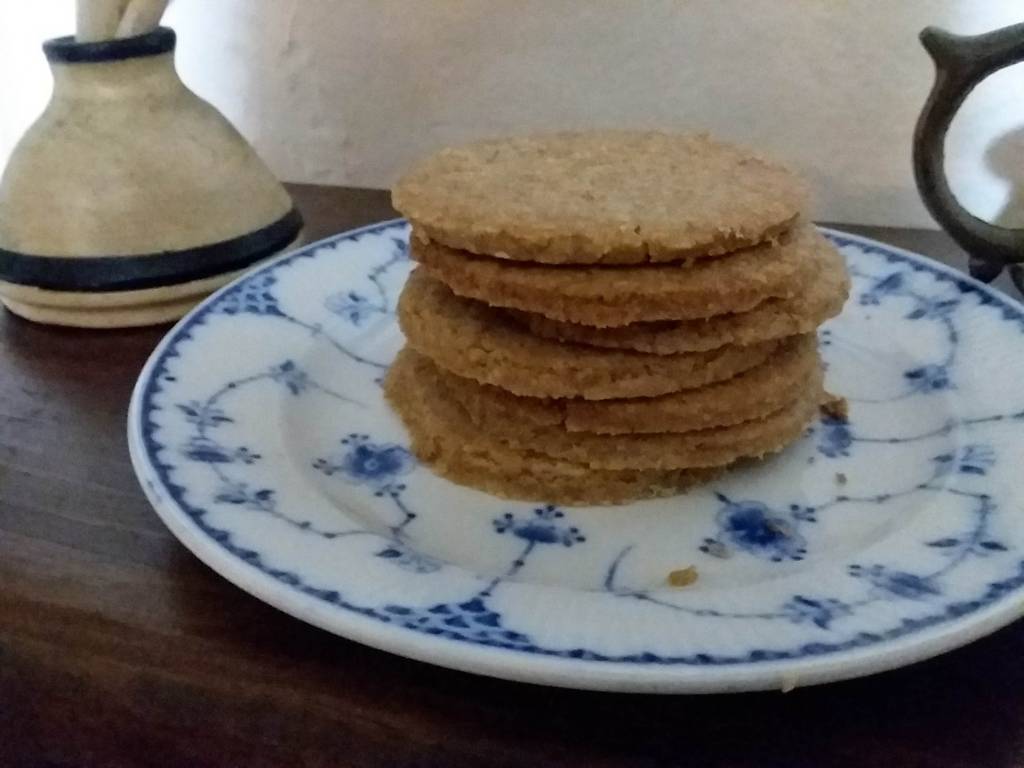
Shrewsbury cakes, to be exact, because I have great medieval recipes for Shrewsbury cakes. Though there are many versions, a Shrewsbury Cake during the 16th and 17th centuries was a spicy shortbread cookie. This was a medieval food that students invariably liked.
John Murrel, wrote the following recipe in A daily exercise for Ladies and Gentlemen, … (1617) (reprinted p. 317 in Dining with William Shakespeare and in Sallets, Humbles, and Shrewsbury Cakes, p, 64).
Take a quart of very fine flower, eight ounces of fine sugar beaten and ciersed, twelve ounces of sweete butter, a Nutmegge grated, two or three spoonefuls of damaske rose-water, worke all these together with your hands as hard as you can for the space of halfe an houre, then roule it in a little round Cakes, about the thickness of three shillings one upon another, then take a silver Cup or glasse some foure or three inches over, and cut the cakes in them, then strowe some flower upon white papers and lay them upon them, and bake them in an Oven as hot as for Manchet, set up your lid till may tell a hundreth , then you shall see them white, if any of them rise up clap them downe with some cleane thing, and if your Oven be not too hot set up your lid again, and in a quarter of an houre they will be baked enough, but in any case take heede your Oven be not too hot, for they must not looke browne but white, and so draw them foorth and lay them one upon another till they be could, and you may keep them half a yeare, the new baked are best.
Modern Version: Shrewsbury Cakes
- ½ c. white flour
- 1/2 c. whole wheat flour
- 1/2 c. butter or margerine
- 1/4 c. white or brown sugar
- 1/2 T. ground nutmeg
- 1/2 T. rosewater (or vanilla)
(Note that the proportion of sugar to flour in the modern version is less than the original, but I find the original is too sweet. For sweeter cookies, double the sugar)
Cut the butter into the flours,nutmeg, and sugar as for pie crust. Sprinkle the rose water over the mixture. Work the dough just enough to form it into a ball. Roll it out to ⅛-¼ inch thick. Cut in 3 inch circles. Bake for 12 minutes at 400 degrees.
I’m convinced you will enjoy your Shrewsbury cakes as much as my students did. And as you celebrate think of this:
Please to remember
the 5th of November,
Gunpowder Treason and Plot.
I see no reason
Why Gunpowder Treason
Should ever be forgot.
Sources:
Beebe, Ruth Anne. Sallets, Humbles, and Shrewsbury Cakes. David R. Godine Publisher, 1976.
Lorwin, Madge. Dining with William Shakespeare. New York: Atheneum, 1976.
 BRIC-A-BRAC
I was so delighted that my first child, due on Guy Fawkes Day, elected to be born two days early!
LikeLike
Wise child, indeed.
LikeLike