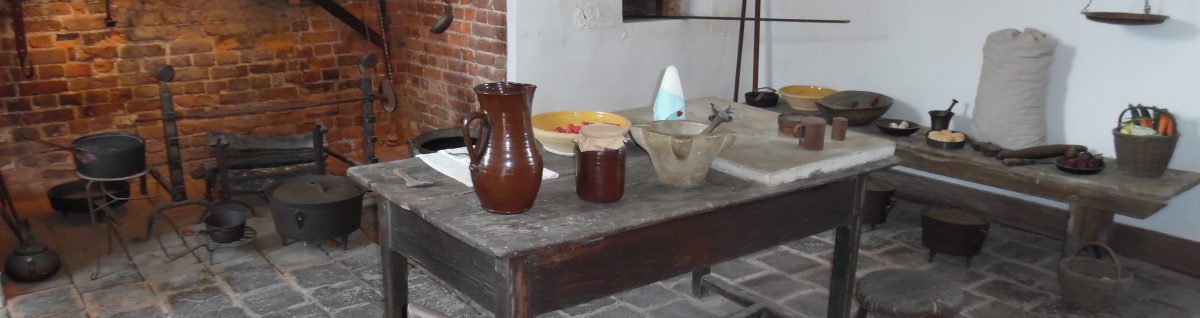

The Yangtze River is the most important river in China. Starting in the mountains of Tibet and draining into the East China Sea near Shanghai, it is the longest river in China, the longest river in the world to flow entirely in one country, and the third longest river in the world overall. The Yangtze River is considered the birthplace of the Chinese Civilization. People have been living along its banks for thousands of years, possibly as early as 3000 BCE. Though Westerners call it the Yangtze River, this name, meaning ‘child of the oceans,’ is technically reserved for the area near the mouth of the river. In Chinese the river is called Cháng Jiang (long river) or just Jiang (the river).
The Yangtze River is also the setting for the beloved picture book, The Story about Ping by Marjorie Flack and Kurt Weise (originally published by Viking, 1933). This is the heartwarming tale of a young duck, Ping, who lives in a wise-eyed boat on the Yangtze River with his large family. Each day the duck family forages for food and then returns at night to their home on the boat. But the last duck to return home always gets a spank. One day Ping sees he will be the last duck, so he hides instead of returning home. After a night alone on the river, Ping faces many adventures including an encounter with cormorants and capture by a young boat boy. As Ping narrowly escapes becoming the boy’s duck dinner, he is thrilled to see his home, the wise-eyed boat. Unfortunately Ping sees that no matter how fast he travels, he will once again be last. But this time he marches up, takes his spanking, and happily rejoins his family. I’ve read the story at least a thousand times and have never met a 3-year-old who didn’t love Ping.
Ping’s home, “the beautiful yellow waters of the Yangtze River” became for me symbolic of all China. So when I embarked on a Yangtze River cruise, I wondered what I might discover of Ping.
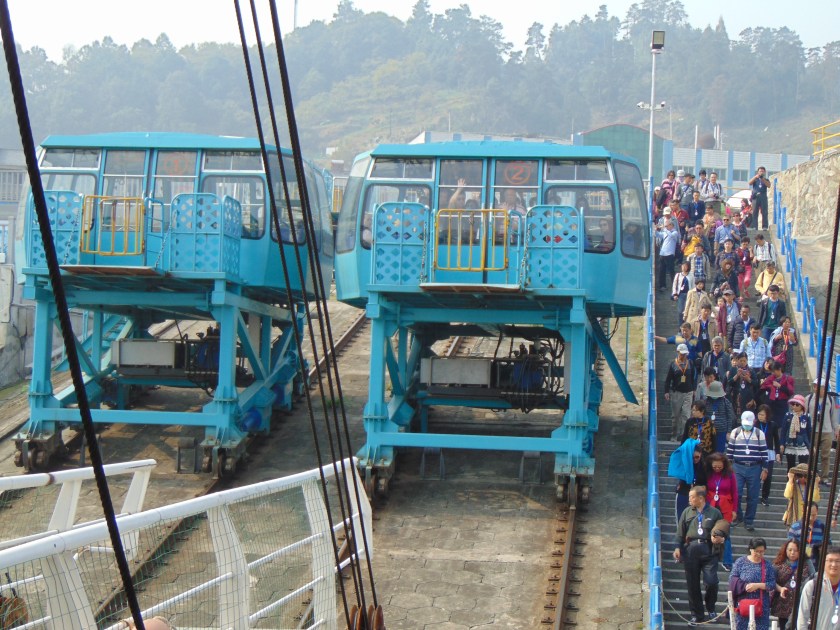
We began our cruise late at night at the dock in Maoping, which is in Zigui County, upstream from Yichang and the Three Gorges Dam. With creaking, clanking, old machinery, a big blue funicular laboriously transported us and our luggage down to the pier. Cruise boats are docked side by side, so that we had to walk through other boats to reach ours.


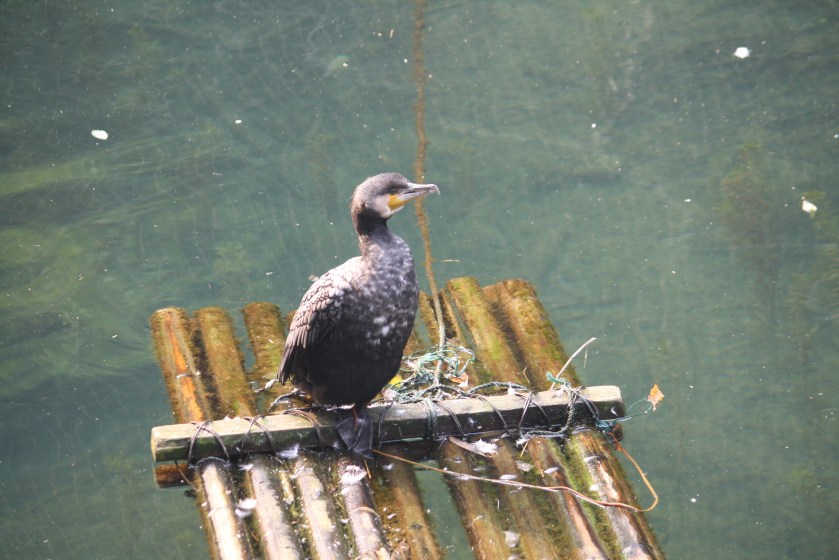
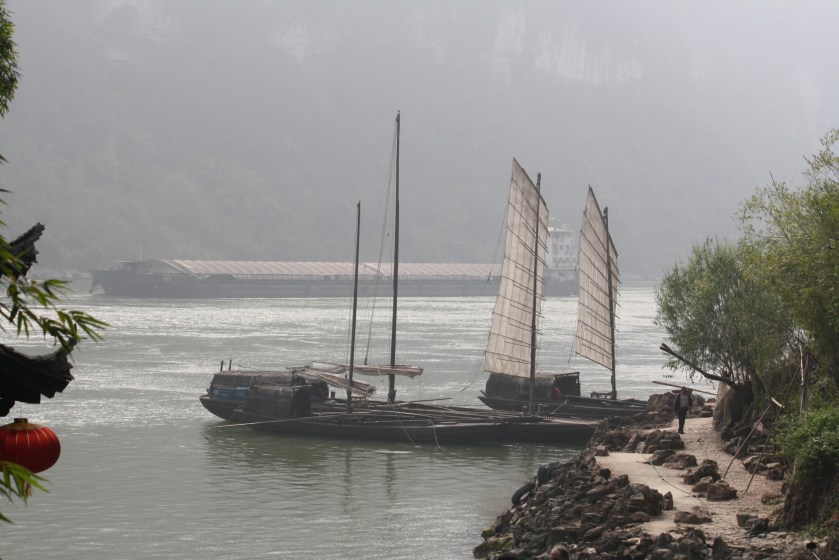
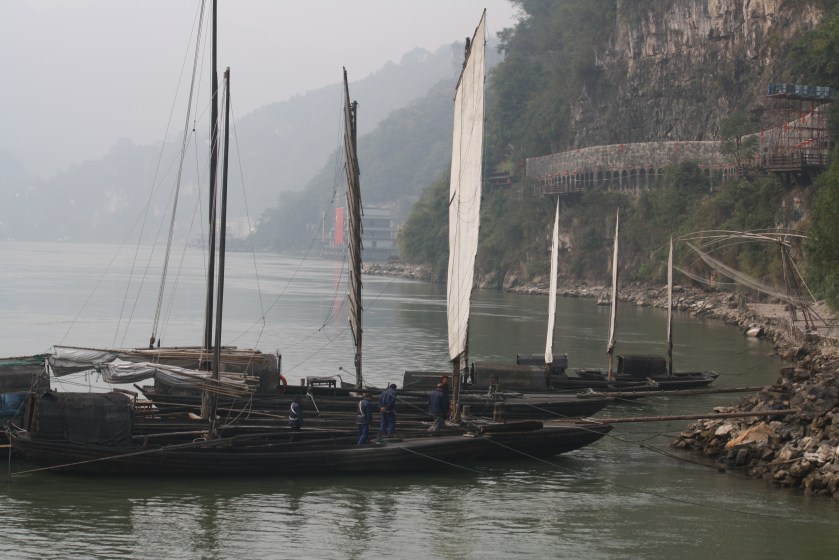
The next morning, eager to see more of the Yangtze, we went on our first shore excursion to visit the Tribe of the Three Gorges, a protected center of culture in the Xiling Gorge. This tourist attraction is located at the junction of the Longjin Brook (Jumping Dragon Brook) and the Yangzte River. It is below the Three Gorges Dam, so this large scenic area has not been affected by the dam. The site features the recreated lifestyle of the Tujia Ethnic minority. There are three “villages” along the path up the gorge: the Village on the Water, the Brookside Village, and the Mountain Top Village. Each set of houses shows traditional building styles, including houses on stilts. Hiking upstream along a paved path offers beautiful views of the river, shrouded with bamboo groves and overhung with graceful willows, surrounded by mist-shrouded jagged mountains. The path follows alongside the brook past a wooden waterwheel up to a gentle waterfall. Along the way, costumed reenactors fish, play the flute, and sing against a backdrop of sampans, junks, and houseboats. A pair of cormorants are tethered to a floating dock, and a few ducks paddle near the mouth of the stream. It could be a scene right out of The Story about Ping, except none of the boats had eyes on them.

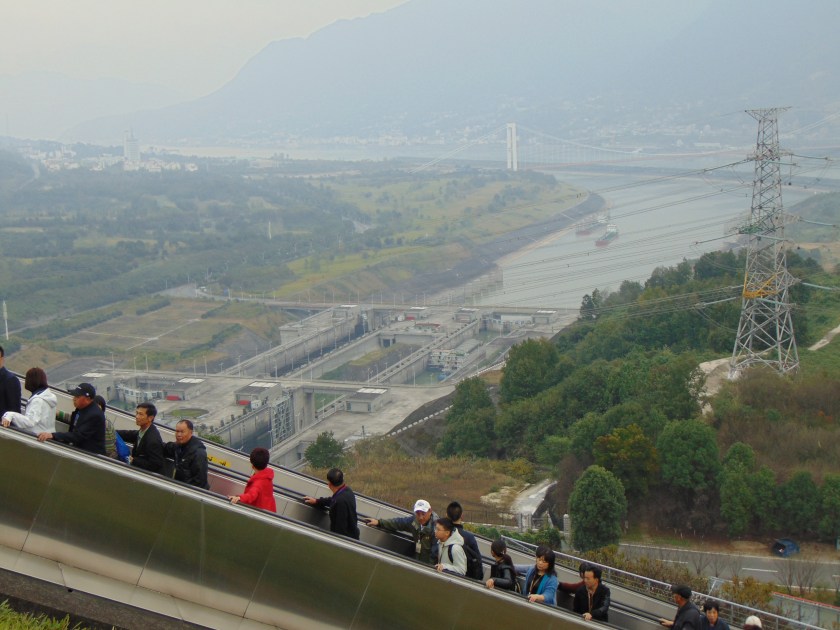
Our next excursion was to the Three Gorges Dam, the biggest hydroelectric dam in the world. The idea of a dam at this point was first put forward by Sun Yet Sen in 1919, but the actual building didn’t begin until 1993. It took 22 years to complete. The dam raised the water upstream 113 meters and required rebuilding ancient cities, moving countless artifacts, and relocating 1.3 million people (and who knows how many ducks).
The dam is big and impressive, but more interesting is the different perspectives on moving so many people and inundating so many culturally significant areas in order to build it. This huge project has been very controversial. What many people don’t realize is that the Yangzte River was extremely treacherous for thousands of years with difficult navigation and disastrous floods. Millions have died from flooding along the Yangtze. The estimated death toll from the 1931 flood alone ranges from 443,000 to 4 million. Building the dam destroyed many things, but it also is an important source of clean, renewable energy and has greatly improved the lifestyle for millions of people. Our guide today said it was mostly older people who objected and that younger people in the area were glad of the greater opportunities and chance to better their lives.
That night, we cruised through the Xiling Gorge which used to be the most hazardous section of the river, now tamed by the dam. In the morning we docked at Wushan Pier, and took another shore excursion, this time on a smaller, wooden sightseeing boat up the Shennv (Goddess) Stream. This is a narrow gorge, with towering cliffs and spectacular views. A fine mist hung over the river, giving the cliff tops an eerie, magical appearance. Ancient hanging coffins on the towering cliffs added to the sense of mystery. Our guide sang beautiful folk songs as we motored upstream and told a story of a ghost wedding. When a young man died before he could marry, a girl chosen as his bride was killed and buried with him. This gruesome practice seemed at odds with the peaceful mountains surrounding us.


Back on the cruise ship, we continued upriver, drifting through the rest of Wu Gorge and Qutang Gorge. In spite of rising water from the dam, the Three Gorges area is still spectacular. From out of the fog, towering cliffs rise in vertiginous masses, with stratifications tilted in uncanny angles. We passed peaks with lovely names such as Goddess Mountain, Opening Scissors Mountain, Flying Eagle Mountain, Morning Cloud Mountain and Holy Waterfall Mountain.
Our ship docked for the night in Fengjie, a city just west of the Qutang Gorge. Fengjie was the capital of Kui during Spring and Autumn period 722-481 BC and Warring States Period 475-221 BC. A good section of these early period town walls and gates remain. The harbor here provides docking space for many boats, large and small, including one sampan full of ducks and chickens. They were too far away to get a good picture, but they could easily have been Ping’s relatives, though this boat had no eyes.
Our last shore excursion was to Shibaozhou (Stone Treasure Stockade).This twelve-story, 56 meters, wooden pagoda was originally from the Qing Dynasty Emperor Kangxi (1662-1722).


Before the Three Gorges Dam was built, it was determined that the rising water might undermine the foundation of this building, so a retaining wall was built to protect it. Inside the temple, a series of very steep wooden steps leads past floors with statues dedicated to the Jade Emperor, the Queen of Heaven, and other beings familiar to me from Monkey, Journey to the West.
We ended our cruise in Chongqing. As we approached the city, the towering cliffs of the gorges were replaced with more and more cities crowding the banks of the river. Smog mixed with the river fog, and the pollution became noticeable. It turned out that the first excursion was the closest I got to the traditional boat culture depicted in Ping’s story. No one I talked to along the way knew of the tradition of painting eyes on a boat. I’m guessing that Ping’s journey actually took place further downstream, closer to Shanghai. After all, I travelled from the Three Gorges Dam to Chonqing, a distance of about 450 km, or 279.6 miles, only about 7% of the Yangtze’s 6378 km (3915 miles).

It’s been over 100 years since The Story about Ping was written, and the Yangtze River has changed a great deal in that time. Today the sampans are motorized, the water is not yellow but green, and the water level is much higher and more stable than before the dam. Cruise ships ply their way up and down the river carrying tourists instead of ducks. It’s easier to find Ping’s relatives in restaurants than foraging along the banks.

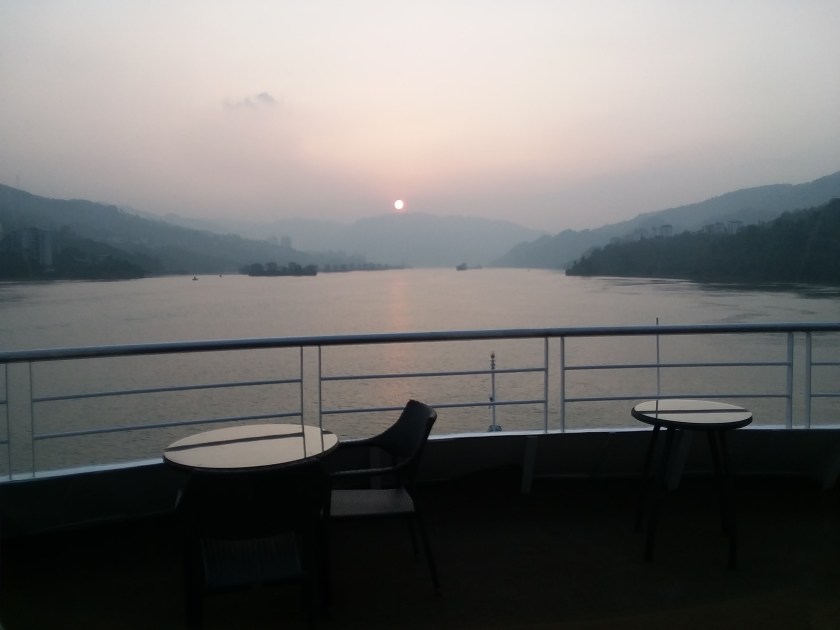
But the Yangtze River is still the lifeblood of China, and I’m confident Ping or his descendents are hiding somewhere in the beautiful emerald waters.

 BRIC-A-BRAC
What a beautiful, whimsical way to paint the picture of the Yangtze River while providing information and history of this important landmark in China.
LikeLiked by 1 person
Thanks, Dana. There’s nothing quite like going someplace to see a new perspective.
LikeLike
Ha, What a fun story to go along. We are headed to China soon, and will be on the Yangtze River, looking and learning before we go.
LikeLike
Have a wonderful time!
LikeLiked by 1 person