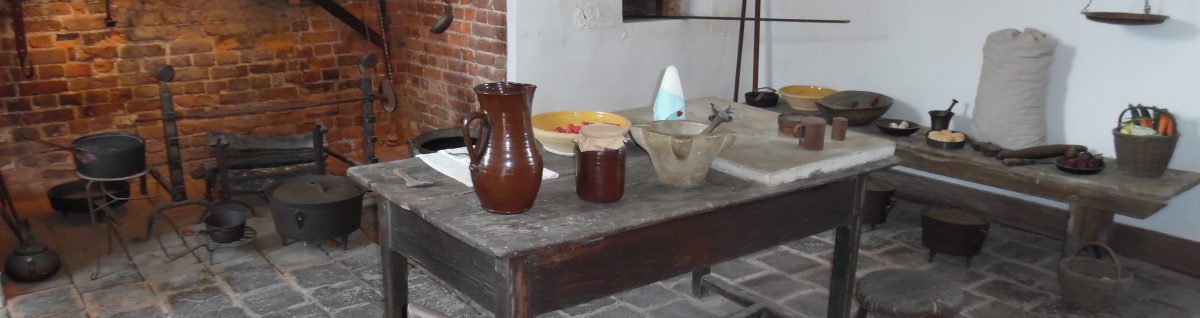
Colonial women did not know about germs or viruses, but they did know about pests and vermin. Housewives were expected to keep the home clean and provide first aid for common illnesses. Many cookbooks of the day included recipes for home remedies along with cleaning advice. As we face the current pandemic with widespread shortages of some cleaning products, I thought it useful to take a look at how our foremothers coped. (Please note that any medicinal information in this blog is not meant to be medical advice. I cannot vouch for the efficacy of any ancient or colonial remedy.)
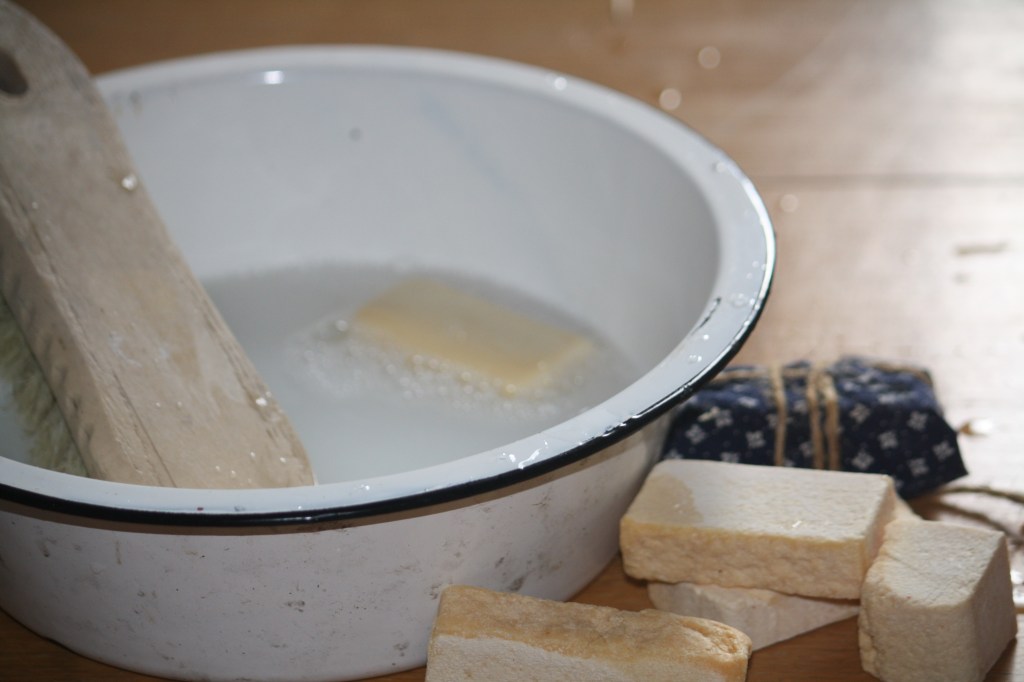
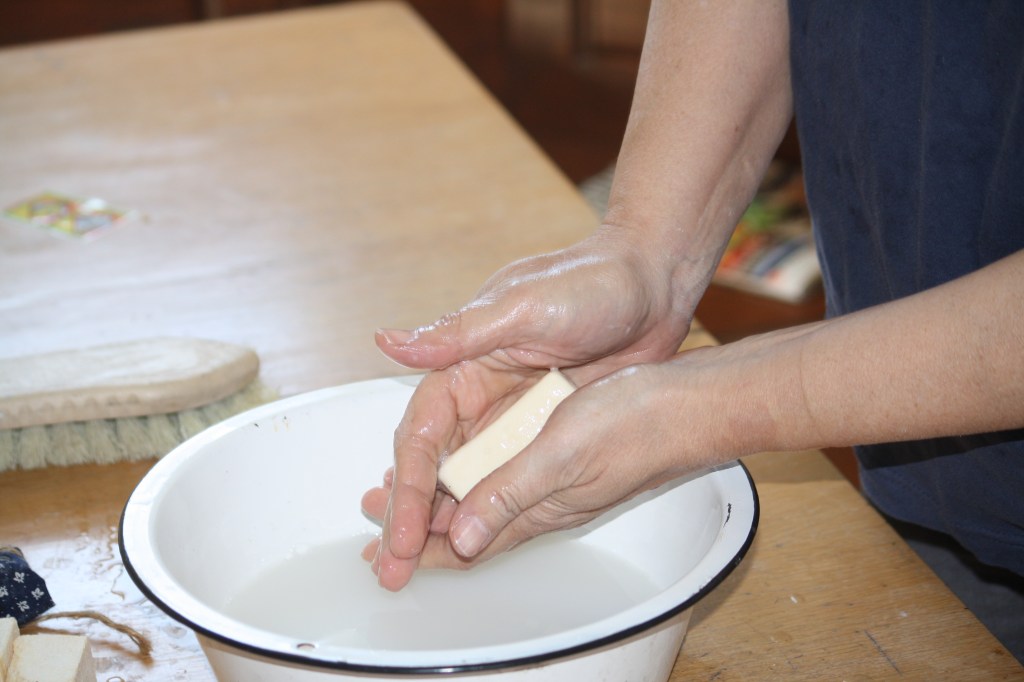
Soap and Washing: It has always surprised me that soap is made from two very ‘dirty’ substances. To make soap, you use grease and lye. Lye is made from water dripped through wood ash. The end result is a very effective cleaner. You might think that lye soap would be harsh, but the stuff I made is gentle and not at all hard on the skin. Many households made their own soap, and so soap recipes are included in nearly every cookbook. Mrs. Child claims it is more economical for people in the city to exchange grease and ashes for finished soap ,but those living in the country should make their own (22). Still, such soap is mostly used for washing clothing, hands, and dishes. Hair should be washed in New England Rum to keep it clean and free from disease (12). Perhaps in her day, rum was cheaper than it is today.
Vinegar: Widely used since ancient times, vinegar has both cleaning and medicinal properties. It cuts grease and helps preserve foods because it slows the growth of bacteria. As one of the first medicines, it was used for treating wounds and infections in Biblical times. As early as 400 B.C. Hippocrates claimed vinegar had therapeutic properties. In the seventeenth century, ladies carried vinegar-soaked sponges to mask the smell of garbage in the streets. Even today, vinegar is recommended for treating rashes and some bug bites. Mrs. Child suggests buying vinegar by the barrel or half-barrel, and adding old cider, wine settlings, or sour beer to the barrel to make it last longer, though care must be made not to add too much at a time (15-16). In times of plague, coins might be dropped in vinegar for disinfecting before handling. So, if you are having trouble finding Lysol, bleach, or other cleaners, you might just try vinegar.
Pests and Vermin: Mrs. Child has advice for keeping pests out of the house. To get rid of cockroaches, try turpentine (10). For bedbugs, use quicksilver mixed with egg whites and brushed on with a feather (10). Ants are among the worst of the vermin. Mrs. Child suggests luring them to a dish of shagbarks, then putting corrosive sublimate in the dish and painting all the cracks the ants came from with the corrosive sublimate (21). (Corrosive sublimate is mercuric chloride, a toxic, crystalline substance still used as a fungicide and antiseptic.) Not surprisingly, Mrs. Child includes a strong warning that great care should be taken with this substance, especially around children.
The listings above are all ways to promote cleanliness and prevent disease, but even under the best circumstances, disease can spread. (As it has in the last few months.) Caring for the sick is especially challenging when no one is sure what causes the illness or how to treat it. In the 18th century, the old ideas of the four humors (blood, phlegm, yellow bile and black bile) were changing, but many of the remedies were still based on balancing the humors, or pairing things that are hot and dry with those that are cold and moist.
Fever: To prevent fevers, Mrs. Child recommends the constant use of malt beer (28), though I suspect constant beer drinking would hide a fever rather than prevent it. More useful perhaps is her entire section on the use of herbs as remedies for nearly everything. Catnip tea is thought to prevent fevers, while sweet balm tea can be given to cool a fever (37). According to the theory of humors, a person suffering from a fever should be given cooling foods, like lettuce, melon, or vinegar (Martha…, 207). White quince jelly was considered an effective remedy for fever (Martha…, 230). One of the best known and generally effective herbal remedies is willow bark tea, which has been used throughout China, Europe and the Middle East since before 400 BC. Hippocrates wrote that chewing on willow bark helps relieve pain or fever. Indeed, willow bark tea is still sold today to relieve pain and inflammation. Willow bark contains salicins (similar to aspirin) and other anti-inflammatory compounds. Research has shown willow bark tea is generally effective for reducing pain, but not necessarily fever (“Willow bark”).
Sore throat: Many of Mrs. Child’s remedies for sore throat involve wrapping a poultice around the throat. One such poultice mashes warm apples with tobacco and wine. The mixture is spread on a linen rag and bound around the throat (27). Or else, take a stocking that has been worn all day and is still warm, and tie that around the neck (26). A third remedy is sugar mixed with brandy. (to be drunk, not used as a poultice.) Inhaling hot vinegar steam is also said to be effective, though care should be taken not to scald the throat (26).
Croup (a lung infection usually caused by a virus) or cough: For croup, Mrs. Child recommends rubbing bear grease or goose grease on the neck. In very bad cases, the warmed grease can be poured down the throat (24) Another recipe, involving camphor, wine spirits, and hartshorn (24) would have a similar effect to the vapor rubs used today. Hyssop tea is said to be good for lung problems (36). Even better, mix the hyssop with maiden-hair, lungwort, elecampane and horehound to make tea (37). Martha Washington’s Booke of Cookery and Booke of Sweetmeats contains about 90 recipes for medicinal waters and syrups, including ‘sirrup of hyssope’ and ‘sirrup of horehound’ (375-376).
In the modern world, we have stronger, often more reliable, medicines, along with more complete knowledge of how the chemicals work. We can go to a trained pharmacist and get a stable prescription with known qualities and precise dosages. Householders no longer have to grow their own herbs and distill their own medicines. Even so, it is worthwhile to remember some of the older remedies. You can still buy horehound cough drops (horehound candy) or try making horehound syrup.
A simple Horehound syrup recipe:
…take horehound, violet leaves, and hyssop, of ech a good handful, seethe them in water, and put thereto a little saffron, liquorice, and sugar candy; after they have boiled a good while, then strain it into an earthen vessel, and let the sick drink thereov six spoonful at a time morning and evening…” (Markham, 23).
Final parting advice: Today, times are hard. The pandemic is disrupting life world-wide. Our fears for our health are exacerbated by worry over the collapsing economy. In such times, I find a glance at history can provide a calming perspective. Consider these words, written by Mrs. Child in 1833: “Perhaps there never was a time when the depressing effects of stagnation in business were so universally felt, all the world over, as they are now.” (108)
Our forebears survived that crisis. I have no doubt we shall survive our own.
Sources:
Child, Lydia Marie. The American Frugal Housewife. Dedicated to those who are not ashamed of economy. 12th Edition. Boston: Carter, Hendee, and Co. 1833. (First published 1828)
Markham, Gervase. The English Housewife. [originally published 1615], edited by Michael R. Best McGill-Queen’s University Press:Montreal] 1994, Chapter 1, recipe 88 (p. 23) (retrieved from Food Timeline: http://www.foodtimeline.org/foodcandy.html#horehound)
—–. Martha Washington’s Booke of Cookery and Booke of Sweetmeats. (A Family Manuscript, Hand written circa 17th century. Transcribed and annotated by Karen Hess, New York: Columbia University Press, 1995).
“Willow Bark”. Penn State Hershey. Milton S. Hershey Medical Center. http://pennstatehershey.adam.com/content.aspx?productId=107&pid=33&gid=000281
 BRIC-A-BRAC
This was a very enjoyable read! I just wanted to mention, when you are using vinegar to clean and disinfect, also use it on your windows. They get clean, and are less likely to streak. Your house will smell pickled, but what’s wrong with that?
LikeLike
Good advice, indeed. And really, who doesn’t like pickles?
LikeLike