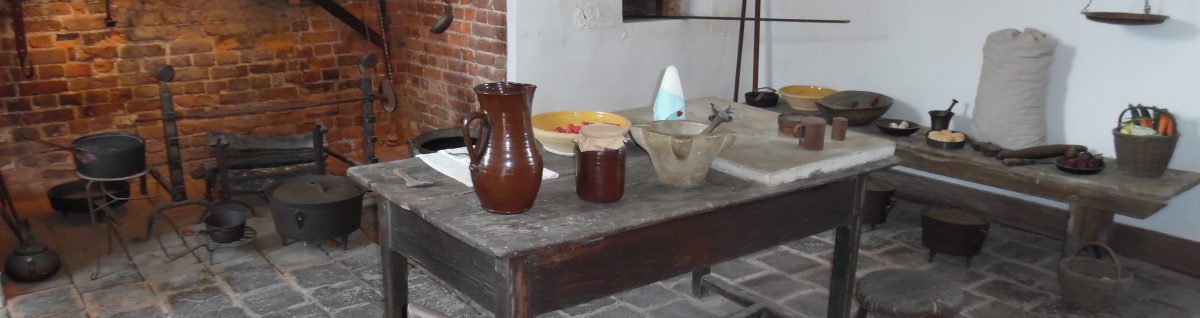

Imagine there is someone sick in your household. Do you feed them pudding or gruel?
This may be harder to decide than you realize. A look at the history of each dish may help.
First: Gruel
Such an ominous, even cruel word. It conjures feelings of want and deprivation. I can’t help thinking of poor Oliver Twist, pathetically asking for ‘more’. But what exactly is gruel?
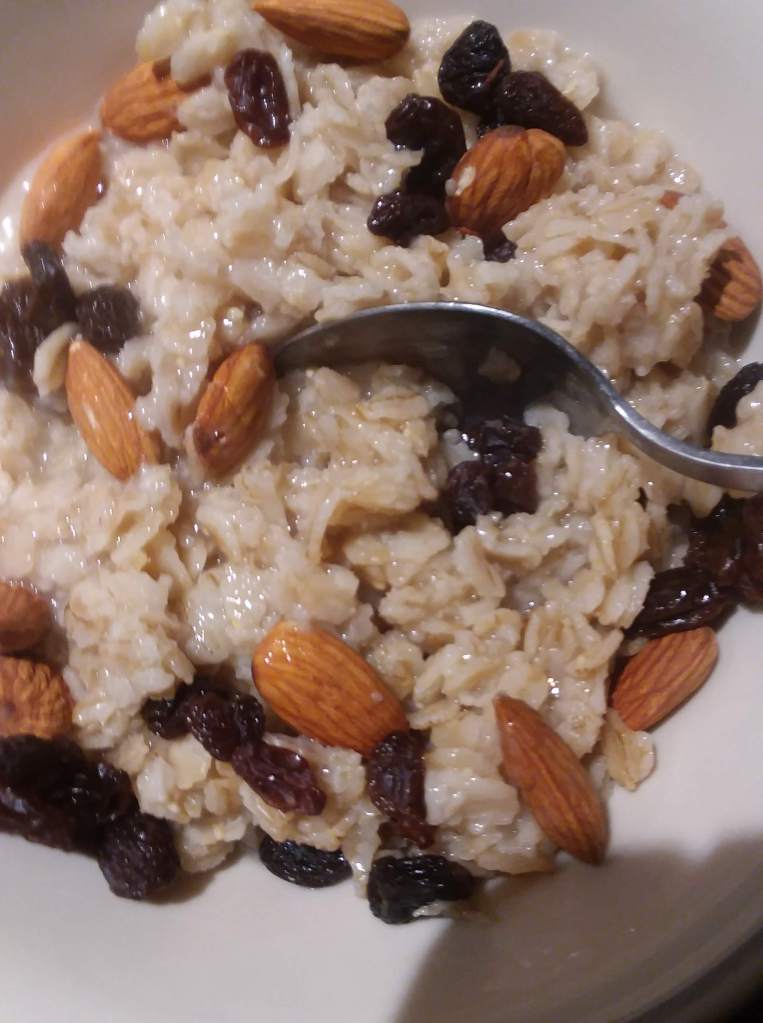
Gruel has meant a lot of things over the centuries and hasn’t always been seen with such a negative view. Etymonline gives a twelfth-century definition as fine flour or meal made of lentils or beans. According to the Oxford English Dictionary, from the 14th century, gruel is a light, liquid food, made with ground grain such as oatmeal, boiled in water or milk. Oats, wheat or barley were all considered suitable grains. Recipes in the middle ages often suggest adding meat, onions, spices, sugar, or almonds. When English colonists came to the Americas and learned about corn, that grain was added to the list of those suitable for making gruel. By this time, gruel was noted as a good food for invalids, nourishing for someone too sick to eat regular food.
Unfortunately, it is also easy to stretch the grain by adding more water until the resulting gruel is thin, tasteless, and bland, more like a thin soup. By the 19th century, ‘take one’s gruel’ came to mean ‘take one’s punishment’ and ‘to gruel’ was ‘to punish’. Later in the century ‘gruelling’ as an adjective came into play, meaning exhausting, physically difficult, or punishing.
And so the bland but nutritious aspect of gruel morphed into the thin, watery mess we find so unappetizing.
Next we come to pudding. Here’s a word to conjure all that is good to eat. It was an essential holiday treat for Mrs. Cratchit and still is a lunchbox favorite. Of course, Mrs. Cratchit’s pudding is a far cry from the sugary custard found in pudding cups, and even further from the original puddings. So what exactly is pudding?
Back in the 14th century, pudding referred to the stomach or intestines of a cow or sheep. This was often stuffed with meat and oatmeal. So at that time, pudding meant something like sausage. By the 16th century, pudding meant any soft food, generally some vegetable mixed with grain and boiled in a bag. Gradually pudding became more and more like porridge, and porridge originally made of pureed vegetables (think of pease porridge hot) became more grain based. Like with gruel, the pudding/porridge often had other things added, like raisins, spices, and especially, sugar.
Though the earliest cooking methods for pudding and gurel were different, the ingredients for gruel and pudding are surprisingly similar. For instance, take a look at the following recipes.
Recipes for gruel:

Indian Gruel 
Egg Gruel
Gruel
Gruel is very easily made. Have a pint of water boiling in a skillet. Stir up three or four large spoonfuls of nicely sifted oatmeal, rye, or Indian, in cold water. Pour it into the skillet while the water boils. Let it boil eight or ten minutes. Throw in a large handful of raisins to boil, if the patient is well enough to bear them. When put in a bowl, add a little salt, white sugar, and nutmeg .
Child, 36
(Note Indian refers to corn meal. This is nearly identical to the recipe found on the box for modern corn meal. Oatmeal porridge is also still made in the same way, though it is no longer called oatmeal gruel).
The barley gruel in Martha Washington’s Booke of Cookery is a bit richer, adding cream, sugar, mace, eggs and rose water to the basic gruel. (136)
Egg Gruel is even less like the tasteless images we have of gruel. Lacking any grain at all, the result is more like a warm eggnog or soft custard, and is quite delicious.
Egg Gruel
This is at once food and medicine. Some people have great faith in its efficacy in cases of chronic dysentery. It is made thus: Boil a pint of new milk; beat four new-laid eggs to a light froth, and pour in while the milk boils; stir them together thoroughly but do not let them boil; sweeten it with the best of loaf sugar, and grate in a whole nutmeg; add a little salt if you like it. Drink half of it while it is warm and the other half in two hours.
Child, 31
Now compare the gruel recipes to pudding recipes from the same sources:
Make White pudding
Take 3 pintes of milke & when it is boyled, put in tw quarts of great oatmeale bruised a little, & stirr it over ye fire till it be ready to boyle. Then take if of & cover it close all night. 3 pound of suet minced small, put in wth 3 grated nutmegs, ye oulks of 8 eggs, 2 whites, & a littel rosewater, a pound of sugar and a litel grated bread, currans, & creame as you think fit. This quantity will make 3 or 4 dosin.
Martha Washington’s Booke of Cookery, 106
(Note this is really a recipe for pudding stuffing, that is the mixture to be stuffed into a sausage skin. It is much thicker than gruel, but uses many of the same ingredients.)
The main difference between Mrs. Child’s pudding and her gruel is the cooking time and method, and the proportion of meal to liquid. Her pudding is much thicker than her gruel, more like stiff cake–think plum pudding.).
Here’s her recipe for boiled Indian pudding:
Indian pudding should be boiled for four or five hours. Sifted Indian meal and warm milk should be stirred together pretty stiff. A little salt, and two or three great spoonfuls of molasses added; a spoonful of ginger if you like that spice. Boil it in a tight covered pan or a very thick cloth; if the water gets in, it will ruin it. Leave plenty of room; for Indian swells very much. The milk with which you mix it should be merely warm; if it be scalding, the pudding will break to pieces. Some people chop sweet suet fine, and warm in the milk; others warm think slices of sweet apple to be stirred into the pudding. Water will answer instead of milk.
Child, 61
Both books have recipes for sweetened gruels and sweet puddings.
Martha Washington’s Booke of Cookery also has recipes for all kinds of meat puddings, curd puddings, almond puddings and rice puddings, etc. The almond and rice puddings have sugar added, but the majority of her puddings are not sweet. Mrs. Child on the other hand, has recipes for apple, cherry, and other fruit or custardy puddings, none of which are savory.
So will it be pudding or gruel? Maybe we can have it both ways. For many English speakers world-wide, pudding has come to mean any kind of dessert. In this time of rampant virus, many people find themselves eating and cooking more than ever before. Perhaps we should all start making gruel for our pudding.
Sources:
Child, Lydia Marie. The American Frugal Housewife. Dedicated to those who are not ashamed of economy. 12th Edition. Boston: Carter, Hendee, and Co. 1833. (First published 1828)
—–. Martha Washington’s Booke of Cookery and Booke of Sweetmeats. (A Family Manuscript, Hand written circa 17th century. Transcribed and annotated by Karen Hess, New York: Columbia University Press, 1995).
The Compact Edition of the Oxford English Dictionary (OED): Complete text reproduced micro graphically. Oxford University Press, 1971. Volume 1, 2.
 BRIC-A-BRAC
Gruel or pudding-I like them both! But gruel has the connotation of illness and want, so I prefer to call my Indian meal ‘mush!’ I should like very much to someday taste rose water, and use it to flavor my pudding.
LikeLike
I purchased a bottle of rose water awhile back. It is a fairly subtle flavor.
LikeLike