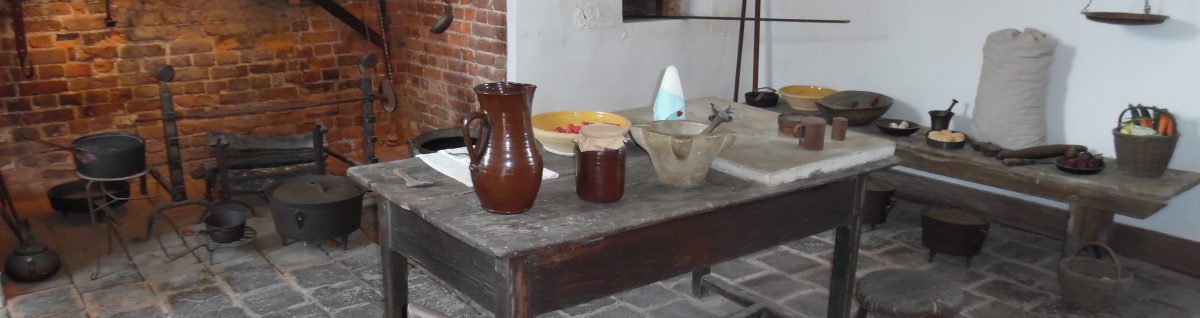
We all know what an apple is, right? Sweet, crunchy fruit, ripening each fall. But it turns out a lot of things called apples actually aren’t apples at all. There are love apples (tomatoes), earth apples (potatoes), golden apples (oranges), and of course, pommes dorées (golden apples in French.)
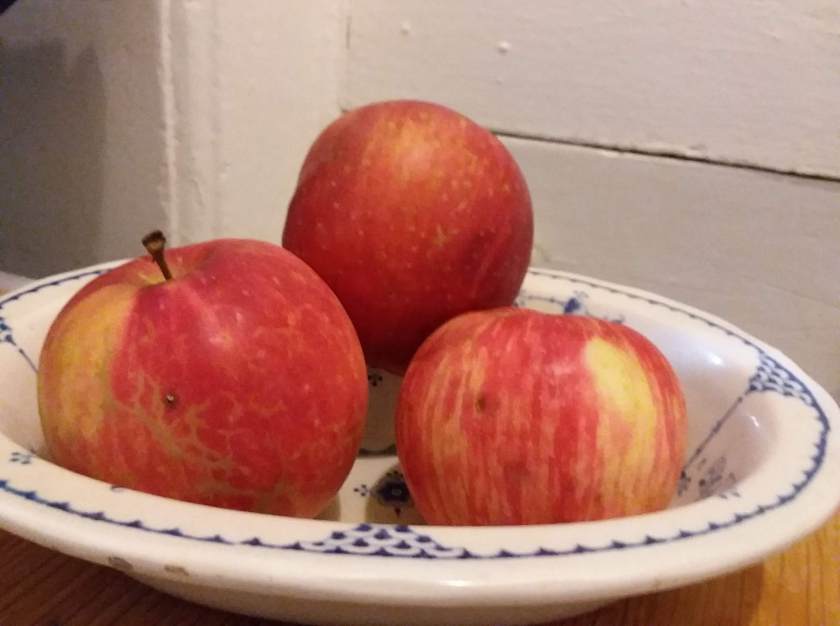
Click on the picture to see the 2019 post with a history of the word ‘apple’.
Let’s take a closer look at golden apples. There are a number of myths from various cultural traditions that feature golden apples. The well-known Greek myth concerns Paris of Troy and the golden apple of discord. Angry at not being invited to the wedding of Thetis and Peleus, Eris, the goddess of discord, tossed a golden apple with the inscription, “for the fairest.” into the celebration. The three goddesses present, Hera, Athena, and Aphrodite, all wanted the golden apple. Paris of Troy was called upon to judge which was fairest. Each goddess bribed him to pick her. Paris chose Aphrodite, and she awarded him the most beautiful woman in the world, Helen. Unfortunately, Helen was already married to King Menelaus. When Paris and Helen met, they fell in love and ran away back to Paris’s home in Troy. Furious, Menelaus gathered up a Greek army to attack Tro, and get his wife back. Thus began the epic Trojan War.
In Norse Mythology, golden apples also were highly desired but not without trouble. Idunn, goddess of youth had charge of the golden apples, which insured the gods eternal youth. One day Loki tricked Idunn into coming with him to Jotunheim, land of the giants, in order to save himself from the giants. But Idunn’s apples were crucial for keeping the Norse gods immortal. When the other gods learned what Loki had done, they forced him to bring her back. He did s, by turning Idunn into a nut and himself into a hawk. Loki flew back to Midgard carrying Idunn, but pursued by Thjazi, in the form of an eagle. Loki made it back to Asgard, barely escaping Thjazi and the gods once again had access to Idunn’s golden apples.
The most surprising of all these golden apples are the pommes dorées, the gilded apples of French. Many versions of recipes for Pommes Dorées can be found in medieval English cookbooks. This was a period when the language of the English court was often still French, and most English nobility spoke French, so it’s not surprising to find French words in English books. What is surprising is that all these golden apple recipes aren’t apples at all, but meatballs. (Other recipes, like mashed apples, also use the French word, pomme).
So when is an apple not an apple?
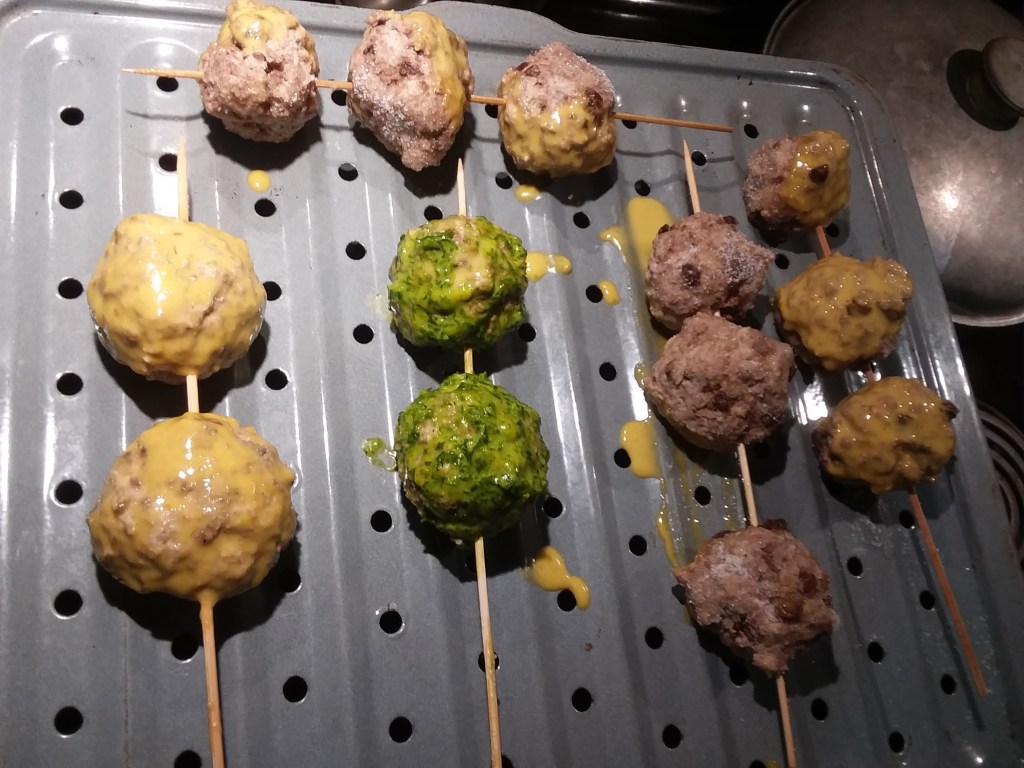
When it’s a meatball.
Here are two recipes for gilded apples, in the original, translated to more modern English,and then adapted as a recipe for modern use.
59. For to make poum dorroge, tak pertrichis wit longe filettis of pork al raw & hak hem wel smale, and after bray hem in a mortar, & when they be wel brayd do thereto god plente of poudere & yolkys of eyryn, & after mak thereof a farsure formed of the greteness of an onyoun, & after do it boyle in god breth of buf other of pork. After lat yt kele, & after do it on a broche of hasel & do hem to the fere to roste, & mak god bature of floure & egges, on bature wyt and an othere yelow & do thereto god plente of sugur & tak a fethere or a styk & tak of the bature & peynte theron aobue the applyn so that on be wyt & that othere yelow wel colourd. (Curye on Inglysch II. Diuersa servicia)
Rough translation from Middle English to modern English:
To make gilded apples, take fillets of raw partridges and pork. Chop it up and grind it in a mortar. When it is well ground, add plenty of powder (spices) and egg yolks. Then make it into stuffing (balls) the size of onions and after that, boil them in beef or pork broth. Then let them cool and put them on a branch of hazel and put them on the fire to roast. Make a good batter of flour and eggs, one batter white and the other yellow. Add plenty of sugar. Take a feather or a stick and paint the top of the apples so they are white and the other (part of the apple) is yellow, well colored.
42 For to make pommedorry, tak buff & hewe yt smal all raw, & cast yt in a mortar & grynd yt noyt to smal. Tak safroun and grynd therewyth. Wan yt is grounde, take the wyte of the eyren, yf yt be noyt styf; cast into the buf pouder of pepyr, olde reysyns & reysyns of coronse. Set ouer a panne wyth fayr water, & mak pelotys of the buf; & wan the water & and the pelotes ys wel yboylyd, set yt adoun & kele it. Put yt on a broche & rost yt & endorre yt wyth yolkys of eyren & serue yt forth. (Curye on Inglysch II. Diuersa servicia)
Rough translation from Middle English to modern English:
To make gilded apples, take raw beef and chop it small, put it in a mortar and grind it not too small. Take saffron and grind it with (the beef). When it is ground, take the whites of eggs if it is not too stiff, and put them in the beef along with powder of pepper, old raisins and dried currants. Set over a pan with fair water, and make pellets (balls) of the beef, and when the water and the pellets are well boiled, set them down and cool them. Put them on a spit and roast them and gild them with the yolks of eggs and serve them.
Modern version of the Recipe
(Note this version draws on both of the recipes above, as well as a few other medieval recipes for pomme dorées)
1 lb. ground beef
1 lb. ground chicken (if you have no partridges available)
2 egg whites (save the yolks for gilding the meatballs)
1 t. Salt (optional)
1 T. ground black pepper
1 T. ground ginger
1 T. ground cinnamon
½ c. raisins (optional)
Mix all these together. Form into balls the size of small onions. Boil the balls for 10 minutes in beef broth. (Save the beef broth, and add sliced onions to make a nice onion soup to serve with your pommes dorés.) Remove the meatballs from the broth and put them on skewers.
To gild the meatballs:
1 T. Safflower (an inexpensive substitute for saffron- not the     same taste, but serves as a good coloring agent.)
2T. Beef broth
2 egg yolks
¼ c. flour
Put the safflower in the warm beef broth and let it steep for 5 minutes. Strain out the safflower. Mix the colored beef broth, the egg yolk and the flour to make a nice batter. If it is too thick to spread on the meatball, thin it with a little more broth. If it is too thin, add a little more flour.
Options:
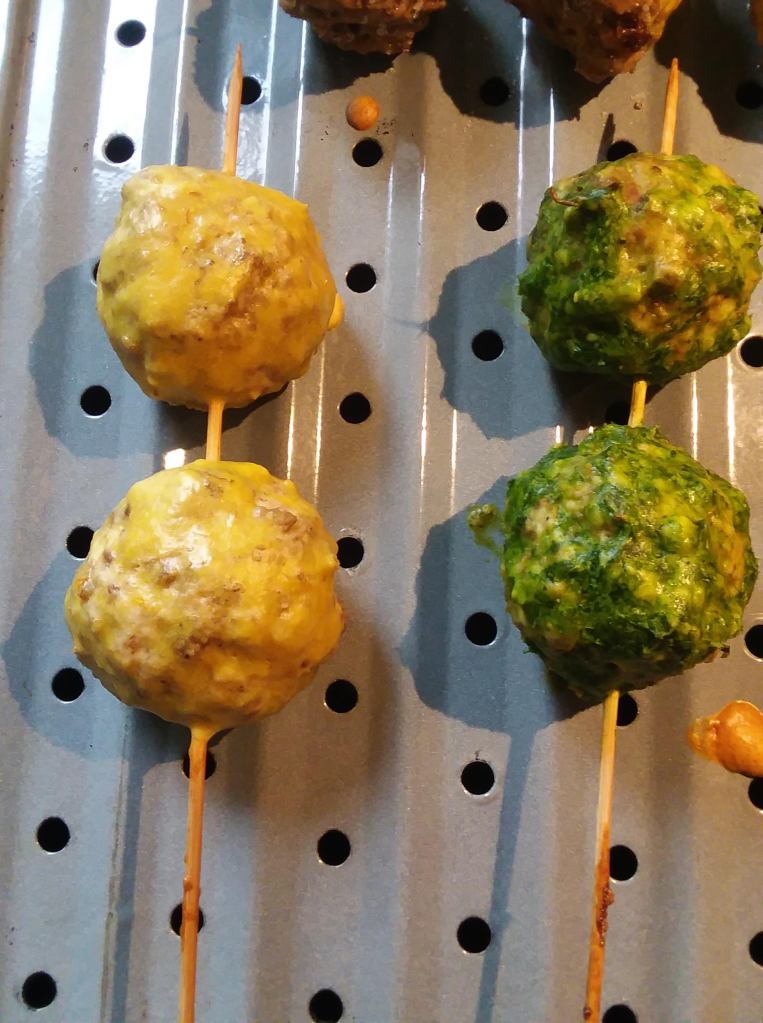
- Version 1: Spread the gilding over the meatballs.
- Version 2: Chop parsley fine and add to the gilding mixture. Some of the recipes called for gilding to be green.
- Version 3: Roll the meatball in sugar, then paint half of it with the egg gilding.
For all versions: Roast at 350 degrees for 15 minutes, and serve.

 BRIC-A-BRAC
All I thought of was love apples! I may have heard of earth apples, but didn’t remember that term. These do sound good, but I am not sure I’d like the meat boiled first. Interesting read!
LikeLike
Surprisingly, boiling the meat did not affect the flavor of the meatballs much. And, a benefit was some quite delicious soup stock.
LikeLike