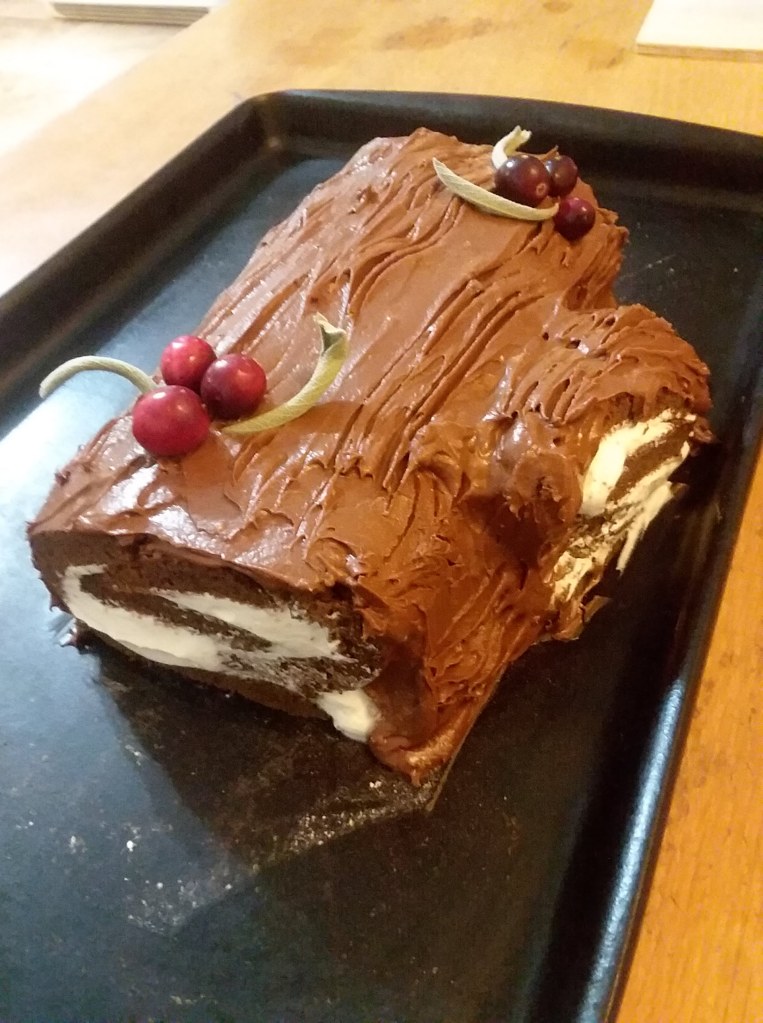
This year I decided to celebrate the holiday season with a good, old-fashioned Bûche de Noël. To my surprise this delightful chocolate cake shaped like a log is not really all that old-fashioned. Although the methods and ingredients for sponge cakes, the base cake of the Bûche, were known at least by 1615 (see The English Huswife, by Gervaise Markham), the earliest mention of a Yule log meant to be eaten is from over two hundred years later. (see Alfred Suzanne’s La Cuisine Anglaise et la Pâtisserie, 1894). The earliest recipe recorded for such a confection is from 1898, in Pierre Lacam’s Le Mémorial Historique et Géographique de la Pâtisserie. It wasn’t until 1905 that the earliest recipe resembling the cake we love today was recorded, in Joseph Favre’s Dictionnaire Universel de Cuisine Pratique. From the cake’s name and the first places a recipe was published, it’s easy to see that French bakers popularized this treat in the 19th century. No one seems to know exactly how the tradition got started, but it probably has to do with the ancient tradition of the Yule Log.
Buche de Noel is often translated at Yule Log, but there is an important difference. Noel is FRench for Christmas, stemming from the Latin ‘natalis’ or ‘birth’, and can also be connected to the French phrase ‘bonnes nouvelles’ or ‘good news’, specifically the good news of Christ’s birth. It is a decidedly Christian sentiment. Yule, on the other hand, comes from much earlier times, before the spread of Christianity, even though now Yule means Christmas in many places. Jol (yul) from old Norse refers to a pagan feast or time of feasting in December and January, a mid-winter celebration.
In many pre-Christian cultures, especially Germanic and Celtic, the tradition of a Yule log was important. Not a log-like cake, but an actual log, or in some cases a whole tree, to be burned, not eaten. The log was brought in and kept burning throughout the darkest time of the year, the Winter Solstice, and the days following. Winter Solstice, around December 22, is the shortest day of the year. Following the solstice, the days gradually grow longer and thus lighter. The burning log was thought to cleanse the air and welcome the coming of Spring, or at least the time of year when the earth turns toward Spring, rather than away from it.
The carefully chosen log was imbued with certain powers to protect and predict. Oak, a magical tree in Celtic tradition, was often used. Other special trees included beech, elm, or fruit trees. In some places the ‘log’ was actually a huge tree, including the roots.
Various rites and traditions accompanied the burning log. Often it was sprinkled with wine, salt, or oil (and later, after Christianity spread, with holy water.) The log might be decorated with holly, pinecones, or ivy, all plants which have importance in both Germanic and Celtic mythology.
The importance of the tree did not end with the burning. The ashes were said to have medicinal value, guard the house against evil, and even protect from lightning. Ashes buried in the garden helped insure a good harvest and prevent crop diseases. These ashes could also deter pests–foxes away from the chicken coop, and rats and weevils out of the barn loft.
In some places it was also thought that the burning log could predict the future. Striking the log to produce a shower of sparks gave insight to the coming year’s harvest. The sparks represented the grain. A lot of sparks promised more abundance. On the other hand, if the flames of the burning log cast shadows on the walls, someone in the family would suffer death in the coming year.
It’s unlikely the Buche gracing my table will predict anything, good or bad, though I do hope it brings a 2021 better than this year has been. Whatever the next year brings, however, this yule log will be thoroughly enjoyed!
There are vast numbers of recipes for Bûches de Noël. For my cake, I translated and adapted the recipe from from Bûche de Noël facile, Marmiton (accessed 12/9/2020) https://www.marmiton.org/recettes/recette_buche-de-noel-facile_18219.aspxt
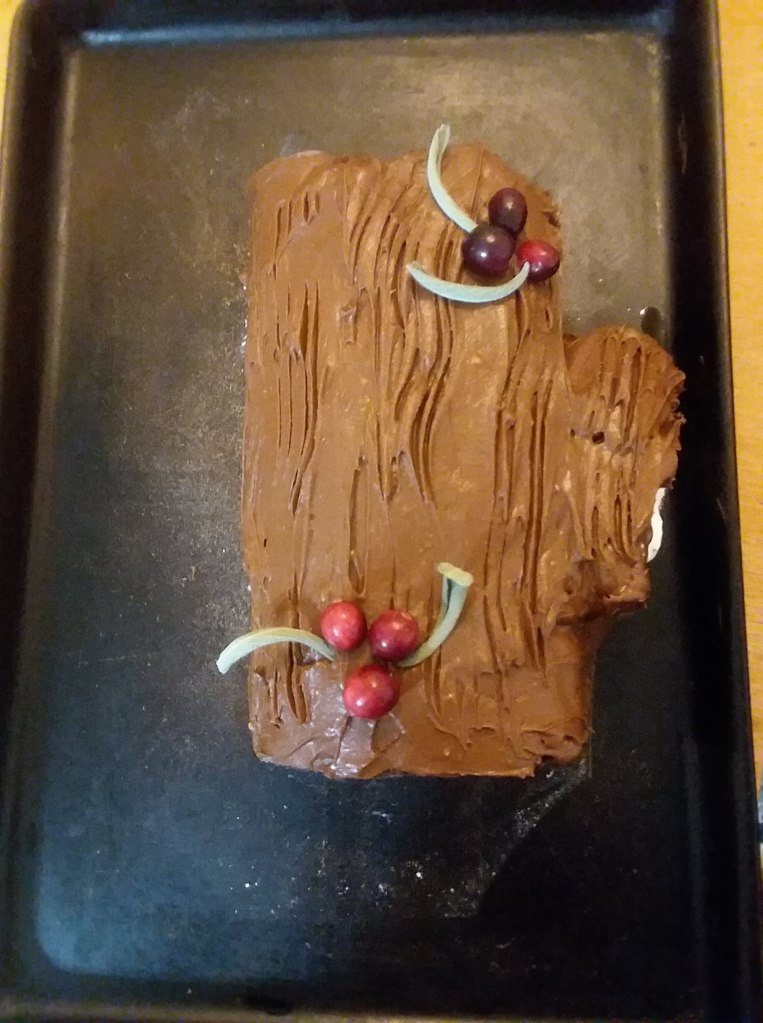
I added ¼ cup. cocoa to the cake for more chocolate, and one additional egg to make the batter moist enough. I filled the log roll with whipped cream, and used chocolate buttercream frosting to decorate the log. For garnish, I used cranberries and dried sage leaves.
My Recipe:
5 eggs, separated
½ c. plus 1 T. powdered sugar
2 T. water
1 c. flour
½ c. cocoa
2 t. Baking powder
½ t. salt
Filling:
1 c. whipping cream
1 t. Vanilla
2 T. sugar
Frosting:
1 c. butter
¼ c. cocoa
2 c. powdered sugar
2 T. milk
For the cake: beat the eggs with the water and egg yolks. Mix the baking powder, cocoa, and salt to the flour, and add this to the egg mixture a little at a time. The dough will be stiff.
Beat the egg whites to stiff peaks. Gently fold the egg whites into the batter. Spread gently into a parchment-lined jelly roll pan so the batter is about ¼ to ½ inch thick. Bake at 350 degrees for 15 to 20 minutes. Check for doneness by inserting a toothpick. Cake is done if the toothpick comes out clean.
While the cake is still warm, sprinkle powdered sugar on a kitchen towel. Turn the cake out onto the towel. Remove the parchment paper, and roll the cake up in the towel, starting at the short end. Let the rolled cake cool completely.
Prepare the filling: Whip the cream to stiff peaks. Mix in sugar and vanilla.
Prepare the frosting: Mix all the ingredients until smooth. Add either more powdered sugar or more milk, a little at a time, to achieve a spreadable consistency.
To assemble the cake: Gently unroll the cake. Remove the towel. Spread the whipped cream on the cake and reroll it. Cut a 1 -2” slice off of one end of the cake. Set the slice along one side of the cake. Frost the cake, leaving the ends (and cut end of slice) unfrosted. Use a fork to mark lines in the “bark.” Decorate as desired.
 BRIC-A-BRAC
This looks delicious! How difficult is it to unroll the cake without it cracking?
LikeLike
It is tricky to unroll the cake without cracking it. However, the filling and frosting can hide most cracks. Together, they act as glue and no one will know the difference.
LikeLike